Loading page, please wait…
Vaidra Logo
Vaidra

Top 4 items + smart groups

UPSC GPT
New
Current Affairs
Daily Solutions
Daily Puzzle
Mains Evaluator

Version 2.0.0 • Built with ❤️ for UPSC aspirants

Loading...
Loading...
Loading...
Loading...
Loading...
Loading...
Loading...
Loading...
Loading...
Loading...
Loading...
Loading...
Loading...
Back
All Subjects

Topics

0 topics • 0 completed

Loading topics...
Loading...
Loading...
Loading...
Loading...
Loading...
Overall Progress0%

Digital Public Infrastructure (DPI) - UPSC Agriculture Allied Sector

What is Digital Public Infrastructure (DPI) in UPSC Agriculture Allied Sector?

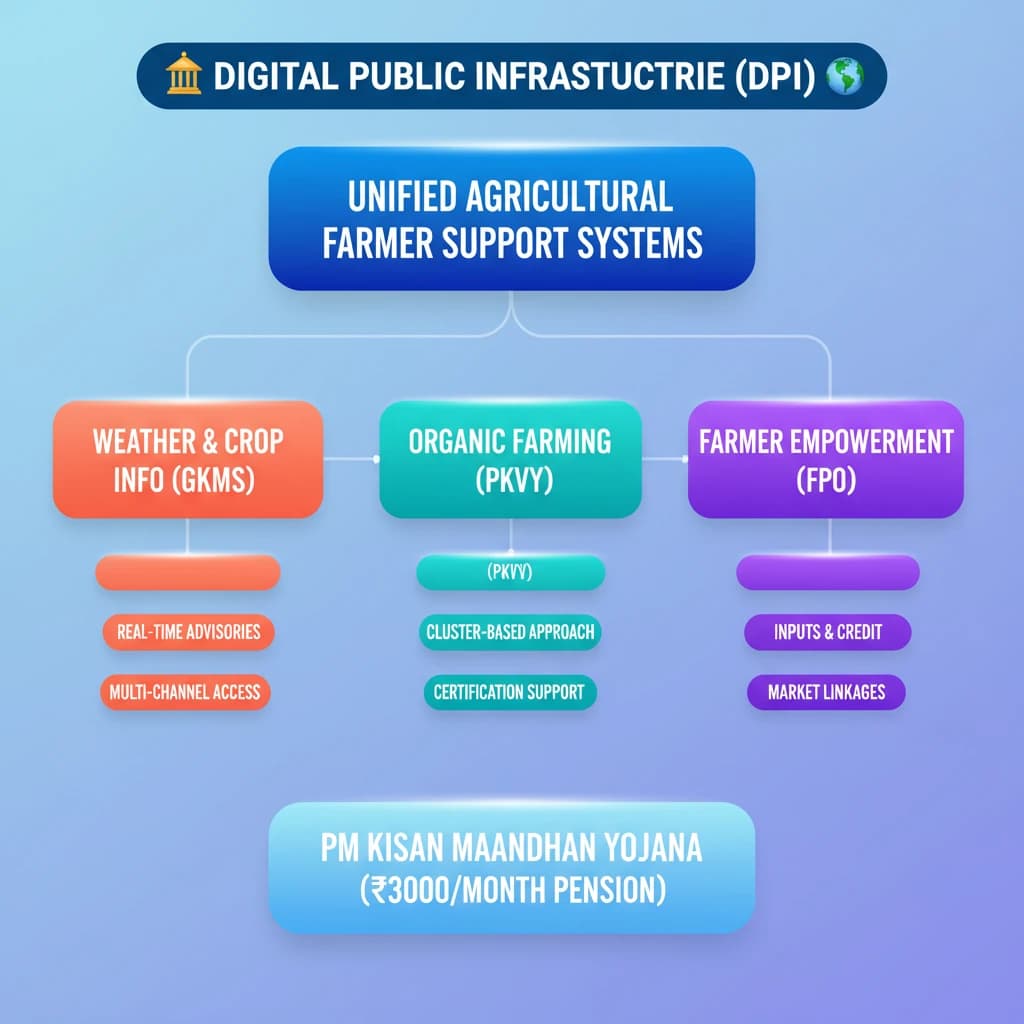
Digital Public Infrastructure (DPI) is a key topic under Agriculture Allied Sector for UPSC Civil Services Examination. Key points include: Digital Public Infrastructure (DPI) aims to unify agricultural extension services for real-time farmer support.. Gramin Krishi Mausam Sewa (GKMS) provides crucial weather and crop information through various channels.. Paramparagat Krishi Vikas Yojana (PKVY) promotes organic farming through a cluster-based approach.. Understanding this topic is essential for both UPSC Prelims and Mains preparation.

Why is Digital Public Infrastructure (DPI) important for UPSC exam?

Digital Public Infrastructure (DPI) is a Medium-level topic in UPSC Agriculture Allied Sector. It is tested in both Prelims (factual MCQs) and Mains (analytical answer writing). Previous year UPSC questions have frequently covered aspects of Digital Public Infrastructure (DPI), making it essential for comprehensive IAS preparation.

How to prepare Digital Public Infrastructure (DPI) for UPSC?

To prepare Digital Public Infrastructure (DPI) for UPSC: (1) Study the comprehensive notes covering all key concepts on Vaidra. (2) Practice previous year questions on this topic. (3) Connect it with current affairs using daily updates. (4) Revise using key takeaways and mind maps available for Agriculture Allied Sector. (5) Write practice answers linking Digital Public Infrastructure (DPI) to related GS Paper topics.

Key takeaways of Digital Public Infrastructure (DPI) for UPSC

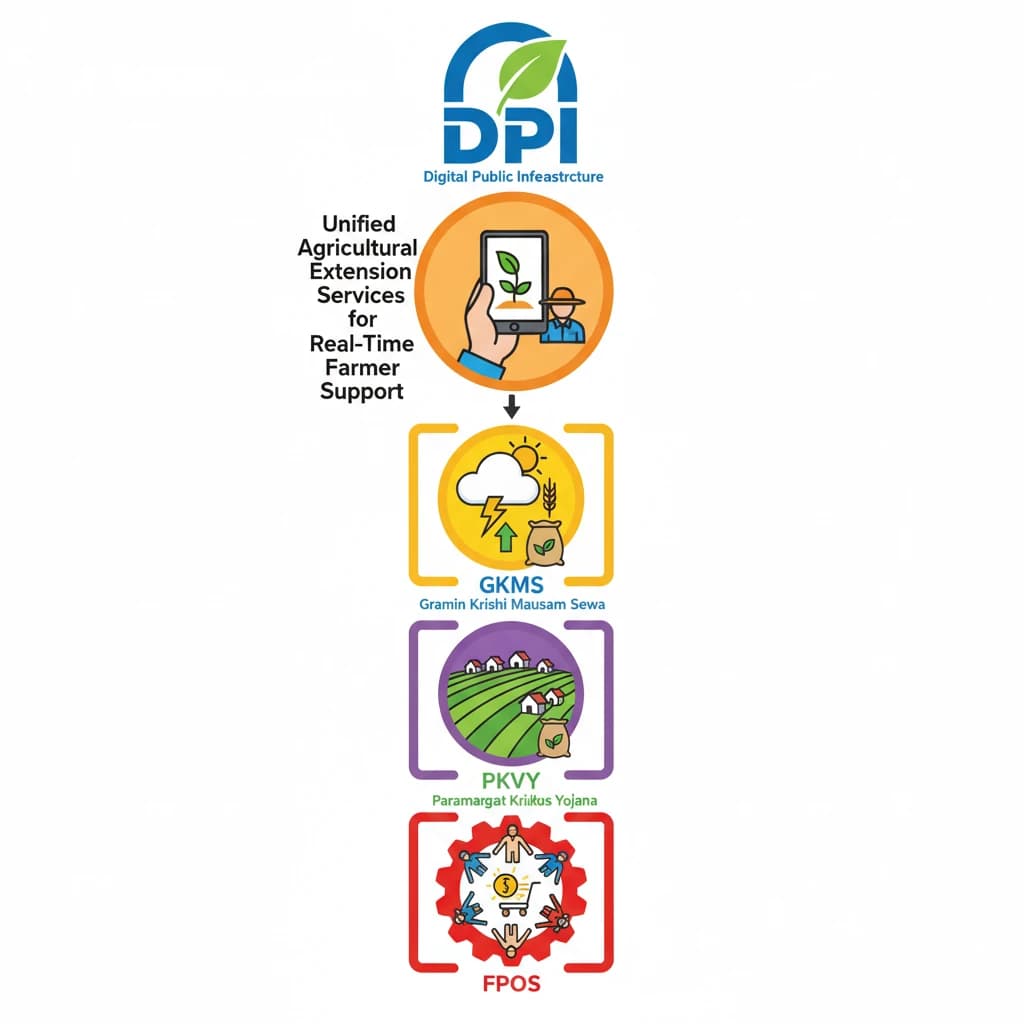
  • Digital Public Infrastructure (DPI) aims to unify agricultural extension services for real-time farmer support.
  • Gramin Krishi Mausam Sewa (GKMS) provides crucial weather and crop information through various channels.
  • Paramparagat Krishi Vikas Yojana (PKVY) promotes organic farming through a cluster-based approach.
  • Farmer Producer Organizations (FPOs) empower farmers by improving input sourcing, credit access, and marketing.
  • Pradhan Mantri Kisan Maandhan Yojana (PMKMY) offers a minimum pension of Rs 3,000 to eligible farmers at 60 years.
  • Per Drop More Crop (PDMC) incentivizes micro-irrigation systems with significant financial assistance.
  • Agriculture Infrastructure Fund (AIF) enhances post-harvest infrastructure with interest subvention for loans.
  • Skill development programs like STRY, KVK, and ATMA are vital for rural youth and farmers to adopt modern agricultural practices.
Digital Public Infrastructure (DPI)

Digital Public Infrastructure (DPI)

Medium⏱️ 8 min read✓ 95% Verified
agriculture allied sector

📖 Introduction

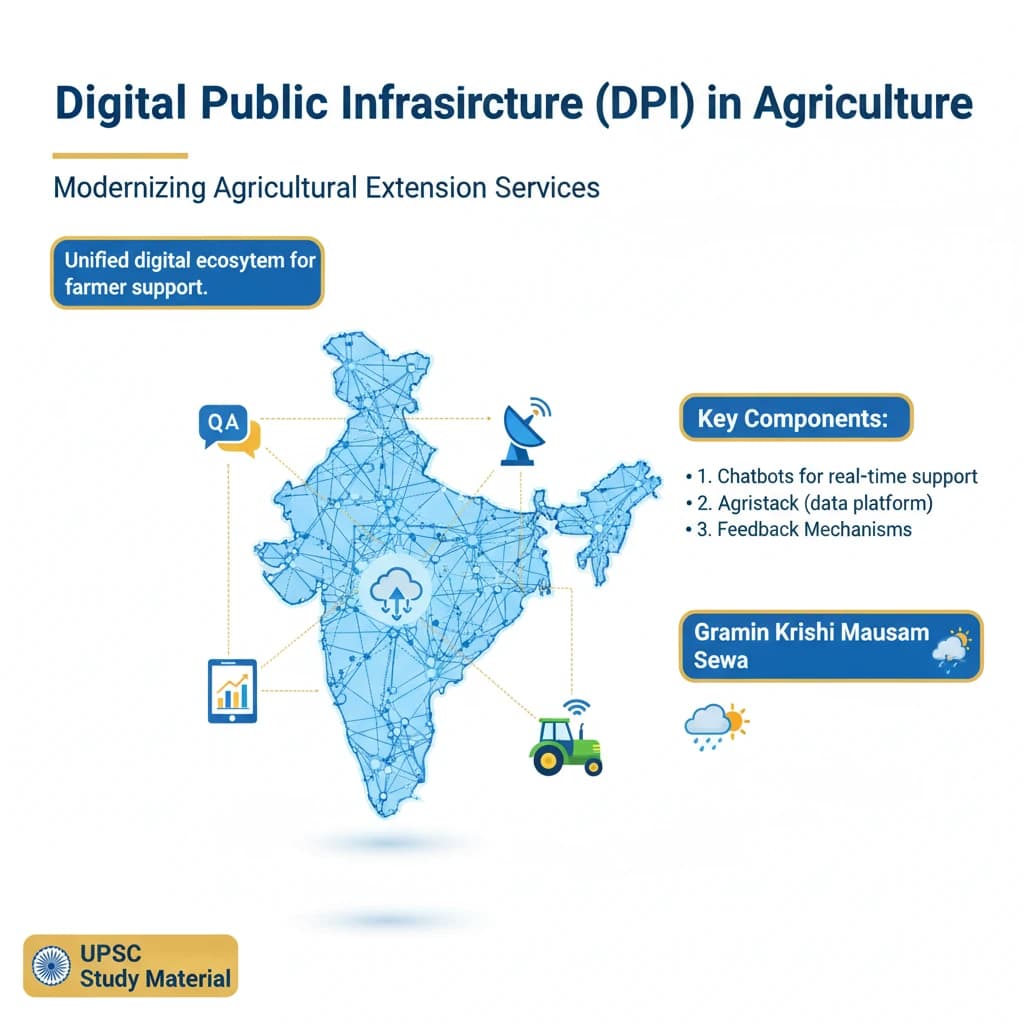
<h4>Digital Public Infrastructure (DPI) in Agriculture</h4><p>The concept of <strong>Digital Public Infrastructure (DPI)</strong> is crucial for modernizing agricultural extension services. It aims to create a unified digital ecosystem to support farmers effectively.</p><div class="key-point-box"><strong>DPI</strong> integrates various digital tools, including chatbots and <strong>Agristack</strong>, to provide real-time farmer support and feedback mechanisms.</div><h4>Gramin Krishi Mausam Sewa (GKMS)</h4><p>The <strong>Gramin Krishi Mausam Sewa (GKMS)</strong> is a vital component of digital outreach, focusing on weather and crop-related information dissemination. It operates through a network of specialized units.</p><div class="info-box"><ul><li><strong>130 Agromet Field Units (AMFUs)</strong> are responsible for gathering and disseminating localized information.</li><li>Information is shared via multiple channels: <strong>SMS</strong>, <strong>radio</strong>, and <strong>social media</strong>.</li></ul></div><p>Additionally, mobile applications like <strong>Kisan Suvidha</strong> and <strong>Bhuvan</strong> further assist farmers in accessing critical weather updates directly on their devices.</p><h4>Paramparagat Krishi Vikas Yojana (PKVY)</h4><p>The <strong>Paramparagat Krishi Vikas Yojana (PKVY)</strong> is a flagship scheme promoting organic farming practices in India. It focuses on cluster-based implementation to maximize impact.</p><div class="info-box"><ul><li>Since <strong>2015-16</strong>, <strong>PKVY</strong> has covered <strong>14.99 lakh hectares</strong>.</li><li>The scheme has benefited over <strong>25 lakh farmers</strong> by promoting certified organic production.</li></ul></div><h4>Farmer Producer Organizations (FPOs)</h4><p>The formation and promotion of <strong>Farmer Producer Organizations (FPOs)</strong> are central to empowering farmers by enhancing their collective bargaining power and market access.</p><div class="info-box">As of <strong>December 2024</strong>, <strong>9268 FPOs</strong> have been registered under the scheme to form and promote <strong>10,000 FPOs</strong>. These organizations help farmers with input sourcing, credit access, and marketing their produce.</div><h4>Pradhan Mantri Kisan Maandhan Yojana (PMKMY)</h4><p>The <strong>Pradhan Mantri Kisan Maandhan Yojana (PMKMY)</strong> is a social security scheme designed to provide a safety net for small and marginal farmers in their old age.</p><div class="info-box"><ul><li>As of <strong>November 2024</strong>, <strong>24.66 lakh farmers</strong> are enrolled.</li><li>The scheme provides a minimum pension of <strong>Rs 3,000 per month</strong> upon reaching <strong>60 years of age</strong>.</li></ul></div><h4>Per Drop More Crop (PDMC)</h4><p>The <strong>Per Drop More Crop (PDMC)</strong> component of Pradhan Mantri Krishi Sinchayee Yojana (PMKSY) emphasizes efficient water use through micro-irrigation techniques.</p><div class="info-box">The government provides significant financial assistance for the installation of <strong>drip and sprinkler systems</strong>:<ul><li><strong>55%</strong> of project cost for <strong>small and marginal farmers</strong>.</li><li><strong>45%</strong> of project cost for <strong>other farmers</strong>.</li></ul></div><h4>Agriculture Infrastructure Fund (AIF)</h4><p>The <strong>Agriculture Infrastructure Fund (AIF)</strong> aims to bolster post-harvest management infrastructure and community farming assets, thereby reducing losses and improving farmer incomes.</p><div class="info-box">Key features of <strong>AIF</strong> include:<ul><li>Enhancing <strong>post-harvest infrastructure</strong> and reducing losses.</li><li>Eliminating intermediaries, allowing farmers to sell directly for better prices.</li><li>Interest rate for loans capped at <strong>9%</strong>.</li><li><strong>3% interest subvention</strong> for loans up to <strong>Rs 2 crore</strong>.</li></ul></div><h4>Skill Development Initiatives for Rural Youth</h4><p>Various programs are in place to enhance the skills of rural youth and farmers in the agricultural and allied sectors, fostering self-employment and modern practices.</p><div class="key-point-box">These initiatives are crucial for bridging the skill gap and promoting sustainable agricultural development.</div><ul><li><strong>Skill Training of Rural Youth (STRY)</strong>: Offers <strong>7-day short-term skill training</strong> in agriculture and allied sectors, specifically targeting self-employment opportunities.</li><li><strong>Krishi Vigyan Kendra (KVK)</strong>: Provides comprehensive training in agriculture, horticulture, livestock, and allied sectors to strengthen rural skills and knowledge.</li><li><strong>Agriculture Technology Management Agency (ATMA)</strong>: Delivers decentralized extension services, keeping farmers updated on new technologies and best practices.</li><li><strong>Student READY Programme</strong>: Focuses on practical skill development and hands-on learning through training, rural awareness programs, internships, and projects for agricultural students.</li></ul><div class="exam-tip-box"><strong>UPSC Insight:</strong> Understanding the objectives and implementation status of these schemes is vital for questions on <strong>agricultural policy</strong>, <strong>rural development</strong>, and <strong>farmer welfare</strong> in <strong>GS Paper III</strong>. Note the specific targets and beneficiaries.</div>
Concept Diagram

💡 Key Takeaways

  • •Digital Public Infrastructure (DPI) aims to unify agricultural extension services for real-time farmer support.
  • •Gramin Krishi Mausam Sewa (GKMS) provides crucial weather and crop information through various channels.
  • •Paramparagat Krishi Vikas Yojana (PKVY) promotes organic farming through a cluster-based approach.
  • •Farmer Producer Organizations (FPOs) empower farmers by improving input sourcing, credit access, and marketing.
  • •Pradhan Mantri Kisan Maandhan Yojana (PMKMY) offers a minimum pension of Rs 3,000 to eligible farmers at 60 years.
  • •Per Drop More Crop (PDMC) incentivizes micro-irrigation systems with significant financial assistance.
  • •Agriculture Infrastructure Fund (AIF) enhances post-harvest infrastructure with interest subvention for loans.
  • •Skill development programs like STRY, KVK, and ATMA are vital for rural youth and farmers to adopt modern agricultural practices.

🧠 Memory Techniques
Memory Aid
95% Verified Content

📚 Reference Sources

•Drishti IAS Summary: Gramin Krishi Mausam Sewa (GKMS)
•Drishti IAS Summary: Paramparagat Krishi Vikas Yojana (PKVY)
•Drishti IAS Summary: Farmer Producer Organizations (FPOs)
•Drishti IAS Summary: Pradhan Mantri Kisan Maandhan Yojana (PMKMY)
•Drishti IAS Summary: Per Drop More Crop (PDMC)
•Drishti IAS Summary: Agriculture Infrastructure Fund (AIF)
•Drishti IAS Summary: Skill Training of Rural Youth (STRY)
•Drishti IAS Summary: Krishi Vigyan Kendra (KVK)
•Drishti IAS Summary: Agriculture Technology Management Agency (ATMA)
•Drishti IAS Summary: Student READY Programme

Related Topics

Loading related topics...
Explore:Agriculture Allied Sector Topics·All Subjects·Daily Current Affairs·Editorial Analysis·Previous Year Questions·UPSC GPT
Digital Public Infrastructure (DPI) - UPSC Agriculture Allied Sector