Loading page, please wait…
Vaidra Logo
Vaidra

Top 4 items + smart groups

UPSC GPT
New
Current Affairs
Daily Solutions
Daily Puzzle
Mains Evaluator

Version 2.0.0 • Built with ❤️ for UPSC aspirants

Loading...
Loading...
Loading...
Loading...
Loading...
Loading...
Loading...
Loading...
Loading...
Loading...
Loading...
Loading...
Loading...

High-Yielding Seeds - UPSC Agriculture Allied Sector

What is High-Yielding Seeds in UPSC Agriculture Allied Sector?

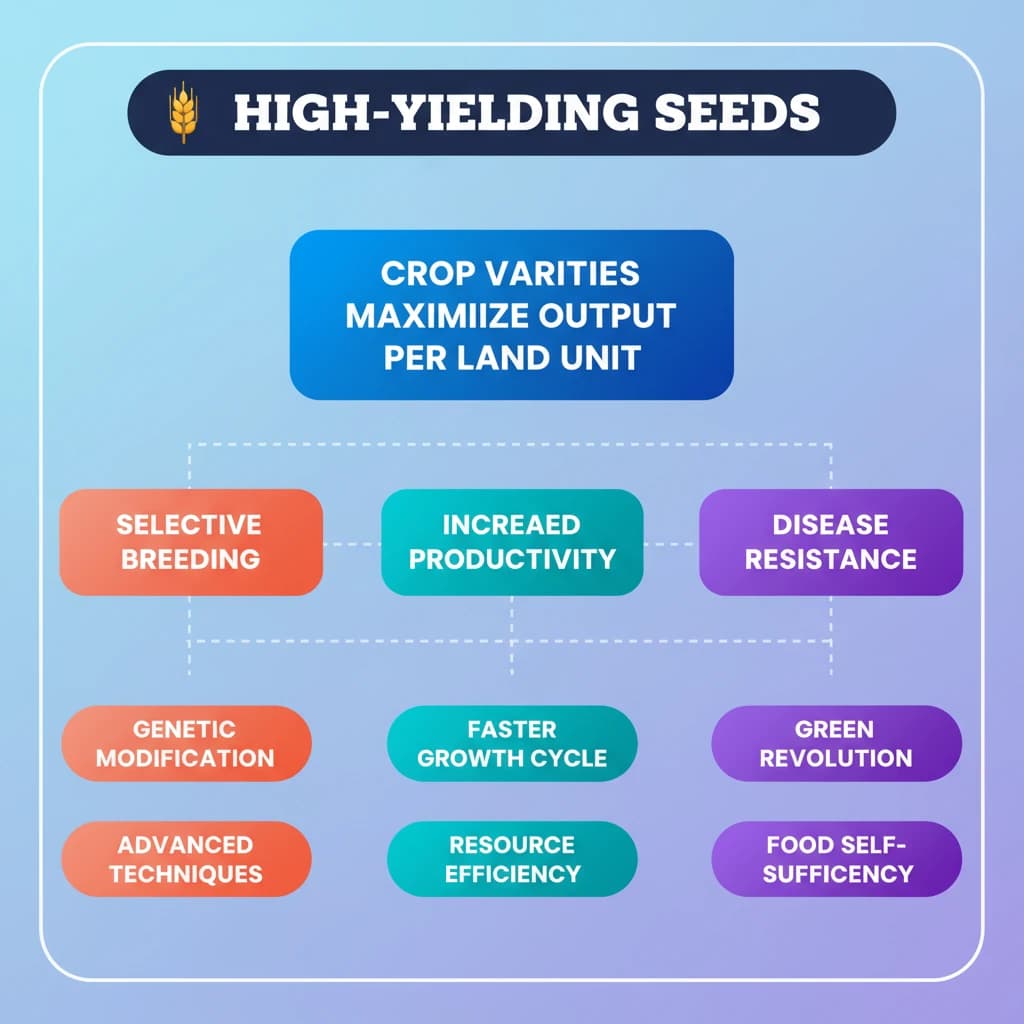
High-Yielding Seeds is a key topic under Agriculture Allied Sector for UPSC Civil Services Examination. Key points include: High-Yielding Seeds (HYVs) are crop varieties developed to produce significantly more output per unit of land.. They are created through selective breeding, genetic modification, or advanced techniques.. Key benefits include increased output, faster growth, better disease resistance, and potential for resource efficiency.. Understanding this topic is essential for both UPSC Prelims and Mains preparation.

Why is High-Yielding Seeds important for UPSC exam?

High-Yielding Seeds is a Medium-level topic in UPSC Agriculture Allied Sector. It is tested in both Prelims (factual MCQs) and Mains (analytical answer writing). Previous year UPSC questions have frequently covered aspects of High-Yielding Seeds, making it essential for comprehensive IAS preparation.

How to prepare High-Yielding Seeds for UPSC?

To prepare High-Yielding Seeds for UPSC: (1) Study the comprehensive notes covering all key concepts on Vaidra. (2) Practice previous year questions on this topic. (3) Connect it with current affairs using daily updates. (4) Revise using key takeaways and mind maps available for Agriculture Allied Sector. (5) Write practice answers linking High-Yielding Seeds to related GS Paper topics.

Key takeaways of High-Yielding Seeds for UPSC

  • High-Yielding Seeds (HYVs) are crop varieties developed to produce significantly more output per unit of land.
  • They are created through selective breeding, genetic modification, or advanced techniques.
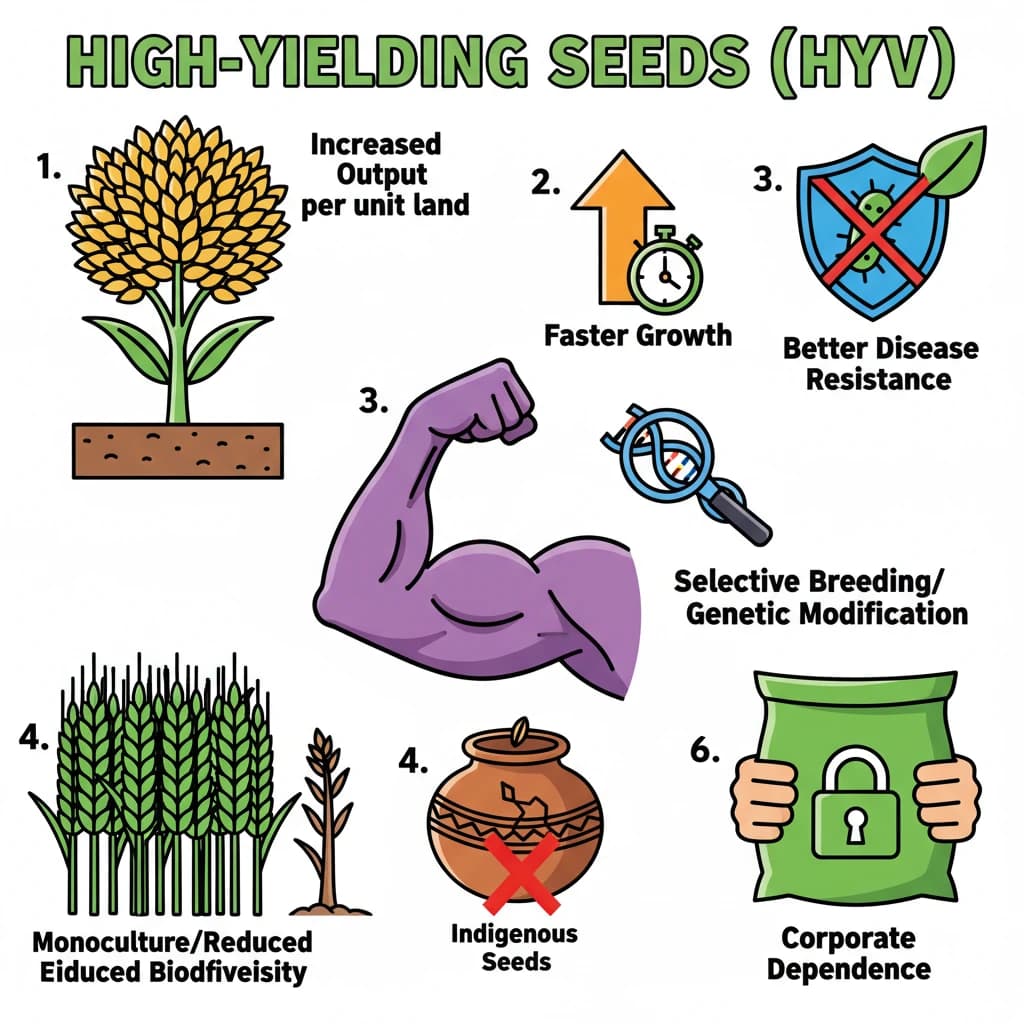
  • Key benefits include increased output, faster growth, better disease resistance, and potential for resource efficiency.
  • Concerns include promotion of monocultures, reduction in biodiversity, threat to indigenous seeds, and increased corporate dependence.
  • HYVs were crucial to India's Green Revolution, leading to food self-sufficiency.
  • Examples include hybrid rice (PRH 10), hybrid wheat (HD 3086), and Bt Cotton.
  • Current relevance involves balancing food security with environmental sustainability and farmer welfare.
High-Yielding Seeds

High-Yielding Seeds

Medium⏱️ 8 min read✓ 98% Verified
agriculture allied sector

📖 Introduction

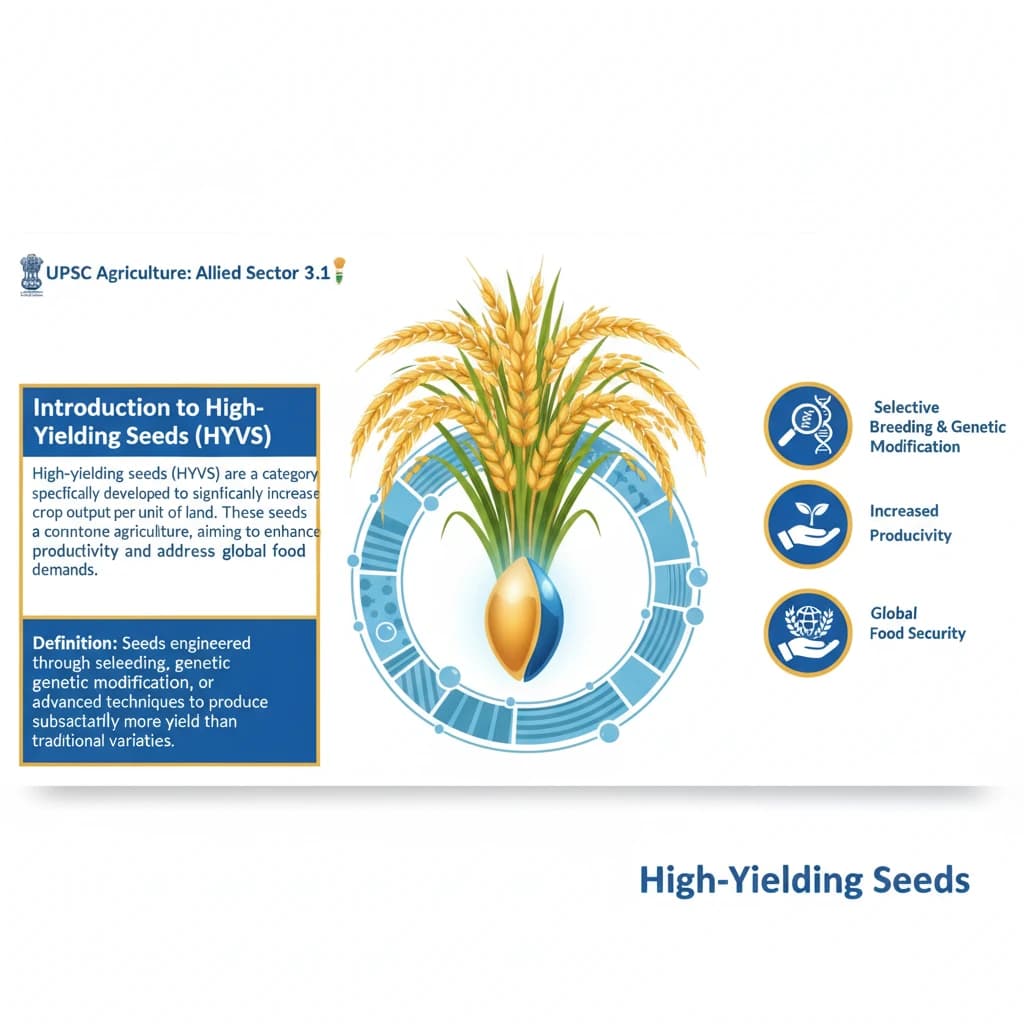
<h4>Introduction to High-Yielding Seeds (HYVs)</h4><p><strong>High-yielding seeds (HYVs)</strong> are a category of seeds specifically developed to significantly increase crop output per unit of land. These seeds are a cornerstone of modern agriculture, aiming to enhance productivity and address global food demands.</p><div class="info-box"><strong>Definition:</strong> Seeds engineered through selective breeding, genetic modification, or advanced techniques to produce substantially more yield than traditional varieties.</div><h4>Methods of Development</h4><p>The development of HYVs involves sophisticated agricultural science. Farmers utilize various methods to achieve the desired traits:</p><ul><li><strong>Selective Breeding:</strong> Identifying and propagating plants with desirable characteristics over generations.</li><li><strong>Genetic Modification:</strong> Directly altering the genetic makeup of seeds to introduce specific traits, such as pest resistance.</li><li><strong>Advanced Agronomic Techniques:</strong> Employing modern cultivation practices that complement the genetic potential of HYVs.</li></ul><h4>Key Benefits of High-Yielding Seeds</h4><p>HYVs offer numerous advantages that have transformed agricultural landscapes globally. Their adoption has been critical for improving food security in many regions.</p><div class="key-point-box"><strong>Primary Advantages:</strong><ul><li><strong>Increased Output:</strong> Produce a much larger quantity of crops from the same land area.</li><li><strong>Faster Growth Cycle:</strong> Often mature more quickly, allowing for multiple cropping seasons in a year.</li><li><strong>Enhanced Disease Resistance:</strong> Bred to withstand common plant diseases, reducing crop loss.</li><li><strong>Resource Efficiency:</strong> Can be optimized to utilize water and nutrients more efficiently, though sometimes requiring specific inputs.</li></ul></div><h4>Concerns Associated with High-Yielding Seeds</h4><p>Despite their benefits, the widespread adoption of HYVs also raises several ecological, economic, and social concerns that warrant careful consideration.</p><div class="exam-tip-box"><strong>UPSC Relevance:</strong> The debate around HYVs often appears in <strong>GS-III (Agriculture, Economy, Environment)</strong>, focusing on their impact on food security, biodiversity, and farmers' livelihoods.</div><ul><li><strong>Promotion of Monocultures:</strong> Encourages the cultivation of single crop varieties over vast areas, increasing vulnerability to specific pests and diseases.</li><li><strong>Reduction in Biodiversity:</strong> Leads to the displacement and loss of traditional, indigenous seed varieties, diminishing genetic diversity.</li><li><strong>Threat to Indigenous Seeds:</strong> Local varieties, often well-adapted to specific regional conditions, are sidelined in favor of commercially viable HYVs.</li><li><strong>Increased Dependence on Corporate Seed Companies:</strong> Farmers often become reliant on a few large corporations for seeds, fertilizers, and pesticides, impacting their autonomy and input costs.</li></ul>
Concept Diagram

💡 Key Takeaways

  • •High-Yielding Seeds (HYVs) are crop varieties developed to produce significantly more output per unit of land.
  • •They are created through selective breeding, genetic modification, or advanced techniques.
  • •Key benefits include increased output, faster growth, better disease resistance, and potential for resource efficiency.
  • •Concerns include promotion of monocultures, reduction in biodiversity, threat to indigenous seeds, and increased corporate dependence.
  • •HYVs were crucial to India's Green Revolution, leading to food self-sufficiency.
  • •Examples include hybrid rice (PRH 10), hybrid wheat (HD 3086), and Bt Cotton.
  • •Current relevance involves balancing food security with environmental sustainability and farmer welfare.

🧠 Memory Techniques
Memory Aid
98% Verified Content

📚 Reference Sources

•NCERT Textbooks (Agriculture, Economics)
•Government of India reports on Agriculture and Seed Policy
•International Rice Research Institute (IRRI) publications

Related Topics

Loading related topics...
Explore:Agriculture Allied Sector Topics·All Subjects·Daily Current Affairs·Editorial Analysis·Previous Year Questions·UPSC GPT
Back
All Subjects

Topics

0 topics • 0 completed

Loading topics...
Loading...
Loading...
Loading...
Loading...
Loading...
Overall Progress0%
High-Yielding Seeds - UPSC Agriculture Allied Sector