📖 Introduction
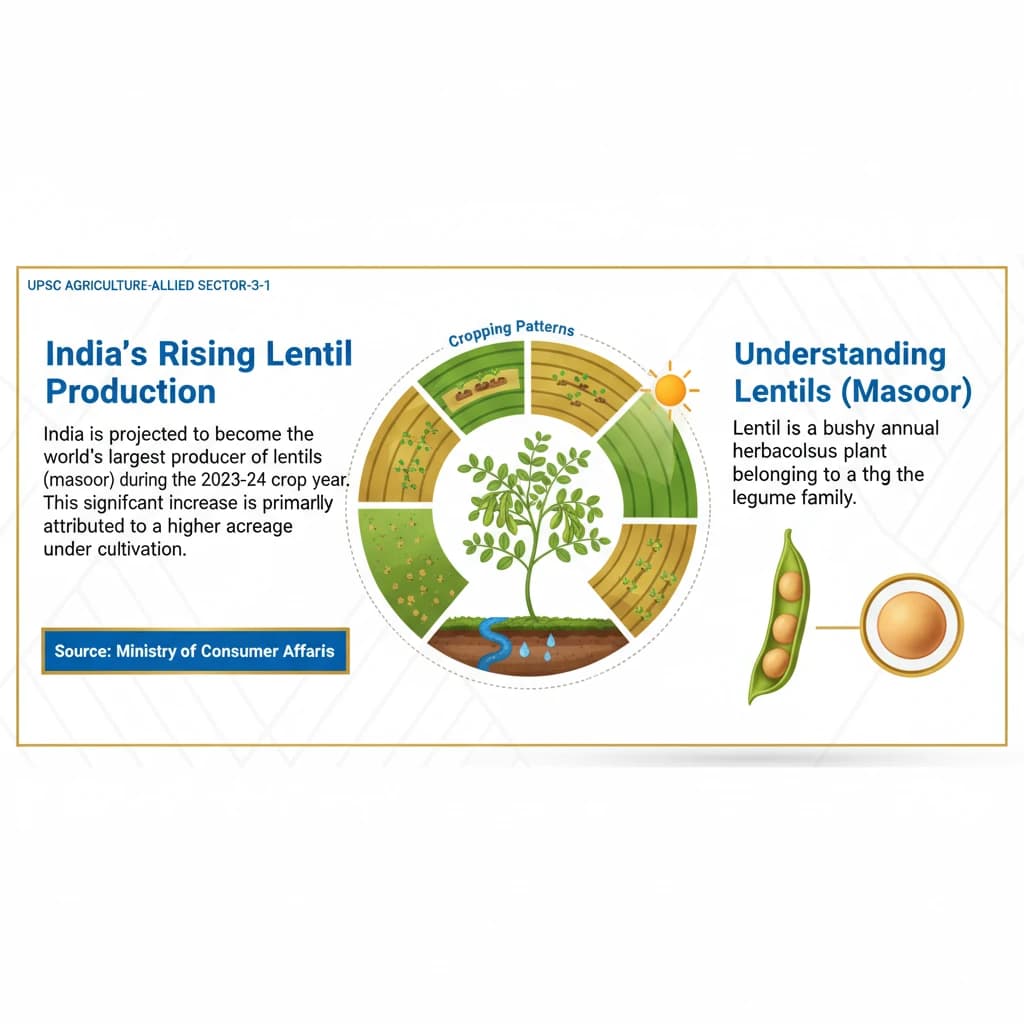
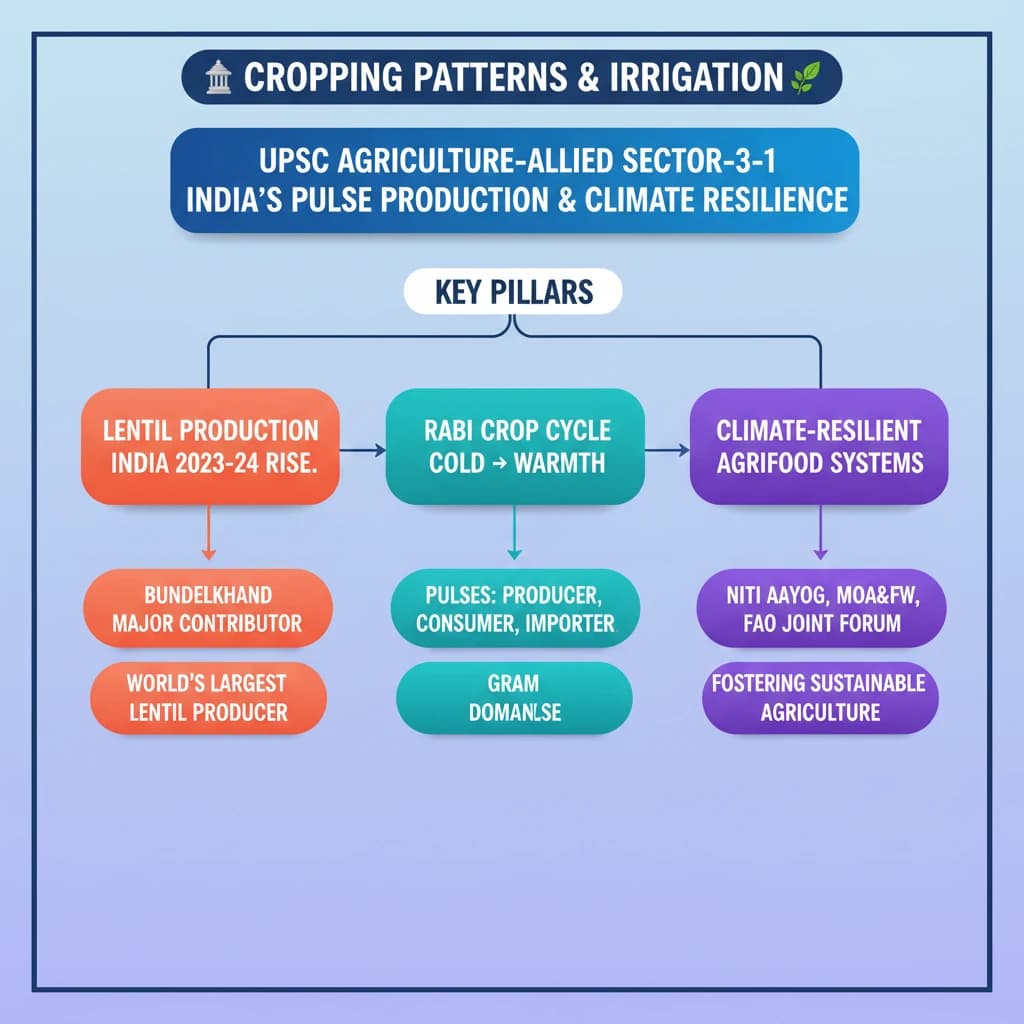
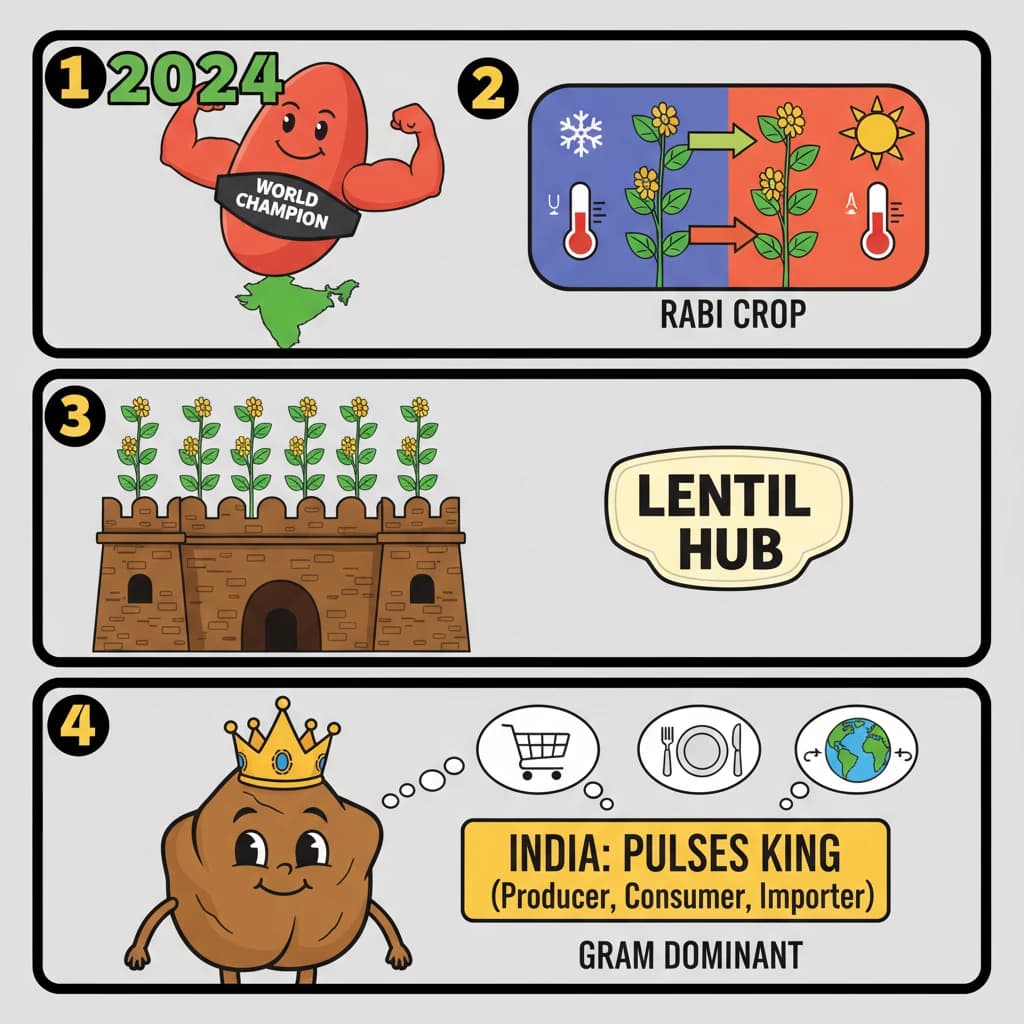
<h4>India's Rising Lentil Production</h4><p>India is projected to become the <strong>world's largest producer of lentils (masoor)</strong> during the <strong>2023-24 crop year</strong>. This significant increase is primarily attributed to a higher acreage under cultivation.</p><div class="info-box"><strong>Source:</strong> Ministry of Consumer Affairs</div><h4>Understanding Lentils (Masoor)</h4><p>Lentil is a <strong>bushy annual herbaceous plant</strong> belonging to the <strong>legume family</strong>. Its flowers are typically short and self-pollinated, contributing to efficient cultivation.</p><p>Lentils are highly nutritious, serving as excellent sources of energy, carbohydrates, and protein. They also provide essential fats, fiber, phosphorus, iron, zinc, carotene, various vitamins, and antioxidants, making them a vital part of a balanced diet.</p><div class="info-box"><strong>Nutritional Profile:</strong> Energy, Carbohydrates, Protein, Fat, Fiber, Phosphorus, Iron, Zinc, Carotene, Vitamins, Antioxidants</div><h4>Climatic Conditions and Growing Regions for Lentils</h4><p>Lentils are classified as a <strong>rabi crop</strong>, primarily grown as a rain-fed crop in India. They require specific climatic conditions for optimal growth.</p><ul><li><strong>Vegetative Growth:</strong> Needs <strong>cold temperatures</strong> during its initial growth phase.</li><li><strong>Maturity:</strong> Requires <strong>warm temperatures</strong> as the crop approaches maturity.</li></ul><p>Major lentil-growing regions in India include <strong>Uttar Pradesh, Madhya Pradesh, Bihar, West Bengal, Chhattisgarh</strong>, and <strong>Jharkhand</strong>. The <strong>Bundelkhand region</strong>, spanning parts of Uttar Pradesh and Madhya Pradesh, is particularly significant, contributing nearly <strong>25%</strong> to India's total lentil production, earning it the moniker 'lentil bowl'.</p><h4>Global Lentil Production Landscape</h4><p>According to the <strong>Food and Agriculture Organization (FAO)</strong>, the top lentil growers globally in <strong>2022</strong> were:</p><ul><li><strong>Canada</strong></li><li><strong>India</strong></li><li><strong>Australia</strong></li><li><strong>Turkey</strong></li><li><strong>Russia</strong></li></ul><h4>Status of Pulse Production in India</h4><p>India holds a dominant position in the global pulse market. It is the <strong>largest producer, consumer, and importer of pulses</strong> worldwide.</p><div class="info-box"><ul><li><strong>Global Production Share:</strong> 25%</li><li><strong>Global Consumption Share:</strong> 27%</li><li><strong>Global Import Share:</strong> 14%</li></ul></div><p>Pulses collectively account for approximately <strong>20% of the total area under food grains</strong> in India. They contribute around <strong>7-10%</strong> to the country's total foodgrain production, highlighting their importance in agricultural output and food security.</p><p>Among various pulses, <strong>Gram</strong> is the most dominant, contributing about <strong>40%</strong> to the total pulse production. It is followed by <strong>Tur/Arhar</strong> (15-20%) and then <strong>Urad/Black Matpe</strong> and <strong>Moong</strong>, each contributing around 8-10%.</p><div class="key-point-box"><strong>Key Pulses in India:</strong> <strong>Gram</strong> (most dominant), <strong>Tur/Arhar</strong>, <strong>Urad/Black Matpe</strong>, <strong>Moong</strong>.</div><h4>Investment Forum for Climate Resilient Agrifood Systems: An Overview</h4><p>An important initiative, the <strong>'Investment Forum for Advancing Climate Resilient Agrifood Systems in India'</strong>, was jointly launched in New Delhi. This forum represents a collaborative effort to address pressing agricultural challenges.</p><div class="info-box"><strong>Key Collaborators:</strong><ul><li><strong>NITI Aayog</strong> (National Institution for Transforming India)</li><li><strong>Ministry of Agriculture and Farmers’ Welfare (MoA&FW)</strong>, Government of India</li><li><strong>Food and Agriculture Organization (FAO)</strong> of the United Nations</li></ul></div><p>The primary aim of this forum is to develop an <strong>investment and partnership strategy</strong>. This strategy focuses on fostering <strong>climate-resilient agrifood systems</strong> among various stakeholders across India, promoting sustainable agricultural practices.</p><h4>Key Discussion Areas of the Forum</h4><p>The forum facilitated extensive discussions and deliberations across six crucial areas, designed to cover a holistic approach to climate resilience in agriculture:</p><ul><li><strong>Climate resilient agriculture:</strong> Sharing experiences and outlining future pathways.</li><li><strong>Digital infrastructure and solutions:</strong> Leveraging technology for agricultural resilience.</li><li><strong>Financing climate resilient agrifood systems:</strong> Exploring both domestic and global funding mechanisms.</li><li><strong>Climate resilient value chains:</strong> Ensuring resilience throughout the agricultural supply chain.</li><li><strong>Production practices and inputs:</strong> Identifying and promoting climate-resilient farming methods.</li><li><strong>Gender mainstreaming and social inclusion:</strong> Ensuring equitable participation and benefits in climate adaptation efforts.</li></ul><h4>Importance of Investing in Climate-Resilient Agrifood Systems</h4><p><strong>Climate change</strong> poses profound implications for India, significantly impacting its economically vulnerable rural population. A large segment of this population relies heavily on <strong>climate-sensitive agricultural livelihoods</strong>.</p><p>Agriculture itself contributes approximately <strong>13%</strong> of India's total <strong>greenhouse gas emissions</strong>. Simultaneously, it is highly vulnerable to the adverse effects of climate change, creating a complex challenge.</p><div class="exam-tip-box"><strong>UPSC Relevance:</strong> Understanding the dual role of agriculture as both a contributor to and victim of climate change is crucial for answers on environmental issues and agricultural policy.</div><p>Indian agriculture is particularly susceptible to a range of climate-related hazards. These include <strong>extreme temperatures, droughts, floods, cyclones</strong>, and increasing <strong>soil salinity</strong>, all of which threaten food security and farmer livelihoods.</p>