Loading page, please wait…
Vaidra Logo
Vaidra

Top 4 items + smart groups

UPSC GPT
New
Current Affairs
Daily Solutions
Daily Puzzle
Mains Evaluator

Version 2.0.0 • Built with ❤️ for UPSC aspirants

Loading...
Loading...
Loading...
Loading...
Loading...
Loading...
Loading...
Loading...
Loading...
Loading...
Loading...
Loading...
Loading...
What are Government Initiatives for Sustainable Agriculture? - UPSC Agriculture Allied Sector

What are Government Initiatives for Sustainable Agriculture? - UPSC Agriculture Allied Sector

What is What are Government Initiatives for Sustainable Agriculture? in UPSC Agriculture Allied Sector?

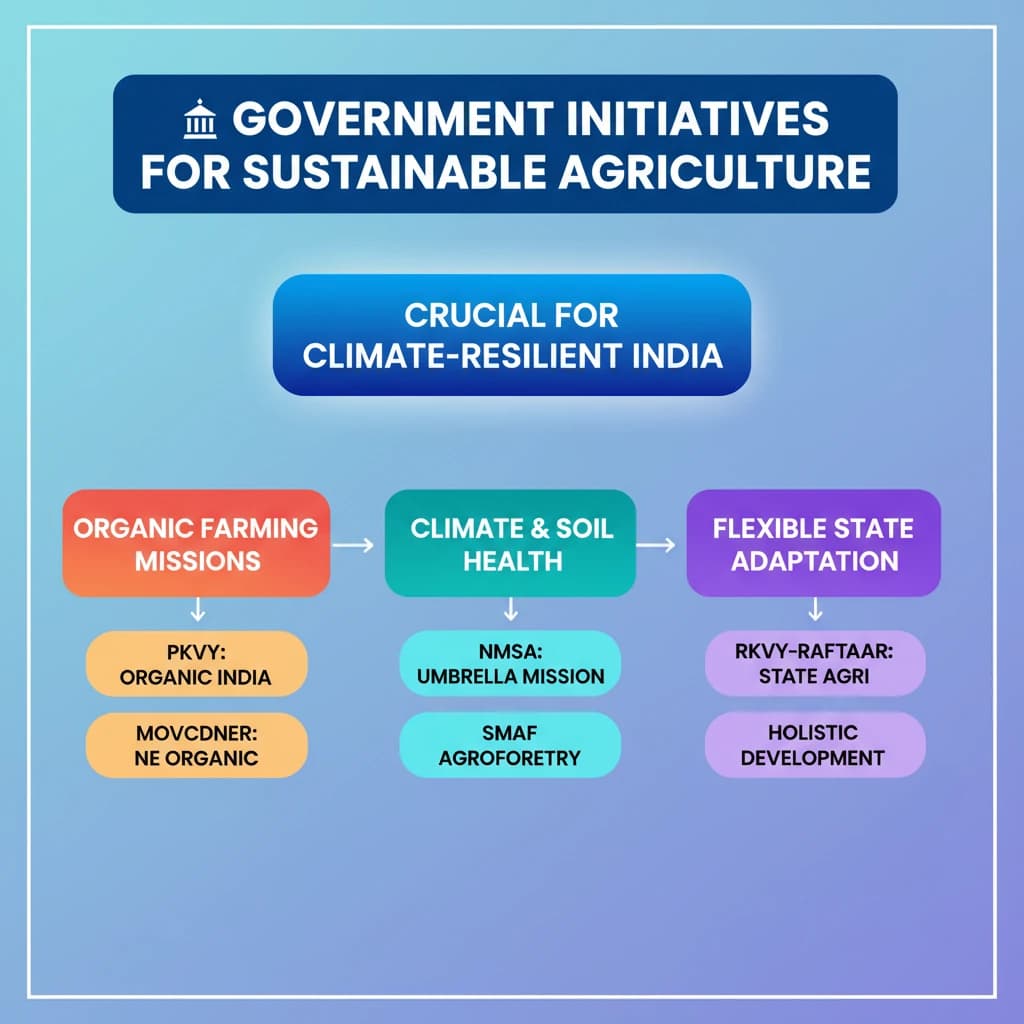
What are Government Initiatives for Sustainable Agriculture? is a key topic under Agriculture Allied Sector for UPSC Civil Services Examination. Key points include: Government initiatives are crucial for promoting sustainable agriculture in India.. NMSA is an umbrella mission for climate-resilient agriculture.. PKVY and MOVCDNER focus on organic farming, with MOVCDNER specific to the North East.. Understanding this topic is essential for both UPSC Prelims and Mains preparation.

Why is What are Government Initiatives for Sustainable Agriculture? important for UPSC exam?

What are Government Initiatives for Sustainable Agriculture? is a Medium-level topic in UPSC Agriculture Allied Sector. It is tested in both Prelims (factual MCQs) and Mains (analytical answer writing). Previous year UPSC questions have frequently covered aspects of What are Government Initiatives for Sustainable Agriculture?, making it essential for comprehensive IAS preparation.

How to prepare What are Government Initiatives for Sustainable Agriculture? for UPSC?

To prepare What are Government Initiatives for Sustainable Agriculture? for UPSC: (1) Study the comprehensive notes covering all key concepts on Vaidra. (2) Practice previous year questions on this topic. (3) Connect it with current affairs using daily updates. (4) Revise using key takeaways and mind maps available for Agriculture Allied Sector. (5) Write practice answers linking What are Government Initiatives for Sustainable Agriculture? to related GS Paper topics.

Key takeaways of What are Government Initiatives for Sustainable Agriculture? for UPSC

  • Government initiatives are crucial for promoting sustainable agriculture in India.
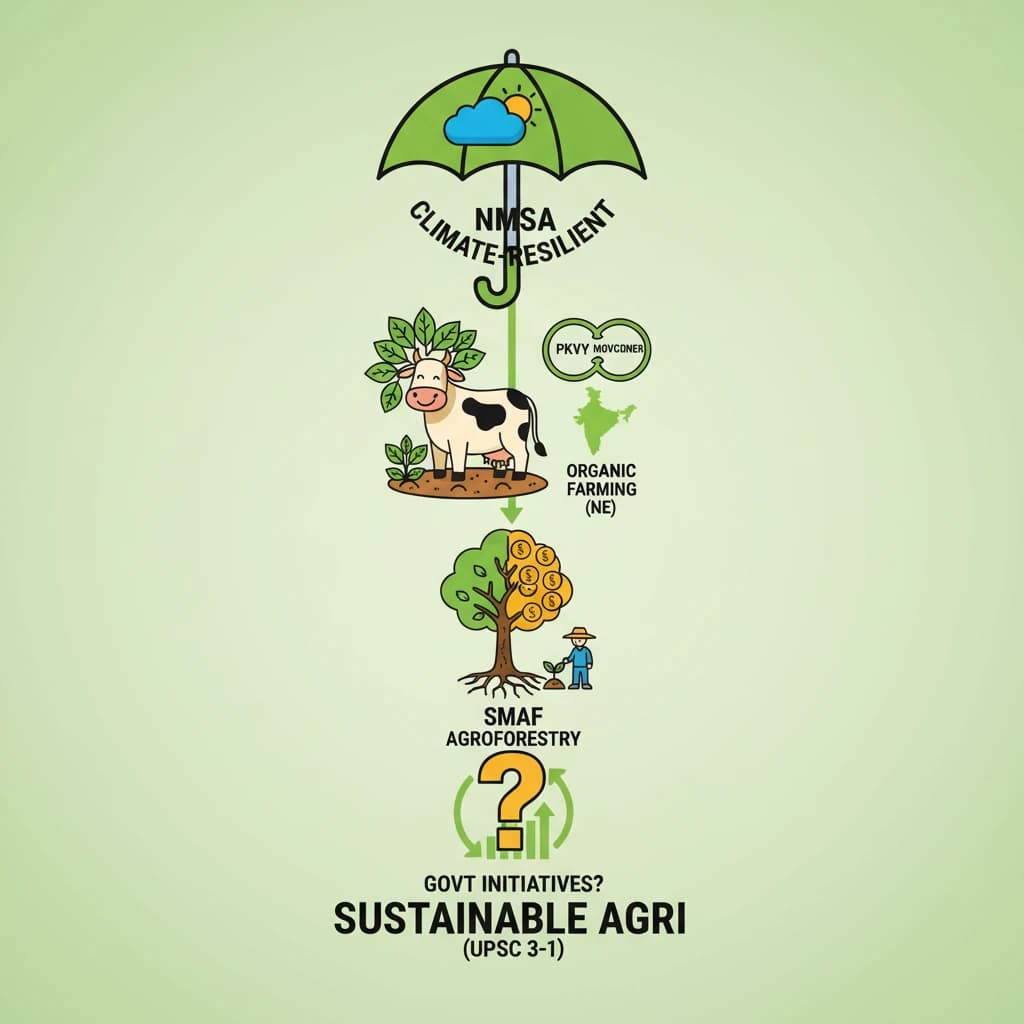
  • NMSA is an umbrella mission for climate-resilient agriculture.
  • PKVY and MOVCDNER focus on organic farming, with MOVCDNER specific to the North East.
  • SMAF promotes agroforestry for environmental and economic benefits.
  • RKVY-RAFTAAR provides states flexibility for agricultural development.
  • These schemes collectively address environmental degradation, farmer income, and food security.
  • They are essential for India's long-term agricultural sustainability and climate goals.
What are Government Initiatives for Sustainable Agriculture?

What are Government Initiatives for Sustainable Agriculture?

Medium⏱️ 7 min read✓ 95% Verified
agriculture allied sector

📖 Introduction

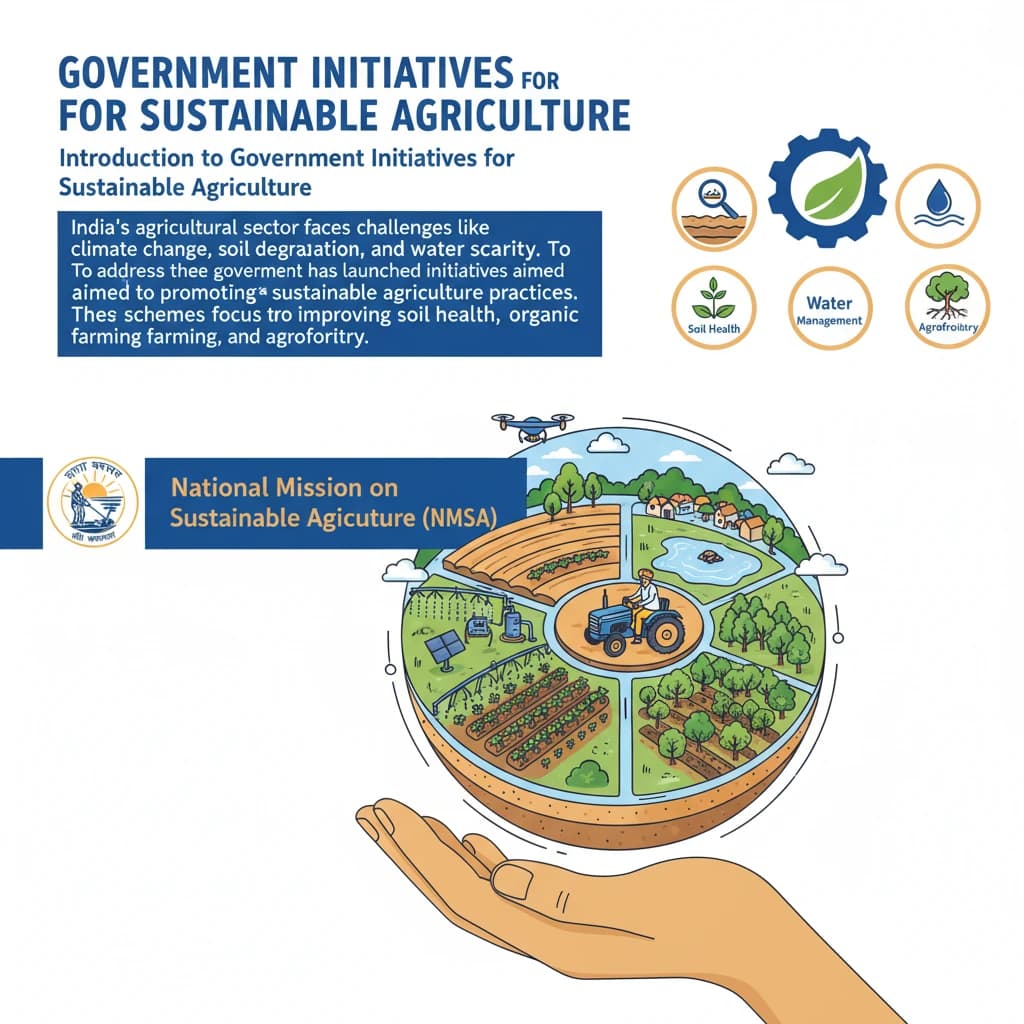
<h4>Introduction to Government Initiatives for Sustainable Agriculture</h4><p>India's agricultural sector faces challenges like climate change, soil degradation, and water scarcity. To address these, the government has launched several initiatives aimed at promoting <strong>sustainable agriculture</strong> practices. These schemes focus on improving soil health, water management, organic farming, and agroforestry.</p><h4>National Mission on Sustainable Agriculture (NMSA)</h4><p>The <strong>National Mission on Sustainable Agriculture (NMSA)</strong> is one of the eight missions under the <strong>National Action Plan on Climate Change (NAPCC)</strong>. It aims to make Indian agriculture more resilient to climate change.</p><div class="info-box"><strong>Launched:</strong> 2014-15<br><strong>Objective:</strong> Enhance food security, sustainable resource management, and adaptation to climate variability.</div><p>NMSA comprises various components like <strong>Rainfed Area Development (RAD)</strong>, <strong>On-Farm Water Management (OFWM)</strong>, <strong>Soil Health Management (SHM)</strong>, and <strong>Climate Change and Sustainable Agriculture: Monitoring, Modelling & Networking (CCSAMMN)</strong>.</p><h4>Paramparagat Krishi Vikas Yojana (PKVY)</h4><p>The <strong>Paramparagat Krishi Vikas Yojana (PKVY)</strong> is a significant scheme promoting <strong>organic farming</strong> in India. It encourages farmers to adopt traditional and modern organic practices.</p><div class="info-box"><strong>Launched:</strong> 2015<br><strong>Focus:</strong> Cluster-based organic farming, part of the <strong>NMSA</strong>.</div><p>Under PKVY, farmers receive financial assistance for organic inputs, certification, and marketing of organic produce. The scheme aims to improve soil health and ensure the availability of healthy food.</p><h4>Sub-mission on Agroforestry (SMAF)</h4><p>The <strong>Sub-mission on Agroforestry (SMAF)</strong> promotes the integration of trees and shrubs in farming systems. This practice helps diversify farm income and provides environmental benefits.</p><div class="info-box"><strong>Launched:</strong> 2014-15<br><strong>Goal:</strong> Increase tree cover on farm lands and optimize land productivity.</div><p>SMAF provides financial assistance to farmers for planting improved varieties of trees, including fruit trees and bamboo. It contributes to carbon sequestration, soil conservation, and biodiversity.</p><h4>Rashtriya Krishi Vikas Yojana (RKVY-RAFTAAR)</h4><p>The <strong>Rashtriya Krishi Vikas Yojana (RKVY)</strong>, now known as <strong>RKVY-RAFTAAR (Remunerative Approaches for Agriculture and Allied sector Rejuvenation)</strong>, is a state-plan scheme. It offers flexibility to states to plan and execute agricultural development strategies.</p><div class="info-box"><strong>Original Launch:</strong> 2007<br><strong>Re-structured as RKVY-RAFTAAR:</strong> 2017<br><strong>Aim:</strong> Achieve 4% annual growth in agriculture and allied sectors.</div><p>RKVY-RAFTAAR focuses on strengthening infrastructure, promoting value chains, and fostering innovation and entrepreneurship in agriculture. It supports a wide range of activities tailored to state-specific needs.</p><h4>Mission Organic Value Chain Development for North Eastern Region (MOVCDNER)</h4><p>The <strong>Mission Organic Value Chain Development for North Eastern Region (MOVCDNER)</strong> specifically targets the promotion of <strong>organic farming</strong> in the <strong>North Eastern States</strong> of India.</p><div class="info-box"><strong>Launched:</strong> 2015<br><strong>Objective:</strong> Develop certified organic production in a value chain mode, from input to market.</div><p>This mission supports various aspects, including input procurement, seed production, processing, packaging, and marketing of organic products unique to the region. It helps farmers in NER gain better market access for their organic produce.</p>
Concept Diagram

💡 Key Takeaways

  • •Government initiatives are crucial for promoting sustainable agriculture in India.
  • •NMSA is an umbrella mission for climate-resilient agriculture.
  • •PKVY and MOVCDNER focus on organic farming, with MOVCDNER specific to the North East.
  • •SMAF promotes agroforestry for environmental and economic benefits.
  • •RKVY-RAFTAAR provides states flexibility for agricultural development.
  • •These schemes collectively address environmental degradation, farmer income, and food security.
  • •They are essential for India's long-term agricultural sustainability and climate goals.

🧠 Memory Techniques
Memory Aid
95% Verified Content

📚 Reference Sources

•NITI Aayog reports on agricultural policy
•Official scheme guidelines for NMSA, PKVY, SMAF, RKVY-RAFTAAR, MOVCDNER
•Press Information Bureau (PIB) releases on agricultural schemes

Related Topics

Loading related topics...
Explore:Agriculture Allied Sector Topics·All Subjects·Daily Current Affairs·Editorial Analysis·Previous Year Questions·UPSC GPT
Back
All Subjects

Topics

0 topics • 0 completed

Loading topics...
Loading...
Loading...
Loading...
Loading...
Loading...
Overall Progress0%