Loading page, please wait…
Vaidra Logo
Vaidra

Top 4 items + smart groups

UPSC GPT
New
Current Affairs
Daily Solutions
Daily Puzzle
Mains Evaluator

Version 2.0.0 • Built with ❤️ for UPSC aspirants

Loading...
Loading...
Loading...
Loading...
Loading...
Loading...
Loading...
Loading...
Loading...
Loading...
Loading...
Loading...
Loading...
Back
All Subjects

Topics

0 topics • 0 completed

Loading topics...
Loading...
Loading...
Loading...
Loading...
Loading...
Overall Progress0%

Micronutrient-Rich Food, Climate Resilience & Sustainable Agriculture - UPSC Agriculture Allied Sector

What is Micronutrient-Rich Food, Climate Resilience & Sustainable Agriculture in UPSC Agriculture Allied Sector?

Micronutrient-Rich Food, Climate Resilience & Sustainable Agriculture is a key topic under Agriculture Allied Sector for UPSC Civil Services Examination. Key points include: Agriculture must prioritize producing micronutrient-rich foods to combat hidden hunger.. Minimizing Greenhouse Gas Emissions is crucial for sustainable agriculture and climate action.. Techniques like precision farming, organic agriculture, and agroforestry reduce agricultural emissions.. Understanding this topic is essential for both UPSC Prelims and Mains preparation.

Why is Micronutrient-Rich Food, Climate Resilience & Sustainable Agriculture important for UPSC exam?

Micronutrient-Rich Food, Climate Resilience & Sustainable Agriculture is a Medium-level topic in UPSC Agriculture Allied Sector. It is tested in both Prelims (factual MCQs) and Mains (analytical answer writing). Previous year UPSC questions have frequently covered aspects of Micronutrient-Rich Food, Climate Resilience & Sustainable Agriculture, making it essential for comprehensive IAS preparation.

How to prepare Micronutrient-Rich Food, Climate Resilience & Sustainable Agriculture for UPSC?

To prepare Micronutrient-Rich Food, Climate Resilience & Sustainable Agriculture for UPSC: (1) Study the comprehensive notes covering all key concepts on Vaidra. (2) Practice previous year questions on this topic. (3) Connect it with current affairs using daily updates. (4) Revise using key takeaways and mind maps available for Agriculture Allied Sector. (5) Write practice answers linking Micronutrient-Rich Food, Climate Resilience & Sustainable Agriculture to related GS Paper topics.

Key takeaways of Micronutrient-Rich Food, Climate Resilience & Sustainable Agriculture for UPSC

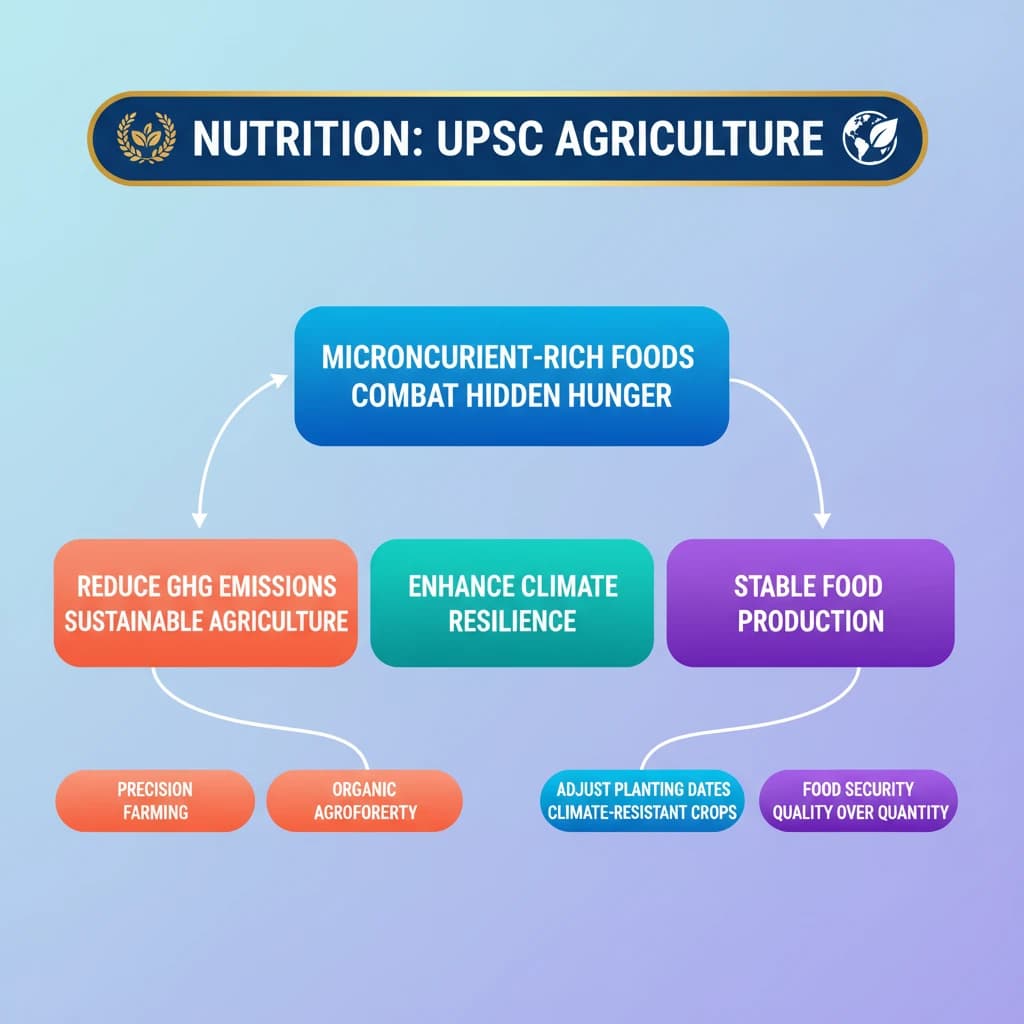
  • Agriculture must prioritize producing micronutrient-rich foods to combat hidden hunger.
  • Minimizing Greenhouse Gas Emissions is crucial for sustainable agriculture and climate action.
  • Techniques like precision farming, organic agriculture, and agroforestry reduce agricultural emissions.
  • Enhancing climate change resilience is vital for ensuring stable food production.
  • Adjusting planting dates and selecting climate-resistant crop varieties are key resilience strategies.
  • Sustainable agriculture integrates nutritional security, environmental sustainability, and climate adaptation.
  • Modern agricultural policies increasingly focus on holistic approaches to food systems.
Micronutrient-Rich Food, Climate Resilience & Sustainable Agriculture

Micronutrient-Rich Food, Climate Resilience & Sustainable Agriculture

Medium⏱️ 8 min read✓ 95% Verified
agriculture allied sector

📖 Introduction

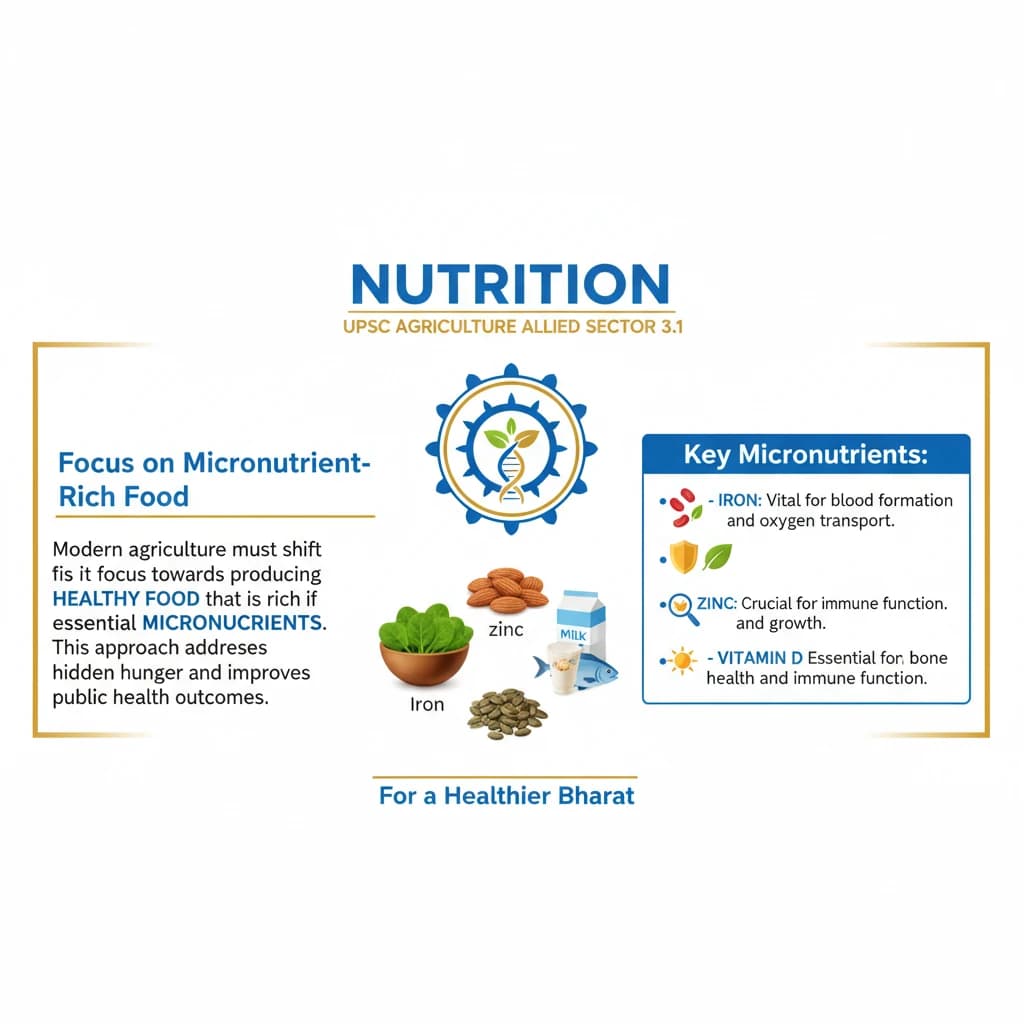
<h4>Focus on Micronutrient-Rich Food</h4><p>Modern agriculture must shift its focus towards producing <strong>healthy food</strong> that is rich in essential <strong>micronutrients</strong>. This approach addresses hidden hunger and improves public health outcomes.</p><div class="key-point-box"><strong>Key Micronutrients:</strong><ul><li><strong>Iron:</strong> Vital for blood formation and oxygen transport.</li><li><strong>Zinc:</strong> Crucial for immune function and cell growth.</li><li><strong>Vitamin A:</strong> Essential for vision, immune system, and skin health.</li><li><strong>Folate:</strong> Important for cell division and preventing birth defects.</li></ul>These micronutrients are vital for various bodily functions and overall human development.</div><h4>Minimizing Greenhouse Gas Emissions in Agriculture</h4><p>Agricultural practices need to adopt strategies that significantly reduce <strong>Greenhouse Gas (GHG) Emissions</strong>. This is crucial for combating climate change and ensuring environmental sustainability.</p><div class="info-box"><strong>Techniques for GHG Reduction:</strong><ul><li><strong>Precision Farming:</strong> Optimizes input use (fertilizers, water) through technology, reducing waste and emissions.</li><li><strong>Organic Agriculture:</strong> Avoids synthetic fertilizers and pesticides, relying on natural processes to maintain soil health and reduce fossil fuel-based inputs.</li><li><strong>Agroforestry:</strong> Integrates trees and shrubs into agricultural landscapes, enhancing carbon sequestration and biodiversity.</li><li><strong>Conservation Tillage:</strong> Minimizes soil disturbance, leading to improved soil structure, reduced erosion, and lower fuel consumption for farm machinery.</li></ul>These methods help minimize inputs like synthetic fertilizers and fossil fuels, thereby directly reducing agricultural emissions.</div><h4>Enhancing Climate Change Resilience in Agriculture</h4><p>Building <strong>resilience to Climate Change</strong> is paramount for agricultural systems to withstand adverse impacts like droughts, floods, and extreme temperatures. This ensures food security in a changing climate.</p><div class="key-point-box"><strong>Strategies for Climate Resilience:</strong><ul><li><strong>Adjusting Planting Dates:</strong> Modifying sowing times to align with changing rainfall patterns and temperature regimes.</li><li><strong>Selecting Climate-Resistant Crop Varieties:</strong> Utilizing crops engineered or naturally adapted to tolerate stress factors such as drought, salinity, or heat.</li><li><strong>Agroforestry:</strong> The integration of trees provides shade, reduces wind erosion, improves soil moisture retention, and diversifies farm income, all contributing to resilience.</li></ul>These adaptations can significantly increase agricultural resilience to the varied impacts of climate change, ensuring stable yields and farmer livelihoods.</div>
Concept Diagram

💡 Key Takeaways

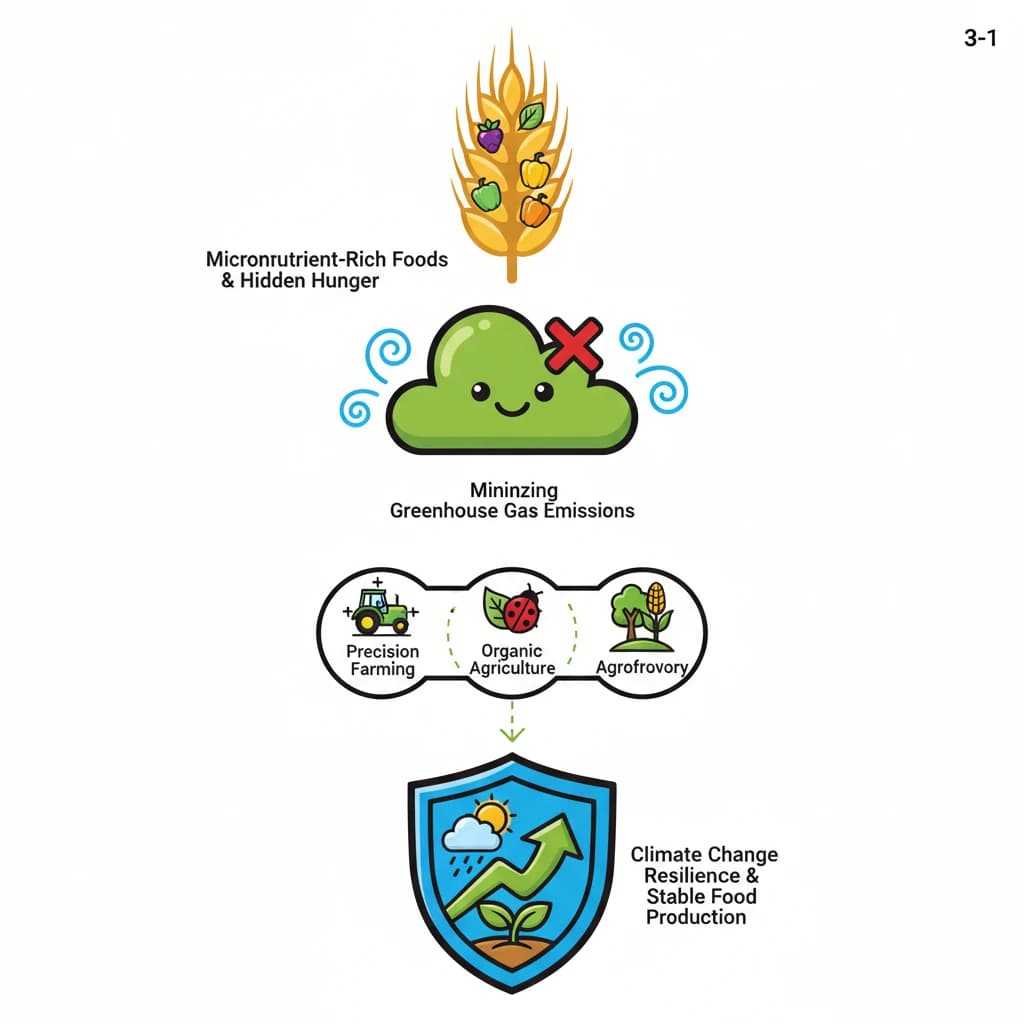
  • •Agriculture must prioritize producing micronutrient-rich foods to combat hidden hunger.
  • •Minimizing Greenhouse Gas Emissions is crucial for sustainable agriculture and climate action.
  • •Techniques like precision farming, organic agriculture, and agroforestry reduce agricultural emissions.
  • •Enhancing climate change resilience is vital for ensuring stable food production.
  • •Adjusting planting dates and selecting climate-resistant crop varieties are key resilience strategies.
  • •Sustainable agriculture integrates nutritional security, environmental sustainability, and climate adaptation.
  • •Modern agricultural policies increasingly focus on holistic approaches to food systems.

🧠 Memory Techniques
Memory Aid
95% Verified Content

📚 Reference Sources

•FAO reports on Climate-Smart Agriculture
•ICAR publications on Biofortification
•Government of India, Ministry of Agriculture & Farmers Welfare documents

Related Topics

Loading related topics...
Explore:Agriculture Allied Sector Topics·All Subjects·Daily Current Affairs·Editorial Analysis·Previous Year Questions·UPSC GPT
Micronutrient-Rich Food, Climate Resilience & Sustainable Agriculture - UPSC Agriculture Allied Sector