Loading page, please wait…
Vaidra Logo
Vaidra

Top 4 items + smart groups

UPSC GPT
New
Current Affairs
Daily Solutions
Daily Puzzle
Mains Evaluator

Version 2.0.0 • Built with ❤️ for UPSC aspirants

Loading...
Loading...
Loading...
Loading...
Loading...
Loading...
Loading...
Loading...
Loading...
Loading...
Loading...
Loading...
Loading...
Floriculture In India - UPSC Agriculture Allied Sector
Back
All Subjects

Topics

0 topics • 0 completed

Loading topics...
Loading...
Loading...
Loading...
Loading...
Loading...
Overall Progress0%

Floriculture In India - UPSC Agriculture Allied Sector

What is Floriculture In India in UPSC Agriculture Allied Sector?

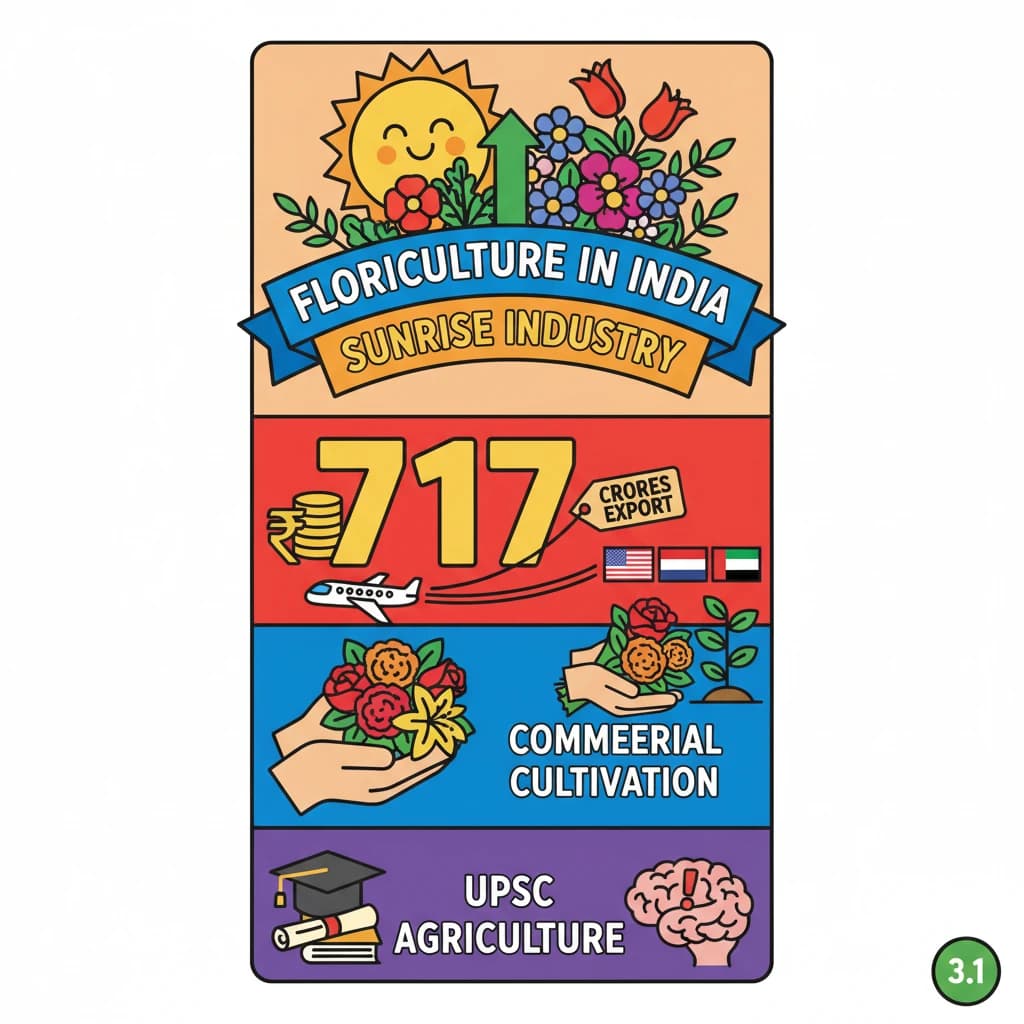
Floriculture In India is a key topic under Agriculture Allied Sector for UPSC Civil Services Examination. Key points include: Floriculture is the cultivation of flowering and ornamental plants for diverse purposes.. It is recognized as a 'sunrise industry' in India with significant growth potential.. India exported floriculture products worth Rs 717.83 crores in 2023-24.. Understanding this topic is essential for both UPSC Prelims and Mains preparation.

Why is Floriculture In India important for UPSC exam?

Floriculture In India is a Medium-level topic in UPSC Agriculture Allied Sector. It is tested in both Prelims (factual MCQs) and Mains (analytical answer writing). Previous year UPSC questions have frequently covered aspects of Floriculture In India, making it essential for comprehensive IAS preparation.

How to prepare Floriculture In India for UPSC?

To prepare Floriculture In India for UPSC: (1) Study the comprehensive notes covering all key concepts on Vaidra. (2) Practice previous year questions on this topic. (3) Connect it with current affairs using daily updates. (4) Revise using key takeaways and mind maps available for Agriculture Allied Sector. (5) Write practice answers linking Floriculture In India to related GS Paper topics.

Key takeaways of Floriculture In India for UPSC

  • Floriculture is the cultivation of flowering and ornamental plants for diverse purposes.
  • It is recognized as a 'sunrise industry' in India with significant growth potential.
  • India exported floriculture products worth Rs 717.83 crores in 2023-24.
  • Key crops include roses, carnations, and gerberas, grown in both open fields and greenhouses.
  • Karnataka, Tamil Nadu, and Maharashtra are leading floriculture regions.
  • Government initiatives like APEDA support, CSIR Mission, and 100% FDI boost the sector.
  • Floriculture contributes to farmer income, employment, and agricultural exports.
Floriculture In India

Floriculture In India

Medium⏱️ 8 min read✓ 95% Verified
agriculture allied sector

📖 Introduction

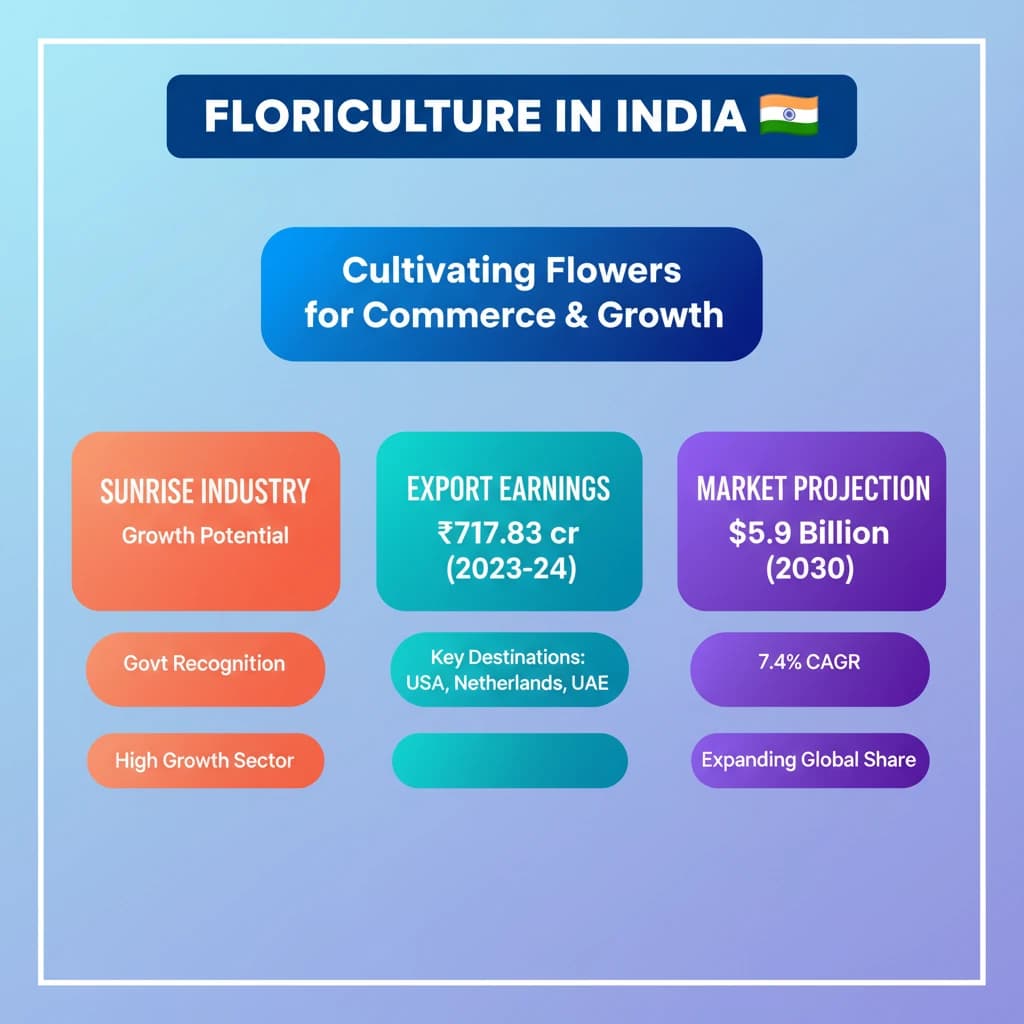
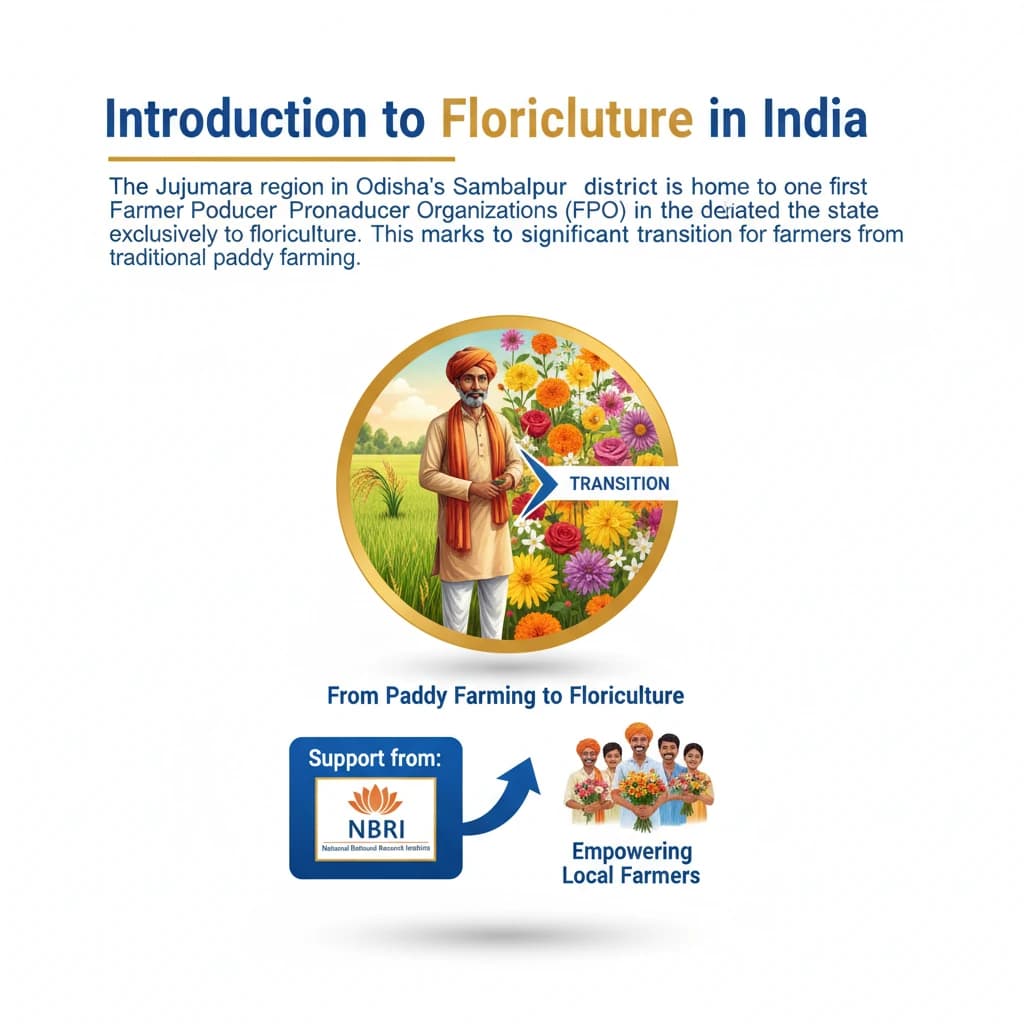
<h4>Introduction to Floriculture in India</h4><p>The <strong>Jujumara region</strong> in <strong>Odisha’s Sambalpur district</strong> showcases a successful transition in agriculture. A <strong>Farmer Producer Organization (FPO)</strong> there has moved from traditional <strong>paddy farming</strong> to exclusive <strong>floriculture</strong>.</p><p>This shift has been supported by the <strong>National Botanical Research Institute (NBRI)</strong>, leading to significant economic improvements for local farmers.</p><div class="info-box"><strong>What is Floriculture?</strong><br>It is the cultivation of <strong>flowering and ornamental plants</strong>.<br><strong>Purposes:</strong> Direct sale, cosmetics, perfume, pharmaceutical industries.<br><strong>Propagation:</strong> Includes seed and plant material production via cutting, grafting, budding.</div><h4>Market Overview and Economic Significance</h4><p>The <strong>Government of India</strong> has recognized floriculture as a <strong>“sunrise industry”</strong>, highlighting its growth potential and economic importance.</p><p>The sector is experiencing robust growth, with significant area under cultivation and increasing export figures.</p><div class="info-box"><strong>Area under Cultivation (2023-24):</strong> Approximately <strong>297 thousand hectares</strong> (2nd advance estimates).<br><strong>Exports (2023-24):</strong> Around <strong>20,000 metric tonnes</strong> valued at <strong>Rs 717.83 crores</strong>.<br><strong>Major Importers:</strong> <strong>USA, Netherlands, UAE, UK, Canada, Malaysia</strong>.<br><strong>Projected Growth:</strong> Expected to reach <strong>USD 5.9 billion by 2030</strong> with a <strong>CAGR of 7.4%</strong> (2023-2030).</div><h4>Key Varieties of Floricultural Crops</h4><p>India's floriculture industry encompasses a diverse range of products, catering to both domestic and international markets.</p><ul><li><strong>Products:</strong> <strong>Cut flowers, pot plants, bulbs, tubers, dried flowers</strong>.</li></ul><div class="key-point-box"><strong>Important International Cut Flower Trade Crops:</strong><br><strong>Rose, Carnation, Chrysanthemum, Gerbera, Gladiolus, Gypsophila, Liatris, Limonium, Orchids, Achillea, Anthurium, Tulip, Lilies</strong>.</div><p>Cultivation methods vary depending on the crop and desired environmental conditions.</p><ul><li><strong>Greenhouse Crops:</strong> <strong>Gerberas, Carnation</strong> (grown under controlled environmental conditions).</li><li><strong>Open Field Crops:</strong> <strong>Chrysanthemum, Roses, Gaillardia, Lily, Marigold, Aster, Tuberose</strong>.</li></ul><div class="info-box"><strong>Greenhouses:</strong> Inflated structures covered with transparent material, allowing for controlled environmental conditions for crop growth.</div><h4>Leading Floriculture Regions in India</h4><p>Several states have emerged as significant hubs for floriculture, contributing to the sector's overall growth and production.</p><ul><li><strong>Major Centres:</strong> <strong>Karnataka, Tamil Nadu, Madhya Pradesh, West Bengal, Chhattisgarh, Andhra Pradesh, Gujarat, Uttar Pradesh, Assam, Maharashtra</strong>.</li></ul><h4>Government Initiatives and Support</h4><p>The Indian government actively promotes floriculture through various schemes and policies to boost farmer income and exports.</p><ul><li><strong>APEDA (Agricultural and Processed Food Products Export Development Authority):</strong> Nodal organization for agri-exports.<ul><li>Supports exporters with <strong>cold storage, freight subsidies, infrastructure development</strong>.</li></ul></li><li><strong>CSIR Floriculture Mission (Council of Scientific & Industrial Research):</strong><ul><li>Nation-wide mission implemented in <strong>22 states</strong>.</li><li>Aims to enhance farmer income and develop entrepreneurship using <strong>CSIR technologies</strong>.</li></ul></li><li><strong>FDI in Floriculture:</strong><ul><li><strong>100% Foreign Direct Investment (FDI)</strong> allowed under the <strong>automatic route</strong>.</li><li>Simplifies investment for foreign entities.</li></ul></li><li><strong>Integrated Development of Commercial Floriculture Scheme:</strong><ul><li>Ensures access to <strong>quality planting material</strong>.</li><li>Promotes <strong>off-season cultivation</strong>.</li><li>Enhances <strong>post-harvest management</strong>.</li></ul></li></ul>
Concept Diagram

💡 Key Takeaways

  • •Floriculture is the cultivation of flowering and ornamental plants for diverse purposes.
  • •It is recognized as a 'sunrise industry' in India with significant growth potential.
  • •India exported floriculture products worth Rs 717.83 crores in 2023-24.
  • •Key crops include roses, carnations, and gerberas, grown in both open fields and greenhouses.
  • •Karnataka, Tamil Nadu, and Maharashtra are leading floriculture regions.
  • •Government initiatives like APEDA support, CSIR Mission, and 100% FDI boost the sector.
  • •Floriculture contributes to farmer income, employment, and agricultural exports.

🧠 Memory Techniques
Memory Aid
95% Verified Content

Related Topics

Loading related topics...
Explore:Agriculture Allied Sector Topics·All Subjects·Daily Current Affairs·Editorial Analysis·Previous Year Questions·UPSC GPT