Loading page, please wait…
Vaidra Logo
Vaidra

Top 4 items + smart groups

UPSC GPT
New
Current Affairs
Daily Solutions
Daily Puzzle
Mains Evaluator

Version 2.0.0 • Built with ❤️ for UPSC aspirants

Loading...
Loading...
Loading...
Loading...
Loading...
Loading...
Loading...
Loading...
Loading...
Loading...
Loading...
Loading...
Loading...
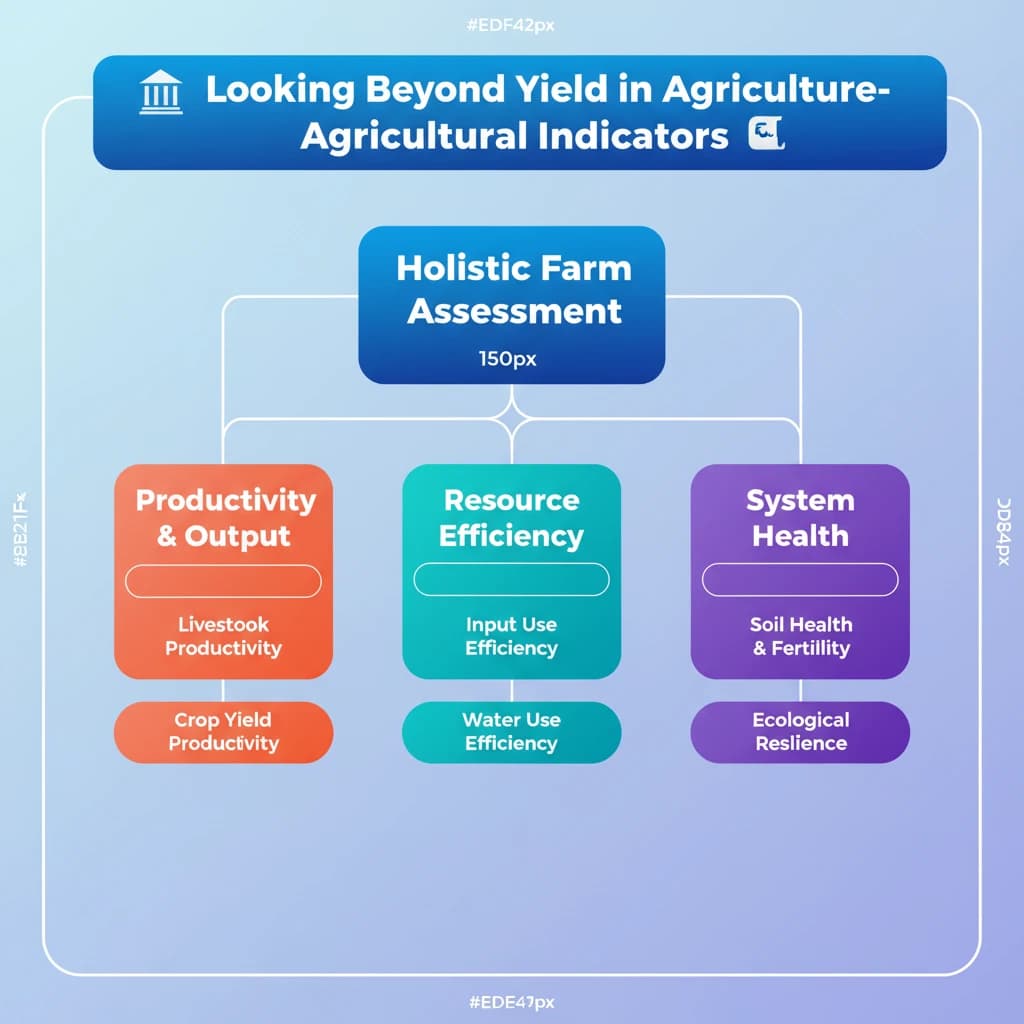
Looking Beyond Yield in Agriculture- Agricultural Indicators - UPSC Agriculture Allied Sector

Looking Beyond Yield in Agriculture- Agricultural Indicators - UPSC Agriculture Allied Sector

What is Looking Beyond Yield in Agriculture- Agricultural Indicators in UPSC Agriculture Allied Sector?

Looking Beyond Yield in Agriculture- Agricultural Indicators is a key topic under Agriculture Allied Sector for UPSC Civil Services Examination. Key points include: Agricultural success must be measured beyond mere crop yield.. Comprehensive indicators assess health, performance, and sustainability of farm systems.. Key indicators include crop yield, livestock productivity, input efficiency, soil health, and water use efficiency.. Understanding this topic is essential for both UPSC Prelims and Mains preparation.

Why is Looking Beyond Yield in Agriculture- Agricultural Indicators important for UPSC exam?

Looking Beyond Yield in Agriculture- Agricultural Indicators is a Medium-level topic in UPSC Agriculture Allied Sector. It is tested in both Prelims (factual MCQs) and Mains (analytical answer writing). Previous year UPSC questions have frequently covered aspects of Looking Beyond Yield in Agriculture- Agricultural Indicators, making it essential for comprehensive IAS preparation.

How to prepare Looking Beyond Yield in Agriculture- Agricultural Indicators for UPSC?

To prepare Looking Beyond Yield in Agriculture- Agricultural Indicators for UPSC: (1) Study the comprehensive notes covering all key concepts on Vaidra. (2) Practice previous year questions on this topic. (3) Connect it with current affairs using daily updates. (4) Revise using key takeaways and mind maps available for Agriculture Allied Sector. (5) Write practice answers linking Looking Beyond Yield in Agriculture- Agricultural Indicators to related GS Paper topics.

Key takeaways of Looking Beyond Yield in Agriculture- Agricultural Indicators for UPSC

  • Agricultural success must be measured beyond mere crop yield.
  • Comprehensive indicators assess health, performance, and sustainability of farm systems.
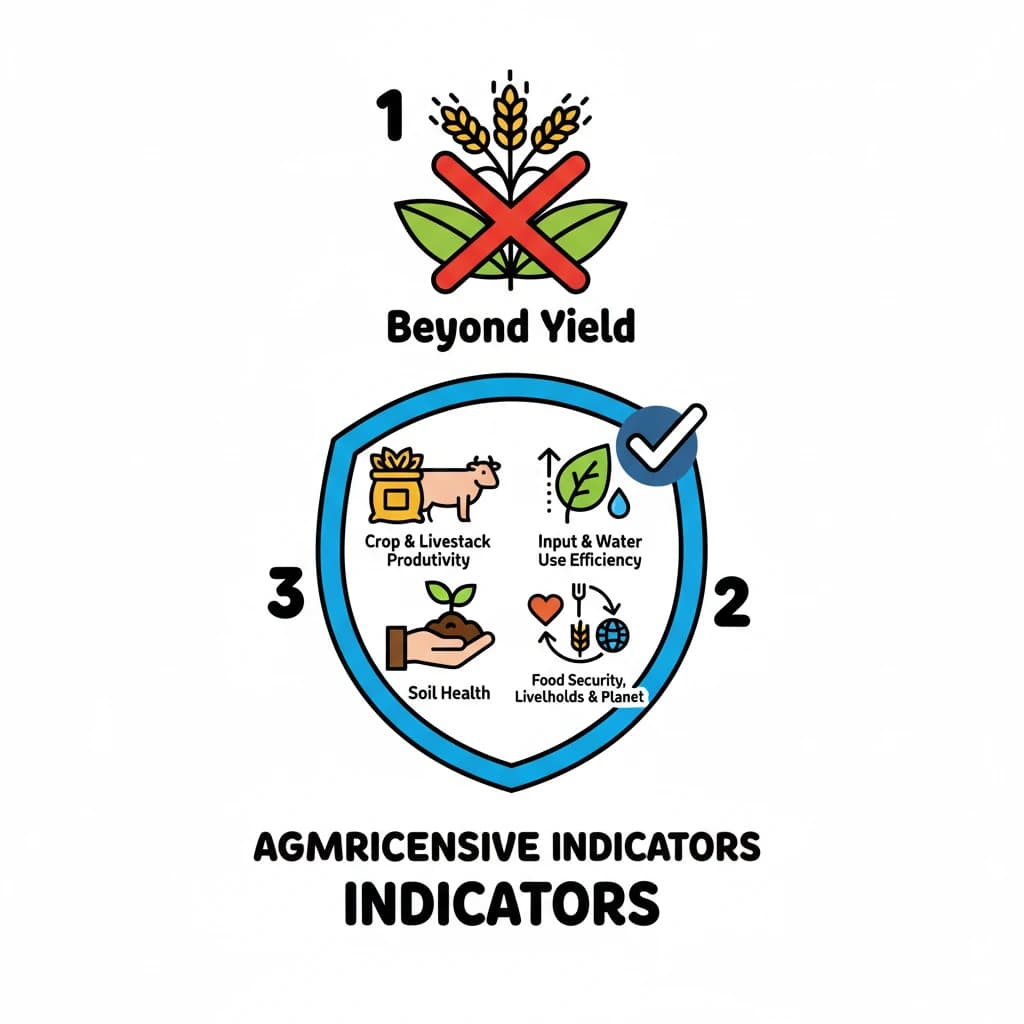
  • Key indicators include crop yield, livestock productivity, input efficiency, soil health, and water use efficiency.
  • These indicators help ensure food security, farmer livelihoods, and planetary protection.
  • Moving beyond yield is crucial for sustainable agriculture and climate resilience.
  • Government policies increasingly rely on these broader indicators for effective planning.
Looking Beyond Yield in Agriculture- Agricultural Indicators

Looking Beyond Yield in Agriculture- Agricultural Indicators

Medium⏱️ 8 min read✓ 95% Verified
agriculture allied sector

📖 Introduction

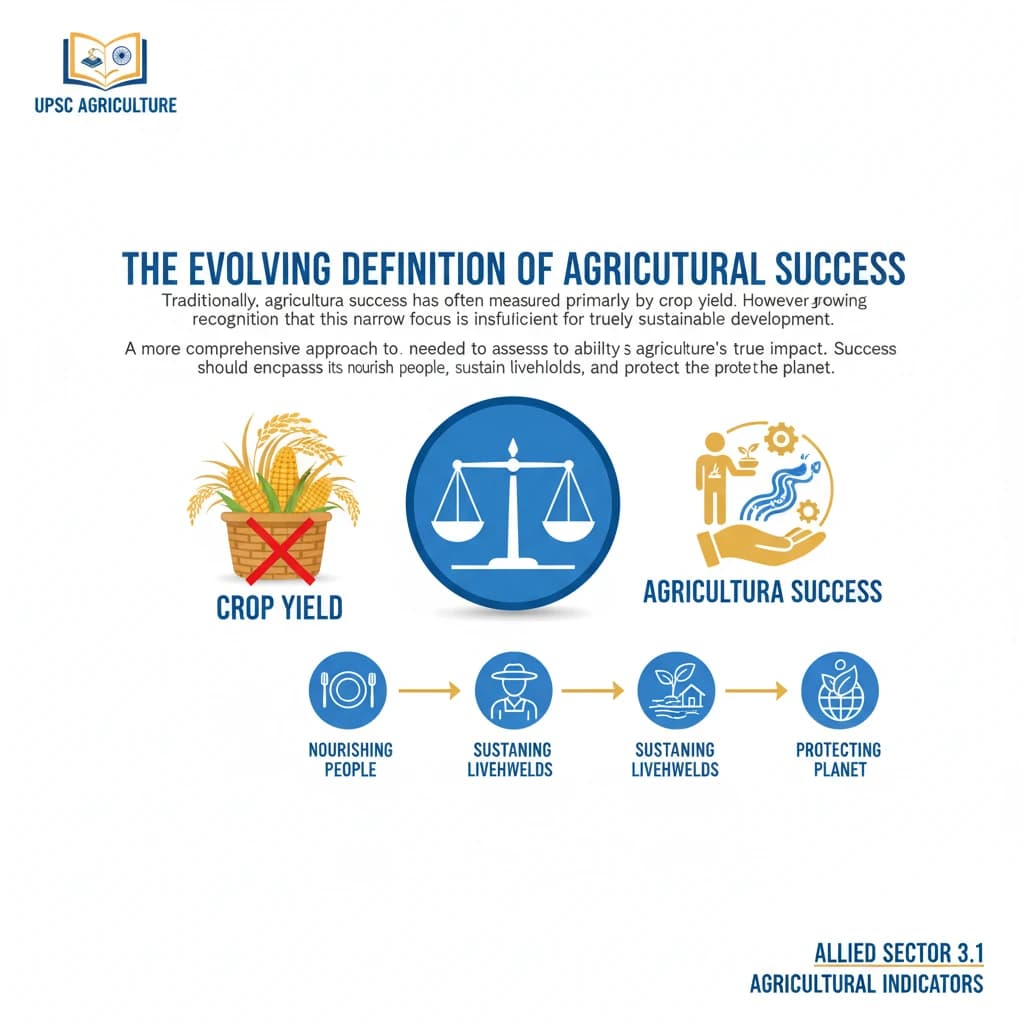
<h4>The Evolving Definition of Agricultural Success</h4><p>Traditionally, <strong>agricultural success</strong> has often been measured primarily by <strong>crop yield</strong>. However, there is a growing recognition that this narrow focus is insufficient for truly sustainable development.</p><p>A more comprehensive approach is needed to assess agriculture's true impact. Success should encompass its ability to <strong>nourish people</strong>, sustain <strong>livelihoods</strong>, and protect the <strong>planet for future generations</strong>.</p><h4>What are Agricultural Indicators?</h4><p><strong>Agricultural indicators</strong> are crucial tools that provide measurable insights into the overall health, performance, and long-term sustainability of agricultural systems.</p><div class="info-box"><strong>Definition:</strong> <strong>Agricultural indicators</strong> are quantifiable variables used to assess various facets of agriculture, including <strong>productivity</strong>, <strong>economic viability</strong>, <strong>environmental impact</strong>, and <strong>social factors</strong>.</div><div class="key-point-box">These indicators move beyond mere production figures to offer a holistic view, helping policymakers and farmers make informed decisions for sustainable development and resilience.</div><h4>Key Agricultural Indicators Beyond Yield</h4><h5>1. Crop Yield</h5><p><strong>Crop yield</strong> remains a fundamental indicator, representing the direct output from cultivated land. It is a measure of how much produce is harvested from a given area.</p><div class="info-box"><strong>Definition:</strong> <strong>Crop yield</strong> refers to the <strong>amount of harvested produce</strong> (e.g., grains, fruits, vegetables) obtained per <strong>unit of land</strong> used for cultivation. It's a primary measure of agricultural productivity.</div><h5>2. Livestock Farming Productivity</h5><p>Beyond crops, <strong>livestock farming</strong> is a significant component of agriculture. Its productivity is measured by the output of various animal products.</p><div class="info-box"><strong>Definition:</strong> <strong>Livestock farming</strong> is the practice of raising animals, such as cattle, poultry, or sheep, primarily for their products like <strong>meat, milk, eggs, or wool</strong>. Indicators here include output per animal or per unit of feed.</div><h5>3. Input Efficiency</h5><p><strong>Input efficiency</strong> is a critical indicator for sustainable agriculture, focusing on optimizing resource use. It assesses how effectively resources are converted into agricultural output.</p><div class="info-box"><strong>Concept:</strong> <strong>Input efficiency</strong> implies achieving high quantity and quality of food production while utilizing <strong>finite resources</strong> such as <strong>land, water, nutrients, and energy</strong> in the most optimal and responsible way.</div><h5>4. Soil Health</h5><p>The foundation of productive and sustainable agriculture lies in <strong>healthy soil</strong>. This indicator assesses the soil's capacity to support plant growth and broader ecosystem functions.</p><div class="info-box"><strong>Components:</strong> <strong>Soil health</strong> involves factors like adequate <strong>nutrient availability</strong>, sufficient <strong>oxygen availability to roots</strong>, and the soil's <strong>nutrient retention capacity</strong>, all of which determine its overall functionality and fertility.</div><h5>5. Water Use Efficiency (WUE)</h5><p>Given increasing water scarcity globally and in India, <strong>Water Use Efficiency</strong> is paramount. It measures how effectively water is utilized by crops to produce biomass or grain.</p><div class="info-box"><strong>Definition:</strong> <strong>Water Use Efficiency (WUE)</strong> refers to the amount of <strong>carbon stored as biomass or grain produced</strong> for each unit of <strong>water used by the crop</strong>. It is a key metric for sustainable irrigation practices and drought resilience.</div>
Concept Diagram

💡 Key Takeaways

  • •Agricultural success must be measured beyond mere crop yield.
  • •Comprehensive indicators assess health, performance, and sustainability of farm systems.
  • •Key indicators include crop yield, livestock productivity, input efficiency, soil health, and water use efficiency.
  • •These indicators help ensure food security, farmer livelihoods, and planetary protection.
  • •Moving beyond yield is crucial for sustainable agriculture and climate resilience.
  • •Government policies increasingly rely on these broader indicators for effective planning.

🧠 Memory Techniques
Memory Aid
95% Verified Content

📚 Reference Sources

•Ministry of Agriculture & Farmers Welfare, Government of India reports
•NITI Aayog documents on agricultural reforms and sustainability
•Food and Agriculture Organization (FAO) publications on sustainable agriculture
•Economic Survey of India (various editions)

Related Topics

Loading related topics...
Explore:Agriculture Allied Sector Topics·All Subjects·Daily Current Affairs·Editorial Analysis·Previous Year Questions·UPSC GPT
Back
All Subjects

Topics

0 topics • 0 completed

Loading topics...
Loading...
Loading...
Loading...
Loading...
Loading...
Overall Progress0%