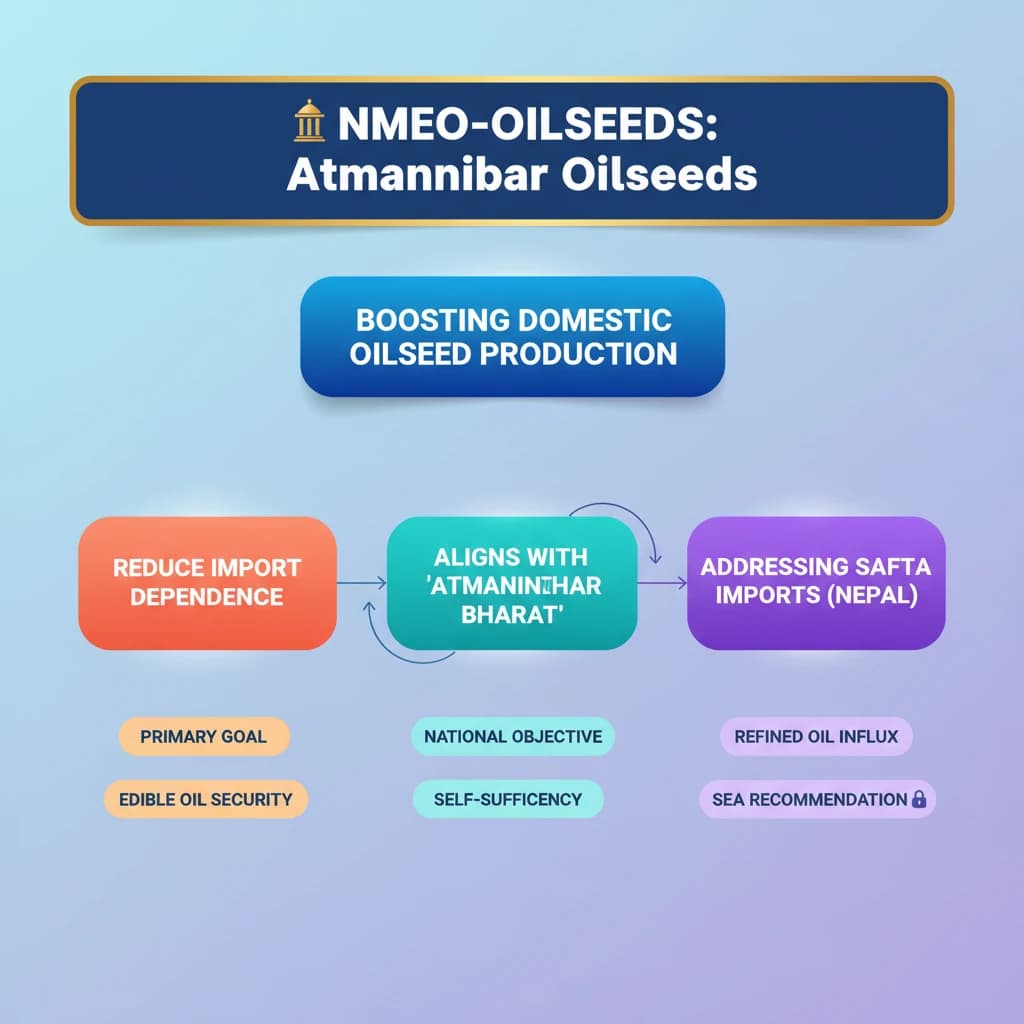
Loading page, please wait…
Vaidra Logo
Vaidra

Top 4 items + smart groups

UPSC GPT
New
Current Affairs
Daily Solutions
Daily Puzzle
Mains Evaluator

Version 2.0.0 • Built with ❤️ for UPSC aspirants

Loading...
Loading...
Loading...
Loading...
Loading...
Loading...
Loading...
Loading...
Loading...
Loading...
Loading...
Loading...
Loading...
Back
All Subjects

Topics

0 topics • 0 completed

Loading topics...
Loading...
Loading...
Loading...
Loading...
Loading...
Overall Progress0%

About NMEO-Oilseeds - UPSC Agriculture Allied Sector

What is About NMEO-Oilseeds in UPSC Agriculture Allied Sector?

About NMEO-Oilseeds is a key topic under Agriculture Allied Sector for UPSC Civil Services Examination. Key points include: NMEO-Oilseeds is a mission to boost domestic oilseed production.. Its primary goal is to reduce India's heavy reliance on edible oil imports.. The mission aligns with the national objective of Atmanirbhar Oilseeds.. Understanding this topic is essential for both UPSC Prelims and Mains preparation.

Why is About NMEO-Oilseeds important for UPSC exam?

About NMEO-Oilseeds is a Medium-level topic in UPSC Agriculture Allied Sector. It is tested in both Prelims (factual MCQs) and Mains (analytical answer writing). Previous year UPSC questions have frequently covered aspects of About NMEO-Oilseeds, making it essential for comprehensive IAS preparation.

How to prepare About NMEO-Oilseeds for UPSC?

To prepare About NMEO-Oilseeds for UPSC: (1) Study the comprehensive notes covering all key concepts on Vaidra. (2) Practice previous year questions on this topic. (3) Connect it with current affairs using daily updates. (4) Revise using key takeaways and mind maps available for Agriculture Allied Sector. (5) Write practice answers linking About NMEO-Oilseeds to related GS Paper topics.

Key takeaways of About NMEO-Oilseeds for UPSC

  • NMEO-Oilseeds is a mission to boost domestic oilseed production.
  • Its primary goal is to reduce India's heavy reliance on edible oil imports.
  • The mission aligns with the national objective of Atmanirbhar Oilseeds.
  • Rising refined edible oil imports from Nepal via SAFTA pose a significant concern.
  • The Solvent Extractors' Association (SEA) recommends restricting duty-free imports.
  • SEA also suggests amending SAFTA to prevent agro-commodity dumping.
  • Introducing a Minimum Import Price (MIP) linked to MSP is proposed to protect farmers.
About NMEO-Oilseeds

About NMEO-Oilseeds

Medium⏱️ 6 min read✓ 95% Verified
agriculture allied sector

📖 Introduction

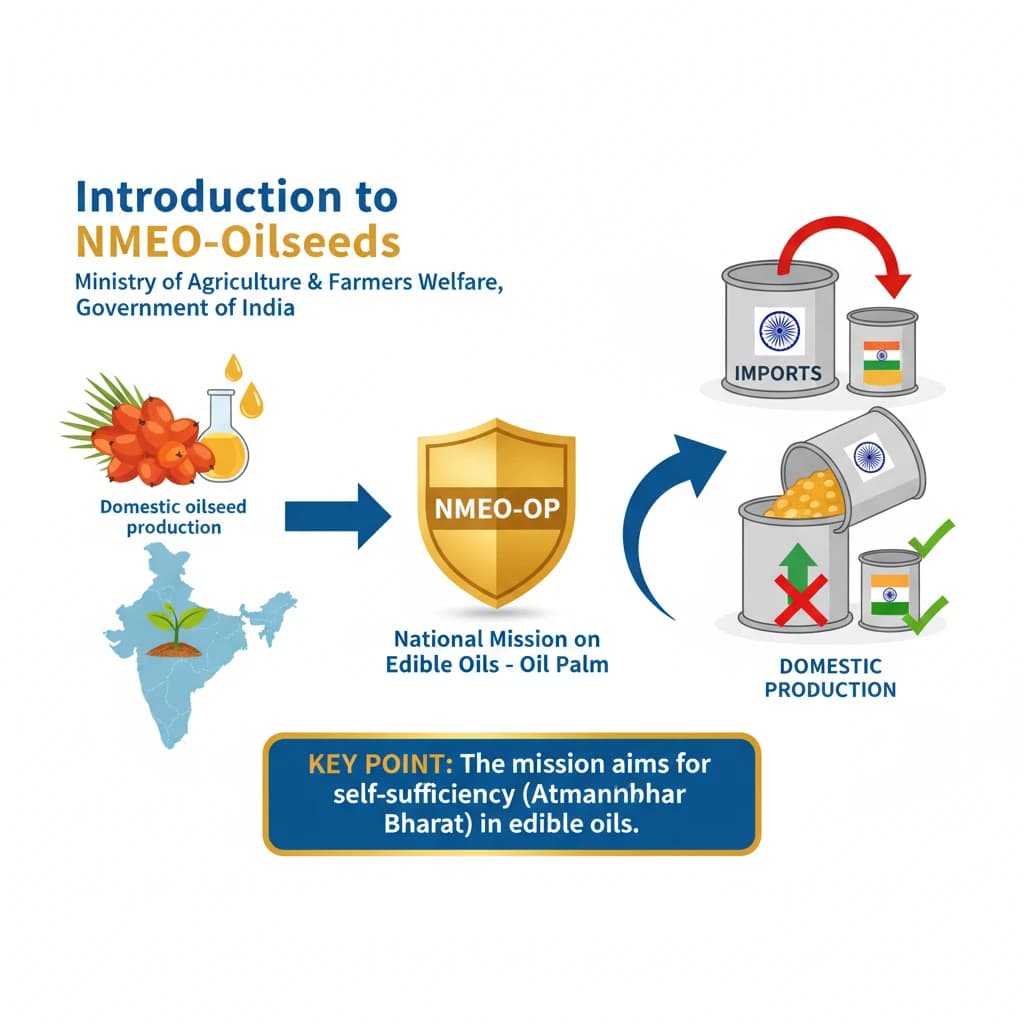
<h4>Introduction to NMEO-Oilseeds</h4><p>The <strong>National Mission on Edible Oils - Oil Palm (NMEO-OP)</strong> is a key initiative launched by the <strong>Ministry of Agriculture & Farmers Welfare</strong>. Its primary objective is to significantly enhance <strong>domestic oilseed production</strong>.</p><p>This strategic focus aims to reduce India's substantial dependency on <strong>edible oil imports</strong>, a long-standing economic challenge.</p><div class="key-point-box">The mission aligns with the broader national goal of <strong>Atmanirbhar Oilseeds</strong>, promoting self-reliance in the crucial edible oil sector.</div><p><strong>NMEO-Oilseeds</strong> specifically targets boosting both <strong>primary oilseed production</strong> (from traditional oilseed crops) and <strong>secondary oilseed production</strong> (from sources like cotton seeds, rice bran, etc.) across the country.</p><h4>Concerns Regarding Edible Oil Imports</h4><p>The <strong>Solvent Extractors' Association of India (SEA)</strong> has raised significant concerns regarding the rising trend of <strong>refined edible oil imports</strong>, particularly from <strong>Nepal</strong>.</p><p>This situation emerged after <strong>India increased import duties on edible oils in 2024</strong>, intended to protect domestic producers and reduce imports.</p><div class="info-box"><strong>Mechanism of Concern:</strong> Nepalese refiners import large quantities of <strong>crude oil</strong> and then export it onward to India at lower prices. This is facilitated through the <strong>South Asian Free Trade Area (SAFTA)</strong> agreement, which allows for duty-free trade.</div><p>This practice severely impacts <strong>Indian refiners</strong> and <strong>domestic oilseed farmers</strong>, undermining the effectiveness of India's import duty hike.</p><h4>SEA Recommendations for Import Policy</h4><p>To address these challenges and protect domestic interests, the <strong>SEA</strong> has put forth several crucial recommendations for India's import policy:</p><ul><li><strong>Restrict Duty-Free Imports:</strong> India should restrict <strong>duty-free edible oil imports</strong> from <strong>SAFTA nations</strong> that do not possess significant domestic oilseed production capabilities.</li><li><strong>Amend SAFTA:</strong> There is a strong recommendation to <strong>amend the SAFTA agreement</strong> itself. The goal is to prevent the <strong>dumping of agro-commodities</strong>, which distorts domestic markets.</li><li><strong>Introduce Minimum Import Price (MIP):</strong> Implement a <strong>Minimum Import Price (MIP)</strong> for edible oils. This MIP should be based on the <strong>Minimum Support Price (MSP)</strong> of domestic oilseeds.</li></ul><div class="exam-tip-box"><strong>UPSC Insight:</strong> Understanding the interplay between domestic agricultural policies (like NMEO-Oilseeds, MSP, import duties) and international trade agreements (SAFTA) is crucial for questions on economy, agriculture, and international relations.</div><p>The introduction of an <strong>MIP</strong> is designed to protect <strong>Indian farmers</strong> from <strong>predatory import pricing</strong>, ensuring fair competition and stable incomes in the domestic market.</p>
Concept Diagram

💡 Key Takeaways

  • •NMEO-Oilseeds is a mission to boost domestic oilseed production.
  • •Its primary goal is to reduce India's heavy reliance on edible oil imports.
  • •The mission aligns with the national objective of Atmanirbhar Oilseeds.
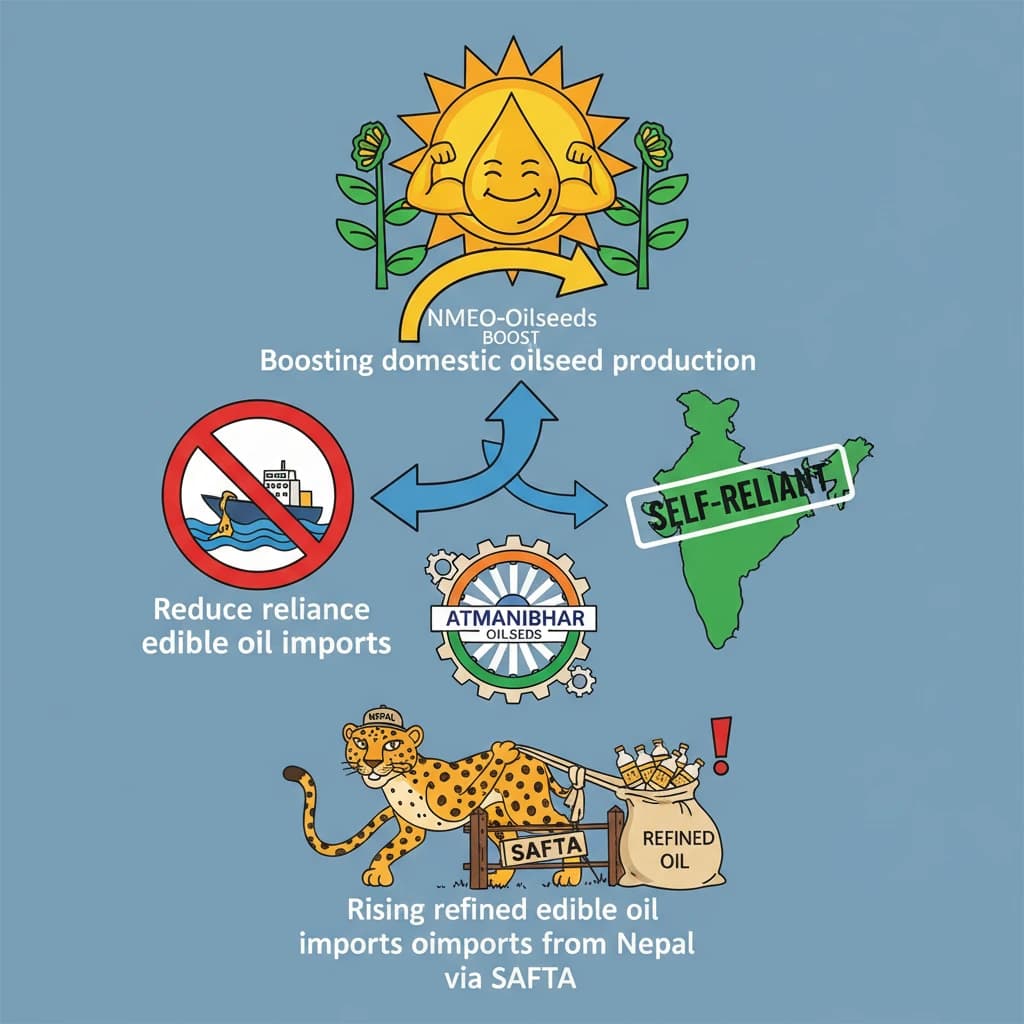
  • •Rising refined edible oil imports from Nepal via SAFTA pose a significant concern.
  • •The Solvent Extractors' Association (SEA) recommends restricting duty-free imports.
  • •SEA also suggests amending SAFTA to prevent agro-commodity dumping.
  • •Introducing a Minimum Import Price (MIP) linked to MSP is proposed to protect farmers.

🧠 Memory Techniques
Memory Aid
95% Verified Content

Related Topics

Loading related topics...
Explore:Agriculture Allied Sector Topics·All Subjects·Daily Current Affairs·Editorial Analysis·Previous Year Questions·UPSC GPT
About NMEO-Oilseeds - UPSC Agriculture Allied Sector