Loading page, please wait…
Vaidra Logo
Vaidra

Top 4 items + smart groups

UPSC GPT
New
Current Affairs
Daily Solutions
Daily Puzzle
Mains Evaluator

Version 2.0.0 • Built with ❤️ for UPSC aspirants

Loading...
Loading...
Loading...
Loading...
Loading...
Loading...
Loading...
Loading...
Loading...
Loading...
Loading...
Loading...
Loading...
Back
All Subjects

Topics

0 topics • 0 completed

Loading topics...
Loading...
Loading...
Loading...
Loading...
Loading...
Overall Progress0%

Lentil Production India - UPSC Agriculture Allied Sector

What is Lentil Production India in UPSC Agriculture Allied Sector?

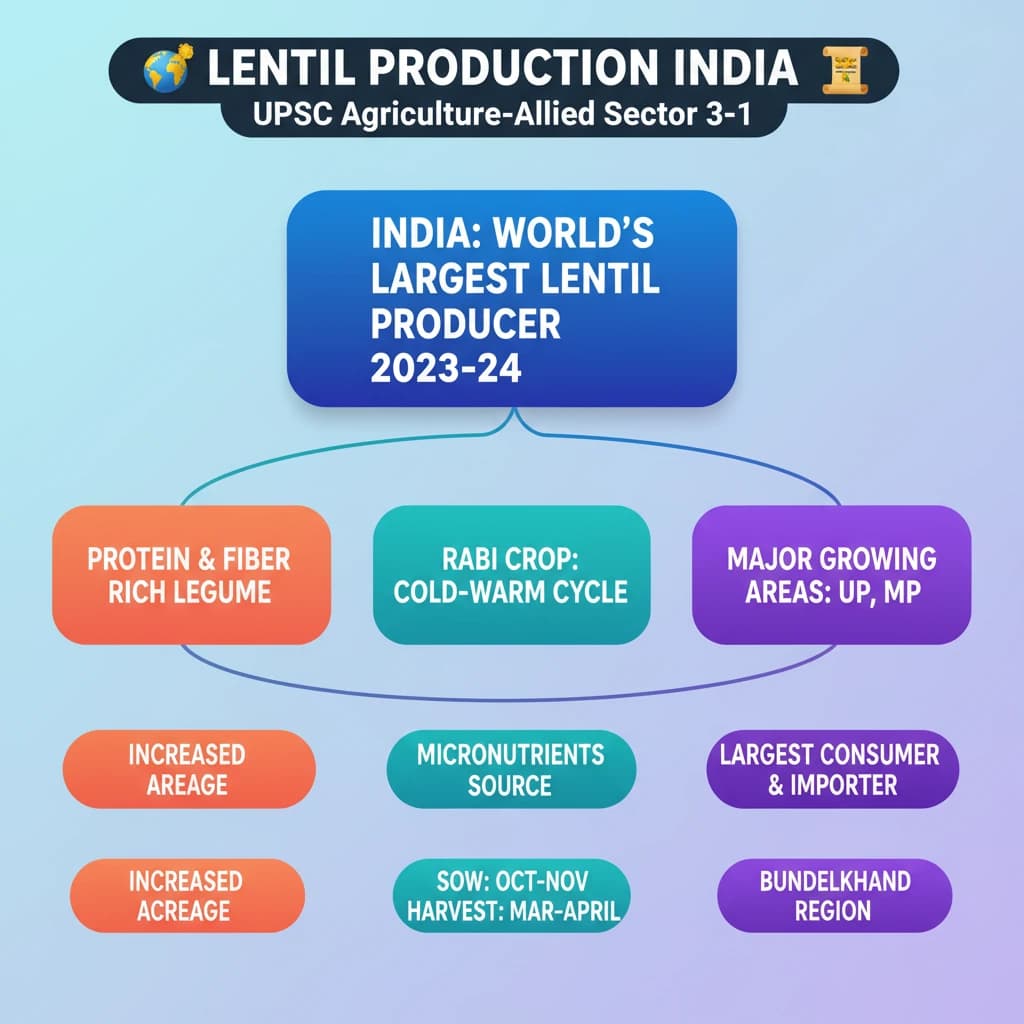
Lentil Production India is a key topic under Agriculture Allied Sector for UPSC Civil Services Examination. Key points include: India is projected to be the world's largest lentil producer in 2023-24 due to higher acreage.. Lentils are a bushy annual herbaceous legume, rich in protein, fiber, and micronutrients.. They are a rabi crop requiring cold temperatures for growth and warm temperatures for maturity.. Understanding this topic is essential for both UPSC Prelims and Mains preparation.

Why is Lentil Production India important for UPSC exam?

Lentil Production India is a Medium-level topic in UPSC Agriculture Allied Sector. It is tested in both Prelims (factual MCQs) and Mains (analytical answer writing). Previous year UPSC questions have frequently covered aspects of Lentil Production India, making it essential for comprehensive IAS preparation.

How to prepare Lentil Production India for UPSC?

To prepare Lentil Production India for UPSC: (1) Study the comprehensive notes covering all key concepts on Vaidra. (2) Practice previous year questions on this topic. (3) Connect it with current affairs using daily updates. (4) Revise using key takeaways and mind maps available for Agriculture Allied Sector. (5) Write practice answers linking Lentil Production India to related GS Paper topics.

Key takeaways of Lentil Production India for UPSC

  • India is projected to be the world's largest lentil producer in 2023-24 due to higher acreage.
  • Lentils are a bushy annual herbaceous legume, rich in protein, fiber, and micronutrients.
  • They are a rabi crop requiring cold temperatures for growth and warm temperatures for maturity.
  • Uttar Pradesh and Madhya Pradesh, especially the Bundelkhand region, are major lentil-growing areas.
  • India is the largest producer, consumer, and importer of pulses globally.
  • Pulses contribute significantly to India's foodgrain area and production, with Gram being the dominant variety.
Lentil Production India

Lentil Production India

Medium⏱️ 8 min read✓ 98% Verified
agriculture allied sector

📖 Introduction

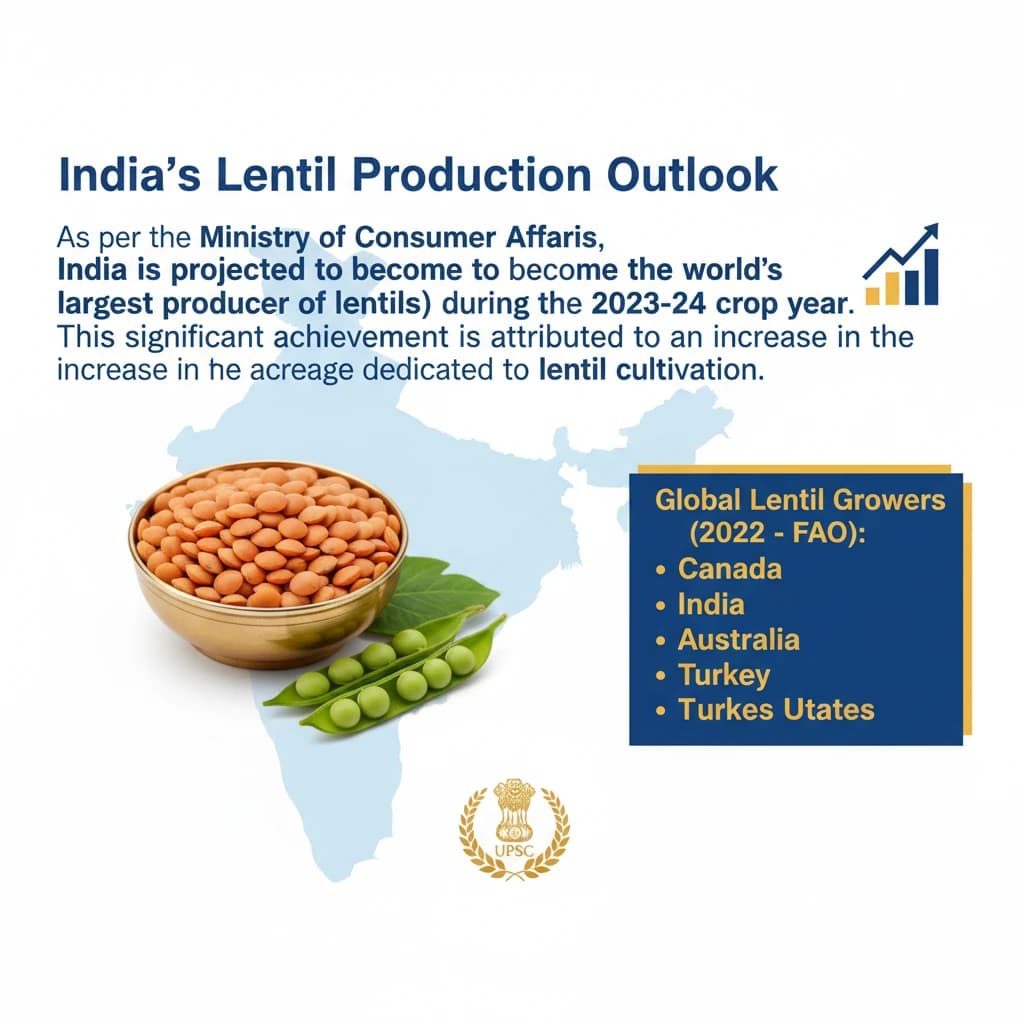
<h4>India's Lentil Production Outlook</h4><p>As per the <strong>Ministry of Consumer Affairs</strong>, India is projected to become the <strong>world's largest producer of lentils (masoor)</strong> during the <strong>2023-24 crop year</strong>. This significant achievement is attributed to an increase in the acreage dedicated to lentil cultivation.</p><div class="info-box"><strong>Global Lentil Growers (2022 - FAO):</strong><ul><li><strong>Canada</strong></li><li><strong>India</strong></li><li><strong>Australia</strong></li><li><strong>Turkey</strong></li><li><strong>Russia</strong></li></ul></div><h4>About Lentils: Characteristics</h4><p>Lentil is a <strong>bushy annual herbaceous plant</strong> belonging to the <strong>legume family</strong>. These plants are typically short in stature and bear <strong>self-pollinated flowers</strong>.</p><div class="info-box"><strong>Nutritional Profile of Lentils:</strong>Excellent sources of:<ul><li><strong>Energy</strong></li><li><strong>Carbohydrates</strong></li><li><strong>Protein</strong></li><li><strong>Fat</strong></li><li><strong>Fibers</strong></li><li><strong>Phosphorus</strong></li><li><strong>Iron</strong></li><li><strong>Zinc</strong></li><li><strong>Carotene</strong></li><li><strong>Vitamins</strong></li><li><strong>Antioxidants</strong></li></ul></div><h4>Lentil Cultivation Conditions</h4><p>Lentils are primarily grown as a <strong>rabi crop</strong> in India, typically cultivated as a <strong>rainfed crop</strong>. They require specific climatic conditions for optimal growth.</p><p>During its <strong>vegetative growth</strong> phase, lentils thrive in <strong>cold temperatures</strong>. However, at the time of <strong>maturity</strong>, they necessitate a <strong>warm temperature</strong> to complete their life cycle.</p><h4>Key Lentil Growing Regions</h4><p>Lentil cultivation is concentrated in several states across India. These regions provide the suitable climatic and soil conditions for the crop.</p><ul><li><strong>Uttar Pradesh</strong></li><li><strong>Madhya Pradesh</strong></li><li><strong>Bihar</strong></li><li><strong>West Bengal</strong></li><li><strong>Chhattisgarh</strong></li><li><strong>Jharkhand</strong></li></ul><p>The <strong>Bundelkhand region</strong>, spanning parts of <strong>Uttar Pradesh</strong> and <strong>Madhya Pradesh</strong>, is notably considered a <strong>'lentil bowl'</strong>. This region alone contributes nearly <strong>25%</strong> to the total lentil production in India.</p><h4>Status of Pulse Production in India</h4><p>India holds a pre-eminent position in the global pulse market. It is the <strong>largest producer</strong>, <strong>largest consumer</strong>, and a significant <strong>importer</strong> of pulses worldwide.</p><div class="key-point-box"><strong>India's Global Share in Pulses:</strong><ul><li><strong>Production:</strong> 25% of global production</li><li><strong>Consumption:</strong> 27% of world consumption</li><li><strong>Import:</strong> 14% of global imports</li></ul></div><p>Pulses collectively account for approximately <strong>20% of the total area under food grains</strong> in the country. They contribute around <strong>7-10%</strong> to the total foodgrain production.</p><h4>Dominant Pulse Varieties in India</h4><p>Among various pulse varieties, <strong>Gram</strong> is the most dominant, accounting for around <strong>40%</strong> of the total pulse production. Other significant pulses follow in contribution.</p><ul><li><strong>Tur/Arhar:</strong> 15 to 20%</li><li><strong>Urad/Black Matpe:</strong> 8-10%</li><li><strong>Moong:</strong> 8-10%</li></ul>
Concept Diagram

💡 Key Takeaways

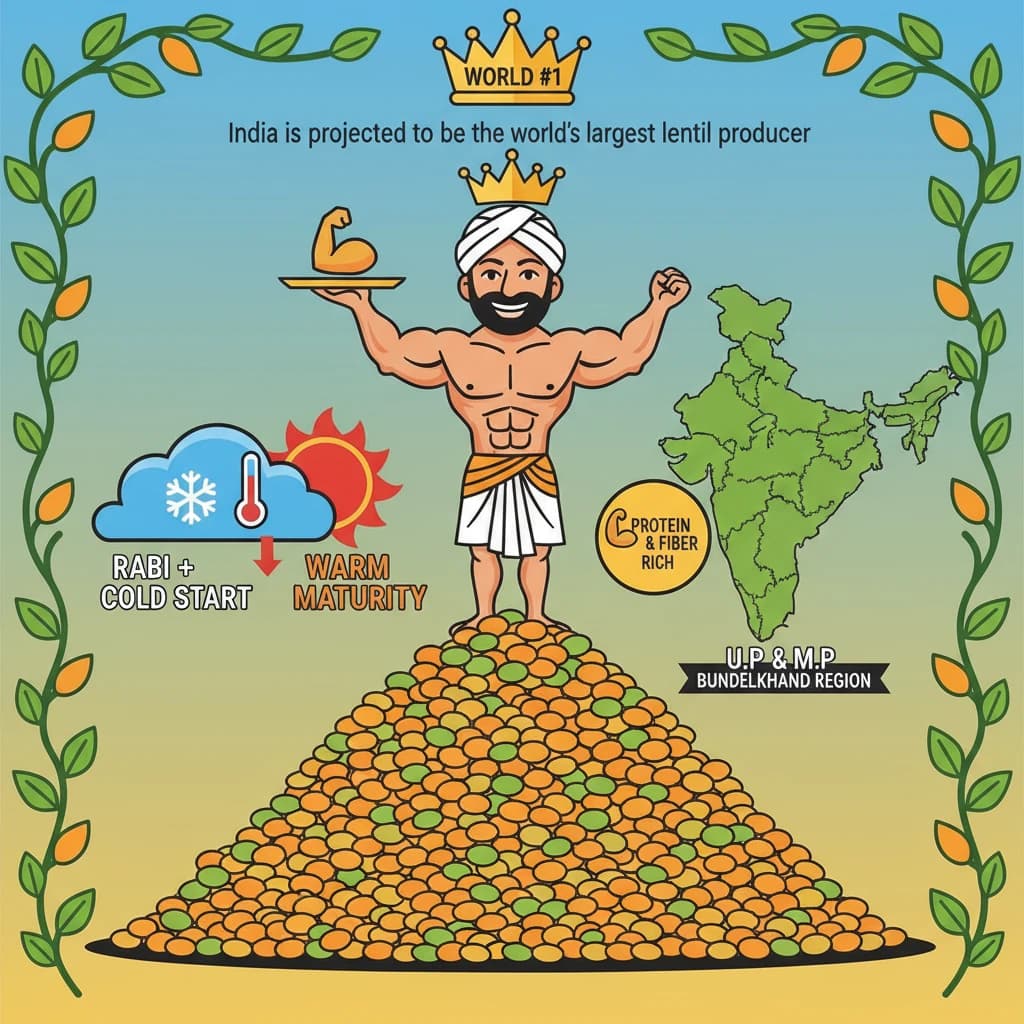
  • •India is projected to be the world's largest lentil producer in 2023-24 due to higher acreage.
  • •Lentils are a bushy annual herbaceous legume, rich in protein, fiber, and micronutrients.
  • •They are a rabi crop requiring cold temperatures for growth and warm temperatures for maturity.
  • •Uttar Pradesh and Madhya Pradesh, especially the Bundelkhand region, are major lentil-growing areas.
  • •India is the largest producer, consumer, and importer of pulses globally.
  • •Pulses contribute significantly to India's foodgrain area and production, with Gram being the dominant variety.

🧠 Memory Techniques
Memory Aid
98% Verified Content

📚 Reference Sources

•Food and Agriculture Organization (FAO)
•Drishti IAS Summary on Lentil Production India

Related Topics

Loading related topics...
Explore:Agriculture Allied Sector Topics·All Subjects·Daily Current Affairs·Editorial Analysis·Previous Year Questions·UPSC GPT
Lentil Production India - UPSC Agriculture Allied Sector