Loading page, please wait…
Vaidra Logo
Vaidra

Top 4 items + smart groups

UPSC GPT
New
Current Affairs
Daily Solutions
Daily Puzzle
Mains Evaluator

Version 2.0.0 • Built with ❤️ for UPSC aspirants

Loading...
Loading...
Loading...
Loading...
Loading...
Loading...
Loading...
Loading...
Loading...
Loading...
Loading...
Loading...
Loading...
Back
All Subjects

Topics

0 topics • 0 completed

Loading topics...
Loading...
Loading...
Loading...
Loading...
Loading...
Overall Progress0%

Agriculture Development in India - UPSC Agriculture Allied Sector

What is Agriculture Development in India in UPSC Agriculture Allied Sector?

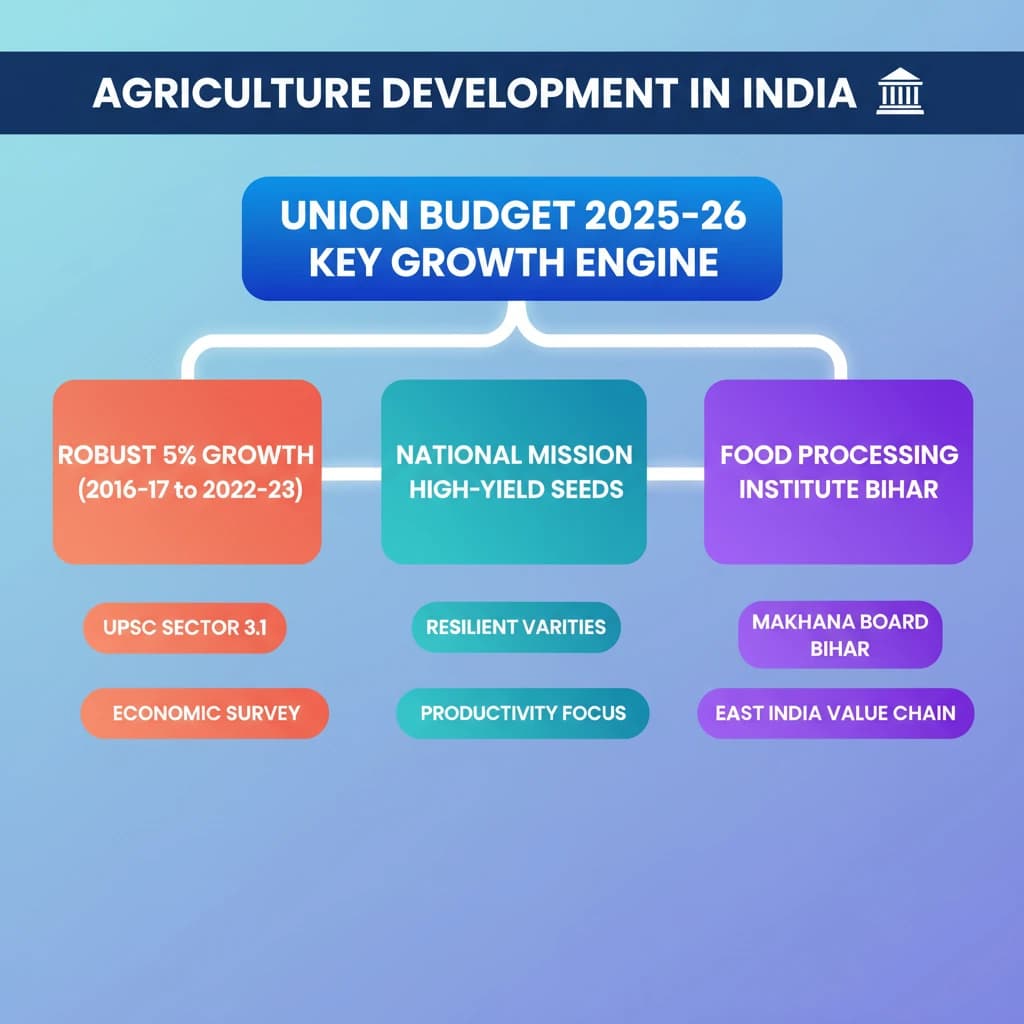
Agriculture Development in India is a key topic under Agriculture Allied Sector for UPSC Civil Services Examination. Key points include: Union Budget 2025-26 prioritizes agriculture as a key growth engine.. Agriculture sector showed robust 5% annual growth from 2016-17 to 2022-23.. National Mission on High-Yielding Seeds aims for resilient, productive varieties.. Understanding this topic is essential for both UPSC Prelims and Mains preparation.

Why is Agriculture Development in India important for UPSC exam?

Agriculture Development in India is a Medium-level topic in UPSC Agriculture Allied Sector. It is tested in both Prelims (factual MCQs) and Mains (analytical answer writing). Previous year UPSC questions have frequently covered aspects of Agriculture Development in India, making it essential for comprehensive IAS preparation.

How to prepare Agriculture Development in India for UPSC?

To prepare Agriculture Development in India for UPSC: (1) Study the comprehensive notes covering all key concepts on Vaidra. (2) Practice previous year questions on this topic. (3) Connect it with current affairs using daily updates. (4) Revise using key takeaways and mind maps available for Agriculture Allied Sector. (5) Write practice answers linking Agriculture Development in India to related GS Paper topics.

Key takeaways of Agriculture Development in India for UPSC

  • Union Budget 2025-26 prioritizes agriculture as a key growth engine.
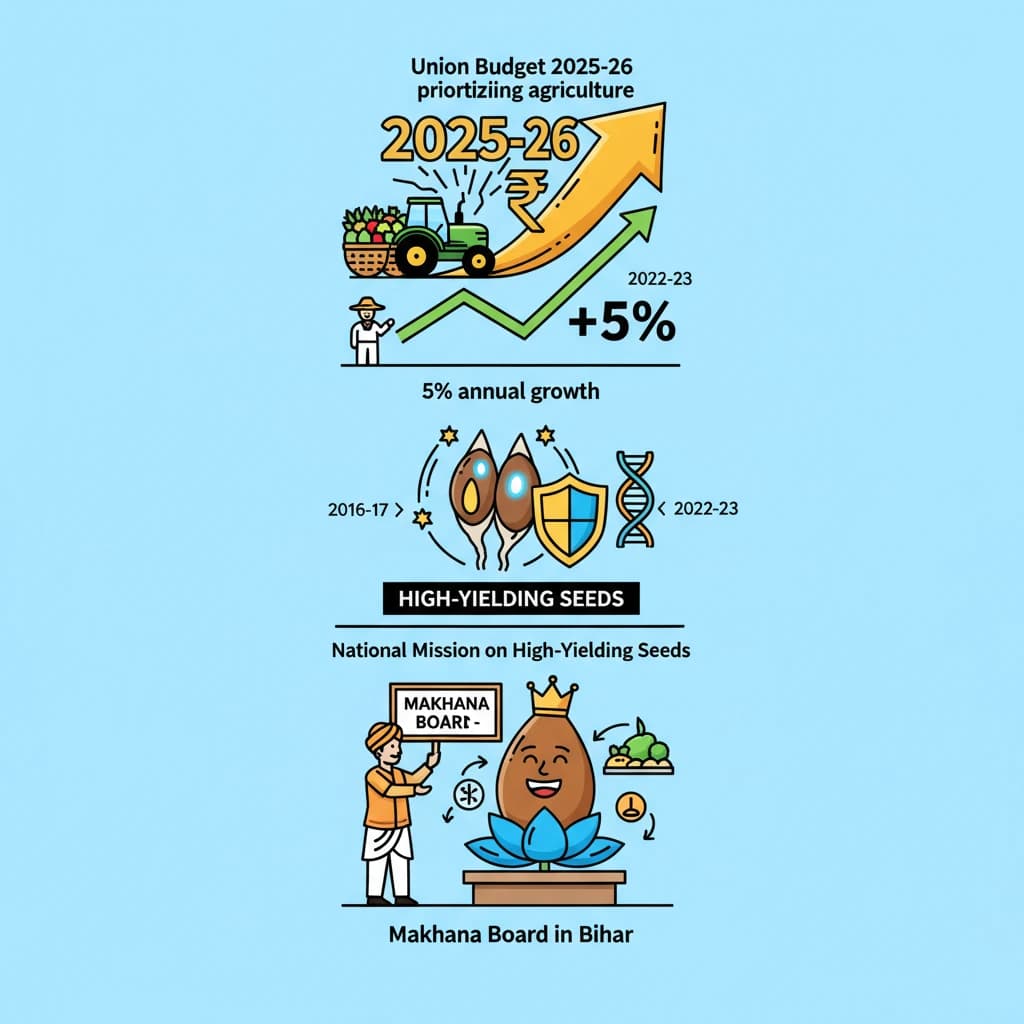
  • Agriculture sector showed robust 5% annual growth from 2016-17 to 2022-23.
  • National Mission on High-Yielding Seeds aims for resilient, productive varieties.
  • Makhana Board in Bihar targets boosting production and marketing of fox nuts.
  • New food processing institute in Bihar will promote eastern India's agricultural value chain.
  • A second Gene Bank with 10 lakh germplasm lines is vital for future food security.
  • Concerns exist regarding monocultures and loss of crop diversity with high-yielding seeds.
Agriculture Development in India

Agriculture Development in India

Medium⏱️ 8 min read✓ 95% Verified
agriculture allied sector

📖 Introduction

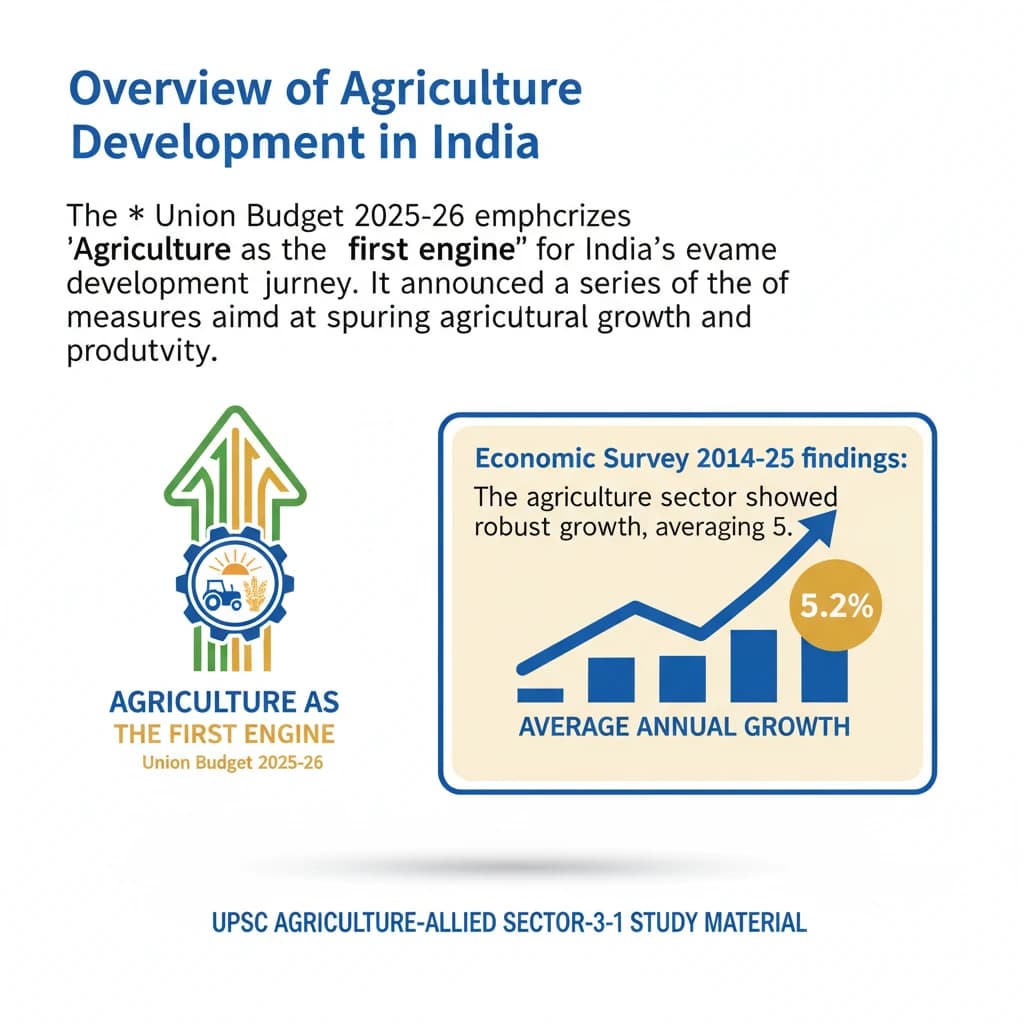
<h4>Overview of Agriculture Development in India</h4><p>The <strong>Union Budget 2025-26</strong> emphasizes <strong>'Agriculture as the first engine'</strong> for India's development journey.</p><p>It announced a series of measures aimed at spurring <strong>agricultural growth</strong> and <strong>productivity</strong>.</p><div class="info-box"><strong>Economic Survey 2024-25</strong> findings:<br>The <strong>agriculture sector</strong> showed <strong>robust growth</strong>, averaging <strong>5% annually</strong> from <strong>2016-17 to 2022-23</strong>.</div><div class="exam-tip-box">While promoting growth, initiatives like the <strong>National Mission on High-Yielding Seeds</strong> raise concerns regarding potential <strong>monocultures</strong> and the loss of <strong>crop diversity</strong>, a crucial point for UPSC mains answers on sustainability.</div><h4>Key Agricultural Initiatives from Union Budget 2025-26</h4><p>The <strong>Union Budget 2025-26</strong> introduced several key initiatives to boost the agriculture sector:</p><ul><li><strong>National Mission on High Yielding Seeds</strong></li><li>Establishment of a <strong>Makhana Board in Bihar</strong></li><li>Promotion of <strong>Food Processing</strong> with a new institute</li><li>Setting up of a <strong>second Gene Bank</strong></li></ul><h4>National Mission on High Yielding Seeds</h4><p>This mission aims to significantly improve <strong>agricultural productivity</strong> across India.</p><p>Its primary goal is to develop and disseminate <strong>high-yielding seeds</strong> that are more resilient to various environmental and biological stressors.</p><div class="key-point-box"><strong>Core Objectives:</strong><ul><li>Develop new <strong>seed varieties</strong> with enhanced productivity and resistance.</li><li>Create seeds specifically resilient to <strong>pests</strong> and <strong>climate stress</strong>.</li><li>Ensure easy and widespread access to these <strong>high-yielding seeds</strong> for farmers.</li></ul></div><div class="info-box"><strong>Target:</strong> Increase the availability of over <strong>100 new seed varieties</strong>, including <strong>23 cereals</strong>, <strong>11 pulses</strong>, and <strong>7 oilseeds</strong>.</div><h4>Makhana Board in Bihar</h4><p>A dedicated <strong>Makhana Board</strong> will be established in <strong>Bihar</strong>, a key region for <strong>Makhana</strong> (fox nut) production.</p><p>The board's mandate is to provide comprehensive support to <strong>Makhana farmers</strong>.</p><div class="key-point-box"><strong>Functions of the Makhana Board:</strong><ul><li>Boost <strong>Makhana production</strong>.</li><li>Enhance <strong>processing capabilities</strong>.</li><li>Strengthen <strong>marketing channels</strong>.</li><li>Support farmers through <strong>Farmer Producer Organizations (FPOs)</strong> and existing <strong>government schemes</strong>.</li></ul></div><h4>Food Processing Initiatives</h4><p>The union government is committed to promoting <strong>food processing activities</strong>, particularly in <strong>Eastern India</strong>.</p><p>This is expected to add value to agricultural produce, reduce wastage, and create employment.</p><div class="info-box"><strong>Key Establishment:</strong> A <strong>National Institute of Food Technology, Entrepreneurship and Management (NIFTEM)</strong> will be established in <strong>Bihar</strong>.</div><h4>Gene Bank for Future Security</h4><p>A significant step towards long-term <strong>food and nutritional security</strong> is the establishment of a <strong>second Gene Bank</strong>.</p><p>This new facility will complement the existing infrastructure for preserving genetic resources.</p><div class="info-box"><strong>Details:</strong><ul><li>This will be India's <strong>second Gene Bank</strong> (the <strong>first</strong> was established in <strong>1996</strong>).</li><li>It will store <strong>10 lakh germplasm lines</strong>.</li></ul></div><div class="key-point-box"><strong>Definition of a Gene Bank:</strong> A facility designed to store and preserve <strong>genetic material</strong> from plants, animals, or microorganisms for future use, crucial for biodiversity and crop improvement.</div>
Concept Diagram

💡 Key Takeaways

  • •Union Budget 2025-26 prioritizes agriculture as a key growth engine.
  • •Agriculture sector showed robust 5% annual growth from 2016-17 to 2022-23.
  • •National Mission on High-Yielding Seeds aims for resilient, productive varieties.
  • •Makhana Board in Bihar targets boosting production and marketing of fox nuts.
  • •New food processing institute in Bihar will promote eastern India's agricultural value chain.
  • •A second Gene Bank with 10 lakh germplasm lines is vital for future food security.
  • •Concerns exist regarding monocultures and loss of crop diversity with high-yielding seeds.

🧠 Memory Techniques
Memory Aid
95% Verified Content

Related Topics

Loading related topics...
Explore:Agriculture Allied Sector Topics·All Subjects·Daily Current Affairs·Editorial Analysis·Previous Year Questions·UPSC GPT
Agriculture Development in India - UPSC Agriculture Allied Sector