Loading page, please wait…
Agro-Economy: MSP, Subsidies, Agri-Marketing - UPSC Agriculture Allied Sector
What is Agro-Economy: MSP, Subsidies, Agri-Marketing in UPSC Agriculture Allied Sector?
Agro-Economy: MSP, Subsidies, Agri-Marketing is a key topic under Agriculture Allied Sector for UPSC Civil Services Examination. Key points include: Government measures aim to support Indian farmers through financial and technological interventions.. PMFBY and RWBCIS crop insurance schemes are extended until 2025-26 to protect farmers.. DAP fertilizer subsidy ensures affordability for farmers despite global market volatility.. Understanding this topic is essential for both UPSC Prelims and Mains preparation.
Why is Agro-Economy: MSP, Subsidies, Agri-Marketing important for UPSC exam?
Agro-Economy: MSP, Subsidies, Agri-Marketing is a Medium-level topic in UPSC Agriculture Allied Sector. It is tested in both Prelims (factual MCQs) and Mains (analytical answer writing). Previous year UPSC questions have frequently covered aspects of Agro-Economy: MSP, Subsidies, Agri-Marketing, making it essential for comprehensive IAS preparation.
How to prepare Agro-Economy: MSP, Subsidies, Agri-Marketing for UPSC?
To prepare Agro-Economy: MSP, Subsidies, Agri-Marketing for UPSC: (1) Study the comprehensive notes covering all key concepts on Vaidra. (2) Practice previous year questions on this topic. (3) Connect it with current affairs using daily updates. (4) Revise using key takeaways and mind maps available for Agriculture Allied Sector. (5) Write practice answers linking Agro-Economy: MSP, Subsidies, Agri-Marketing to related GS Paper topics.
Key takeaways of Agro-Economy: MSP, Subsidies, Agri-Marketing for UPSC
- Government measures aim to support Indian farmers through financial and technological interventions.
- PMFBY and RWBCIS crop insurance schemes are extended until 2025-26 to protect farmers.
- DAP fertilizer subsidy ensures affordability for farmers despite global market volatility.
- FIAT funds YES-TECH and WINDS for transparent yield estimation and hyper-local weather data.
- MSP, established in 1965 by APC (now CACP), guarantees minimum prices to protect farmers.
- The demand for MSP legalization remains a significant debate in agricultural policy.
- CCEA, chaired by the PM, is crucial for economic policy and investment decisions.
Agro-Economy: MSP, Subsidies, Agri-Marketing
Medium⏱️ 10 min read
agriculture allied sector
📖 Introduction
Recent Government Measures for Farmers
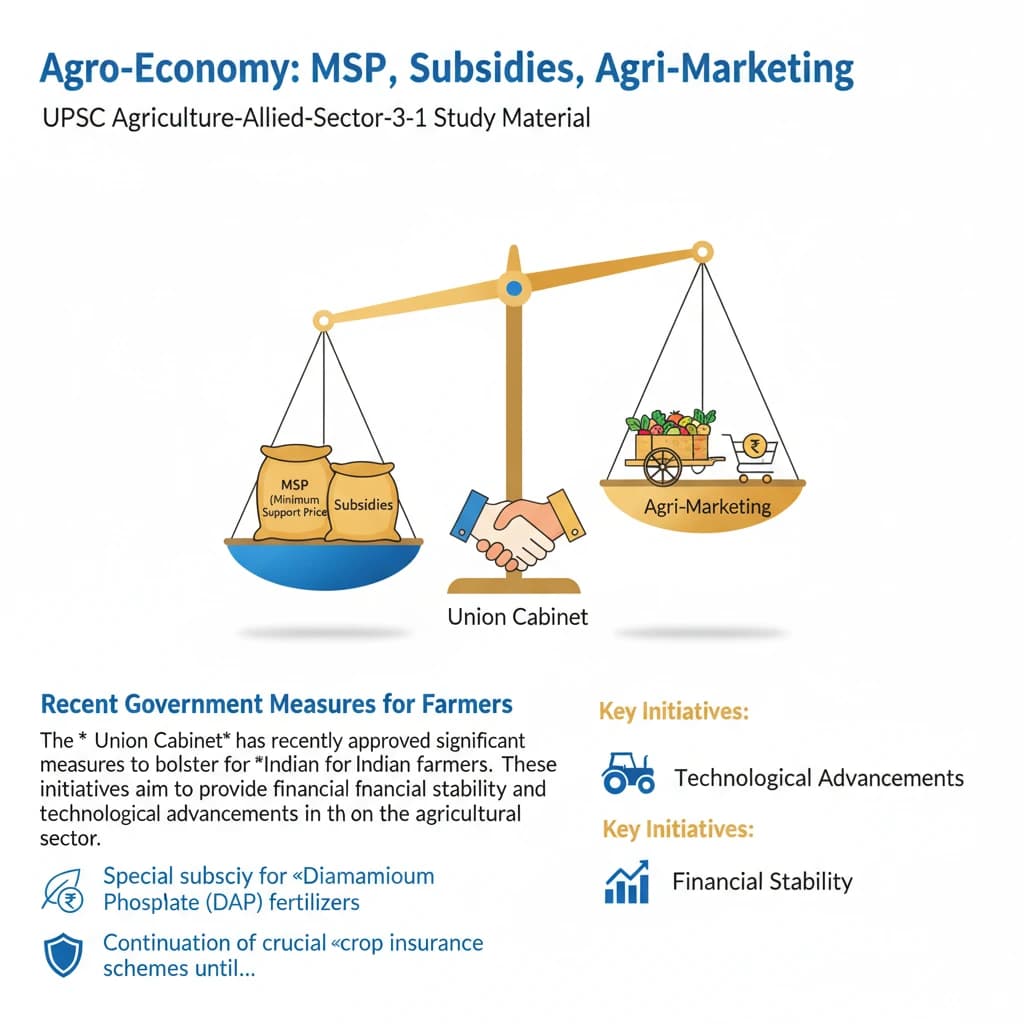
The Union Cabinet has recently approved significant measures to bolster support for Indian farmers. These initiatives aim to provide financial stability and technological advancements in the agricultural sector.
Key among these are the extension of a special subsidy for Diammonium Phosphate (DAP) fertilizers and the continuation of crucial crop insurance schemes until 2025-26.
Continuation of Crop Insurance Schemes
The Union Cabinet has given its approval for the continuation of two major crop insurance schemes:
- Pradhan Mantri Fasal Bima Yojana (PMFBY)
- Restructured Weather Based Crop Insurance Scheme (RWBCIS)
Both schemes will continue to operate until the financial year 2025-26, ensuring ongoing protection for farmers against crop losses.
DAP Fertilizer Subsidy Extension
A significant measure includes extending the one-time special package on DAP. This extension goes beyond the existing Nutrient Based Subsidy, effective from January 1, 2025, until further orders.
This extension is critical for ensuring that DAP fertilizers remain affordable for farmers during both the Kharif and Rabi 2024-25 seasons, mitigating the impact of global market volatility.
Fund for Innovation and Technology (FIAT)
The government has also approved the creation of the Fund for Innovation and Technology (FIAT). This fund has a substantial corpus of Rs 824.77 crore.
FIAT is designed to finance technological initiatives under specific schemes, namely YES-TECH and WINDS. The overarching goal is to enhance transparency and improve the accuracy and speed of claim calculation and settlement processes.
Yield Estimation System using Technology (YES-TECH)
YES-TECH is a technological initiative under FIAT that leverages remote sensing technology for precise yield estimation. This system ensures greater accuracy in assessing crop output.
Key Feature: YES-TECH mandates a minimum of 30% weightage to technology-based yield estimates, integrating modern methods into traditional assessment.
Weather Information and Network Data Systems (WINDS)
Another crucial initiative supported by FIAT is WINDS. This system aims to significantly enhance weather data collection and dissemination across rural areas.
- Automatic Weather Stations: To be installed at the block level.
- Rain Gauges: To be installed at the panchayat level.
The objective of WINDS is to increase network density fivefold, providing hyper-local weather data crucial for agricultural planning and risk management.
Pradhan Mantri Fasal Bima Yojana (PMFBY) Explained
The Pradhan Mantri Fasal Bima Yojana (PMFBY) is a flagship crop insurance scheme designed to safeguard farmers from financial losses.
It provides comprehensive protection against unforeseen crop failures caused by various factors like rainfall, temperature fluctuations, frost, and humidity.
Aim: A central sector scheme offering comprehensive crop insurance from the pre-sowing to post-harvest period.
PMFBY Coverage and Eligibility
PMFBY extends its coverage to a wide range of agricultural produce:
- Food Crops: Cereals, millets, and pulses.
- Oilseeds
- Annual Commercial/Annual Horticultural Crops
All farmers, including sharecroppers and tenant farmers, are eligible for coverage, provided they are cultivating notified crops in designated notified areas.
PMFBY Premium Structure
The scheme features a farmer-friendly premium structure, with the remaining premium being subsidized by the government:
- Kharif Crops: Farmers pay a premium of 2%.
- Rabi Crops: Farmers pay a premium of 1.5%.
- Commercial/Horticulture Crops: Farmers pay a premium of 5%.
Minimum Support Price (MSP) and its Legalization Debate
The Cabinet Committee on Economic Affairs (CCEA) recently increased the Minimum Support Price (MSP) for six Rabi crops. These crops include wheat, barley, gram, lentil, rapeseed, mustard, and safflower.
This increase has reignited the long-standing debate among farmers regarding the demand for the legalization of MSP and its potential implications for the broader agricultural ecosystem in India.
Cabinet Committee on Economic Affairs (CCEA)
The CCEA is a high-level government body that plays a crucial role in India's economic policy formulation.
Chaired by: The Prime Minister.
Primary Role: Sets priorities for public sector investments and continuously reviews economic trends.
Primary Role: Sets priorities for public sector investments and continuously reviews economic trends.
The committee develops an integrated economic policy framework and oversees policies and activities in the economic field, particularly those requiring high-level decisions, including foreign investment.
What is Minimum Support Price (MSP)?
The MSP regime was initially established in 1965 as a critical market intervention mechanism by the Indian government.
Its primary objectives are to enhance national food security and to protect farmers from significant declines in market prices for their produce.
Origin: Established in 1965 with the setting up of the Agricultural Prices Commission (APC), later renamed the Commission for Agricultural Costs and Prices (CACP).
MSP Calculation Methodology
The Commission for Agricultural Costs and Prices (CACP) is responsible for calculating the MSP for various crops.
The CACP determines three distinct categories of production costs for each crop. These calculations are performed both at the individual state level and as all-India averages to ensure comprehensive and equitable pricing recommendations.
💡 Key Takeaways
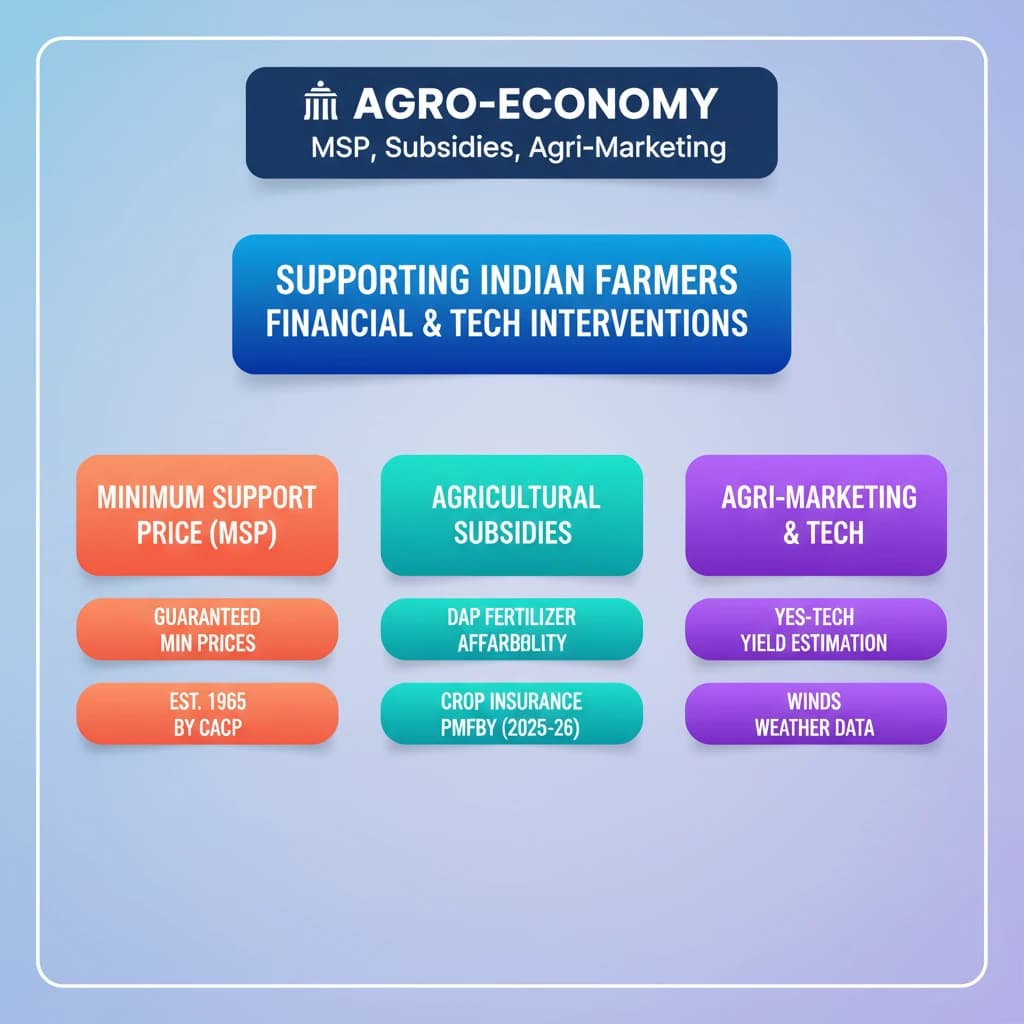
- •Government measures aim to support Indian farmers through financial and technological interventions.
- •PMFBY and RWBCIS crop insurance schemes are extended until 2025-26 to protect farmers.
- •DAP fertilizer subsidy ensures affordability for farmers despite global market volatility.
- •FIAT funds YES-TECH and WINDS for transparent yield estimation and hyper-local weather data.
- •MSP, established in 1965 by APC (now CACP), guarantees minimum prices to protect farmers.
- •The demand for MSP legalization remains a significant debate in agricultural policy.
- •CCEA, chaired by the PM, is crucial for economic policy and investment decisions.
🧠 Memory Techniques
98% Verified Content