Loading page, please wait…
Vaidra Logo
Vaidra

Top 4 items + smart groups

UPSC GPT
New
Current Affairs
Daily Solutions
Daily Puzzle
Mains Evaluator

Version 2.0.0 • Built with ❤️ for UPSC aspirants

Loading...
Loading...
Loading...
Loading...
Loading...
Loading...
Loading...
Loading...
Loading...
Loading...
Loading...
Loading...
Loading...
NITI Aayog’s Strategies for Growth in Edible Oils - UPSC Agriculture Allied Sector
Back
All Subjects

Topics

0 topics • 0 completed

Loading topics...
Loading...
Loading...
Loading...
Loading...
Loading...
Overall Progress0%

NITI Aayog’s Strategies for Growth in Edible Oils - UPSC Agriculture Allied Sector

What is NITI Aayog’s Strategies for Growth in Edible Oils in UPSC Agriculture Allied Sector?

NITI Aayog’s Strategies for Growth in Edible Oils is a key topic under Agriculture Allied Sector for UPSC Civil Services Examination. Key points include: NITI Aayog's report outlines a roadmap for edible oil self-sufficiency.. The goal is to close the demand-supply gap and achieve Atmanirbharta.. India is a major importer of edible oils, leading to significant foreign exchange outflow.. Understanding this topic is essential for both UPSC Prelims and Mains preparation.

Why is NITI Aayog’s Strategies for Growth in Edible Oils important for UPSC exam?

NITI Aayog’s Strategies for Growth in Edible Oils is a Medium-level topic in UPSC Agriculture Allied Sector. It is tested in both Prelims (factual MCQs) and Mains (analytical answer writing). Previous year UPSC questions have frequently covered aspects of NITI Aayog’s Strategies for Growth in Edible Oils, making it essential for comprehensive IAS preparation.

How to prepare NITI Aayog’s Strategies for Growth in Edible Oils for UPSC?

To prepare NITI Aayog’s Strategies for Growth in Edible Oils for UPSC: (1) Study the comprehensive notes covering all key concepts on Vaidra. (2) Practice previous year questions on this topic. (3) Connect it with current affairs using daily updates. (4) Revise using key takeaways and mind maps available for Agriculture Allied Sector. (5) Write practice answers linking NITI Aayog’s Strategies for Growth in Edible Oils to related GS Paper topics.

Key takeaways of NITI Aayog’s Strategies for Growth in Edible Oils for UPSC

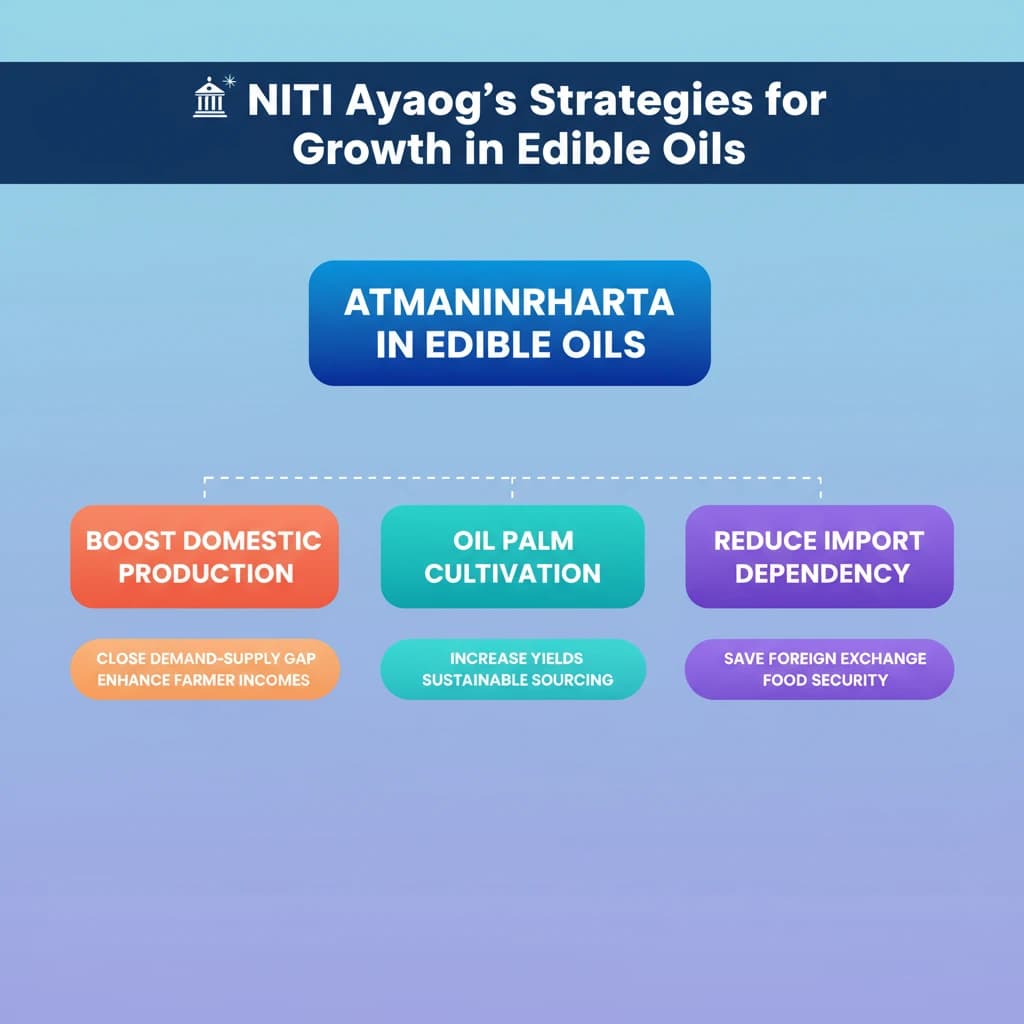
  • NITI Aayog's report outlines a roadmap for edible oil self-sufficiency.
  • The goal is to close the demand-supply gap and achieve Atmanirbharta.
  • India is a major importer of edible oils, leading to significant foreign exchange outflow.
  • Strategies involve boosting domestic oilseed production and oil palm cultivation.
  • Reducing import dependency enhances food security and farmer incomes.
  • The report aligns with the Atmanirbhar Bharat initiative.
NITI Aayog’s Strategies for Growth in Edible Oils

NITI Aayog’s Strategies for Growth in Edible Oils

Medium⏱️ 8 min read✓ 95% Verified
agriculture allied sector

📖 Introduction

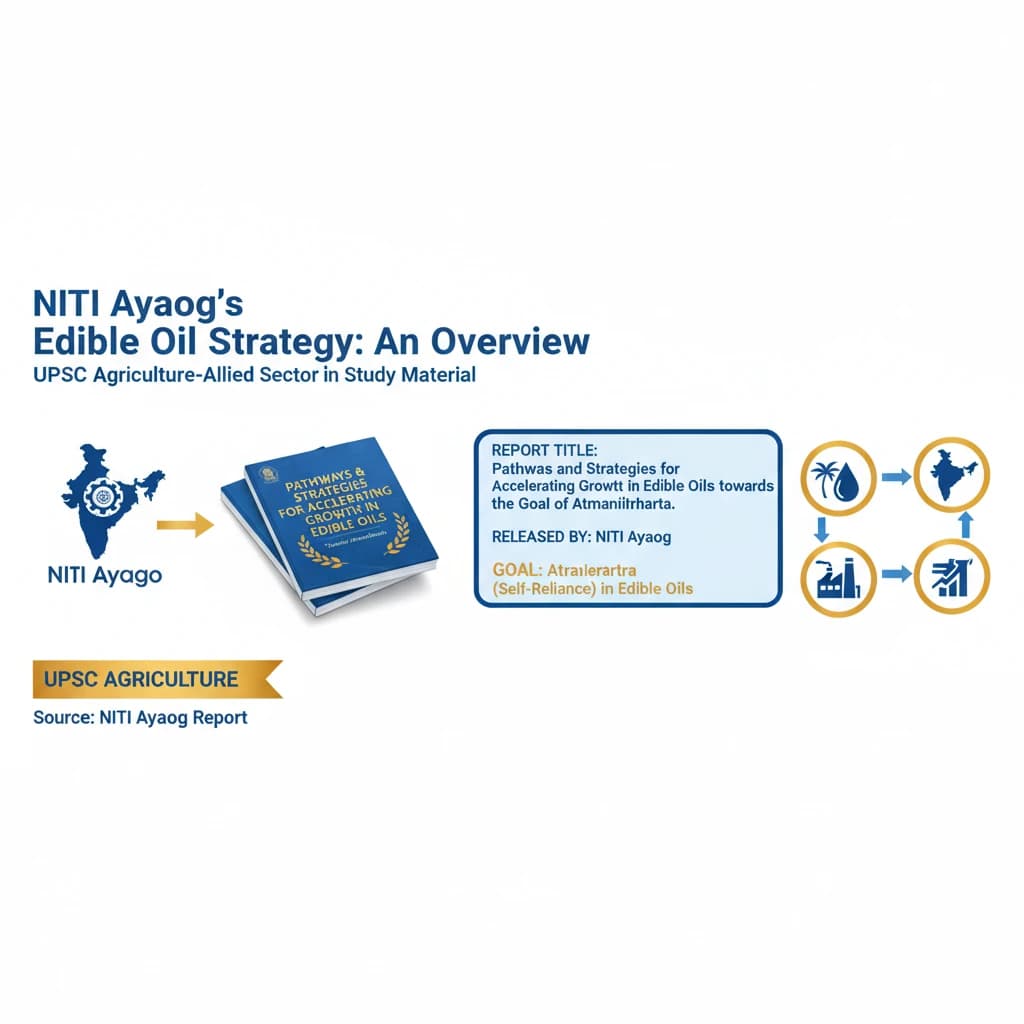
<h4>NITI Aayog's Edible Oil Strategy: An Overview</h4><p>The <strong>NITI Aayog</strong> has released a significant report titled <strong>“Pathways and Strategies for Accelerating Growth in Edible Oils towards the Goal of Atmanirbharta”</strong>. This document is crucial for understanding India's vision for its edible oil sector.</p><div class="info-box"><strong>Report Title:</strong> Pathways and Strategies for Accelerating Growth in Edible Oils towards the Goal of Atmanirbharta<br><strong>Released by:</strong> NITI Aayog<br><strong>Primary Goal:</strong> Achieve <strong>self-sufficiency (Atmanirbharta)</strong> in edible oils.</div><h4>Purpose and Scope of the Report</h4><p>The report undertakes a comprehensive analysis of the <strong>current edible oil sector</strong> in India. It delves into the existing landscape, identifying both strengths and weaknesses.</p><p>Furthermore, it outlines the <strong>future potential</strong> for growth and development within this critical agricultural segment. This includes exploring various avenues for increasing domestic production.</p><h4>Addressing Challenges and Roadmap</h4><p>A key focus of the NITI Aayog report is to provide a <strong>detailed roadmap</strong> to address the persistent challenges faced by the edible oil sector. These challenges primarily revolve around production shortfalls and import dependency.</p><p>The ultimate objective of this roadmap is to effectively close the existing <strong>demand-supply gap</strong>. By doing so, India aims to significantly reduce its reliance on imported edible oils and move towards greater <strong>self-sufficiency</strong>.</p><div class="exam-tip-box"><strong>UPSC Relevance:</strong> This report is vital for <strong>GS Paper III (Economy, Agriculture)</strong>. Questions can relate to agricultural policy, food security, import substitution, and government strategies for specific sectors. Understanding the report's recommendations is key for answer enrichment.</div>
Concept Diagram

💡 Key Takeaways

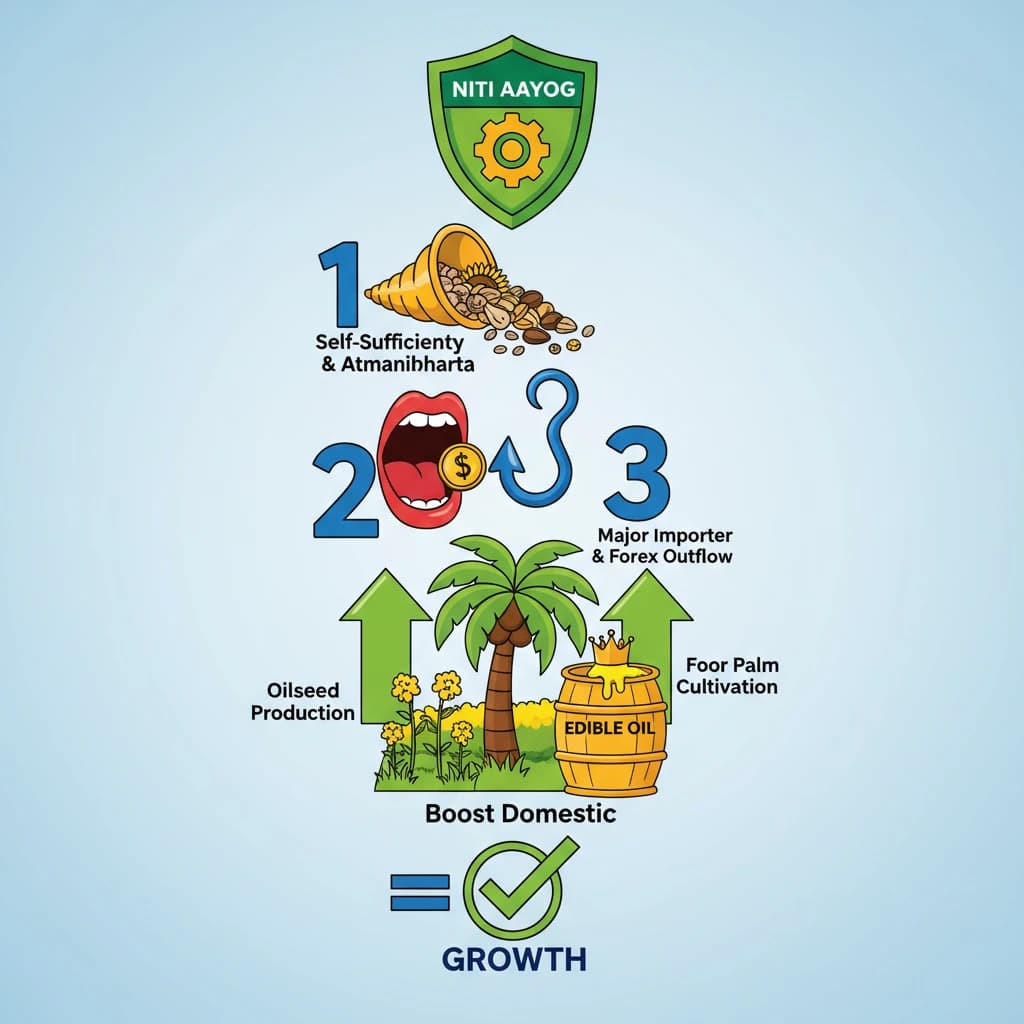
  • •NITI Aayog's report outlines a roadmap for edible oil self-sufficiency.
  • •The goal is to close the demand-supply gap and achieve Atmanirbharta.
  • •India is a major importer of edible oils, leading to significant foreign exchange outflow.
  • •Strategies involve boosting domestic oilseed production and oil palm cultivation.
  • •Reducing import dependency enhances food security and farmer incomes.
  • •The report aligns with the Atmanirbhar Bharat initiative.

🧠 Memory Techniques
Memory Aid
95% Verified Content

Related Topics

Loading related topics...
Explore:Agriculture Allied Sector Topics·All Subjects·Daily Current Affairs·Editorial Analysis·Previous Year Questions·UPSC GPT