Loading page, please wait…
Vaidra Logo
Vaidra

Top 4 items + smart groups

UPSC GPT
New
Current Affairs
Daily Solutions
Daily Puzzle
Mains Evaluator

Version 2.0.0 • Built with ❤️ for UPSC aspirants

Loading...
Loading...
Loading...
Loading...
Loading...
Loading...
Loading...
Loading...
Loading...
Loading...
Loading...
Loading...
Loading...
Back
All Subjects

Topics

0 topics • 0 completed

Loading topics...
Loading...
Loading...
Loading...
Loading...
Loading...
Overall Progress0%

CSR for Agriculture Sustainability - UPSC Agriculture Allied Sector

What is CSR for Agriculture Sustainability in UPSC Agriculture Allied Sector?

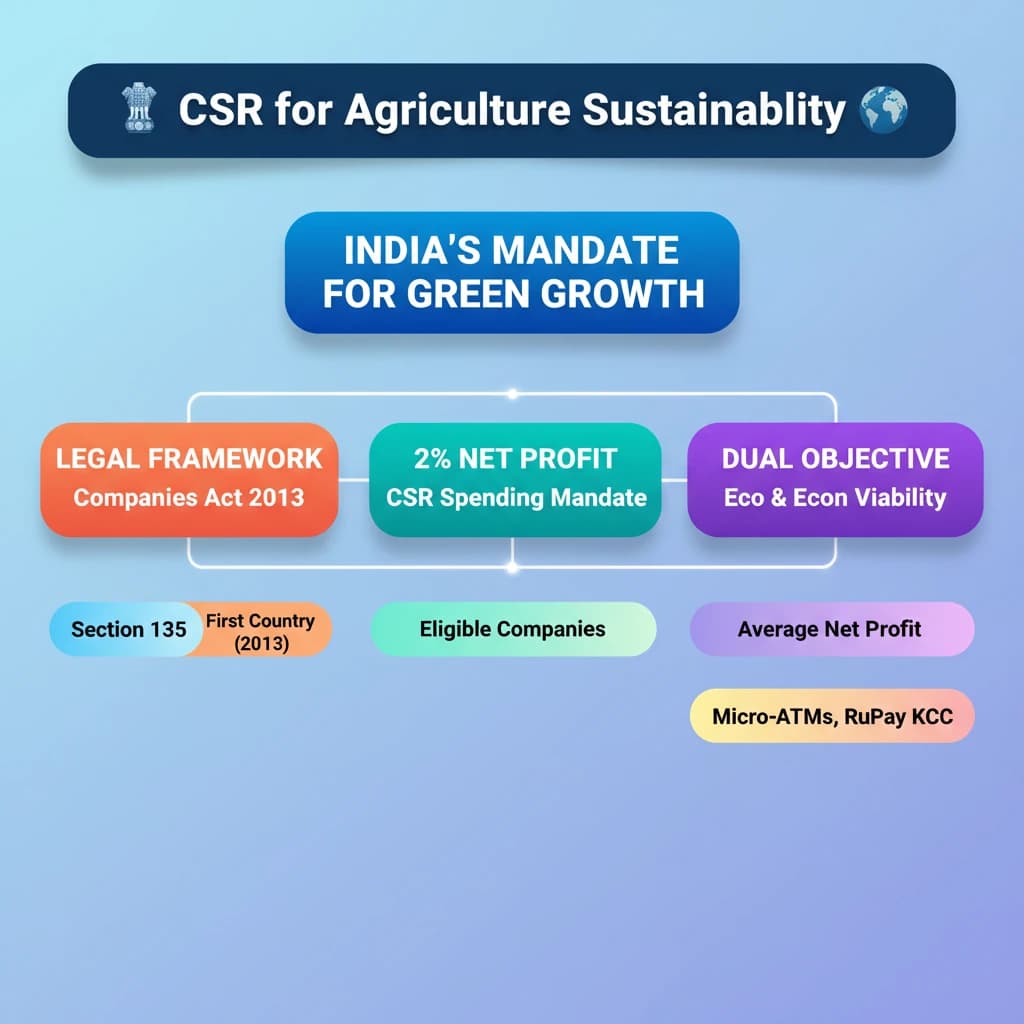
CSR for Agriculture Sustainability is a key topic under Agriculture Allied Sector for UPSC Civil Services Examination. Key points include: India was the first country to legally mandate CSR in 2013.. CSR in India is governed by Section 135 of the Companies Act, 2013.. Eligible companies must spend 2% of their average net profit on CSR activities.. Understanding this topic is essential for both UPSC Prelims and Mains preparation.

Why is CSR for Agriculture Sustainability important for UPSC exam?

CSR for Agriculture Sustainability is a Medium-level topic in UPSC Agriculture Allied Sector. It is tested in both Prelims (factual MCQs) and Mains (analytical answer writing). Previous year UPSC questions have frequently covered aspects of CSR for Agriculture Sustainability, making it essential for comprehensive IAS preparation.

How to prepare CSR for Agriculture Sustainability for UPSC?

To prepare CSR for Agriculture Sustainability for UPSC: (1) Study the comprehensive notes covering all key concepts on Vaidra. (2) Practice previous year questions on this topic. (3) Connect it with current affairs using daily updates. (4) Revise using key takeaways and mind maps available for Agriculture Allied Sector. (5) Write practice answers linking CSR for Agriculture Sustainability to related GS Paper topics.

Key takeaways of CSR for Agriculture Sustainability for UPSC

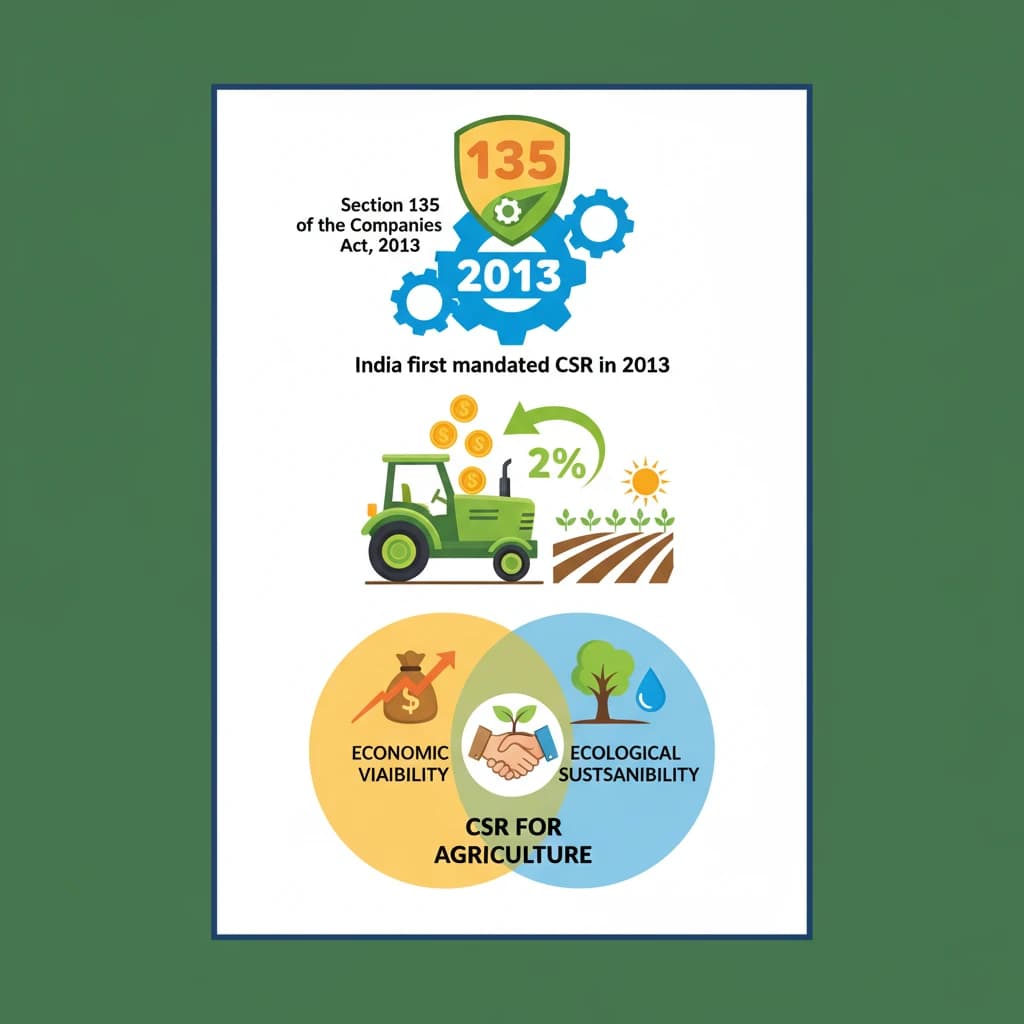
  • India was the first country to legally mandate CSR in 2013.
  • CSR in India is governed by Section 135 of the Companies Act, 2013.
  • Eligible companies must spend 2% of their average net profit on CSR activities.
  • CSR aims to make agriculture economically viable and ecologically sustainable.
  • Financial inclusion, through tools like Micro-ATMs and RuPay Kisan Credit Cards, is a key CSR focus.
  • Environment and sustainability is the second highest priority for CSR spending.
  • CSR supports initiatives like grain banks, farmer schools, and water conservation.
CSR for Agriculture Sustainability

CSR for Agriculture Sustainability

Medium⏱️ 6 min read✓ 98% Verified
agriculture allied sector

📖 Introduction

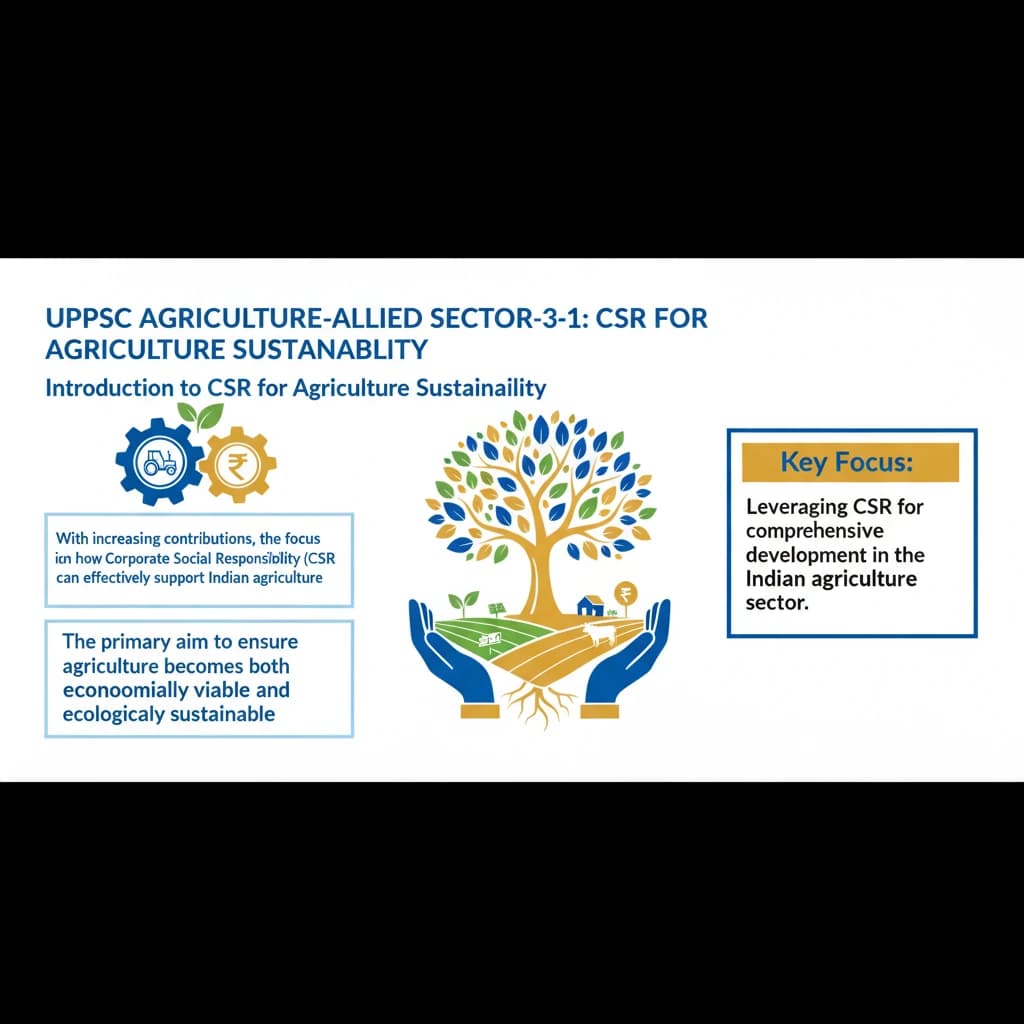
<h4>Introduction to CSR for Agriculture Sustainability</h4><p>With increasing contributions, the focus is on how <strong>Corporate Social Responsibility (CSR)</strong> can effectively support <strong>Indian agriculture</strong>.</p><p>The primary aim is to ensure agriculture becomes both <strong>economically viable</strong> and <strong>ecologically sustainable</strong>.</p><div class="key-point-box"><strong>Key Focus:</strong> Leveraging <strong>CSR</strong> for comprehensive development in the agricultural sector, encompassing sustainability and financial empowerment.</div><h4>Financial Inclusion through CSR Principles</h4><p><strong>Cooperative societies</strong> are being equipped with modern financial tools to enhance farmer access to credit.</p><p>This includes the provision of <strong>RuPay Kisan Credit Cards</strong> and <strong>Micro-ATMs</strong>.</p><div class="info-box">These tools facilitate access to <strong>low-cost loans</strong>, thereby promoting greater <strong>financial inclusion</strong> and support for farmers.</div><h4>Understanding Corporate Social Responsibility (CSR) in India</h4><div class="info-box"><strong>What is CSR?</strong> <strong>CSR</strong> is a business practice where companies voluntarily integrate <strong>social, environmental, and ethical concerns</strong> into their core operations and interactions with stakeholders.</div><p>These concerns often encompass areas like <strong>environmental sustainability</strong>, <strong>poverty reduction</strong>, <strong>education</strong>, and <strong>healthcare</strong>.</p><h4>India's Pioneering CSR Mandate</h4><p><strong>India</strong> holds the distinction of being the <strong>first country</strong> globally to legally mandate <strong>CSR</strong>.</p><p>This landmark legislation was introduced in <strong>2013</strong> under <strong>Section 135</strong> of the <strong>Companies Act, 2013</strong>.</p><div class="info-box"><strong>CSR Fund Disbursement (2014-2023):</strong> A total of <strong>Rs 1.84 lakh crore</strong> of <strong>CSR funds</strong> were disbursed during this period.</div><h4>Legislative Framework and Mandatory Requirements</h4><p>The <strong>CSR concept</strong> in India is governed by a robust legislative framework, ensuring its structured implementation:</p><ul><li><strong>Section 135</strong> of the <strong>Companies Act, 2013</strong></li><li><strong>Schedule VII</strong> of the <strong>Companies Act, 2013</strong></li><li><strong>Companies (CSR Policy) Rules, 2014</strong></li></ul><p><strong>CSR</strong> became a <strong>mandatory requirement</strong> for specific companies, effective from <strong>1st April 2014</strong>.</p><h4>CSR Criteria and Spending Mandate</h4><div class="info-box"><strong>CSR Criteria:</strong> Provisions apply to companies meeting any of the following criteria in the preceding financial year:<ul><li>A <strong>net worth</strong> of over <strong>Rs 5 billion</strong></li><li>A <strong>turnover</strong> exceeding <strong>Rs 10 billion</strong></li><li>A <strong>net profit</strong> greater than <strong>Rs 50 million</strong></li></ul>Such companies are mandated to spend a minimum of <strong>2% of their average net profit</strong> over the last three financial years on <strong>CSR activities</strong>.</div><h4>CSR Priorities and Agricultural Initiatives</h4><div class="exam-tip-box">While <strong>healthcare, water, sanitation, and hygiene</strong> remain the top priorities for companies, <strong>environment and sustainability</strong> is the <strong>second priority</strong> for <strong>CSR contributions</strong>. This underscores its significant potential for the agricultural sector.</div><p>Examples of <strong>CSR-supported initiatives</strong> directly benefiting agriculture include:</p><ul><li>Establishment of <strong>grain banks</strong> for improved food storage and security.</li><li>Development of <strong>farmer schools</strong> for skill enhancement and knowledge dissemination.</li><li>Implementation of <strong>water conservation</strong> projects to ensure efficient resource management.</li><li>Promotion of <strong>energy-efficient irrigation</strong> systems to reduce operational costs and environmental impact.</li></ul>
Concept Diagram

💡 Key Takeaways

  • •India was the first country to legally mandate CSR in 2013.
  • •CSR in India is governed by Section 135 of the Companies Act, 2013.
  • •Eligible companies must spend 2% of their average net profit on CSR activities.
  • •CSR aims to make agriculture economically viable and ecologically sustainable.
  • •Financial inclusion, through tools like Micro-ATMs and RuPay Kisan Credit Cards, is a key CSR focus.
  • •Environment and sustainability is the second highest priority for CSR spending.
  • •CSR supports initiatives like grain banks, farmer schools, and water conservation.

🧠 Memory Techniques
Memory Aid
98% Verified Content

Related Topics

Loading related topics...
Explore:Agriculture Allied Sector Topics·All Subjects·Daily Current Affairs·Editorial Analysis·Previous Year Questions·UPSC GPT
CSR for Agriculture Sustainability - UPSC Agriculture Allied Sector