Loading page, please wait…
Vaidra Logo
Vaidra

Top 4 items + smart groups

UPSC GPT
New
Current Affairs
Daily Solutions
Daily Puzzle
Mains Evaluator

Version 2.0.0 • Built with ❤️ for UPSC aspirants

Loading...
Loading...
Loading...
Loading...
Loading...
Loading...
Loading...
Loading...
Loading...
Loading...
Loading...
Loading...
Loading...
Mission for Cotton Productivity - UPSC Agriculture Allied Sector
Back
All Subjects

Topics

0 topics • 0 completed

Loading topics...
Loading...
Loading...
Loading...
Loading...
Loading...
Overall Progress0%

Mission for Cotton Productivity - UPSC Agriculture Allied Sector

What is Mission for Cotton Productivity in UPSC Agriculture Allied Sector?

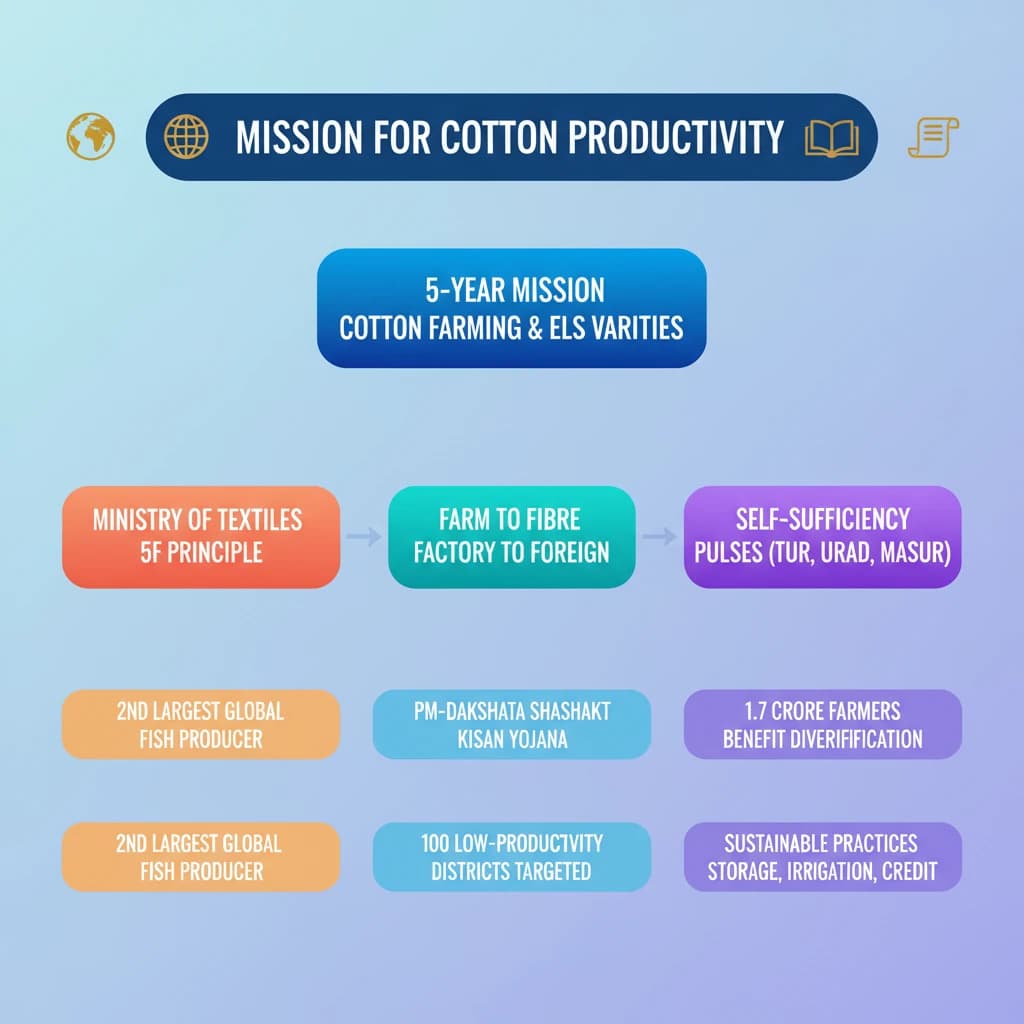
Mission for Cotton Productivity is a key topic under Agriculture Allied Sector for UPSC Civil Services Examination. Key points include: The Mission for Cotton Productivity aims for 5 years to improve cotton farming and promote extra-long staple varieties.. It aligns with the Ministry of Textiles' 5F principle: Farm to Fibre, Fibre to Factory, Factory to Fashion, Fashion to Foreign.. A 5-year mission will be launched for self-sufficiency in pulse production, focusing on Tur, Urad, and Masur.. Understanding this topic is essential for both UPSC Prelims and Mains preparation.

Why is Mission for Cotton Productivity important for UPSC exam?

Mission for Cotton Productivity is a Medium-level topic in UPSC Agriculture Allied Sector. It is tested in both Prelims (factual MCQs) and Mains (analytical answer writing). Previous year UPSC questions have frequently covered aspects of Mission for Cotton Productivity, making it essential for comprehensive IAS preparation.

How to prepare Mission for Cotton Productivity for UPSC?

To prepare Mission for Cotton Productivity for UPSC: (1) Study the comprehensive notes covering all key concepts on Vaidra. (2) Practice previous year questions on this topic. (3) Connect it with current affairs using daily updates. (4) Revise using key takeaways and mind maps available for Agriculture Allied Sector. (5) Write practice answers linking Mission for Cotton Productivity to related GS Paper topics.

Key takeaways of Mission for Cotton Productivity for UPSC

  • The Mission for Cotton Productivity aims for 5 years to improve cotton farming and promote extra-long staple varieties.
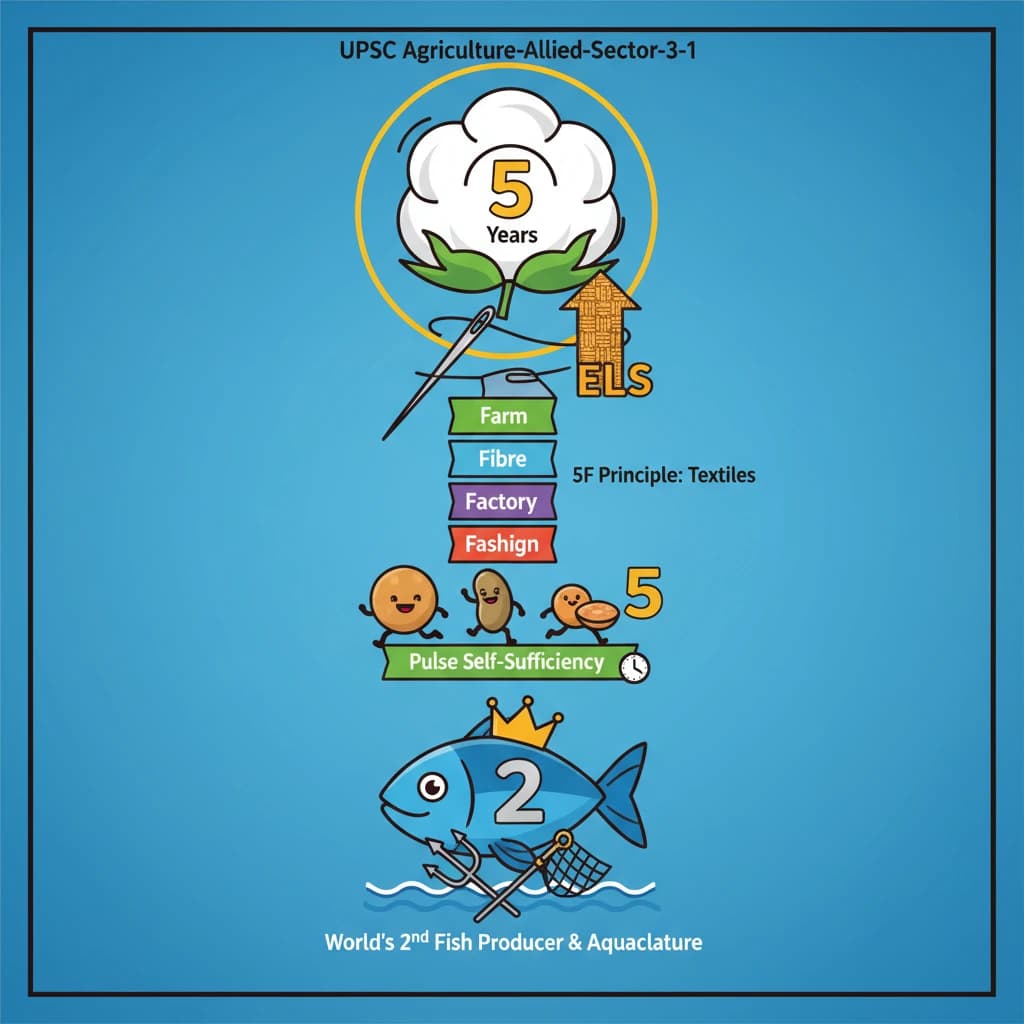
  • It aligns with the Ministry of Textiles' 5F principle: Farm to Fibre, Fibre to Factory, Factory to Fashion, Fashion to Foreign.
  • A 5-year mission will be launched for self-sufficiency in pulse production, focusing on Tur, Urad, and Masur.
  • India is the 2nd-largest global producer in fish production and aquaculture.
  • PM-Dakshta-Shashakt Kisan Yojana targets 100 low-productivity districts, benefiting 1.7 crore farmers through diversification, sustainable practices, storage, irrigation, and credit.
  • The Rural Prosperity and Resilience Programme addresses under-employment through skilling, investment, technology, and empowerment, prioritizing rural women and small farmers.
  • Public Sector Banks will develop a 'Grameen Credit Score' for SHG members and rural populations.
  • The KCC loan limit under the Modified Interest Subvention Scheme increased from Rs 3 lakh to Rs 5 lakh, supporting 7.7 crore farmers, fishermen, and dairy farmers.
Mission for Cotton Productivity

Mission for Cotton Productivity

Medium⏱️ 8 min read✓ 98% Verified
agriculture allied sector

📖 Introduction

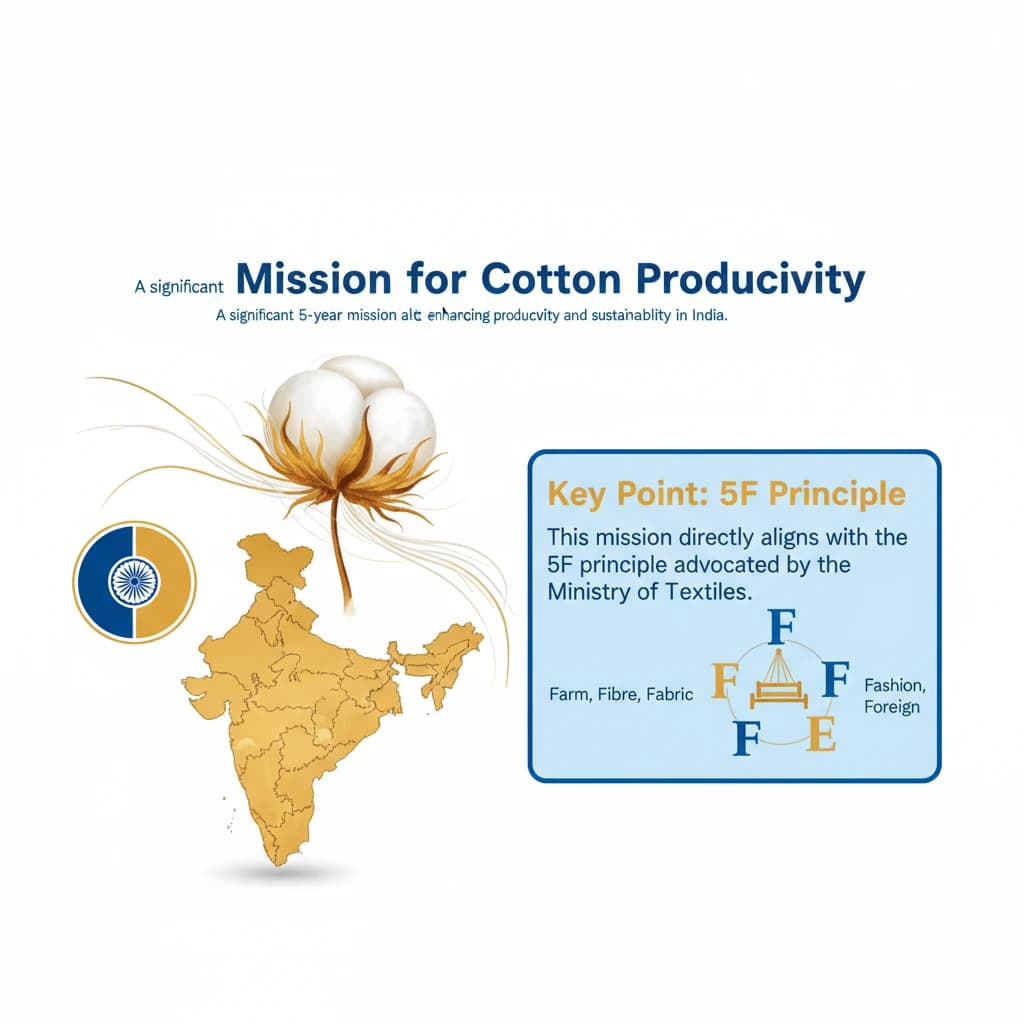
<h4>Mission for Cotton Productivity</h4><p>The <strong>Mission for Cotton Productivity</strong> is a significant <strong>5-year mission</strong> aimed at enhancing the productivity and sustainability of cotton farming in India. It specifically promotes the cultivation of <strong>extra-long staple cotton varieties</strong>.</p><div class="key-point-box">This mission directly aligns with the <strong>5F principle</strong> advocated by the <strong>Ministry of Textiles</strong>. The 5F principle encompasses the entire value chain: <strong>Farm to Fibre, Fibre to Factory, Factory to Fashion, Fashion to Foreign</strong>.</div><h4>Mission for Self-Reliance in Pulses</h4><p>A dedicated <strong>5-year mission</strong> is slated for launch to achieve <strong>self-sufficiency in pulse production</strong>. This initiative will concentrate on key pulse crops such as <strong>Tur, Urad, and Masur</strong>, which are vital for food security.</p><h4>Sustainable Fisheries Framework</h4><p>The government is committed to establishing a comprehensive <strong>sustainable fisheries framework</strong>. This framework will cover operations within India's <strong>Exclusive Economic Zone (EEZ)</strong> and the <strong>High Seas</strong>, with a particular focus on the <strong>Andaman & Nicobar</strong> and <strong>Lakshadweep Islands</strong>.</p><div class="info-box"><strong>Global Ranking:</strong> India holds the position of the <strong>2nd-largest producer</strong> globally in both <strong>fish production and aquaculture</strong>.</div><h4>Prime Minister Dakshta-Shashakt Kisan Yojana (PM-Dakshta)</h4><p>The <strong>Prime Minister Dakshta-Shashakt Kisan Yojana</strong> aims to significantly enhance <strong>agricultural productivity</strong> in <strong>100 identified low-productivity districts</strong> across the country. This comprehensive scheme targets around <strong>1.7 crore farmers</strong>.</p><div class="info-box"><strong>Key Focus Areas:</strong><ul><li><strong>Crop diversification</strong> to reduce risk and improve soil health.</li><li>Promotion of <strong>sustainable farming practices</strong>.</li><li>Improvements in <strong>storage infrastructure</strong>.</li><li>Enhanced <strong>irrigation facilities</strong>.</li><li>Better <strong>credit availability</strong> for farmers.</li></ul></div><h4>Rural Prosperity and Resilience Programme</h4><p>This is a <strong>multi-sectoral initiative</strong> designed to tackle the issue of <strong>under-employment in agriculture</strong>. It seeks to achieve rural prosperity and resilience through a holistic approach.</p><div class="key-point-box">The programme focuses on <strong>skilling, investment, technology adoption, and overall rural empowerment</strong>. It prioritizes the upliftment of <strong>rural women, young farmers, and small farmers</strong>, aiming for job creation and financial independence.</div><h4>Grameen Credit Score Framework</h4><p><strong>Public Sector Banks</strong> are tasked with developing the <strong>‘Grameen Credit Score’ framework</strong>. This innovative system is designed to effectively serve the <strong>credit needs</strong> of members of <strong>Self-Help Groups (SHGs)</strong> and other individuals residing in rural areas.</p><h4>Kisan Credit Cards (KCC) Enhancement</h4><p>Under the <strong>Modified Interest Subvention Scheme</strong>, the <strong>loan limit</strong> for <strong>Kisan Credit Card (KCC) holders</strong> has been substantially increased. This measure aims to provide greater financial support to the agricultural community.</p><div class="info-box"><strong>Previous Limit:</strong> <strong>Rs 3 lakh</strong><br><strong>New Limit:</strong> <strong>Rs 5 lakh</strong><br><strong>Beneficiaries:</strong> Approximately <strong>7.7 crore farmers, fishermen, and dairy farmers</strong>.</div>
Concept Diagram

💡 Key Takeaways

  • •The Mission for Cotton Productivity aims for 5 years to improve cotton farming and promote extra-long staple varieties.
  • •It aligns with the Ministry of Textiles' 5F principle: Farm to Fibre, Fibre to Factory, Factory to Fashion, Fashion to Foreign.
  • •A 5-year mission will be launched for self-sufficiency in pulse production, focusing on Tur, Urad, and Masur.
  • •India is the 2nd-largest global producer in fish production and aquaculture.
  • •PM-Dakshta-Shashakt Kisan Yojana targets 100 low-productivity districts, benefiting 1.7 crore farmers through diversification, sustainable practices, storage, irrigation, and credit.
  • •The Rural Prosperity and Resilience Programme addresses under-employment through skilling, investment, technology, and empowerment, prioritizing rural women and small farmers.
  • •Public Sector Banks will develop a 'Grameen Credit Score' for SHG members and rural populations.
  • •The KCC loan limit under the Modified Interest Subvention Scheme increased from Rs 3 lakh to Rs 5 lakh, supporting 7.7 crore farmers, fishermen, and dairy farmers.

🧠 Memory Techniques
Memory Aid
98% Verified Content

📚 Reference Sources

•Ministry of Agriculture & Farmers Welfare official documents
•Ministry of Fisheries, Animal Husbandry & Dairying official documents
•Ministry of Textiles official documents

Related Topics

Loading related topics...
Explore:Agriculture Allied Sector Topics·All Subjects·Daily Current Affairs·Editorial Analysis·Previous Year Questions·UPSC GPT