Loading page, please wait…
Vaidra Logo
Vaidra

Top 4 items + smart groups

UPSC GPT
New
Current Affairs
Daily Solutions
Daily Puzzle
Mains Evaluator

Version 2.0.0 • Built with ❤️ for UPSC aspirants

Loading...
Loading...
Loading...
Loading...
Loading...
Loading...
Loading...
Loading...
Loading...
Loading...
Loading...
Loading...
Loading...
Back
All Subjects

Topics

0 topics • 0 completed

Loading topics...
Loading...
Loading...
Loading...
Loading...
Loading...
Overall Progress0%

What is the Nitrogen Cycle? - UPSC Agriculture Allied Sector

What is What is the Nitrogen Cycle? in UPSC Agriculture Allied Sector?

What is the Nitrogen Cycle? is a key topic under Agriculture Allied Sector for UPSC Civil Services Examination. Key points include: Plants absorb reactive nitrogen as ammonium (NH4+) and nitrate (NO3–) from the soil.. Humans and animals obtain essential nitrogen-rich amino acids by consuming plants or plant-eating animals.. Nitrogen is vital for forming proteins and nucleic acids in all living organisms.. Understanding this topic is essential for both UPSC Prelims and Mains preparation.

Why is What is the Nitrogen Cycle? important for UPSC exam?

What is the Nitrogen Cycle? is a Medium-level topic in UPSC Agriculture Allied Sector. It is tested in both Prelims (factual MCQs) and Mains (analytical answer writing). Previous year UPSC questions have frequently covered aspects of What is the Nitrogen Cycle?, making it essential for comprehensive IAS preparation.

How to prepare What is the Nitrogen Cycle? for UPSC?

To prepare What is the Nitrogen Cycle? for UPSC: (1) Study the comprehensive notes covering all key concepts on Vaidra. (2) Practice previous year questions on this topic. (3) Connect it with current affairs using daily updates. (4) Revise using key takeaways and mind maps available for Agriculture Allied Sector. (5) Write practice answers linking What is the Nitrogen Cycle? to related GS Paper topics.

Key takeaways of What is the Nitrogen Cycle? for UPSC

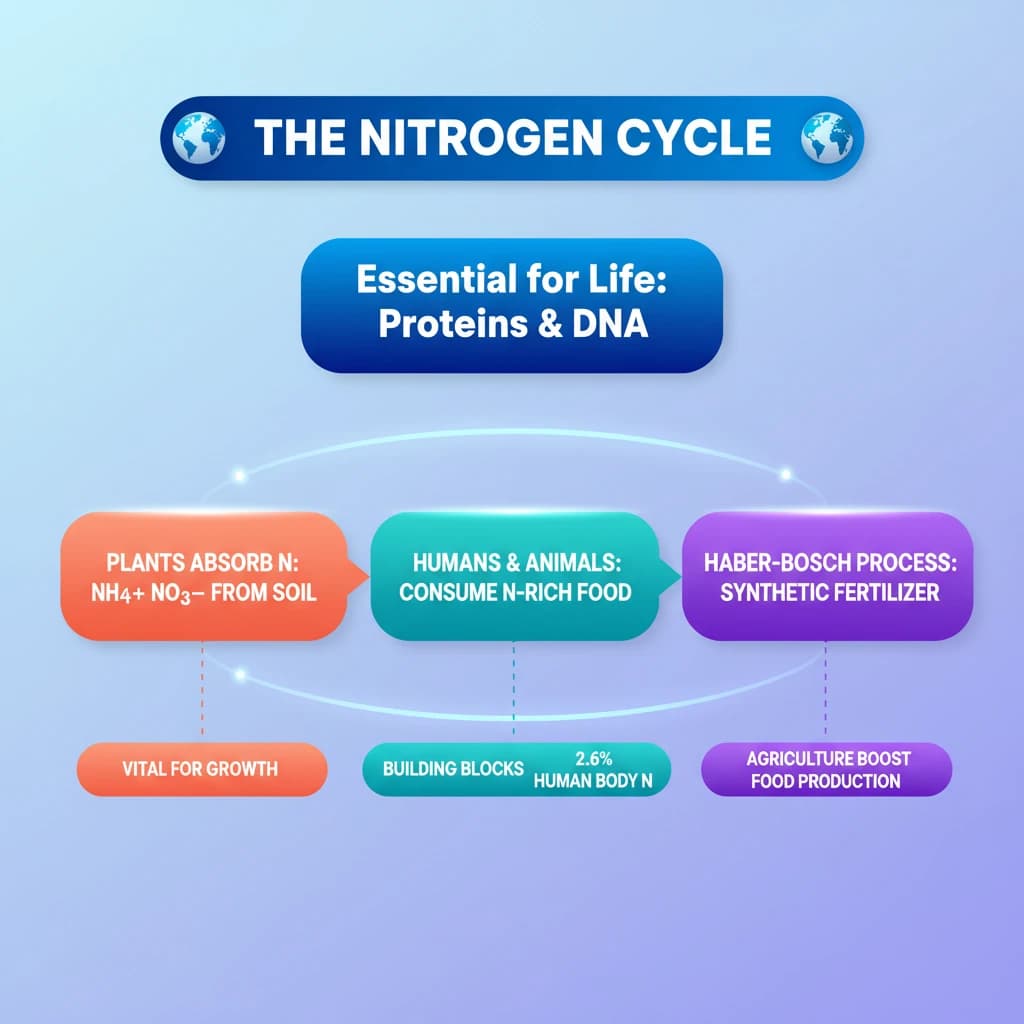
  • Plants absorb reactive nitrogen as ammonium (NH4+) and nitrate (NO3–) from the soil.
  • Humans and animals obtain essential nitrogen-rich amino acids by consuming plants or plant-eating animals.
  • Nitrogen is vital for forming proteins and nucleic acids in all living organisms.
  • Approximately 2.6% of the human body is composed of nitrogen.
  • The Haber-Bosch process revolutionized agriculture by enabling synthetic nitrogen fertilizer production.
  • Excessive nitrogen use leads to environmental issues like eutrophication and nitrous oxide emissions.
What is the Nitrogen Cycle?

What is the Nitrogen Cycle?

Medium⏱️ 6 min read✓ 98% Verified
agriculture allied sector

📖 Introduction

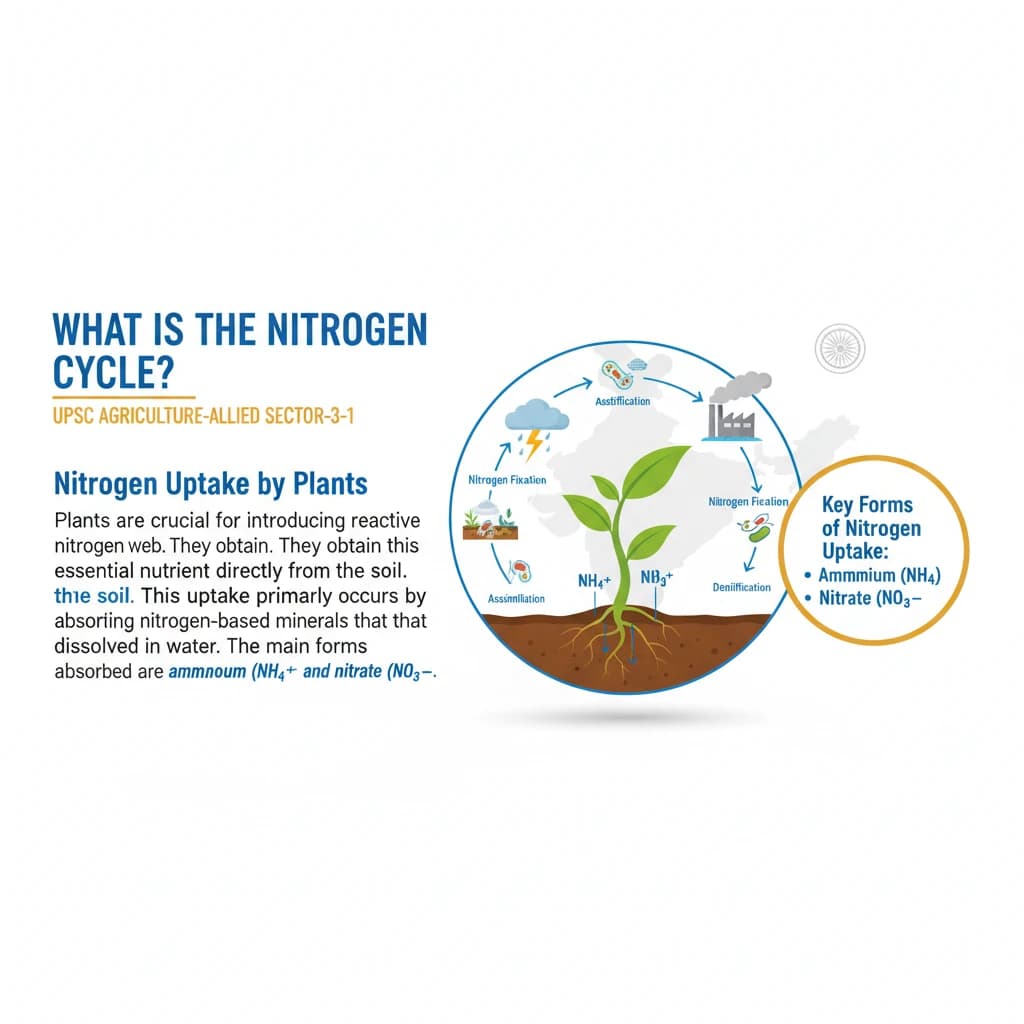
<h4>Nitrogen Uptake by Plants</h4><p>Plants are crucial for introducing <strong>reactive nitrogen</strong> into the food web. They obtain this essential nutrient directly from the soil.</p><p>This uptake primarily occurs by absorbing <strong>nitrogen-based minerals</strong> that are dissolved in water. The main forms absorbed are <strong>ammonium (NH4+)</strong> and <strong>nitrate (NO3–)</strong>.</p><div class="info-box"><strong>Key Forms of Nitrogen Uptake:</strong><ul><li><strong>Ammonium (NH4+):</strong> A positively charged ion, directly usable by plants.</li><li><strong>Nitrate (NO3–):</strong> A negatively charged ion, also readily absorbed by plant roots.</li></ul></div><h4>Biological Importance of Nitrogen for Life</h4><p>Nitrogen is a fundamental element for all life forms, playing a critical role in the structure and function of biological molecules.</p><p>For humans and animals, the reliance on plants is significant. We obtain nine <strong>essential nitrogen-rich amino acids</strong> by consuming plants or animals that have consumed plants.</p><div class="key-point-box"><strong>Nitrogen's Role in the Human Body:</strong><ul><li>Forms the backbone of <strong>proteins</strong> and <strong>nucleic acids (DNA, RNA)</strong>.</li><li>Constitutes approximately <strong>2.6% of the human body's total mass</strong>.</li><li>Essential for enzymes, hormones, and neurotransmitters.</li></ul></div><div class="exam-tip-box">Understanding nitrogen uptake and its biological role is vital for <strong>UPSC Prelims (General Science, Environment)</strong> and <strong>Mains GS-III (Agriculture, Environment)</strong>. Focus on the forms of nitrogen and its significance in food chains.</div>
Concept Diagram

💡 Key Takeaways

  • •Plants absorb reactive nitrogen as ammonium (NH4+) and nitrate (NO3–) from the soil.
  • •Humans and animals obtain essential nitrogen-rich amino acids by consuming plants or plant-eating animals.
  • •Nitrogen is vital for forming proteins and nucleic acids in all living organisms.
  • •Approximately 2.6% of the human body is composed of nitrogen.
  • •The Haber-Bosch process revolutionized agriculture by enabling synthetic nitrogen fertilizer production.
  • •Excessive nitrogen use leads to environmental issues like eutrophication and nitrous oxide emissions.

🧠 Memory Techniques

Memory Aid
98% Verified Content

📚 Reference Sources

•NCERT Class 11 Biology: Mineral Nutrition
•NCERT Class 12 Chemistry: Environmental Chemistry
•Environmental Science: Earth as a Living Planet by Botkin & Keller
•FAO (Food and Agriculture Organization) publications on sustainable agriculture

Related Topics

Loading related topics...
Explore:Agriculture Allied Sector Topics·All Subjects·Daily Current Affairs·Editorial Analysis·Previous Year Questions·UPSC GPT
What is the Nitrogen Cycle? - UPSC Agriculture Allied Sector