Loading page, please wait…
Vaidra Logo
Vaidra

Top 4 items + smart groups

UPSC GPT
New
Current Affairs
Daily Solutions
Daily Puzzle
Mains Evaluator

Version 2.0.0 • Built with ❤️ for UPSC aspirants

Loading...
Loading...
Loading...
Loading...
Loading...
Loading...
Loading...
Loading...
Loading...
Loading...
Loading...
Loading...
Loading...
Edible Oil Imports and SAFTA Agreement - UPSC Agriculture Allied Sector
Back
All Subjects

Topics

0 topics • 0 completed

Loading topics...
Loading...
Loading...
Loading...
Loading...
Loading...
Overall Progress0%

Edible Oil Imports and SAFTA Agreement - UPSC Agriculture Allied Sector

What is Edible Oil Imports and SAFTA Agreement in UPSC Agriculture Allied Sector?

Edible Oil Imports and SAFTA Agreement is a key topic under Agriculture Allied Sector for UPSC Civil Services Examination. Key points include: The Solvent Extractors’ Association of India (SEA) is concerned about refined edible oil imports from Nepal.. These imports, mainly soybean and palm oil, occur under the SAFTA Agreement.. SAFTA allows preferential or zero-duty trade among member countries.. Understanding this topic is essential for both UPSC Prelims and Mains preparation.

Why is Edible Oil Imports and SAFTA Agreement important for UPSC exam?

Edible Oil Imports and SAFTA Agreement is a Medium-level topic in UPSC Agriculture Allied Sector. It is tested in both Prelims (factual MCQs) and Mains (analytical answer writing). Previous year UPSC questions have frequently covered aspects of Edible Oil Imports and SAFTA Agreement, making it essential for comprehensive IAS preparation.

How to prepare Edible Oil Imports and SAFTA Agreement for UPSC?

To prepare Edible Oil Imports and SAFTA Agreement for UPSC: (1) Study the comprehensive notes covering all key concepts on Vaidra. (2) Practice previous year questions on this topic. (3) Connect it with current affairs using daily updates. (4) Revise using key takeaways and mind maps available for Agriculture Allied Sector. (5) Write practice answers linking Edible Oil Imports and SAFTA Agreement to related GS Paper topics.

Key takeaways of Edible Oil Imports and SAFTA Agreement for UPSC

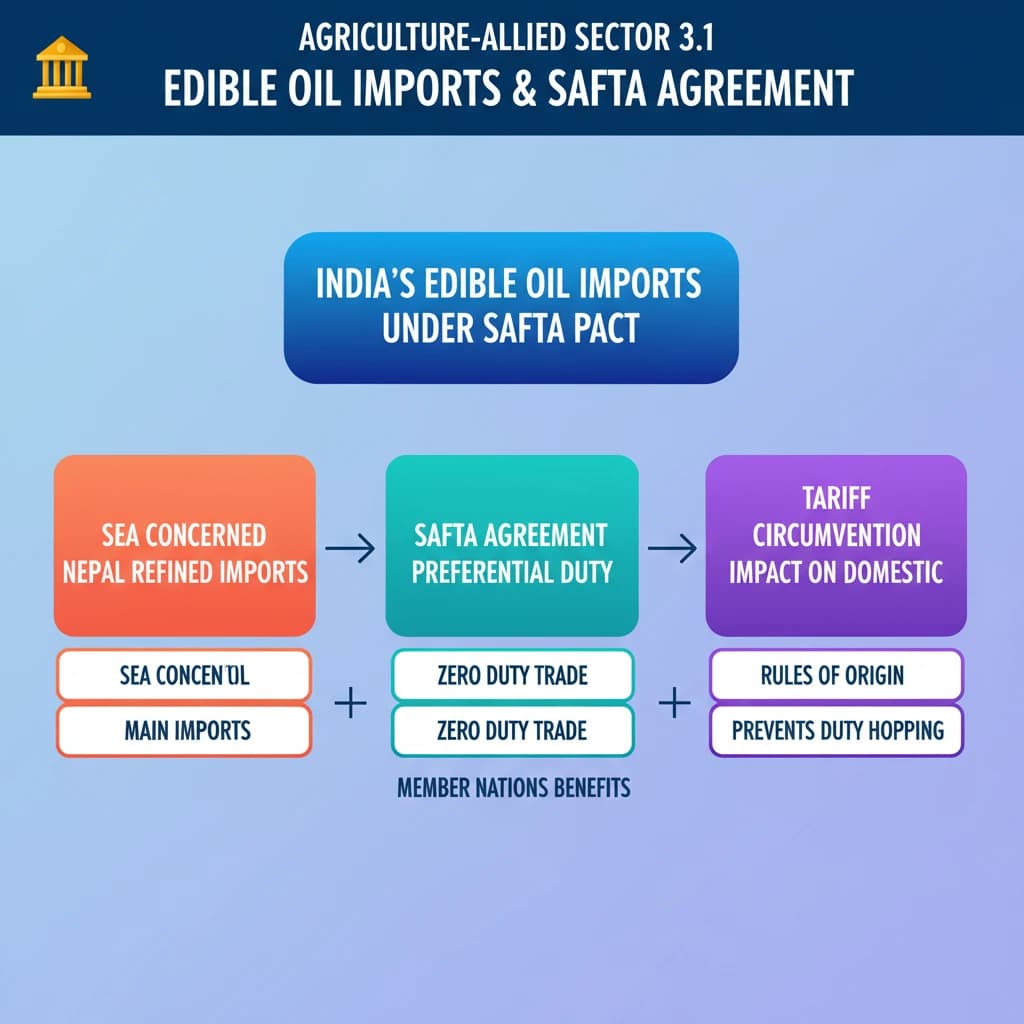
  • The Solvent Extractors’ Association of India (SEA) is concerned about refined edible oil imports from Nepal.
  • These imports, mainly soybean and palm oil, occur under the SAFTA Agreement.
  • SAFTA allows preferential or zero-duty trade among member countries.
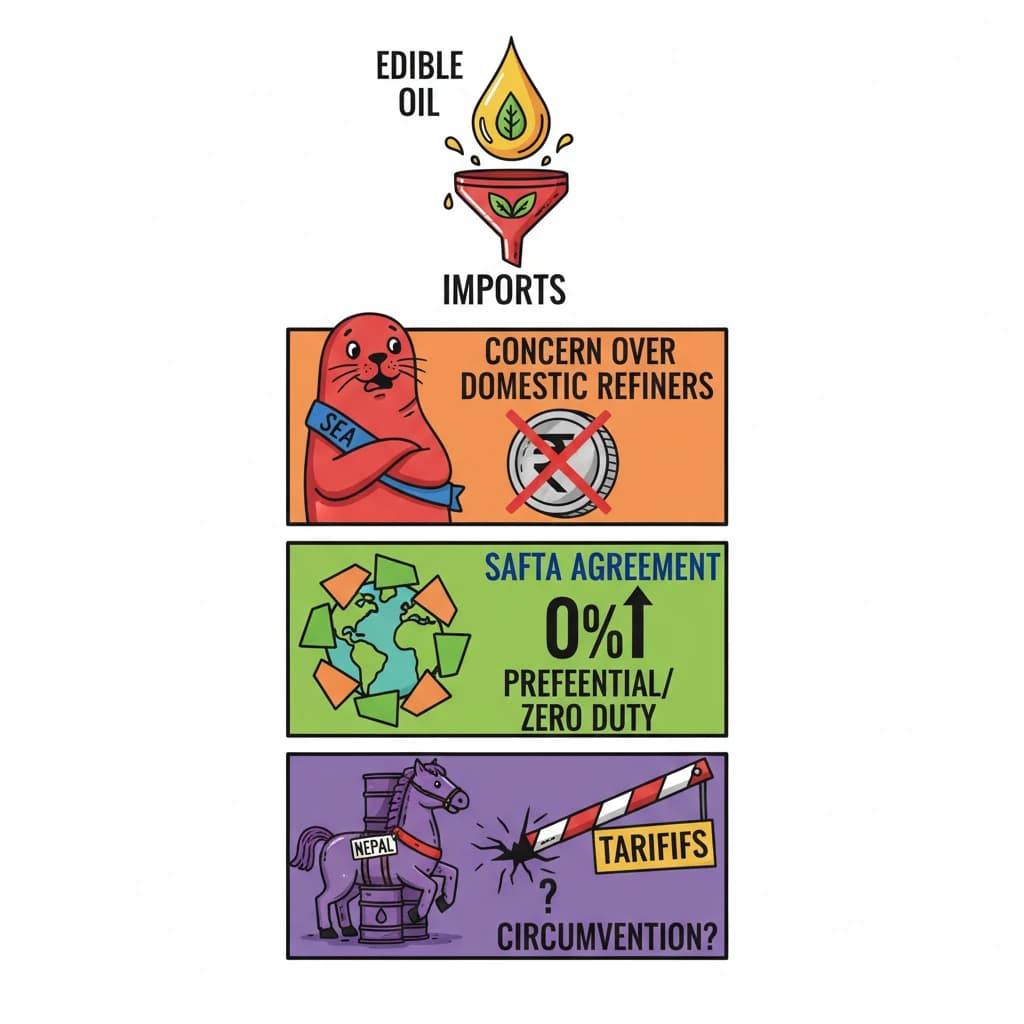
  • SEA's concern likely stems from potential tariff circumvention impacting India's domestic refiners.
  • Rules of Origin are crucial in FTAs to prevent duty hopping.
  • India is a major importer of edible oils, making domestic production a strategic priority.
  • Government initiatives like NEOM-OP aim to reduce India's edible oil import dependency.
Edible Oil Imports and SAFTA Agreement

Edible Oil Imports and SAFTA Agreement

Medium⏱️ 7 min read✓ 95% Verified
agriculture allied sector

📖 Introduction

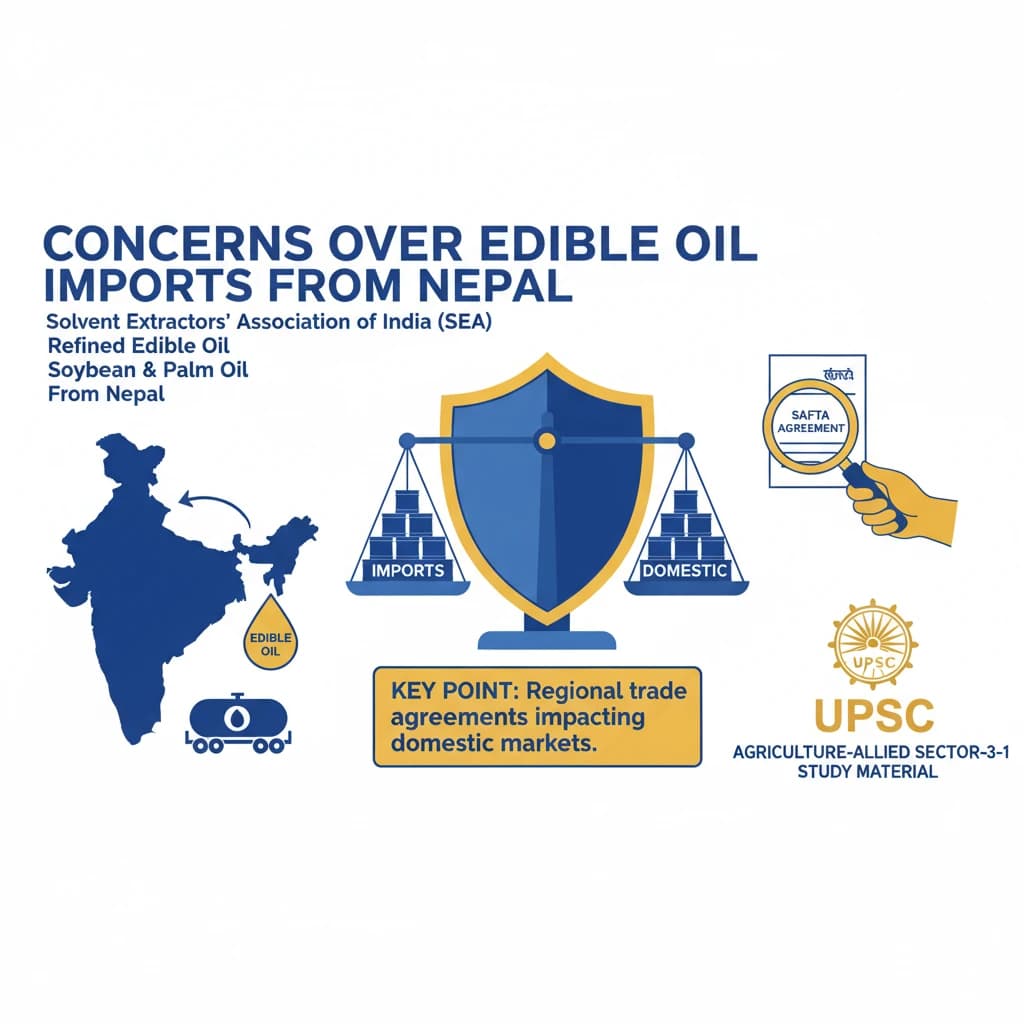
<h4>Concerns Over Edible Oil Imports from Nepal</h4><p>The <strong>Solvent Extractors’ Association of India (SEA)</strong> has expressed significant concerns regarding a substantial influx of <strong>refined Edible Oil</strong> into India. This oil, primarily <strong>soybean</strong> and <strong>palm oil</strong>, is being imported from <strong>Nepal</strong>.</p><div class="key-point-box">This issue highlights potential challenges arising from regional trade agreements and their impact on domestic industries. The concerns are rooted in the implications for India's domestic edible oil sector.</div><h4>Role of SAFTA Agreement</h4><p>The imports are occurring under the framework of the <strong>South Asian Free Trade Area (SAFTA) Agreement</strong>. SAFTA aims to reduce tariffs among member countries, facilitating smoother trade within the South Asian region.</p><div class="info-box"><strong>SAFTA Members:</strong> Afghanistan, Bangladesh, Bhutan, India, Maldives, Nepal, Pakistan, Sri Lanka.</div><p>While SAFTA promotes regional trade, the <strong>SEA's concerns</strong> likely stem from the possibility of tariff arbitrage or the circumvention of import duties that would otherwise apply to edible oil imports from non-SAFTA countries.</p><h4>Nature of the Imports</h4><p>The specific oils causing concern are <strong>refined soybean oil</strong> and <strong>refined palm oil</strong>. These are widely consumed edible oils in India, making the volume of imports a critical factor for the domestic market.</p><ul><li><strong>Soybean Oil:</strong> A major cooking oil, India is a significant consumer and importer.</li><li><strong>Palm Oil:</strong> The most widely consumed edible oil globally, India is its largest importer.</li></ul><div class="exam-tip-box">Understanding the mechanics of <strong>Free Trade Agreements (FTAs)</strong> like SAFTA, especially the role of <strong>Rules of Origin</strong>, is crucial for <strong>UPSC GS Paper 2 (International Relations)</strong> and <strong>GS Paper 3 (Economy)</strong>. Questions often revolve around their impact on domestic industry.</div>
Concept Diagram

💡 Key Takeaways

  • •The Solvent Extractors’ Association of India (SEA) is concerned about refined edible oil imports from Nepal.
  • •These imports, mainly soybean and palm oil, occur under the SAFTA Agreement.
  • •SAFTA allows preferential or zero-duty trade among member countries.
  • •SEA's concern likely stems from potential tariff circumvention impacting India's domestic refiners.
  • •Rules of Origin are crucial in FTAs to prevent duty hopping.
  • •India is a major importer of edible oils, making domestic production a strategic priority.
  • •Government initiatives like NEOM-OP aim to reduce India's edible oil import dependency.

🧠 Memory Techniques
Memory Aid
95% Verified Content

📚 Reference Sources

•Official SAFTA Agreement documents
•Reports from Solvent Extractors’ Association of India (SEA)
•Ministry of Agriculture & Farmers Welfare, Government of India publications on edible oils
•Economic Survey of India

Related Topics

Loading related topics...
Explore:Agriculture Allied Sector Topics·All Subjects·Daily Current Affairs·Editorial Analysis·Previous Year Questions·UPSC GPT