Loading page, please wait…
Vaidra Logo
Vaidra

Top 4 items + smart groups

UPSC GPT
New
Current Affairs
Daily Solutions
Daily Puzzle
Mains Evaluator

Version 2.0.0 • Built with ❤️ for UPSC aspirants

Loading...
Loading...
Loading...
Loading...
Loading...
Loading...
Loading...
Loading...
Loading...
Loading...
Loading...
Loading...
Loading...
Contract Farming in India’s Agriculture - UPSC Agriculture Allied Sector
Back
All Subjects

Topics

0 topics • 0 completed

Loading topics...
Loading...
Loading...
Loading...
Loading...
Loading...
Overall Progress0%

Contract Farming in India’s Agriculture - UPSC Agriculture Allied Sector

What is Contract Farming in India’s Agriculture in UPSC Agriculture Allied Sector?

Contract Farming in India’s Agriculture is a key topic under Agriculture Allied Sector for UPSC Civil Services Examination. Key points include: Contract farming involves a pre-agreed arrangement between farmers and buyers for agricultural produce.. It ensures price certainty, quality standards, and delivery schedules before production begins.. Key advantages include efficient supply chains, access to credit and inputs for farmers, and increased farmer income.. Understanding this topic is essential for both UPSC Prelims and Mains preparation.

Why is Contract Farming in India’s Agriculture important for UPSC exam?

Contract Farming in India’s Agriculture is a Medium-level topic in UPSC Agriculture Allied Sector. It is tested in both Prelims (factual MCQs) and Mains (analytical answer writing). Previous year UPSC questions have frequently covered aspects of Contract Farming in India’s Agriculture, making it essential for comprehensive IAS preparation.

How to prepare Contract Farming in India’s Agriculture for UPSC?

To prepare Contract Farming in India’s Agriculture for UPSC: (1) Study the comprehensive notes covering all key concepts on Vaidra. (2) Practice previous year questions on this topic. (3) Connect it with current affairs using daily updates. (4) Revise using key takeaways and mind maps available for Agriculture Allied Sector. (5) Write practice answers linking Contract Farming in India’s Agriculture to related GS Paper topics.

Key takeaways of Contract Farming in India’s Agriculture for UPSC

  • Contract farming involves a pre-agreed arrangement between farmers and buyers for agricultural produce.
  • It ensures price certainty, quality standards, and delivery schedules before production begins.
  • Key advantages include efficient supply chains, access to credit and inputs for farmers, and increased farmer income.
  • It helps meet food safety standards and can lead to better prices for consumers by reducing intermediaries.
  • India has a policy framework, including the Model APMR Act, 2003, and the Model Contract Farming Act, 2018, to regulate and promote it.
  • The 2018 Act emphasizes FPOs, state-level authorities, and insurance for contracted produce.
  • Successful in processed potatoes, contract farming holds significant potential for other crops and allied sectors.
Contract Farming in India’s Agriculture

Contract Farming in India’s Agriculture

Medium⏱️ 10 min read✓ 95% Verified
agriculture allied sector

📖 Introduction

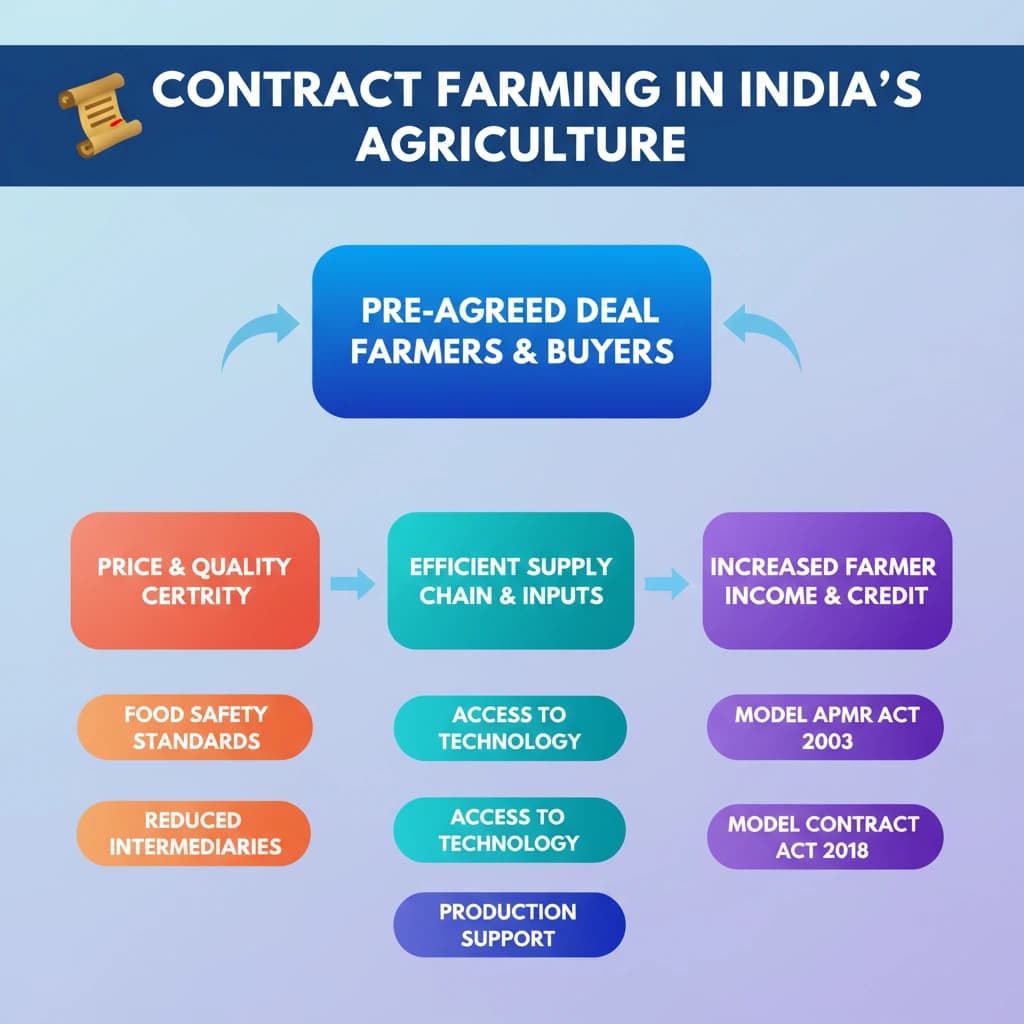
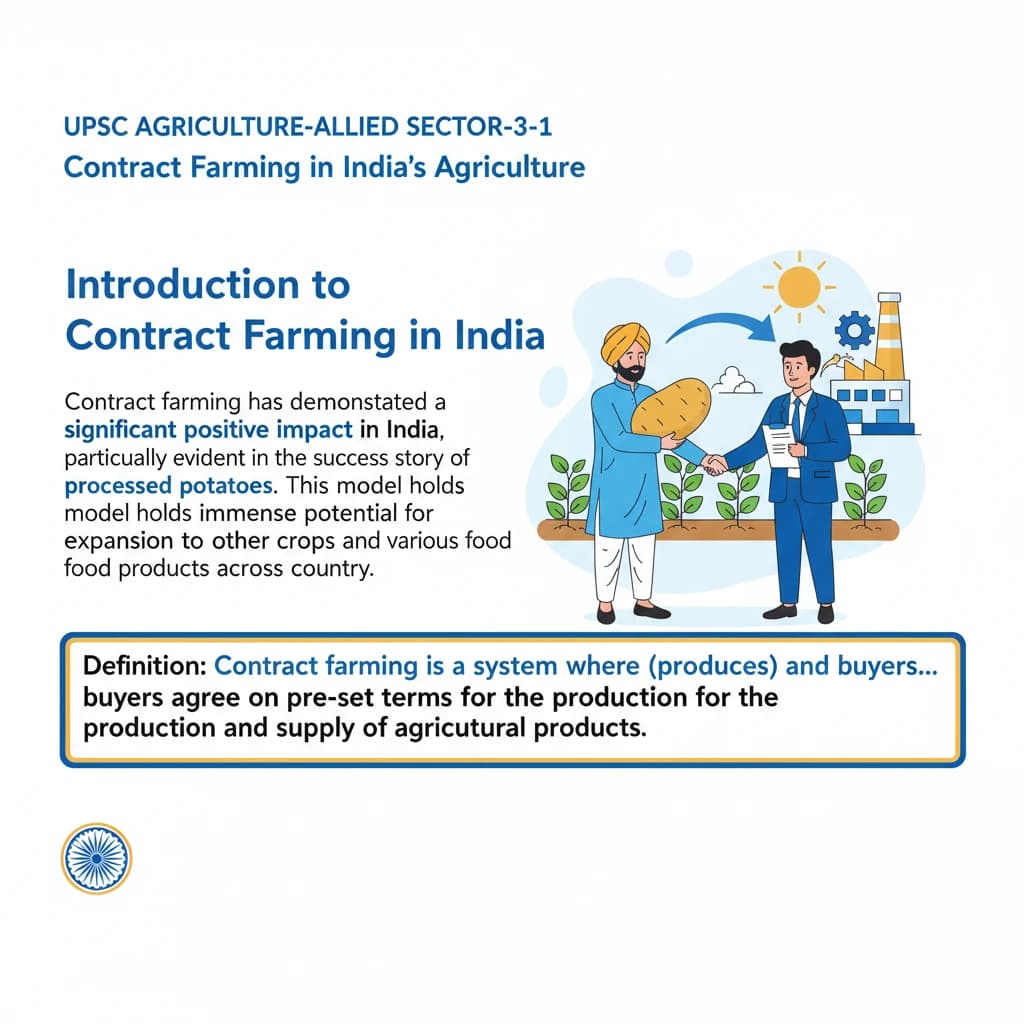
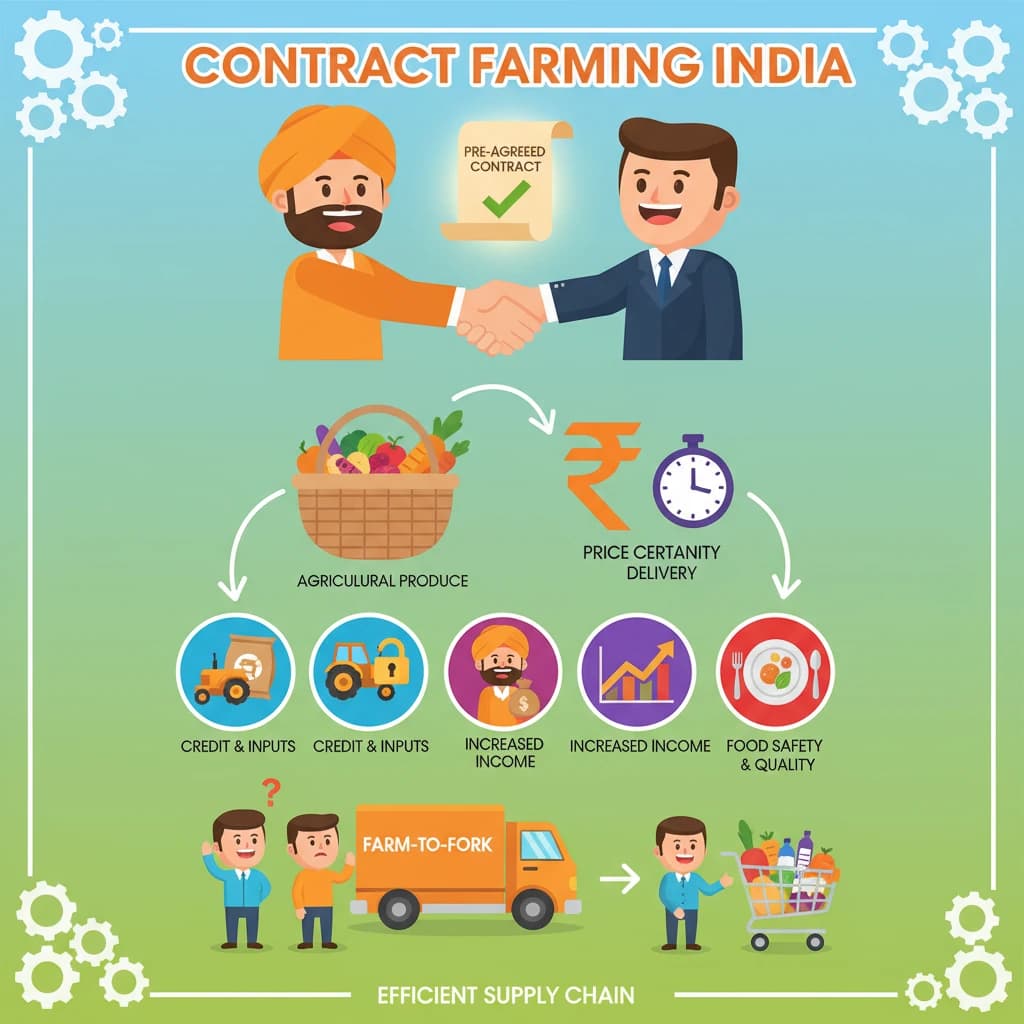
<h4>Introduction to Contract Farming in India</h4><p><strong>Contract farming</strong> has demonstrated a significant positive impact in India, particularly evident in the success story of <strong>processed potatoes</strong>. This model holds immense potential for expansion to other crops and various food products across the country.</p><div class="info-box"><strong>Definition:</strong> <strong>Contract farming</strong> is a system where <strong>farmers (producers)</strong> and <strong>buyers</strong> enter into a formal agreement regarding the production and marketing of specific farm products.</div><p>The core of this agreement specifies crucial terms such as the <strong>price</strong>, <strong>quantity</strong>, <strong>quality standards</strong>, and <strong>delivery date</strong> for the farmer’s produce. These terms are established <strong>before the production process begins</strong>, providing certainty to both parties.</p><h4>Advantages of Contract Farming</h4><p>Contract farming offers a multitude of benefits, streamlining agricultural processes and improving outcomes for both farmers and consumers.</p><ul><li><strong>Efficient Supply Chain Management:</strong> It significantly reduces the <strong>wastage of perishables</strong> by creating a direct link between production and processing/market. This ensures <strong>fair pricing</strong> for both producers and consumers by minimizing intermediaries.</li><li><strong>Access to Credit and Inputs:</strong> Farmers benefit from crucial support provided by contracting firms. This includes access to <strong>credit</strong>, essential <strong>inputs</strong> (like seeds, fertilizers), and valuable <strong>extension services</strong>. This support often leads to improved quality and higher production yields.</li><li><strong>Enhanced Operational Efficiency for Firms:</strong> For contracting firms, this model helps in reducing operational costs, boosting overall efficiency, and reliably meeting the demand for <strong>high-value, non-traditional crops</strong>.</li><li><strong>Increased Income for Farmers:</strong> Farmers engaged in contract farming often report <strong>higher incomes</strong> compared to non-contract farmers. This is due to improved yields, guaranteed prices, and the adoption of more efficient farming practices.</li></ul><div class="info-box">An <strong>RBI paper</strong> highlighted that farmers typically receive only <strong>31%–43%</strong> of the consumer price for fruits and vegetables. This share has the potential to significantly <strong>increase under contract farming</strong> by cutting out middlemen.</div><ul><li><strong>Meeting Food Safety Standards:</strong> Contracting firms frequently provide training to farmers on critical <strong>food safety practices</strong>. This includes guidance on using <strong>organic fertilizers</strong> and effective <strong>pesticide control</strong>, helping farmers meet stringent <strong>international standards</strong> like the <strong>Maximum Residue Level (MRL)</strong>.</li><li><strong>Better Price for Consumers:</strong> By effectively cutting out multiple intermediaries in the supply chain, contract farming can offer <strong>better prices for consumers</strong>. This ensures competitive rates for products without the added markups from middlemen.</li></ul><h4>Policy Framework for Contract Farming in India</h4><p>India has evolved its policy framework to support and regulate contract farming, aiming to protect farmer interests and promote organized agricultural production.</p><div class="key-point-box"><strong>Model APMR (Agricultural Produce Marketing Regulation) Act, 2003:</strong> This landmark act introduced specific provisions for contract farming.</div><ul><li>It mandated <strong>compulsory registration for contracting firms</strong>.</li><li>It established mechanisms for <strong>dispute resolution</strong>.</li><li>It provided for <strong>market fee exemptions</strong> for contracted produce.</li><li>Crucially, it <strong>protected farmers’ land ownership</strong>, ensuring that land cannot be transferred or alienated under contract.</li></ul><div class="key-point-box"><strong>Model Agriculture Produce and Livestock Contract Farming Act, 2018:</strong> This more recent act further refined and strengthened the framework.</div><ul><li>It proposed the establishment of <strong>state-level authorities</strong> for the effective implementation and monitoring of contract farming.</li><li>It emphasized the <strong>promotion of Farmer Producer Organizations (FPOs)</strong> to empower farmers collectively.</li><li>It included provisions for <strong>insurance for contracted produce</strong>, mitigating risks for farmers.</li></ul>
Concept Diagram

💡 Key Takeaways

  • •Contract farming involves a pre-agreed arrangement between farmers and buyers for agricultural produce.
  • •It ensures price certainty, quality standards, and delivery schedules before production begins.
  • •Key advantages include efficient supply chains, access to credit and inputs for farmers, and increased farmer income.
  • •It helps meet food safety standards and can lead to better prices for consumers by reducing intermediaries.
  • •India has a policy framework, including the Model APMR Act, 2003, and the Model Contract Farming Act, 2018, to regulate and promote it.
  • •The 2018 Act emphasizes FPOs, state-level authorities, and insurance for contracted produce.
  • •Successful in processed potatoes, contract farming holds significant potential for other crops and allied sectors.

🧠 Memory Techniques
Memory Aid
95% Verified Content

📚 Reference Sources

•Model Agriculture Produce and Livestock Contract Farming Act, 2018
•Model APMR (Agricultural Produce Marketing Regulation) Act, 2003
•Reserve Bank of India (RBI) papers on agricultural marketing

Related Topics

Loading related topics...
Explore:Agriculture Allied Sector Topics·All Subjects·Daily Current Affairs·Editorial Analysis·Previous Year Questions·UPSC GPT