Loading page, please wait…
Vaidra Logo
Vaidra

Top 4 items + smart groups

UPSC GPT
New
Current Affairs
Daily Solutions
Daily Puzzle
Mains Evaluator

Version 2.0.0 • Built with ❤️ for UPSC aspirants

Loading...
Loading...
Loading...
Loading...
Loading...
Loading...
Loading...
Loading...
Loading...
Loading...
Loading...
Loading...
Loading...
Revamping Crop Data Collection by E-technology - UPSC Agriculture Allied Sector
Back
All Subjects

Topics

0 topics • 0 completed

Loading topics...
Loading...
Loading...
Loading...
Loading...
Loading...
Overall Progress0%

Revamping Crop Data Collection by E-technology - UPSC Agriculture Allied Sector

What is Revamping Crop Data Collection by E-technology in UPSC Agriculture Allied Sector?

Revamping Crop Data Collection by E-technology is a key topic under Agriculture Allied Sector for UPSC Civil Services Examination. Key points include: Government is promoting digital tools for accurate crop data.. DGCES uses mobile apps and web portals for crop yield estimation.. DGCES features GPS-enabled photo capture and geo-referencing for transparency.. Understanding this topic is essential for both UPSC Prelims and Mains preparation.

Why is Revamping Crop Data Collection by E-technology important for UPSC exam?

Revamping Crop Data Collection by E-technology is a Medium-level topic in UPSC Agriculture Allied Sector. It is tested in both Prelims (factual MCQs) and Mains (analytical answer writing). Previous year UPSC questions have frequently covered aspects of Revamping Crop Data Collection by E-technology, making it essential for comprehensive IAS preparation.

How to prepare Revamping Crop Data Collection by E-technology for UPSC?

To prepare Revamping Crop Data Collection by E-technology for UPSC: (1) Study the comprehensive notes covering all key concepts on Vaidra. (2) Practice previous year questions on this topic. (3) Connect it with current affairs using daily updates. (4) Revise using key takeaways and mind maps available for Agriculture Allied Sector. (5) Write practice answers linking Revamping Crop Data Collection by E-technology to related GS Paper topics.

Key takeaways of Revamping Crop Data Collection by E-technology for UPSC

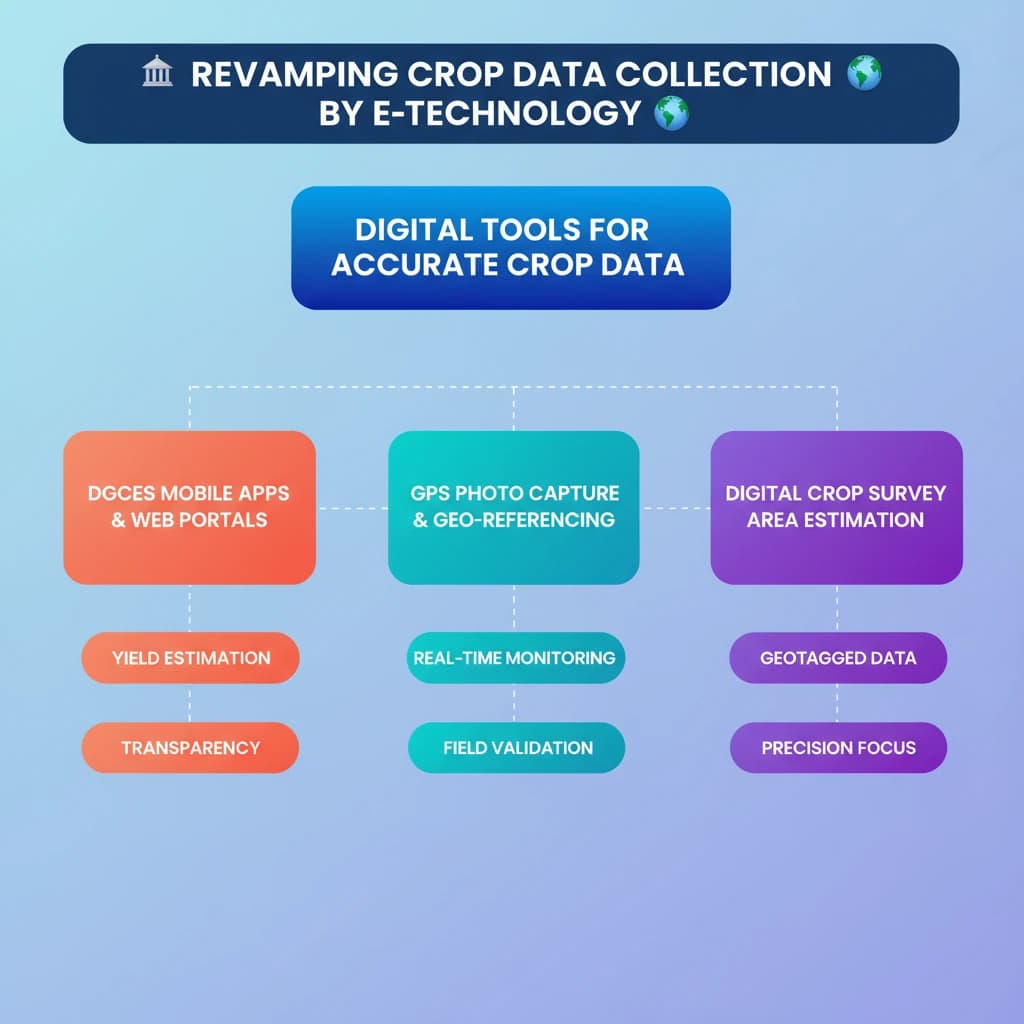
  • Government is promoting digital tools for accurate crop data.
  • DGCES uses mobile apps and web portals for crop yield estimation.
  • DGCES features GPS-enabled photo capture and geo-referencing for transparency.
  • Digital Crop Survey focuses on precise crop area estimation.
  • Geotagged data is a key feature of the Digital Crop Survey.
  • The initiatives aim to reduce reliance on manual methods and improve data accuracy.
  • Better data leads to informed policy-making and farmer welfare.
Revamping Crop Data Collection by E-technology

Revamping Crop Data Collection by E-technology

Medium⏱️ 6 min read✓ 100% Verified
agriculture allied sector

📖 Introduction

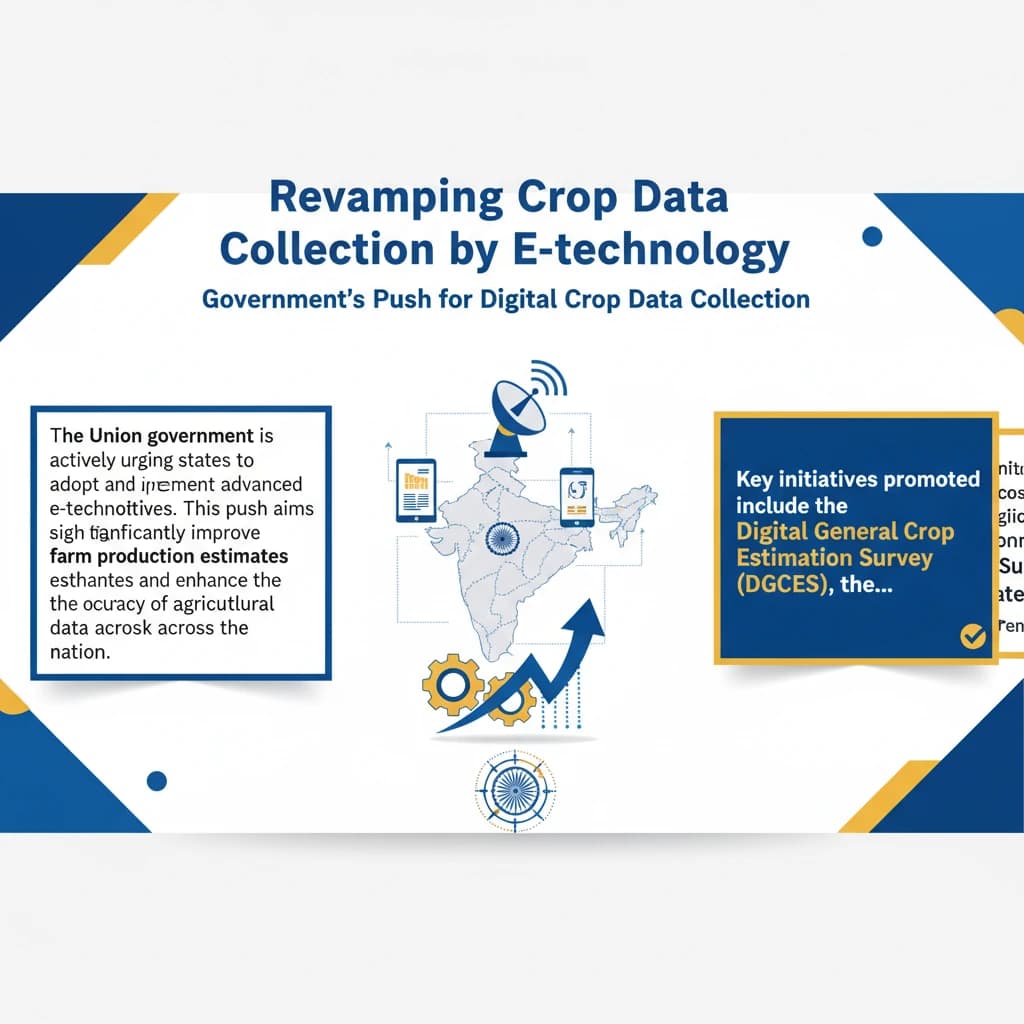
<h4>Government's Push for Digital Crop Data Collection</h4><p>The <strong>Union government</strong> is actively urging states to adopt and implement advanced e-technology initiatives. This push aims to significantly improve <strong>farm production estimates</strong> and enhance the overall <strong>accuracy of agricultural data</strong> across the nation.</p><div class="key-point-box">Key initiatives promoted include the <strong>Digital General Crop Estimation Survey (DGCES)</strong>, the <strong>Digital Crop Survey</strong>, and the <strong>Revamped FASAL Programme</strong>.</div><h4>Digital General Crop Estimation Survey (DGCES)</h4><p>The <strong>Digital General Crop Estimation Survey (DGCES)</strong> is a crucial nationwide initiative. It leverages a dedicated <strong>mobile app</strong> and a comprehensive <strong>web portal</strong> to assess crop yields efficiently and improve agricultural practices throughout India.</p><div class="info-box"><strong>Primary Aim:</strong> To calculate crop yields based on scientifically designed <strong>crop cutting experiments</strong> for all major crops across the country.</div><p>This survey incorporates several advanced features to ensure transparency and accuracy in data collection.</p><ul><li><strong>GPS-enabled photo capture:</strong> Records precise location data with visual proof.</li><li><strong>Automated plot selection:</strong> Streamlines the selection process for unbiased data collection.</li><li><strong>Geo-referencing:</strong> Ensures that data points are accurately mapped to their geographical locations.</li></ul><h4>Digital Crop Survey and its Key Features</h4><p>The <strong>Digital Crop Survey</strong> is a technology-driven initiative specifically designed to provide detailed and highly accurate crop data through digital means. Its primary objective is to enhance the precision of <strong>crop area estimation</strong> and other related agricultural statistics.</p><div class="key-point-box">This survey moves away from traditional manual methods, embracing digital tools for superior data integrity and efficiency.</div><p>Key features of the Digital Crop Survey include:</p><ul><li><strong>Geotagged Data:</strong> Utilizes <strong>geotagging</strong> to record the exact locations of crop plots. This ensures highly accurate measurement of crop areas.</li><li><strong>Digital Documentation:</strong> Employs various digital tools and platforms for comprehensive data collection. This significantly reduces reliance on manual processes, minimizing errors and improving speed.</li></ul><div class="exam-tip-box">Understanding the distinction between <strong>DGCES</strong> (yield estimation) and <strong>Digital Crop Survey</strong> (area estimation) is crucial for UPSC Mains answers, especially in <strong>GS-III Agriculture</strong>.</div>
Concept Diagram

💡 Key Takeaways

  • •Government is promoting digital tools for accurate crop data.
  • •DGCES uses mobile apps and web portals for crop yield estimation.
  • •DGCES features GPS-enabled photo capture and geo-referencing for transparency.
  • •Digital Crop Survey focuses on precise crop area estimation.
  • •Geotagged data is a key feature of the Digital Crop Survey.
  • •The initiatives aim to reduce reliance on manual methods and improve data accuracy.
  • •Better data leads to informed policy-making and farmer welfare.

🧠 Memory Techniques

Memory Aid
100% Verified Content

Related Topics

Loading related topics...
Explore:Agriculture Allied Sector Topics·All Subjects·Daily Current Affairs·Editorial Analysis·Previous Year Questions·UPSC GPT