Loading page, please wait…
Haber-Bosch Process and Production of Fertilizers - UPSC Agriculture Allied Sector
What is Haber-Bosch Process and Production of Fertilizers in UPSC Agriculture Allied Sector?
Haber-Bosch Process and Production of Fertilizers is a key topic under Agriculture Allied Sector for UPSC Civil Services Examination. Key points include: The Haber-Bosch process synthesizes ammonia from atmospheric nitrogen and hydrogen.. It produces hundreds of millions of tonnes of reactive nitrogen for fertilizers annually.. Its output is comparable to or exceeds natural biological nitrogen fixation.. Understanding this topic is essential for both UPSC Prelims and Mains preparation.
Why is Haber-Bosch Process and Production of Fertilizers important for UPSC exam?
Haber-Bosch Process and Production of Fertilizers is a Medium-level topic in UPSC Agriculture Allied Sector. It is tested in both Prelims (factual MCQs) and Mains (analytical answer writing). Previous year UPSC questions have frequently covered aspects of Haber-Bosch Process and Production of Fertilizers, making it essential for comprehensive IAS preparation.
How to prepare Haber-Bosch Process and Production of Fertilizers for UPSC?
To prepare Haber-Bosch Process and Production of Fertilizers for UPSC: (1) Study the comprehensive notes covering all key concepts on Vaidra. (2) Practice previous year questions on this topic. (3) Connect it with current affairs using daily updates. (4) Revise using key takeaways and mind maps available for Agriculture Allied Sector. (5) Write practice answers linking Haber-Bosch Process and Production of Fertilizers to related GS Paper topics.
Key takeaways of Haber-Bosch Process and Production of Fertilizers for UPSC
- The Haber-Bosch process synthesizes ammonia from atmospheric nitrogen and hydrogen.
- It produces hundreds of millions of tonnes of reactive nitrogen for fertilizers annually.
- Its output is comparable to or exceeds natural biological nitrogen fixation.
- The process was critical for the Green Revolution, ensuring global food security.
- It is energy-intensive and contributes to greenhouse gas emissions and water pollution.
- Government policies like fertilizer subsidies and Neem-coated Urea aim to manage its use.
Haber-Bosch Process and Production of Fertilizers
Medium⏱️ 7 min read
agriculture allied sector
📖 Introduction
Introduction to the Haber-Bosch Process
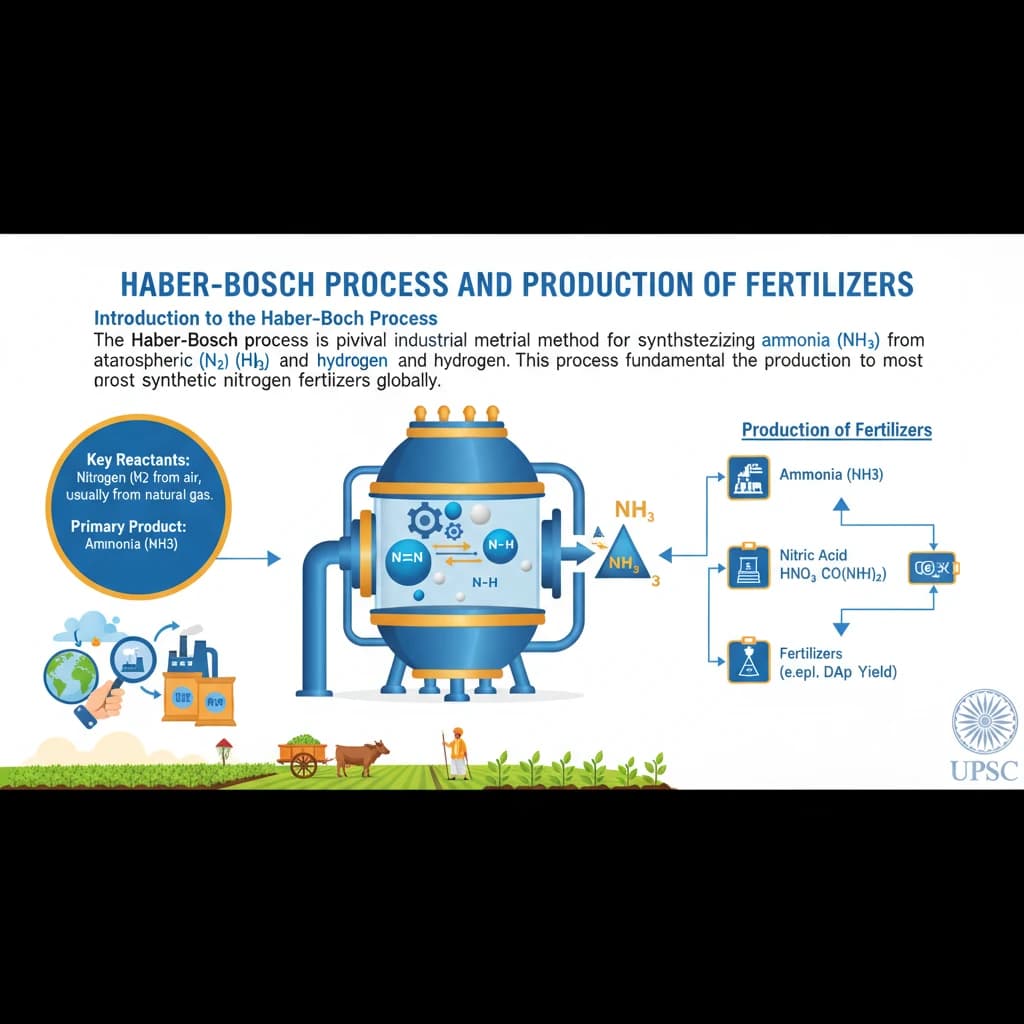
The Haber-Bosch process is a pivotal industrial method for synthesizing ammonia (NH3) from atmospheric nitrogen (N2) and hydrogen (H2). This process is fundamental to the production of most synthetic nitrogen fertilizers globally.
Key Reactants: Nitrogen (N2) from air, Hydrogen (H2) usually from natural gas.
Primary Product: Ammonia (NH3).
Primary Product: Ammonia (NH3).
Mechanism of the Process
The process involves reacting nitrogen gas and hydrogen gas under specific conditions. These conditions include very high temperatures (typically 400-500°C) and high pressures (150-350 atmospheres), in the presence of an iron-based catalyst.
The chemical reaction is reversible, and the carefully controlled conditions are designed to maximize the yield of ammonia. The ammonia produced is then used as a direct fertilizer or as a precursor for other nitrogenous fertilizers.
Global Nitrogen Production and Impact
Through the Haber-Bosch process, an immense quantity of nitrogen is extracted from the atmosphere. Approximately hundred million tonnes of atmospheric nitrogen are transformed into fertilizer annually.
This industrial output results in the addition of about 140 million tonnes of reactive nitrogen to the soil each year. This figure highlights the massive scale and impact of the process on global agricultural productivity.
Reactive Nitrogen: Nitrogen compounds (like ammonia, nitrates) that are biologically active and can participate in biogeochemical cycles, unlike inert atmospheric N2.
Comparison with Natural Nitrogen Fixation
The contribution of the Haber-Bosch process to the global nitrogen cycle is comparable to, and often exceeds, natural processes. Natural biological processes, such as those carried out by nitrogen-fixing bacteria, generate an estimated 100-140 million tonnes of reactive nitrogen annually.
This comparison underscores the profound human impact on the Earth's nitrogen cycle, significantly altering the availability of a crucial nutrient for plant growth.
For UPSC Mains GS-III, understanding the scale of the Haber-Bosch process and its comparison with natural cycles is crucial for questions on agriculture, environment, and food security.
💡 Key Takeaways
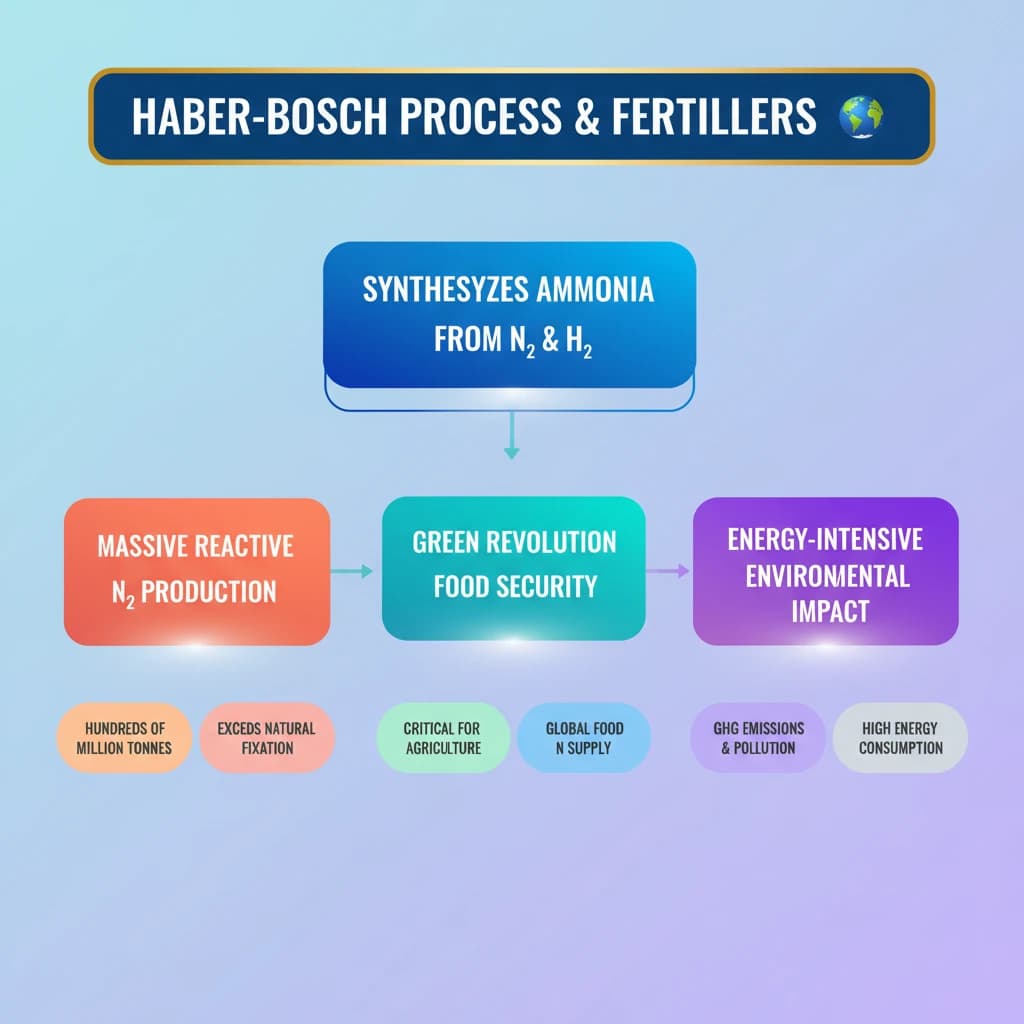
- •The Haber-Bosch process synthesizes ammonia from atmospheric nitrogen and hydrogen.
- •It produces hundreds of millions of tonnes of reactive nitrogen for fertilizers annually.
- •Its output is comparable to or exceeds natural biological nitrogen fixation.
- •The process was critical for the Green Revolution, ensuring global food security.
- •It is energy-intensive and contributes to greenhouse gas emissions and water pollution.
- •Government policies like fertilizer subsidies and Neem-coated Urea aim to manage its use.
🧠 Memory Techniques
95% Verified Content
📚 Reference Sources
•NCERT Chemistry Textbooks (Class 11 & 12)
•Environmental Science textbooks (e.g., Shankar IAS Environment)
•FAO reports on global fertilizer use and food security
•Academic articles on the Haber-Bosch process and its environmental impact