Loading page, please wait…
NITI Aayog Report on Seaweed Value Chain Development - UPSC Agriculture Allied Sector
What is NITI Aayog Report on Seaweed Value Chain Development in UPSC Agriculture Allied Sector?
NITI Aayog Report on Seaweed Value Chain Development is a key topic under Agriculture Allied Sector for UPSC Civil Services Examination. Key points include: NITI Aayog has outlined a strategy for developing India's seaweed value chain.. Seaweeds are primitive marine algae crucial for marine ecosystems and biodiversity.. Globally, East and Southeast Asia dominate seaweed cultivation, with Indonesia as a major producer.. Understanding this topic is essential for both UPSC Prelims and Mains preparation.
Why is NITI Aayog Report on Seaweed Value Chain Development important for UPSC exam?
NITI Aayog Report on Seaweed Value Chain Development is a Medium-level topic in UPSC Agriculture Allied Sector. It is tested in both Prelims (factual MCQs) and Mains (analytical answer writing). Previous year UPSC questions have frequently covered aspects of NITI Aayog Report on Seaweed Value Chain Development, making it essential for comprehensive IAS preparation.
How to prepare NITI Aayog Report on Seaweed Value Chain Development for UPSC?
To prepare NITI Aayog Report on Seaweed Value Chain Development for UPSC: (1) Study the comprehensive notes covering all key concepts on Vaidra. (2) Practice previous year questions on this topic. (3) Connect it with current affairs using daily updates. (4) Revise using key takeaways and mind maps available for Agriculture Allied Sector. (5) Write practice answers linking NITI Aayog Report on Seaweed Value Chain Development to related GS Paper topics.
Key takeaways of NITI Aayog Report on Seaweed Value Chain Development for UPSC
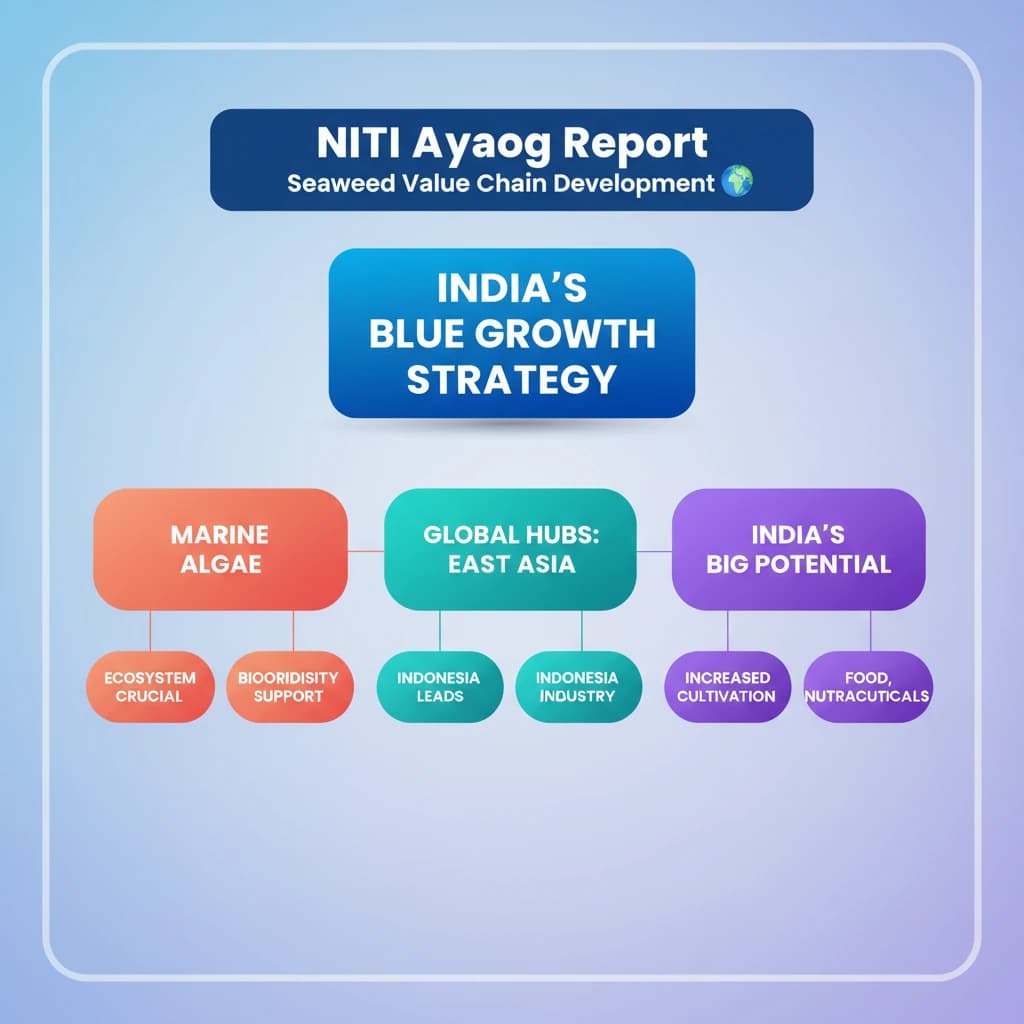
- NITI Aayog has outlined a strategy for developing India's seaweed value chain.
- Seaweeds are primitive marine algae crucial for marine ecosystems and biodiversity.
- Globally, East and Southeast Asia dominate seaweed cultivation, with Indonesia as a major producer.
- India currently harvests a small fraction of global seaweed but aims to significantly increase its contribution.
- Seaweeds offer diverse applications in food, nutraceuticals, and industrial hydrocolloids.
- Government initiatives like the Seaweed Mission and PMMSY are actively promoting seaweed cultivation.
- Developing the seaweed sector can boost coastal livelihoods, economic growth, and environmental sustainability.
NITI Aayog Report on Seaweed Value Chain Development
Medium⏱️ 8 min read
agriculture allied sector
📖 Introduction
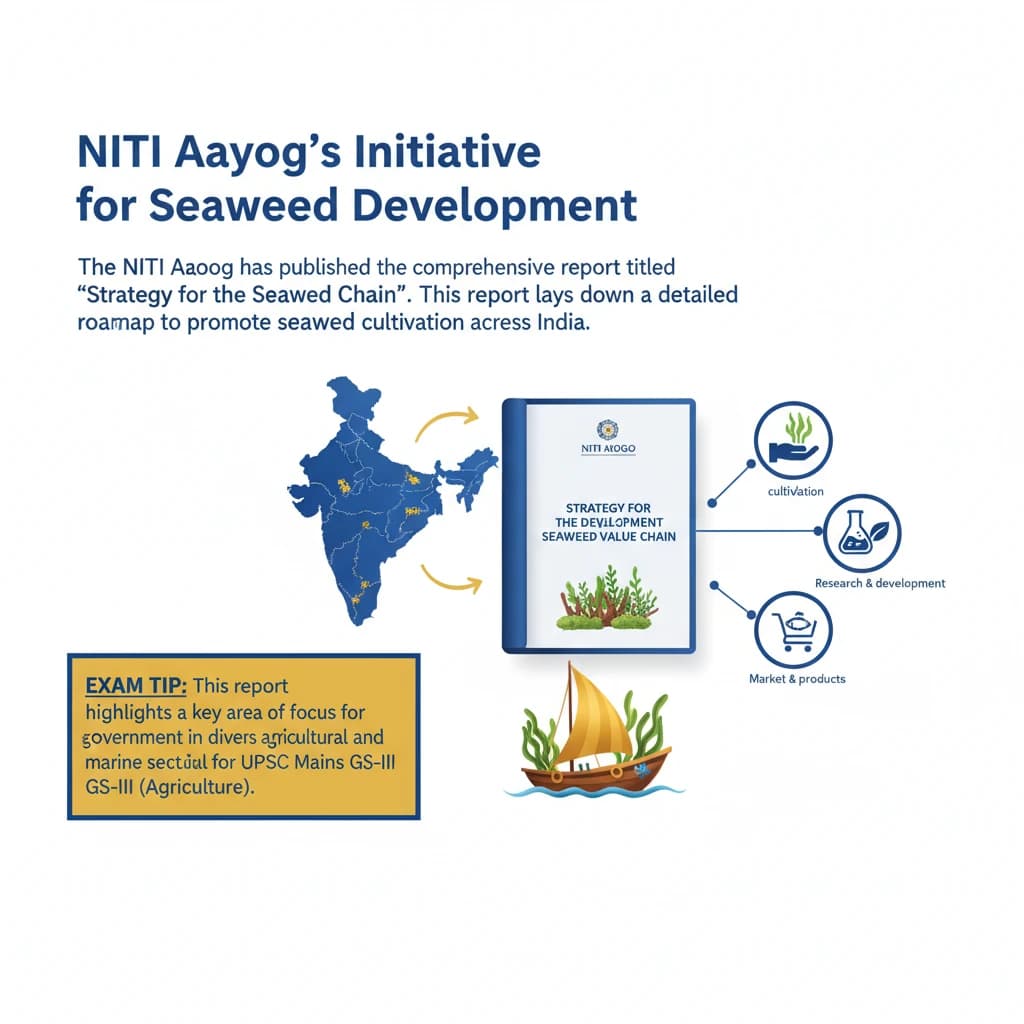
NITI Aayog's Initiative for Seaweed Development
The NITI Aayog has published a comprehensive report titled “Strategy for the development of Seaweed Value Chain”. This report lays down a detailed roadmap to promote seaweed cultivation across India.
This report highlights a key area of focus for the government in diversifying the agricultural and marine sectors, crucial for UPSC Mains GS-III (Agriculture, Economy, Environment).
Understanding Seaweeds: Definition and Ecology
Seaweeds are primitive, marine non-flowering algae that lack true roots, stems, and leaves. They play a fundamental role in marine ecosystems, contributing significantly to biodiversity and marine health.
Key Characteristics of Seaweeds:
- Primitive Algae: Belong to the group of non-flowering marine algae.
- Basic Structure: No differentiated roots, stems, or leaves.
- Ecological Role: Form dense underwater forests (kelp forests) which serve as nurseries for fish, snails, and sea urchins.
Common species found include Gelidiella acerosa, Gracilaria edulis, Gracilaria crassa, Gracilaria verrucosa, Sargassum spp., and Turbinaria spp. Seaweeds are broadly classified into three main groups based on their pigmentation:
- Green Algae (Chlorophyta)
- Brown Algae (Phaeophyta)
- Red Algae (Rhodophyta)
Global Seaweed Production Scenario
The global seaweed industry is a significant marine economic activity. In 2019, the total global seaweed production (combining cultivation and wild collection) reached approximately 35.8 million tonnes.
Global Production Snapshot (2019):
- Total Production: 35.8 million tonnes
- Wild Collection: 1.1 million tonnes
- Dominant Regions (Cultivation): Eastern and Southeastern Asia (account for 97.4% of global production).
- Dominant Regions (Wild Collection): Americas and Europe.
- Leading Producer Nation: Indonesia.
- Key Farmed Species: Kappaphycus alvarezii and Eucheuma denticulatum (27.8% of farmed production).
The seaweed industry is projected to experience continued growth, with a Compound Annual Growth Rate (CAGR) of 2.3% from 2022 to 2030.
Indian Seaweed Production and Economic Contribution
India possesses substantial potential for seaweed cultivation, though its current contribution to global production is modest. Annually, India harvests approximately 33,345 tonnes (wet weight) of seaweeds.
Indian Seaweed Statistics:
- Annual Harvest: ~33,345 tonnes (wet weight) from natural beds.
- Primary Harvesting State: Tamil Nadu, involving around 5,000 families.
- Annual Revenue: Approximately Rs 200 crores.
- Global Share: Less than 1% of global production.
The Indian government aims to significantly increase the contribution of the allied sector to agriculture. The target is to raise the allied sector’s share of Gross Value Added (GVA) in agriculture to 9% by 2024-25, up from 7.26% in 2018-19.
Global Seaweed Trade Dynamics
The global seaweed market is a thriving sector, valued at USD 9.9 billion in 2021. International trade in seaweed and its derivatives is dominated by a few key players.
Major Trading Nations (2021):
- Key Exporters/Importers: China, Indonesia, the Philippines, the Republic of Korea, and Malaysia.
- Leading Exporter: Republic of Korea (over 30% market share).
- Leading Producer of Hydrocolloids: China (over 30% market share).
Hydrocolloids are thickening and gelling agents derived from various types of seaweed, widely used in food, pharmaceutical, and cosmetic industries.
Major Seaweed Beds in India
India's extensive coastline and island territories host abundant seaweed resources. These natural beds are crucial for both wild collection and potential cultivation expansion.
Key Seaweed Resource Locations in India:
- Mainland Coasts: Tamil Nadu and Gujarat.
- Island Territories: Lakshadweep and the Andaman & Nicobar Islands.
- Specific Notable Beds: Mumbai, Ratnagiri, Goa, Karwar, Varkala, Vizhinjam, Pulicat (Tamil Nadu), Andhra Pradesh, and Chilka (Orissa).
Government Initiatives for Seaweed Development
Recognizing the potential of the seaweed sector, the Indian government has launched several initiatives to promote its cultivation, processing, and commercialization.
- Seaweed Mission (Launched 2021):
This mission aims to commercialize seaweed farming and processing, focusing on value addition. It also seeks to expand cultivation along India’s extensive 7,500-kilometre coastline.
- Pradhan Mantri Matsya Sampada Yojana (PMMSY):
The government is leveraging the existing PMMSY scheme to promote seaweed cultivation across the country, integrating it into broader fisheries development goals.
- Commercialisation of Seaweed Products by ICAR-CMFRI:
The Indian Council of Agricultural Research (ICAR) - Central Marine Fisheries Research Institute (CMFRI) has successfully commercialized two significant seaweed-based nutraceutical products:
- CadalminTM Immunalgin extract (CadalminTM IMe)
- CadalminTM Antihypercholesterolemic extract (CadalminTM Ace)
These initiatives underscore India's commitment to harnessing its marine resources for economic growth, livelihood generation, and nutritional security.
💡 Key Takeaways
- •NITI Aayog has outlined a strategy for developing India's seaweed value chain.
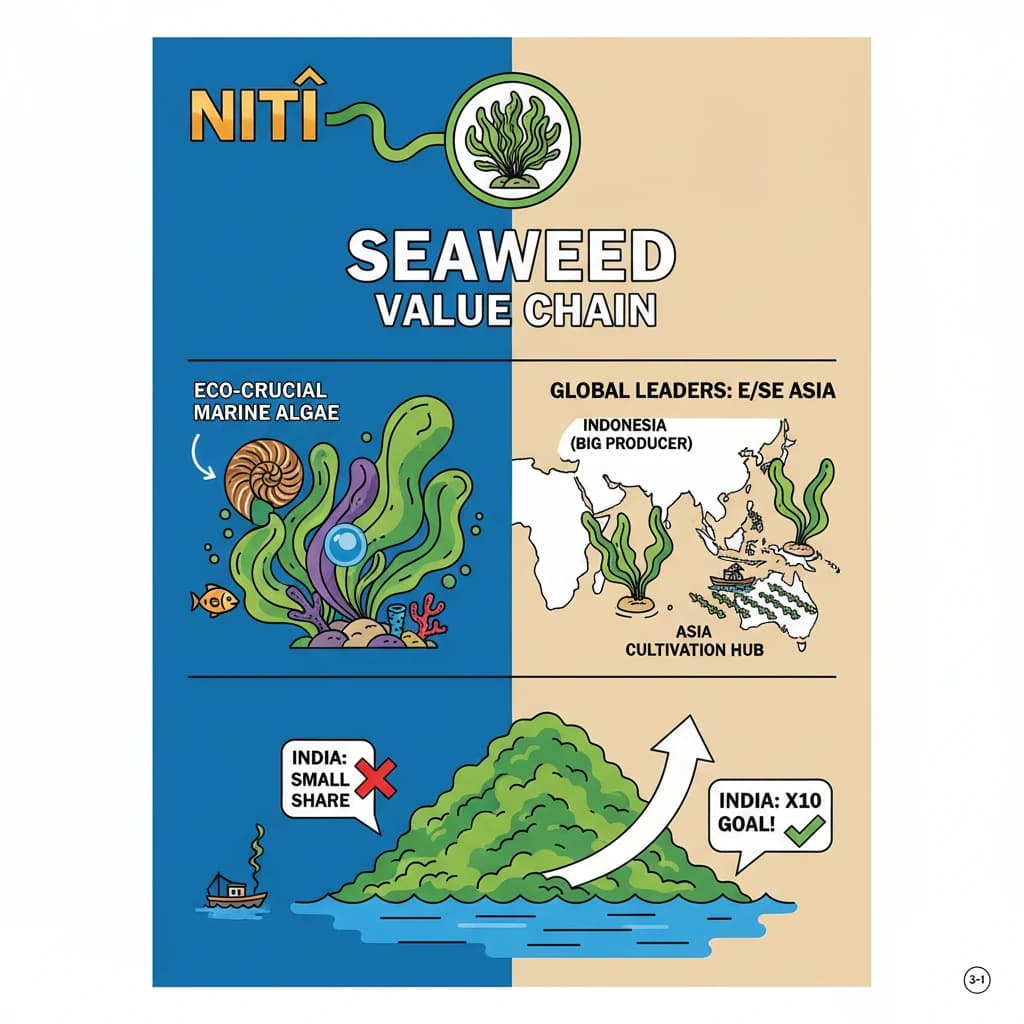
- •Seaweeds are primitive marine algae crucial for marine ecosystems and biodiversity.
- •Globally, East and Southeast Asia dominate seaweed cultivation, with Indonesia as a major producer.
- •India currently harvests a small fraction of global seaweed but aims to significantly increase its contribution.
- •Seaweeds offer diverse applications in food, nutraceuticals, and industrial hydrocolloids.
- •Government initiatives like the Seaweed Mission and PMMSY are actively promoting seaweed cultivation.
- •Developing the seaweed sector can boost coastal livelihoods, economic growth, and environmental sustainability.
🧠 Memory Techniques
95% Verified Content