Loading page, please wait…
Pests of Cotton - UPSC Agriculture Allied Sector
What is Pests of Cotton in UPSC Agriculture Allied Sector?
Pests of Cotton is a key topic under Agriculture Allied Sector for UPSC Civil Services Examination. Key points include: Cotton is a major kharif crop requiring 6-8 months to mature with specific temperature and rainfall needs.. Key insect pests include bollworms, whiteflies, aphids, tobacco caterpillar, and mealy bugs, each with distinct symptoms.. Black cotton soil is ideal for cultivation, and the crop is sensitive to waterlogging.. Understanding this topic is essential for both UPSC Prelims and Mains preparation.
Why is Pests of Cotton important for UPSC exam?
Pests of Cotton is a Medium-level topic in UPSC Agriculture Allied Sector. It is tested in both Prelims (factual MCQs) and Mains (analytical answer writing). Previous year UPSC questions have frequently covered aspects of Pests of Cotton, making it essential for comprehensive IAS preparation.
How to prepare Pests of Cotton for UPSC?
To prepare Pests of Cotton for UPSC: (1) Study the comprehensive notes covering all key concepts on Vaidra. (2) Practice previous year questions on this topic. (3) Connect it with current affairs using daily updates. (4) Revise using key takeaways and mind maps available for Agriculture Allied Sector. (5) Write practice answers linking Pests of Cotton to related GS Paper topics.
Key takeaways of Pests of Cotton for UPSC
- Cotton is a major kharif crop requiring 6-8 months to mature with specific temperature and rainfall needs.
- Key insect pests include bollworms, whiteflies, aphids, tobacco caterpillar, and mealy bugs, each with distinct symptoms.
- Black cotton soil is ideal for cultivation, and the crop is sensitive to waterlogging.
- India has three major cotton growing zones: Northern, Central, and Southern.
- Cotton is economically significant as the primary textile fibre source and for cottonseed oil, India's third-largest domestic vegetable oil.
- Government initiatives like Kasturi Cotton, MSP, CCI, and NFSM-CC support the cotton sector.
- Effective pest management is crucial for maintaining yield and lint quality in cotton farming.
Pests of Cotton
Medium⏱️ 10 min read
agriculture allied sector
📖 Introduction
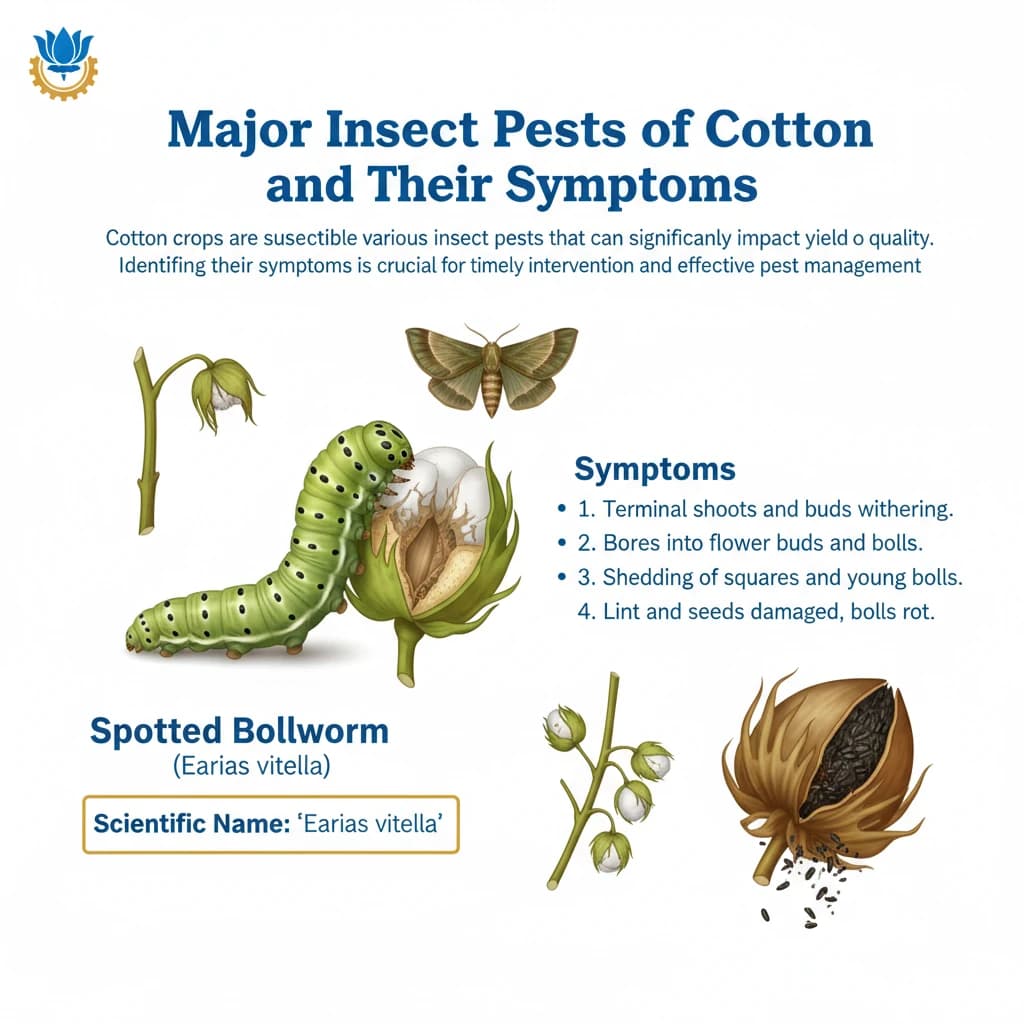
Major Insect Pests of Cotton and Their Symptoms
Cotton crops are susceptible to various insect pests that can significantly impact yield and quality. Identifying their symptoms is crucial for timely intervention and effective pest management.
Spotted Bollworm (Earias vitella)
The Spotted Bollworm is a notorious pest causing damage to cotton plants at different growth stages.
Scientific Name: Earias vitella
- Initially, it causes central shoots to dry, wither, and drop down.
- Later, the larvae bore into flower buds and bolls, leading to their shredding and destruction.
American Bollworm (Helicoverpa armigera)
The American Bollworm is another major pest, known for its destructive feeding habits on cotton.
Scientific Name: Helicoverpa armigera
- A characteristic symptom is the flaring up of bracts, which are the leaf-like structures surrounding the flower bud.
- It creates bore holes on squares (immature flower buds) that are typically filled with frass (insect excrement).
Tobacco Caterpillar (Spodoptera litura)
The Tobacco Caterpillar can cause severe defoliation, impacting the plant's photosynthetic capacity.
Scientific Name: Spodoptera litura
- Symptoms include irregular bore holes on leaves.
- It leads to skeletonization of leaves, where only the veins remain.
- Heavy infestation results in significant defoliation of the plant.
White Fly (Bemisia tabaci)
The White Fly is a sap-sucking insect that can cause multiple issues, including reduced lint quality.
Scientific Name: Bemisia tabaci
- Both nymphs and adults suck sap from the leaves, weakening the plant.
- Infestation results in low quality lint.
- In severe cases, it can lead to premature boll shedding.
Cotton Aphid (Aphis gossypii)
Cotton Aphids are small, soft-bodied insects that feed on plant sap and excrete honeydew.
Scientific Name: Aphis gossypii
- Both nymphs and adults suck sap from the leaves.
- Their feeding leads to a shiny appearance on leaves due to the secretion of honeydew.
Cotton Mealy Bug (Phenacoccus solenopsis)
The Cotton Mealy Bug is a relatively newer pest that can cause significant damage and stunting.
Scientific Name: Phenacoccus solenopsis
- Symptoms include the formation of bushy shoots.
- At an early stage of cotton planting, crop senescence (premature ageing) may be observed.
- The honeydew secreted by mealy bugs often leads to the growth of sooty mould.
Cotton Growing Conditions
Cotton is a vital kharif crop that requires specific climatic conditions for optimal growth and maturation.
Crop Cycle: Requires 6 to 8 months to mature.
Ideal conditions include a long, sunny, and frost-free period.
- Temperature: Best between 21-30°C.
- Rainfall: Around 50-100 cm. It thrives in warm and humid environments.
Soil Requirements for Cotton
Cotton can be cultivated in a diverse range of soils, but certain types are more conducive to its growth.
The most ideal soil for cotton cultivation is black cotton soil.
It can tolerate a wide pH range of 5.5 to 8.5. However, cotton plants are highly sensitive to waterlogging conditions.
Geographic Distribution of Cotton in India
India is a major global producer of cotton, with cultivation spread across distinct agro-climatic zones.
- Northern Zone: Key states include Punjab, Haryana, and Rajasthan.
- Central Zone: Comprises Gujarat, Maharashtra, and Madhya Pradesh.
- Southern Zone: Includes Telangana, Andhra Pradesh, Karnataka, and Tamil Nadu.
Economic Significance: India's "White-Gold"
Cotton holds immense economic importance for India, impacting both agriculture and industry.
Cotton is often referred to as “White-Gold” due to its significant economic contribution.
It serves as the primary source for the textile industry, accounting for approximately two-thirds of India’s total textile fibre consumption.
India is a global leader in cotton production, contributing about 25% of the world's total cotton output.
Beyond fibre, cotton provides valuable by-products:
- Cottonseed oil: Used for cooking and is India’s third-largest domestically-produced vegetable oil.
- Cottonseed cake/meal: Utilized as feed for livestock and poultry.
Government Initiatives for Cotton Sector
The Indian government has implemented several initiatives to support cotton farmers and enhance the sector's productivity and quality.
- Kasturi Cotton: A branding and certification initiative to establish Indian cotton as a premium product globally.
- Minimum Support Price (MSP): Ensures a guaranteed price for cotton, protecting farmers from market fluctuations.
- Cotton Corporation of India (CCI): A public sector undertaking responsible for procurement, distribution, and price stabilization of cotton.
- National Food Security Mission - Commercial Crops (NFSM-CC): Aims to increase production and productivity of various commercial crops, including cotton, through area expansion and improved technologies.
💡 Key Takeaways
- •Cotton is a major kharif crop requiring 6-8 months to mature with specific temperature and rainfall needs.
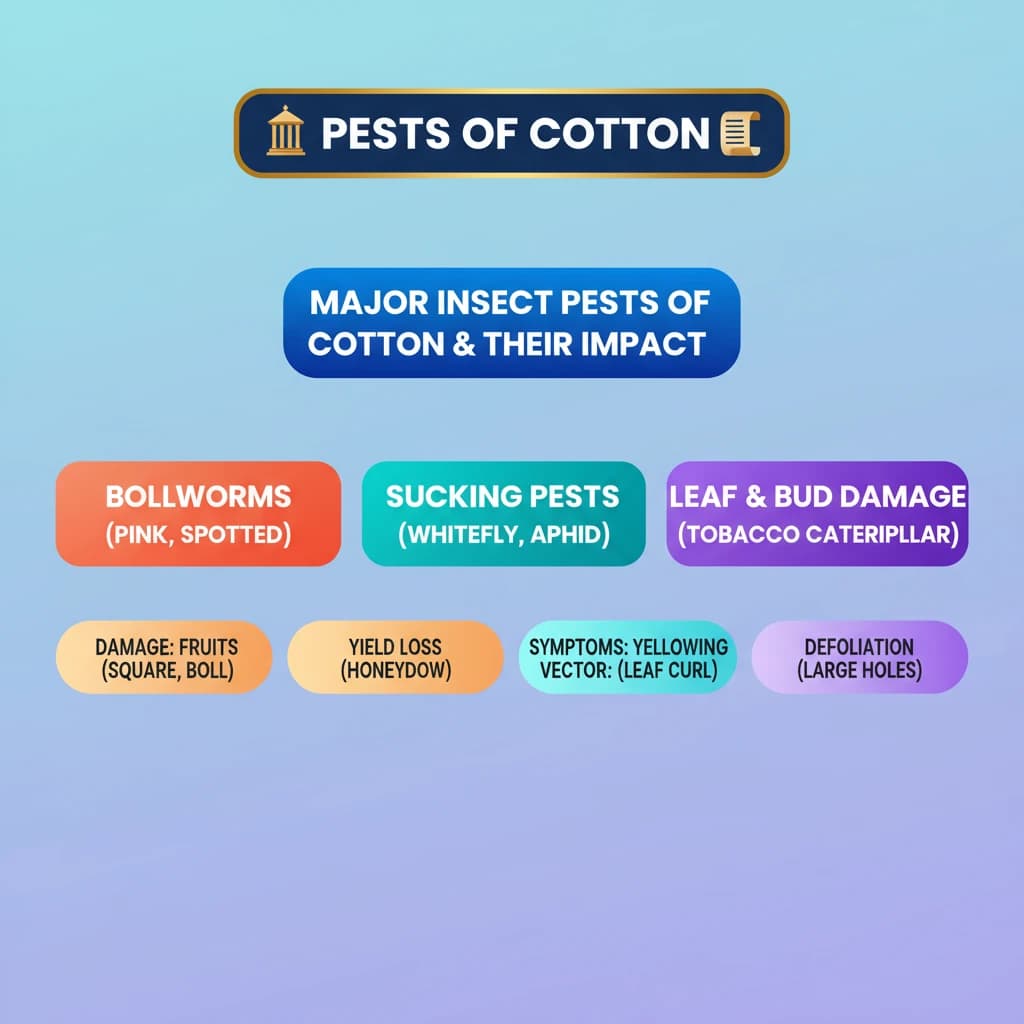
- •Key insect pests include bollworms, whiteflies, aphids, tobacco caterpillar, and mealy bugs, each with distinct symptoms.
- •Black cotton soil is ideal for cultivation, and the crop is sensitive to waterlogging.
- •India has three major cotton growing zones: Northern, Central, and Southern.
- •Cotton is economically significant as the primary textile fibre source and for cottonseed oil, India's third-largest domestic vegetable oil.
- •Government initiatives like Kasturi Cotton, MSP, CCI, and NFSM-CC support the cotton sector.
- •Effective pest management is crucial for maintaining yield and lint quality in cotton farming.
🧠 Memory Techniques

95% Verified Content
📚 Reference Sources
•Ministry of Agriculture & Farmers Welfare, Government of India reports
•NCERT Textbooks (Geography, Economics)
•Indian Council of Agricultural Research (ICAR) publications