Loading page, please wait…
Protection of Plant Varieties and Farmers’ Rights Act, 2001 - UPSC Agriculture Allied Sector
What is Protection of Plant Varieties and Farmers’ Rights Act, 2001 in UPSC Agriculture Allied Sector?
Protection of Plant Varieties and Farmers’ Rights Act, 2001 is a key topic under Agriculture Allied Sector for UPSC Civil Services Examination. Key points include: The PPV&FRA, 2001, protects new plant varieties and the rights of breeders and farmers.. Breeders get exclusive rights for production, sale, marketing, distribution, import, and export of protected varieties.. Researchers can use registered varieties for experimentation and developing new varieties.. Understanding this topic is essential for both UPSC Prelims and Mains preparation.
Why is Protection of Plant Varieties and Farmers’ Rights Act, 2001 important for UPSC exam?
Protection of Plant Varieties and Farmers’ Rights Act, 2001 is a Medium-level topic in UPSC Agriculture Allied Sector. It is tested in both Prelims (factual MCQs) and Mains (analytical answer writing). Previous year UPSC questions have frequently covered aspects of Protection of Plant Varieties and Farmers’ Rights Act, 2001, making it essential for comprehensive IAS preparation.
How to prepare Protection of Plant Varieties and Farmers’ Rights Act, 2001 for UPSC?
To prepare Protection of Plant Varieties and Farmers’ Rights Act, 2001 for UPSC: (1) Study the comprehensive notes covering all key concepts on Vaidra. (2) Practice previous year questions on this topic. (3) Connect it with current affairs using daily updates. (4) Revise using key takeaways and mind maps available for Agriculture Allied Sector. (5) Write practice answers linking Protection of Plant Varieties and Farmers’ Rights Act, 2001 to related GS Paper topics.
Key takeaways of Protection of Plant Varieties and Farmers’ Rights Act, 2001 for UPSC
- The PPV&FRA, 2001, protects new plant varieties and the rights of breeders and farmers.
- Breeders get exclusive rights for production, sale, marketing, distribution, import, and export of protected varieties.
- Researchers can use registered varieties for experimentation and developing new varieties.
- Farmers who develop new varieties can register them, similar to breeders.
- Farmers retain the right to save, use, exchange, share, or sell their farm produce, including protected varieties, with conditions.
- The Act provides compensation to farmers if protected varieties fail to perform as claimed.
- Farmers are exempt from paying fees in legal proceedings under the Act.
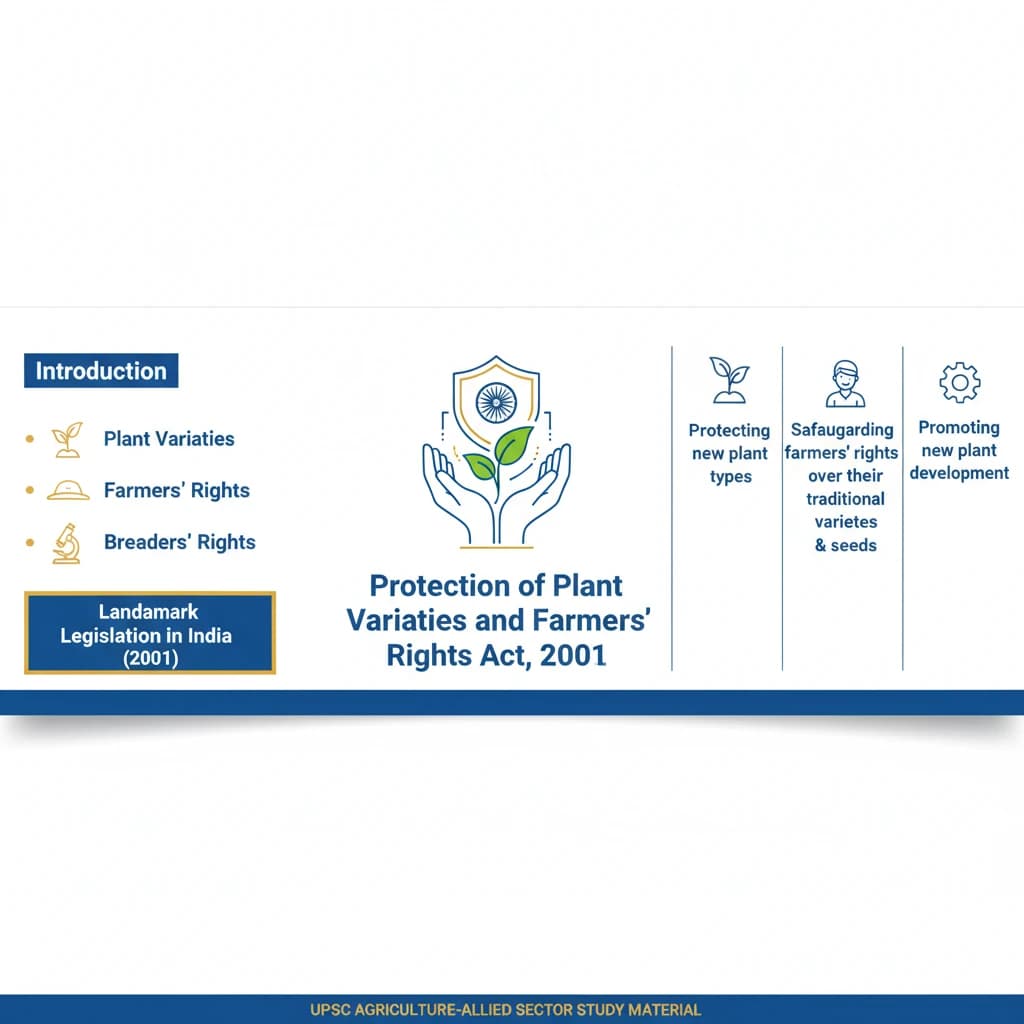
Protection of Plant Varieties and Farmers’ Rights Act, 2001
Medium⏱️ 7 min read
agriculture allied sector
📖 Introduction
Introduction to the Protection of Plant Varieties and Farmers’ Rights Act, 2001
The Protection of Plant Varieties and Farmers’ Rights Act (PPV&FRA), 2001, is a landmark legislation in India. It aims to establish an effective system for the protection of plant varieties, the rights of farmers and plant breeders, and to encourage the development of new varieties of plants.
This Act is crucial for balancing intellectual property rights in agriculture with the traditional rights of farmers. It aligns with India's commitments under the TRIPS Agreement and the International Treaty on Plant Genetic Resources for Food and Agriculture (ITPGRFA).
Breeders' Rights under PPV&FRA
The Act grants specific exclusive rights to breeders whose new plant varieties are registered. These rights are designed to incentivize innovation and investment in plant breeding.
- Production: Breeders have the sole right to produce the propagating material of their protected variety.
- Sale and Marketing: They control the sale and marketing of the protected variety.
- Distribution: The distribution of the variety falls under their exclusive purview.
- Import and Export: Breeders hold the exclusive right to import and export their registered plant varieties.
Objective: To provide a robust legal framework that encourages private sector investment in agricultural research and development, similar to patent protection in other industries.
Researchers' Rights under PPV&FRA
To foster further scientific advancement, the Act includes provisions for researchers' rights. This ensures that registered varieties can be utilized for academic and developmental purposes without undue restrictions.
- Experimentation: Researchers are permitted to use registered varieties for experimentation.
- Research Purposes: The Act allows the use of protected varieties for conducting further research, including developing new varieties.
This provision prevents monopolies from hindering scientific progress, striking a balance between protecting breeders' rights and promoting public good through research.
Farmers' Rights under PPV&FRA
The PPV&FRA, 2001, uniquely recognizes and protects the traditional rights and contributions of farmers. This is a distinguishing feature compared to many international intellectual property regimes.
Registration and Protection for Farmers
Farmers who have played a role in evolving or developing new plant varieties are entitled to similar recognition as traditional breeders. They can apply for registration and protection of their unique varieties.
Example: A farmer developing a drought-resistant local landrace through generations of selection can get it registered under the Act.
Traditional Practices and Use of Produce
The Act safeguards the traditional practices of farmers regarding their farm produce. This is a critical aspect for ensuring food security and preserving agricultural diversity.
- Save: Farmers can save seeds from their harvest.
- Use: They can use these saved seeds for subsequent plantings.
- Exchange: Farmers are allowed to exchange seeds with other farmers.
- Share: They can share their farm produce, including protected varieties.
- Sell: Farmers can sell their farm produce, including seeds of protected varieties, subject to certain conditions (e.g., not as branded seed).
Recognition and Rewards for Conservation
The Act acknowledges the invaluable role farmers play in preserving genetic diversity. It provides for recognition and rewards for their efforts in conserving plant genetic resources.
UPSC often asks about the unique provisions for farmers' rights. Highlighting compensation, fee exemptions, and the right to save/sell produce is essential for answers in GS-III Agriculture.
Compensation for Non-Performance
To protect farmers from potential losses, the Act includes provisions for compensation. If a protected variety fails to perform as claimed by the breeder, farmers can seek redressal.
Condition: If the seed of a protected variety does not conform to the claimed characteristics of the variety, the farmer is entitled to compensation.
Exemption from Fees
Recognizing the economic realities of farmers, the Act provides significant financial relief in legal proceedings. Farmers are exempt from paying fees in any proceedings under the Act.
- This applies to proceedings before relevant authorities (e.g., the PPV&FRA Authority).
- It also extends to proceedings before courts, ensuring access to justice.
💡 Key Takeaways
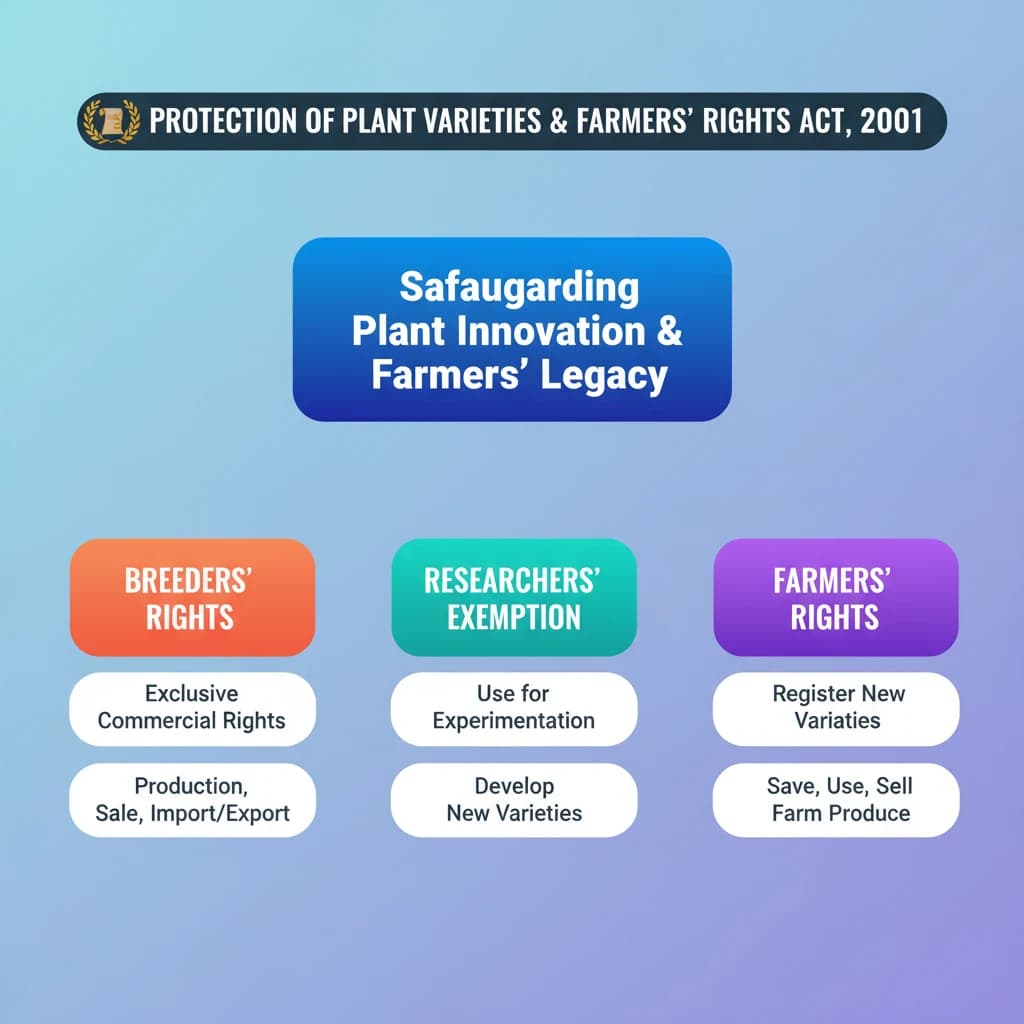
- •The PPV&FRA, 2001, protects new plant varieties and the rights of breeders and farmers.
- •Breeders get exclusive rights for production, sale, marketing, distribution, import, and export of protected varieties.
- •Researchers can use registered varieties for experimentation and developing new varieties.
- •Farmers who develop new varieties can register them, similar to breeders.
- •Farmers retain the right to save, use, exchange, share, or sell their farm produce, including protected varieties, with conditions.
- •The Act provides compensation to farmers if protected varieties fail to perform as claimed.
- •Farmers are exempt from paying fees in legal proceedings under the Act.
🧠 Memory Techniques

98% Verified Content
📚 Reference Sources
•Protection of Plant Varieties and Farmers' Rights Authority (PPV&FRA) website
•Drishti IAS notes on Agriculture Allied Sector