Loading page, please wait…
What are India’s Initiatives for Floriculture? - UPSC Agriculture Allied Sector
What is What are India’s Initiatives for Floriculture? in UPSC Agriculture Allied Sector?
What are India’s Initiatives for Floriculture? is a key topic under Agriculture Allied Sector for UPSC Civil Services Examination. Key points include: APEDA supports floriculture exports with infrastructure, cold storage, and freight subsidies.. The CSIR Floriculture Mission aims to boost farmer income and entrepreneurship using technology in 22 states.. India allows 100% FDI in floriculture via the automatic route to attract foreign investment.. Understanding this topic is essential for both UPSC Prelims and Mains preparation.
Why is What are India’s Initiatives for Floriculture? important for UPSC exam?
What are India’s Initiatives for Floriculture? is a Easy-level topic in UPSC Agriculture Allied Sector. It is tested in both Prelims (factual MCQs) and Mains (analytical answer writing). Previous year UPSC questions have frequently covered aspects of What are India’s Initiatives for Floriculture?, making it essential for comprehensive IAS preparation.
How to prepare What are India’s Initiatives for Floriculture? for UPSC?
To prepare What are India’s Initiatives for Floriculture? for UPSC: (1) Study the comprehensive notes covering all key concepts on Vaidra. (2) Practice previous year questions on this topic. (3) Connect it with current affairs using daily updates. (4) Revise using key takeaways and mind maps available for Agriculture Allied Sector. (5) Write practice answers linking What are India’s Initiatives for Floriculture? to related GS Paper topics.
Key takeaways of What are India’s Initiatives for Floriculture? for UPSC
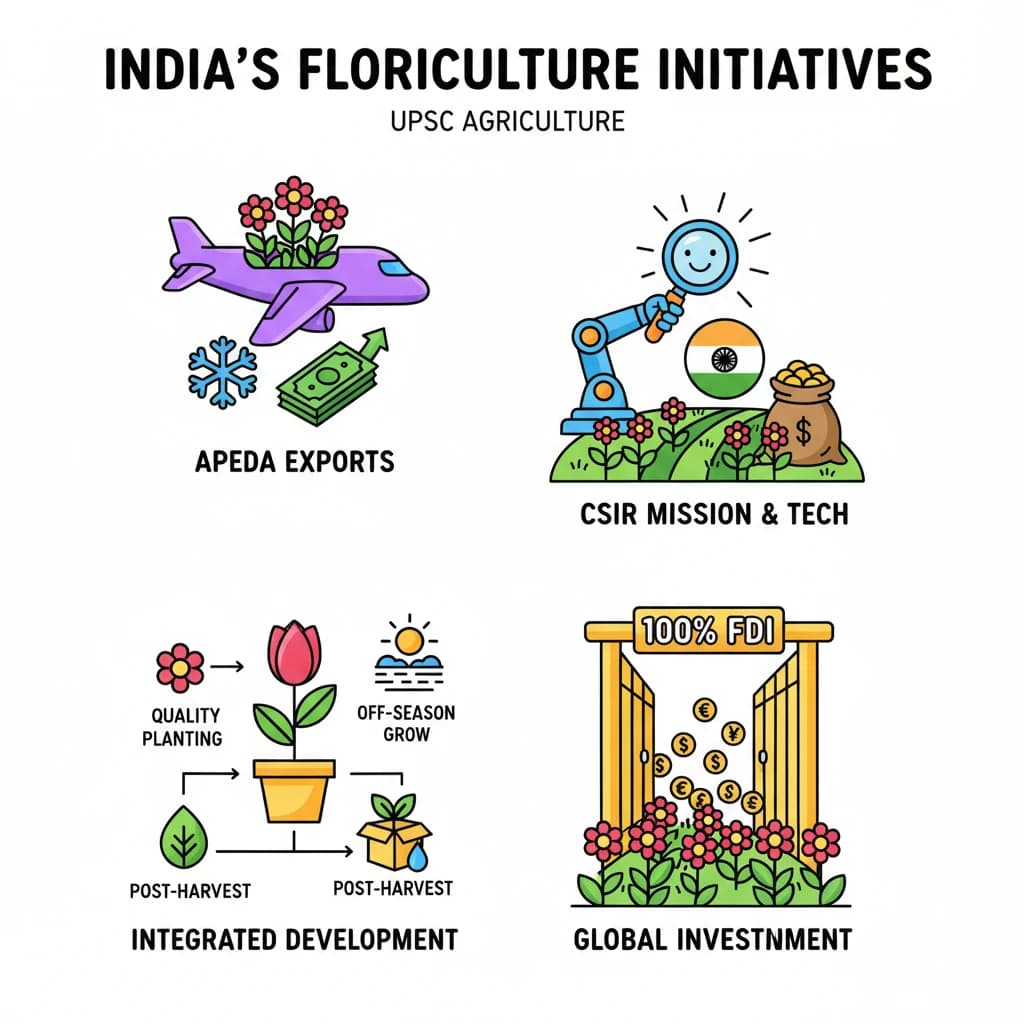
- APEDA supports floriculture exports with infrastructure, cold storage, and freight subsidies.
- The CSIR Floriculture Mission aims to boost farmer income and entrepreneurship using technology in 22 states.
- India allows 100% FDI in floriculture via the automatic route to attract foreign investment.
- The Integrated Development of Commercial Floriculture Scheme focuses on quality planting material, off-season cultivation, and post-harvest management.
- These initiatives collectively aim to transform floriculture into a high-value, export-oriented sector.
- Floriculture contributes to rural employment, crop diversification, and foreign exchange earnings.
What are India’s Initiatives for Floriculture?
Easy⏱️ 8 min read
agriculture allied sector
📖 Introduction
Introduction to India's Floriculture Initiatives
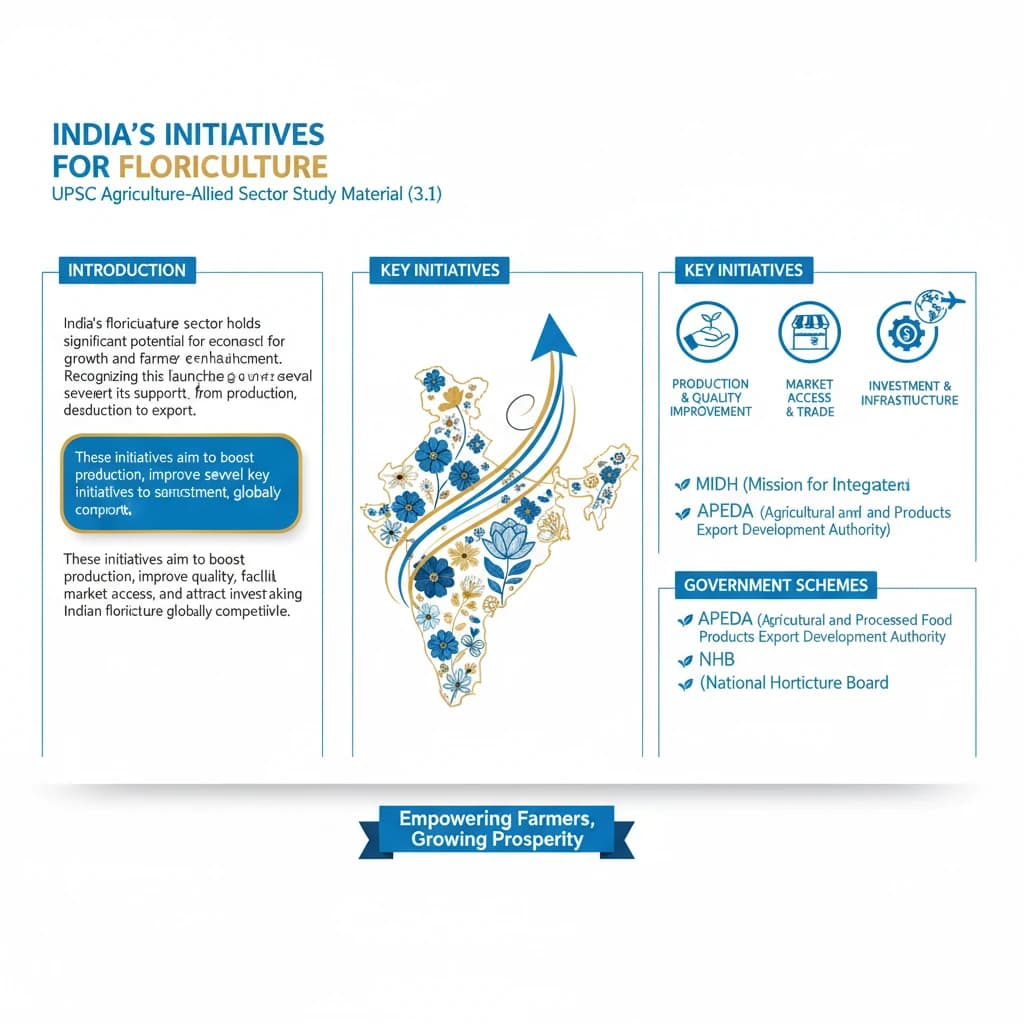
India's floriculture sector holds significant potential for economic growth and farmer income enhancement. Recognizing this, the government has launched several key initiatives to support its development, from production to export.
These initiatives aim to boost production, improve quality, facilitate market access, and attract investment, thereby making Indian floriculture globally competitive.
Agricultural and Processed Food Products Export Development Authority (APEDA)
The Agricultural and Processed Food Products Export Development Authority (APEDA) plays a crucial role in promoting the export of floricultural products from India. It provides comprehensive support to exporters.
- Infrastructure Development: APEDA assists in establishing essential infrastructure, such as pack houses and grading facilities.
- Cold Storage: It supports the creation and maintenance of cold storage facilities, vital for perishable floriculture products.
- Freight Subsidies: Exporters often receive freight subsidies to reduce transportation costs and enhance competitiveness in international markets.
APEDA's Mandate: To promote the export of agricultural and processed food products, including floriculture, by providing financial assistance, market intelligence, and quality assurance.
Council of Scientific & Industrial Research (CSIR) Floriculture Mission
The CSIR Floriculture Mission is a significant nation-wide program aimed at leveraging scientific expertise for floriculture development. It is being implemented across multiple states to bring tangible benefits to farmers.
Scope: This mission is active in 22 states across India, focusing on a broad geographical reach to maximize impact.
The primary objectives of this mission are to enhance the income of farmers and develop entrepreneurship. This is achieved through the promotion of high-value floriculture, utilizing advanced CSIR technologies and scientific interventions.
Foreign Direct Investment (FDI) in Floriculture
To encourage greater capital inflow and technological advancements, India has liberalized its policy regarding Foreign Direct Investment (FDI) in the floriculture sector. This policy aims to make the investment process streamlined and attractive for international players.
FDI Policy: 100% Foreign Direct Investment (FDI) is permitted under the automatic route in the floriculture sector.
The provision of 100% FDI under the automatic route significantly simplifies the investment process for foreign investors, removing the need for prior government approval. This ease of doing business is expected to attract more foreign capital and expertise.
Integrated Development of Commercial Floriculture Scheme
This scheme focuses on a holistic approach to develop commercial floriculture by addressing critical aspects of the value chain. It aims to improve both the quality and quantity of floricultural produce.
- Quality Planting Material: The scheme ensures access to high-quality planting material, which is fundamental for good yield and product quality.
- Off-season Cultivation: It promotes techniques and infrastructure for off-season cultivation, allowing farmers to fetch better prices.
- Post-harvest Management: Significant emphasis is placed on enhancing post-harvest management practices to reduce wastage and increase shelf life.
UPSC Insight: This scheme aligns with the government's broader goal of increasing farmer income and reducing post-harvest losses, a recurring theme in GS-III Agriculture.
💡 Key Takeaways
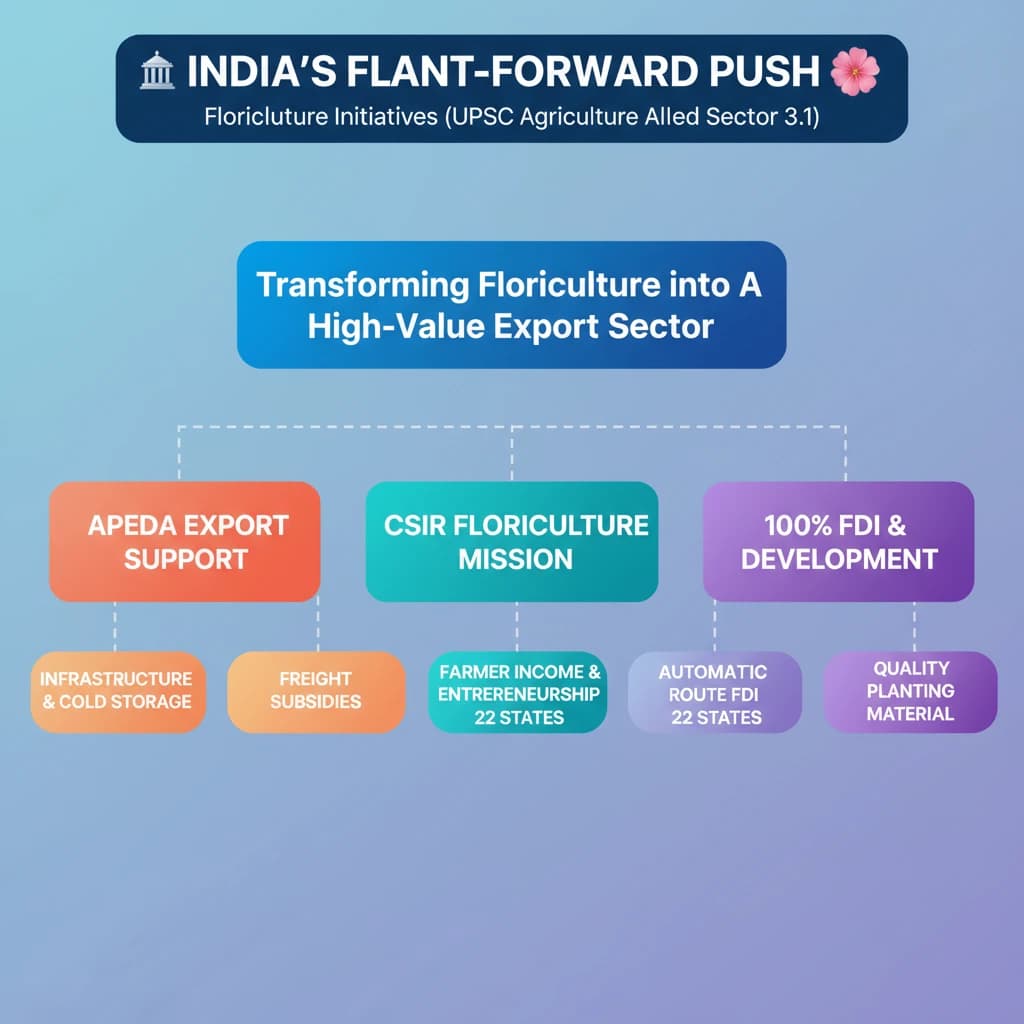
- •APEDA supports floriculture exports with infrastructure, cold storage, and freight subsidies.
- •The CSIR Floriculture Mission aims to boost farmer income and entrepreneurship using technology in 22 states.
- •India allows 100% FDI in floriculture via the automatic route to attract foreign investment.
- •The Integrated Development of Commercial Floriculture Scheme focuses on quality planting material, off-season cultivation, and post-harvest management.
- •These initiatives collectively aim to transform floriculture into a high-value, export-oriented sector.
- •Floriculture contributes to rural employment, crop diversification, and foreign exchange earnings.
🧠 Memory Techniques
95% Verified Content
📚 Reference Sources
•APEDA website (apeda.gov.in)
•CSIR website (csir.res.in)
•Department for Promotion of Industry and Internal Trade (DPIIT) FDI policy documents