Loading page, please wait…
What are the Recommendations of the NITI Aayog Report? - UPSC Agriculture Allied Sector
What is What are the Recommendations of the NITI Aayog Report? in UPSC Agriculture Allied Sector?
What are the Recommendations of the NITI Aayog Report? is a key topic under Agriculture Allied Sector for UPSC Civil Services Examination. Key points include: NITI Aayog recommends boosting oilseed development in Bundelkhand and the Indo-Gangetic Plain.. Sesame is prioritized for Bundelkhand to increase farmer incomes.. Soybean, rapeseed-mustard, and sunflower are suggested for the Indo-Gangetic Plain to improve profitability and address soil issues.. Understanding this topic is essential for both UPSC Prelims and Mains preparation.
Why is What are the Recommendations of the NITI Aayog Report? important for UPSC exam?
What are the Recommendations of the NITI Aayog Report? is a Medium-level topic in UPSC Agriculture Allied Sector. It is tested in both Prelims (factual MCQs) and Mains (analytical answer writing). Previous year UPSC questions have frequently covered aspects of What are the Recommendations of the NITI Aayog Report?, making it essential for comprehensive IAS preparation.
How to prepare What are the Recommendations of the NITI Aayog Report? for UPSC?
To prepare What are the Recommendations of the NITI Aayog Report? for UPSC: (1) Study the comprehensive notes covering all key concepts on Vaidra. (2) Practice previous year questions on this topic. (3) Connect it with current affairs using daily updates. (4) Revise using key takeaways and mind maps available for Agriculture Allied Sector. (5) Write practice answers linking What are the Recommendations of the NITI Aayog Report? to related GS Paper topics.
Key takeaways of What are the Recommendations of the NITI Aayog Report? for UPSC
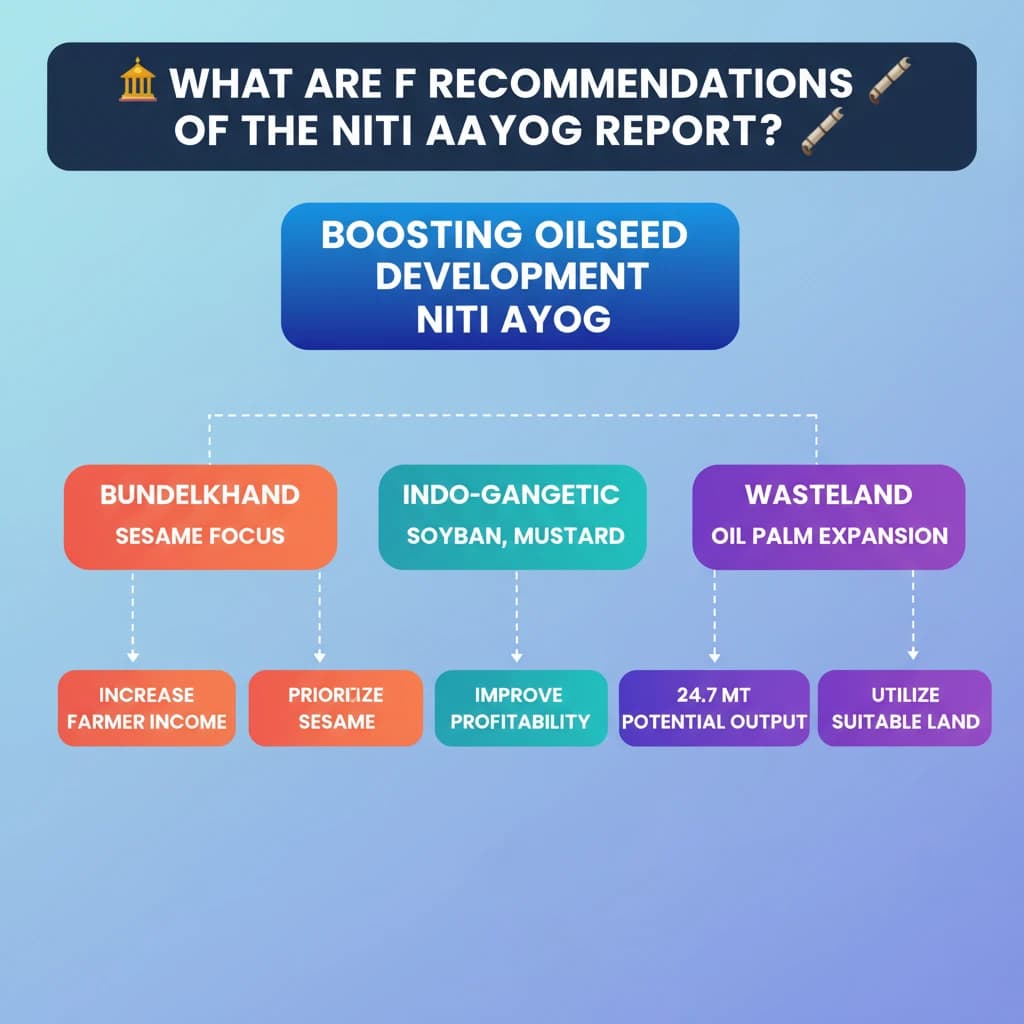
- NITI Aayog recommends boosting oilseed development in Bundelkhand and the Indo-Gangetic Plain.
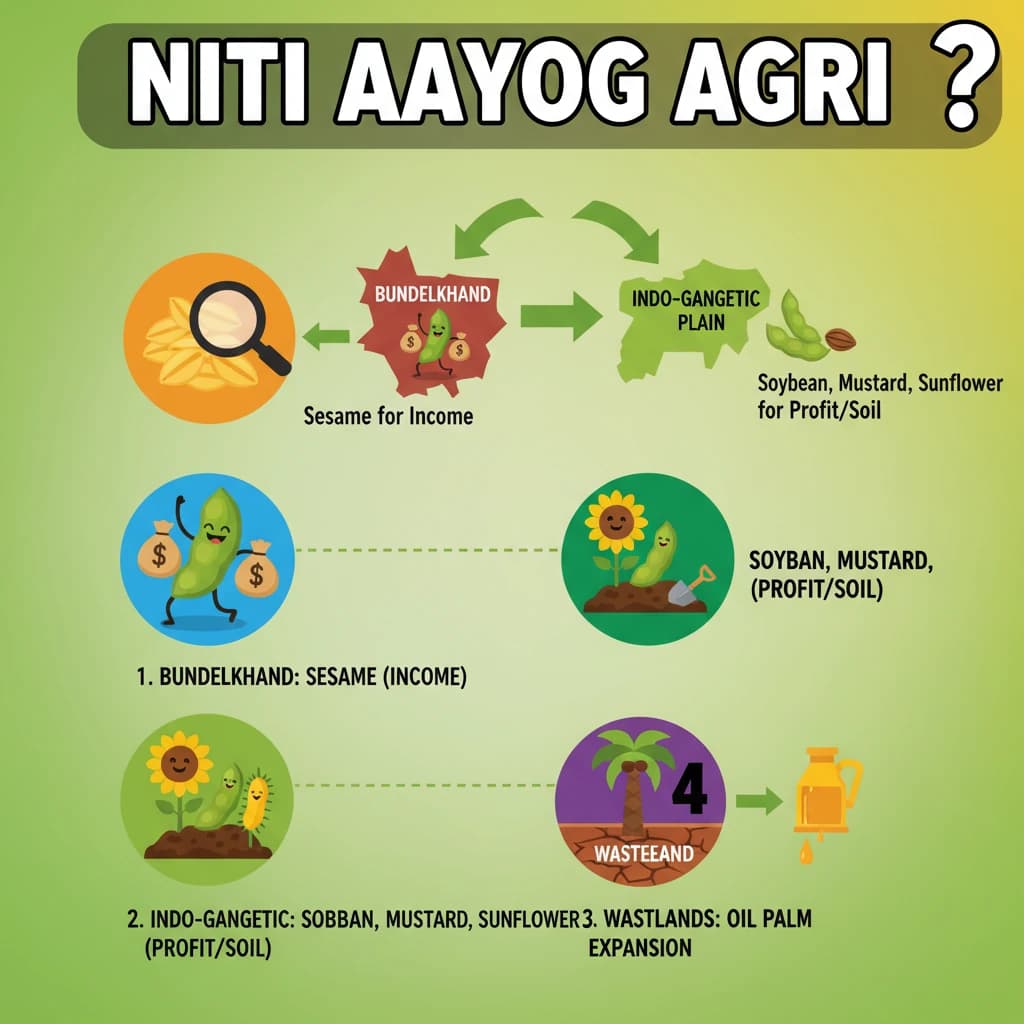
- Sesame is prioritized for Bundelkhand to increase farmer incomes.
- Soybean, rapeseed-mustard, and sunflower are suggested for the Indo-Gangetic Plain to improve profitability and address soil issues.
- Utilizing suitable wastelands for oil palm expansion is a key strategy.
- Oil palm cultivation on wastelands has the potential to add 24.7 MT to production.
- These recommendations aim to reduce India's edible oil import dependency and enhance farmer welfare.
- The strategies align with the broader goals of agricultural diversification and sustainable land use.
What are the Recommendations of the NITI Aayog Report?
Medium⏱️ 7 min read
agriculture allied sector
📖 Introduction
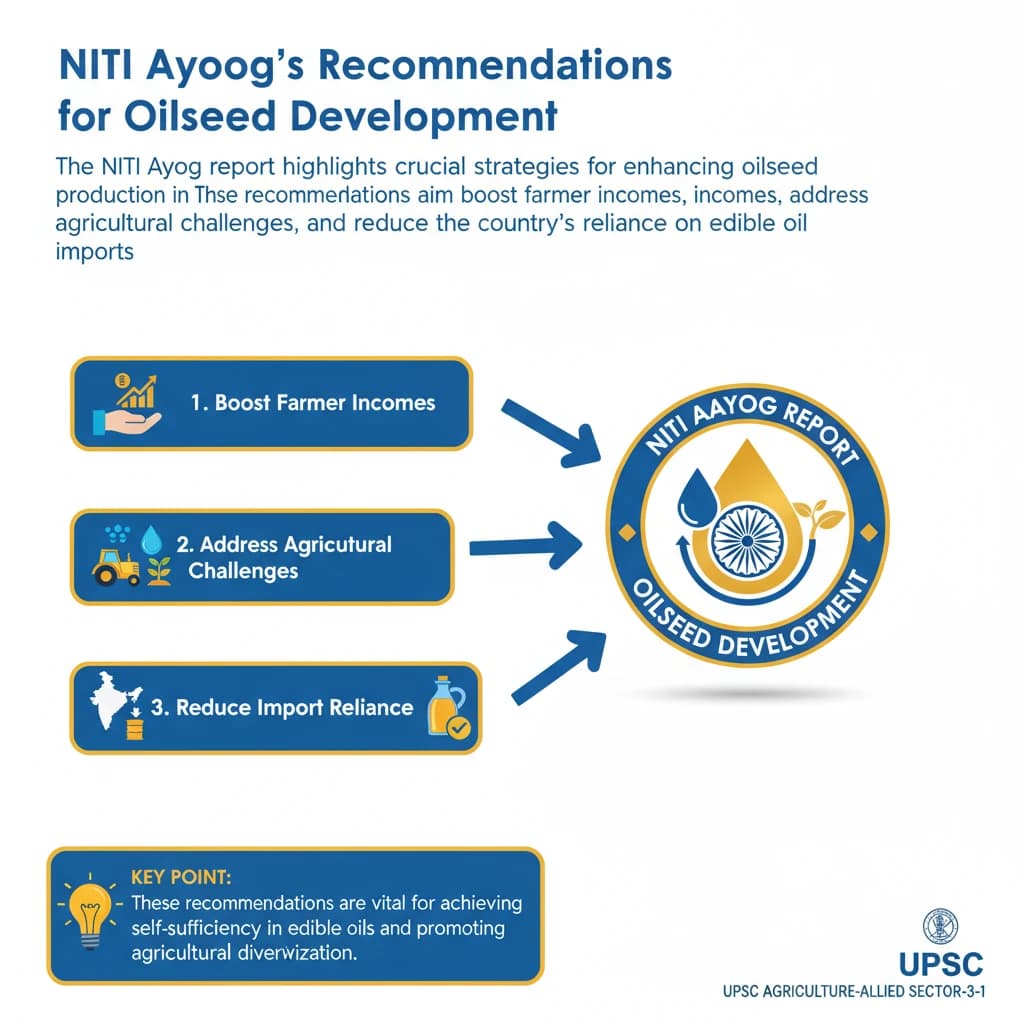
NITI Aayog's Recommendations for Oilseed Development
The NITI Aayog report highlights crucial strategies for enhancing oilseed production in India. These recommendations aim to boost farmer incomes, address agricultural challenges, and reduce the country's reliance on edible oil imports.
These recommendations are vital for achieving self-sufficiency in edible oils and promoting agricultural diversification.
Enhancing Oilseed Development in Specific Regions
The report strongly advocates for revitalizing oilseed cultivation in key agricultural regions. This includes both traditional and non-traditional areas, focusing on suitable crops for each.
Bundelkhand Region Focus
Bundelkhand is identified as a priority area for enhanced oilseed development. The focus here is on crops that can thrive in its specific agro-climatic conditions.
Target Region: Bundelkhand
Primary Oilseed: Sesame
Objective: To significantly boost farmer incomes through increased production.
Primary Oilseed: Sesame
Objective: To significantly boost farmer incomes through increased production.
Indo-Gangetic Plain Initiatives
The Indo-Gangetic Plain, a highly fertile region, is also targeted for introducing new oilseed crops. This diversification aims to improve profitability for farmers and address prevalent soil and water management issues.
Target Region: Indo-Gangetic Plain
Introduced Oilseeds: Soybean, Rapeseed-Mustard, and Sunflower
Objectives: Increase farm profitability, mitigate soil degradation, and improve water use efficiency.
Introduced Oilseeds: Soybean, Rapeseed-Mustard, and Sunflower
Objectives: Increase farm profitability, mitigate soil degradation, and improve water use efficiency.
Prioritising Wasteland Utilisation for Oil Palm Expansion
A significant recommendation involves leveraging wastelands for expanding oil palm cultivation. This strategy not only utilizes otherwise unproductive land but also has a substantial impact on overall oilseed production.
Focus Area: Suitable wastelands across India
Crop: Oil Palm
Potential Production Increase: An estimated 24.7 MT (Million Tonnes) of additional production.
Crop: Oil Palm
Potential Production Increase: An estimated 24.7 MT (Million Tonnes) of additional production.
Understanding the regional focus (Bundelkhand, Indo-Gangetic Plain) and the specific crops recommended (sesame, soybean, rapeseed-mustard, sunflower, oil palm) is crucial for UPSC Prelims. The potential production figures (24.7 MT) are also important for Mains answers on agricultural economy.
💡 Key Takeaways
- •NITI Aayog recommends boosting oilseed development in Bundelkhand and the Indo-Gangetic Plain.
- •Sesame is prioritized for Bundelkhand to increase farmer incomes.
- •Soybean, rapeseed-mustard, and sunflower are suggested for the Indo-Gangetic Plain to improve profitability and address soil issues.
- •Utilizing suitable wastelands for oil palm expansion is a key strategy.
- •Oil palm cultivation on wastelands has the potential to add 24.7 MT to production.
- •These recommendations aim to reduce India's edible oil import dependency and enhance farmer welfare.
- •The strategies align with the broader goals of agricultural diversification and sustainable land use.
🧠 Memory Techniques
98% Verified Content
📚 Reference Sources
•NITI Aayog Official Website (for general role and reports)
•Ministry of Agriculture & Farmers Welfare (for schemes like NMEO-OP, NFSM)
•Press Information Bureau (PIB) releases on agricultural policies