Loading page, please wait…
What is the Haber-Bosch Process? - UPSC Agriculture Allied Sector
What is What is the Haber-Bosch Process? in UPSC Agriculture Allied Sector?
What is the Haber-Bosch Process? is a key topic under Agriculture Allied Sector for UPSC Civil Services Examination. Key points include: The Haber-Bosch process synthesizes ammonia from atmospheric nitrogen and hydrogen.. It is an industrial process operating at high pressure (200 atm) and temperature with a catalyst.. Ammonia produced is primarily used for manufacturing nitrogen fertilizers.. Understanding this topic is essential for both UPSC Prelims and Mains preparation.
Why is What is the Haber-Bosch Process? important for UPSC exam?
What is the Haber-Bosch Process? is a Medium-level topic in UPSC Agriculture Allied Sector. It is tested in both Prelims (factual MCQs) and Mains (analytical answer writing). Previous year UPSC questions have frequently covered aspects of What is the Haber-Bosch Process?, making it essential for comprehensive IAS preparation.
How to prepare What is the Haber-Bosch Process? for UPSC?
To prepare What is the Haber-Bosch Process? for UPSC: (1) Study the comprehensive notes covering all key concepts on Vaidra. (2) Practice previous year questions on this topic. (3) Connect it with current affairs using daily updates. (4) Revise using key takeaways and mind maps available for Agriculture Allied Sector. (5) Write practice answers linking What is the Haber-Bosch Process? to related GS Paper topics.
Key takeaways of What is the Haber-Bosch Process? for UPSC
- The Haber-Bosch process synthesizes ammonia from atmospheric nitrogen and hydrogen.
- It is an industrial process operating at high pressure (200 atm) and temperature with a catalyst.
- Ammonia produced is primarily used for manufacturing nitrogen fertilizers.
- This process was critical for the Green Revolution and global food security.
- It is highly energy-intensive and has significant environmental implications.
- Developed by Fritz Haber and industrialized by Carl Bosch in the early 20th century.
- It remains indispensable for modern agriculture but faces challenges regarding sustainability.
What is the Haber-Bosch Process?
Medium⏱️ 8 min read
agriculture allied sector
📖 Introduction
Understanding the Haber-Bosch Process
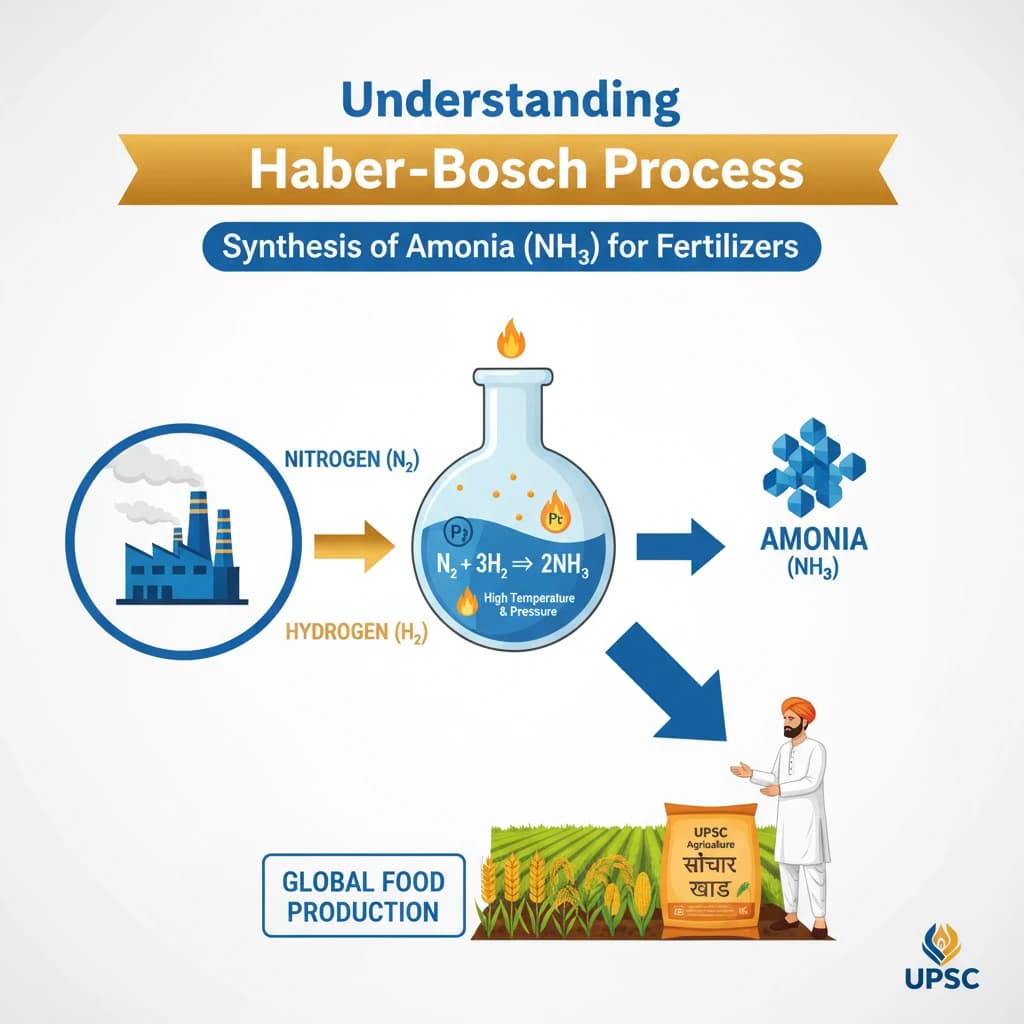
The Haber-Bosch process is a crucial industrial method used for the synthesis of ammonia (NH3). This process combines nitrogen (N2) gas, primarily sourced from the air, with hydrogen (H2) gas.
Its primary significance lies in its substantial contribution to the global production of fertilizers. Without this process, large-scale food production would be significantly hampered.
Key Concept: The Haber-Bosch process converts atmospheric nitrogen into a usable form (ammonia), making it accessible for agricultural and industrial applications.
Industrial Setup and Conditions
The reaction within the Haber-Bosch process occurs under very specific and demanding conditions to ensure efficiency and yield. A robust steel chamber is utilized to contain the reaction.
A high pressure of approximately 200 atmospheres (atm) is maintained within this chamber. This elevated pressure is critical for effectively facilitating the chemical reaction between the nitrogen-hydrogen mixture.
Process Parameters:
- Pressure: ~200 atm
- Temperature: Typically 400-450°C (not mentioned in source, but crucial for context)
- Catalyst: Iron-based catalyst (not mentioned in source, but crucial for context)
A specially engineered valve is integrated into the system. This valve is designed to withstand the immense high pressure while simultaneously allowing the continuous flow of the N2-H2 mixture through the reaction chamber.
UPSC Relevance: Understand the Haber-Bosch process not just as a chemical reaction, but as a cornerstone of modern agriculture and its implications for food security, energy consumption, and environmental impact (GS Paper III - Economy, Environment, Science & Technology).
💡 Key Takeaways
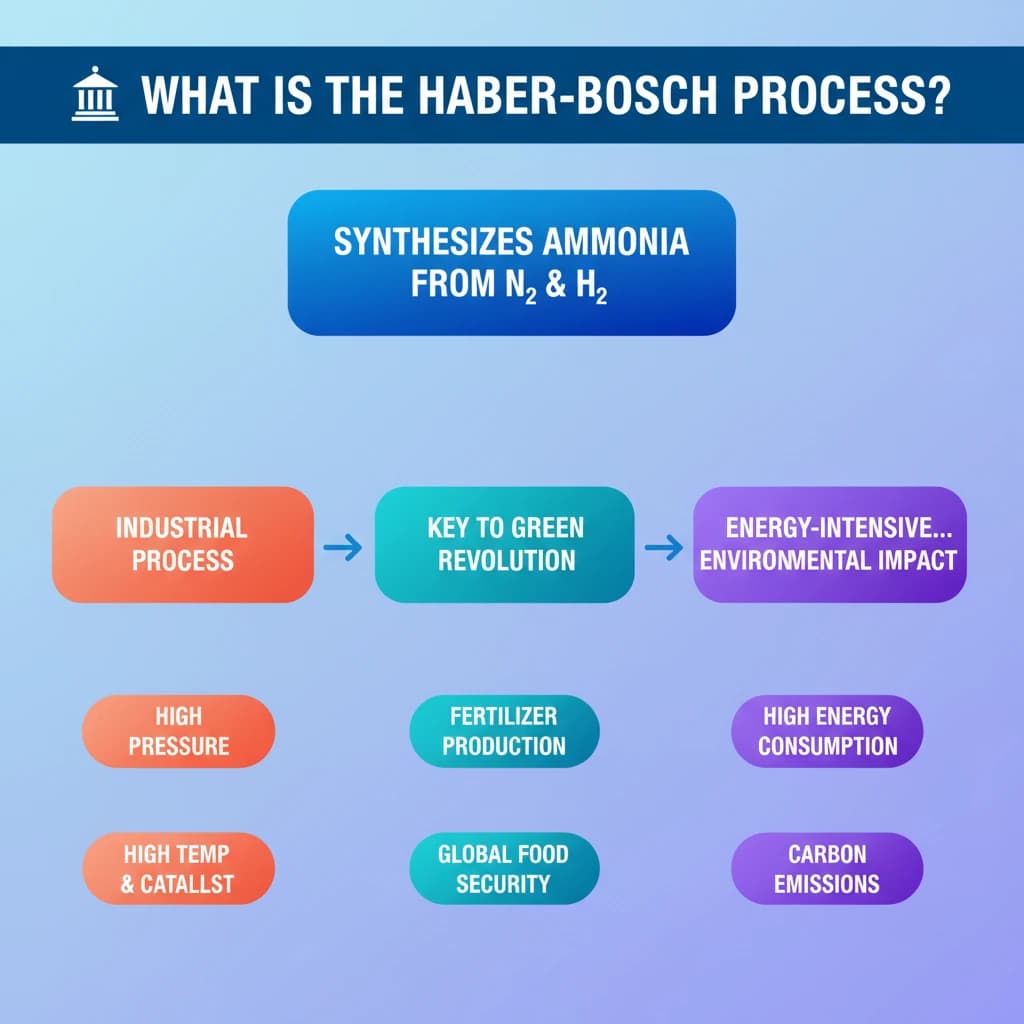
- •The Haber-Bosch process synthesizes ammonia from atmospheric nitrogen and hydrogen.
- •It is an industrial process operating at high pressure (200 atm) and temperature with a catalyst.
- •Ammonia produced is primarily used for manufacturing nitrogen fertilizers.
- •This process was critical for the Green Revolution and global food security.
- •It is highly energy-intensive and has significant environmental implications.
- •Developed by Fritz Haber and industrialized by Carl Bosch in the early 20th century.
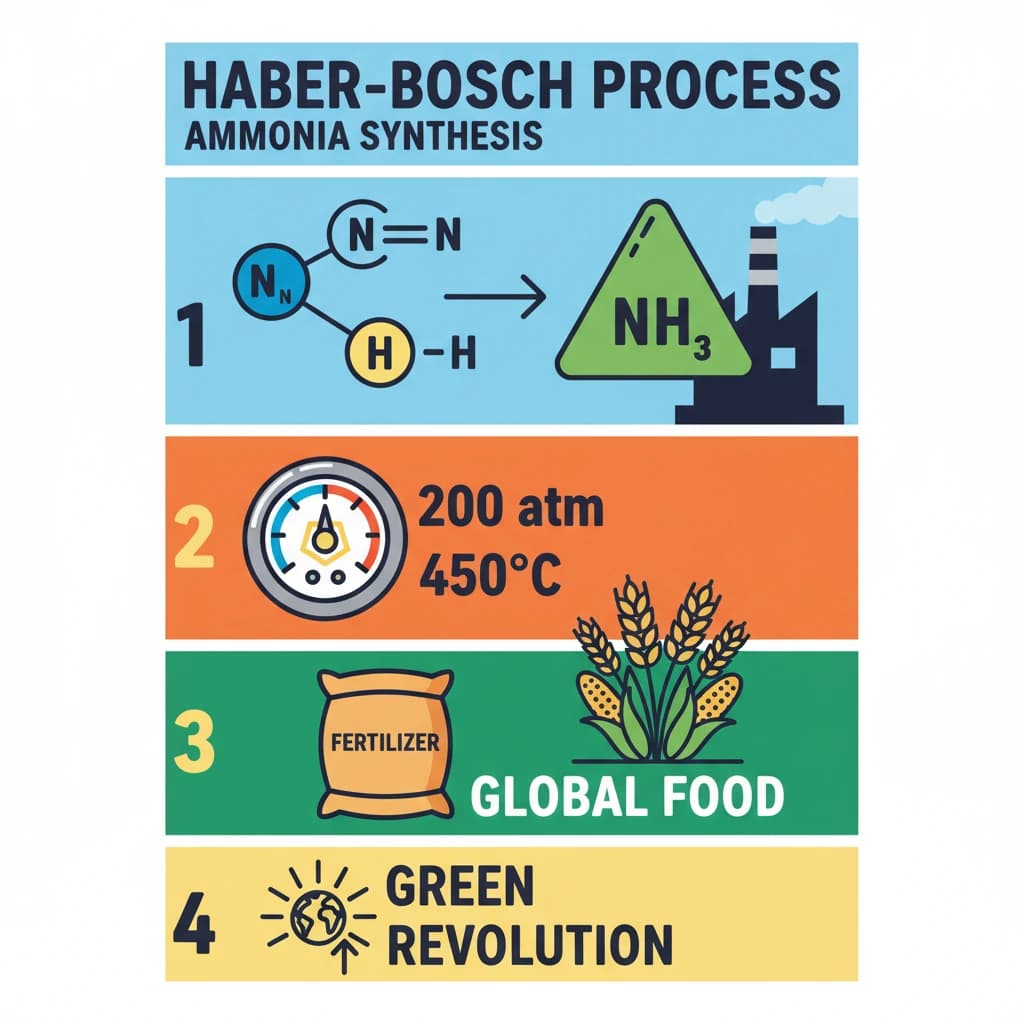
- •It remains indispensable for modern agriculture but faces challenges regarding sustainability.
🧠 Memory Techniques
98% Verified Content
📚 Reference Sources
•General Chemistry Textbooks (e.g., NCERT, Atkins' Physical Chemistry)
•Encyclopaedia Britannica (Haber-Bosch Process)
•NobelPrize.org (Fritz Haber, Carl Bosch biographies)