Loading page, please wait…
Vaidra Logo
Vaidra

Top 4 items + smart groups

UPSC GPT
New
Current Affairs
Daily Solutions
Daily Puzzle
Mains Evaluator

Version 2.0.0 • Built with ❤️ for UPSC aspirants

Loading...
Loading...
Loading...
Loading...
Loading...
Loading...
Loading...
Loading...
Loading...
Loading...
Loading...
Loading...
Loading...
Back
All Subjects

Topics

0 topics • 0 completed

Loading topics...
Loading...
Loading...
Loading...
Loading...
Loading...
Overall Progress0%

What are the Key Facts About Amravati and Andhra Buddhism? - UPSC Art And Culture

What is What are the Key Facts About Amravati and Andhra Buddhism? in UPSC Art And Culture?

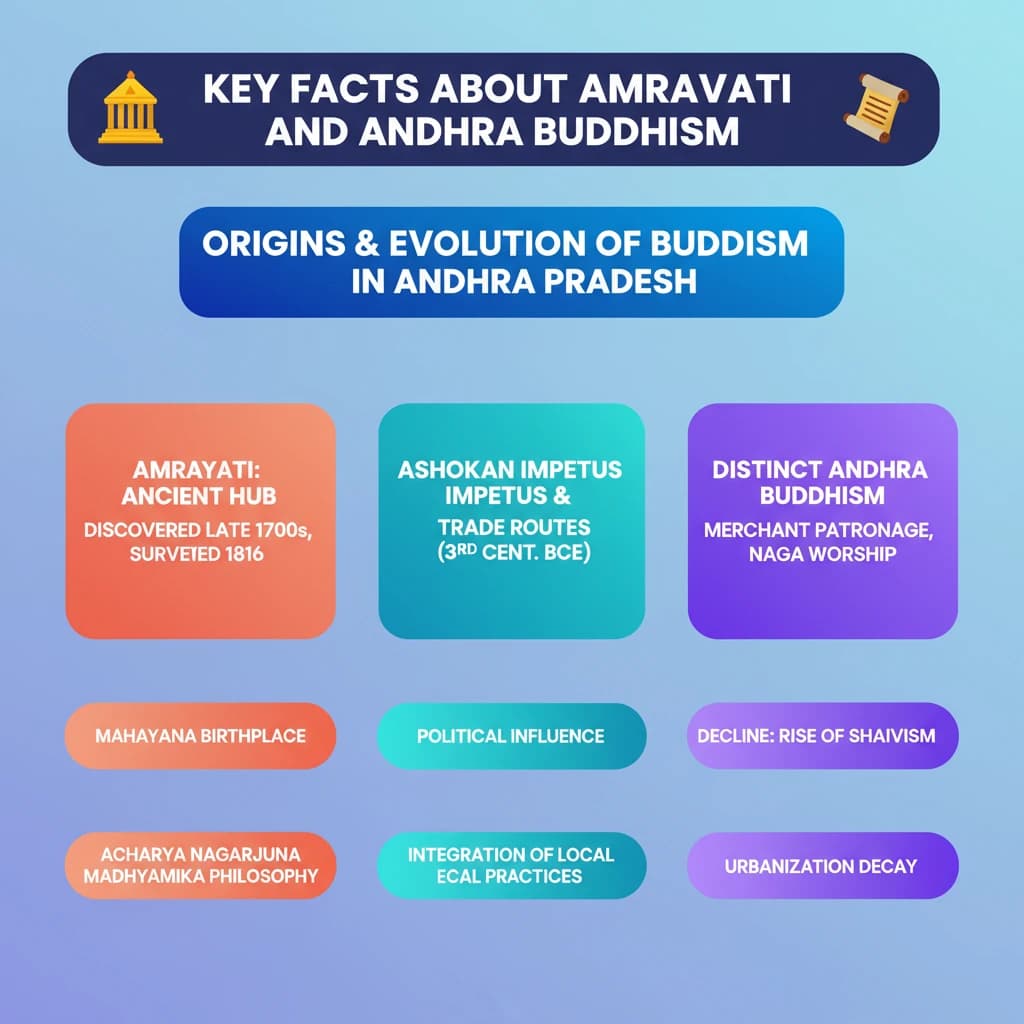
What are the Key Facts About Amravati and Andhra Buddhism? is a key topic under Art And Culture for UPSC Civil Services Examination. Key points include: Amravati was an ancient Buddhist site in Andhra Pradesh, initially discovered in the late 1700s and systematically surveyed in 1816.. Buddhism spread to Andhra Pradesh via trade routes and received a major impetus from Emperor Ashoka in the 3rd century BCE.. Andhra Buddhism was distinct due to merchant patronage, influence on political rulers, and integration of local practices like Naga worship.. Understanding this topic is essential for both UPSC Prelims and Mains preparation.

Why is What are the Key Facts About Amravati and Andhra Buddhism? important for UPSC exam?

What are the Key Facts About Amravati and Andhra Buddhism? is a Medium-level topic in UPSC Art And Culture. It is tested in both Prelims (factual MCQs) and Mains (analytical answer writing). Previous year UPSC questions have frequently covered aspects of What are the Key Facts About Amravati and Andhra Buddhism?, making it essential for comprehensive IAS preparation.

How to prepare What are the Key Facts About Amravati and Andhra Buddhism? for UPSC?

To prepare What are the Key Facts About Amravati and Andhra Buddhism? for UPSC: (1) Study the comprehensive notes covering all key concepts on Vaidra. (2) Practice previous year questions on this topic. (3) Connect it with current affairs using daily updates. (4) Revise using key takeaways and mind maps available for Art And Culture. (5) Write practice answers linking What are the Key Facts About Amravati and Andhra Buddhism? to related GS Paper topics.

Key takeaways of What are the Key Facts About Amravati and Andhra Buddhism? for UPSC

  • Amravati was an ancient Buddhist site in Andhra Pradesh, initially discovered in the late 1700s and systematically surveyed in 1816.
  • Buddhism spread to Andhra Pradesh via trade routes and received a major impetus from Emperor Ashoka in the 3rd century BCE.
  • Andhra Buddhism was distinct due to merchant patronage, influence on political rulers, and integration of local practices like Naga worship.
  • Amravati is considered the birthplace of Mahayana Buddhism and was home to Acharya Nagarjuna, who developed the Madhyamika philosophy.
  • Factors contributing to Buddhism's decline in Andhra included the rise of Shaivism and the decline of urbanization.
  • The new capital of Andhra Pradesh, Amaravati, is named after this historic Buddhist site, symbolizing cultural continuity.
What are the Key Facts About Amravati and Andhra Buddhism?

What are the Key Facts About Amravati and Andhra Buddhism?

Medium⏱️ 8 min read✓ 98% Verified
art and culture

📖 Introduction

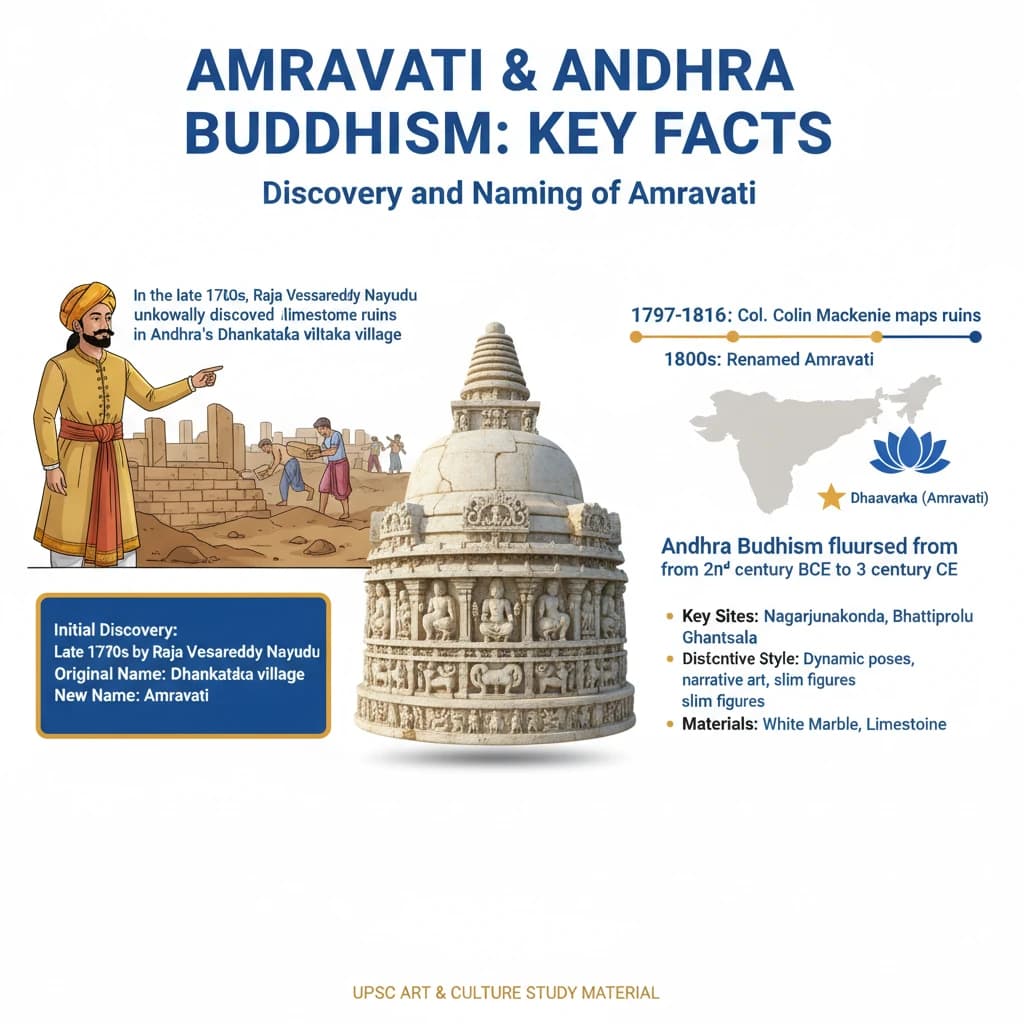
<h4>Discovery and Naming of Amravati</h4><p>In the <strong>late 1700s</strong>, <strong>Raja Vessareddy Nayudu</strong> unknowingly discovered ancient <strong>limestone ruins</strong> in <strong>Andhra's Dhanyakataka village</strong>. These ruins were subsequently used by him and local inhabitants for construction purposes.</p><div class="info-box"><strong>Initial Discovery:</strong> Late 1700s by Raja Vessareddy Nayudu<br><strong>Original Name:</strong> Dhanyakataka village<br><strong>New Name:</strong> Amravati (due to use of ruins for construction)</div><p>The systematic destruction of these ancient structures continued until <strong>1816</strong>. It was then that <strong>Colin Mackenzie's intensive survey</strong> led to the rediscovery of the magnificent <strong>Amravati Stupa</strong>, despite causing some further damage during the process.</p><h4>Buddhism's Arrival and Spread in Andhra</h4><p><strong>Buddhism</strong>, which originated in the <strong>fifth century BCE</strong> in the ancient kingdom of <strong>Magadh</strong> (present-day Bihar), made its way to <strong>Andhra Pradesh</strong> primarily through established <strong>trade routes</strong>.</p><div class="info-box"><strong>Founder of Buddhism:</strong> Siddhartha Gautama (the Buddha)<br><strong>Origin:</strong> Magadh (5th century BCE)<br><strong>Spread to Andhra:</strong> Mainly via trade routes</div><p>The first significant evidence of Buddhism in Andhra Pradesh dates back to the <strong>3rd century BCE</strong>. <strong>Emperor Ashoka</strong> played a crucial role by setting up an inscription in the region, providing a major impetus to the religion's expansion.</p><p>Monks from Andhra were notable attendees at the <strong>first Buddhist council</strong>, which took place in <strong>483 BCE</strong> at <strong>Rajgir, Bihar</strong>. This indicates an early and strong presence of Buddhism in the region.</p><p>Buddhism flourished in Andhra Pradesh for nearly <strong>six centuries</strong>, until the <strong>3rd century CE</strong>. Even after this period, isolated sites such as <strong>Amaravati, Nagarjunakonda, Jaggayyapeta, Salihundam, and Sankaram</strong> continued to practice the religion until the <strong>14th century CE</strong>.</p><p>Historians observe that Buddhism's presence in Andhra coincided with the region's <strong>first urbanization process</strong>. This growth was significantly aided by <strong>oceanic trade</strong>, which facilitated the religion's widespread dissemination.</p><h4>Distinctive Nature of Andhra Buddhism</h4><div class="key-point-box">Andhra Buddhism exhibited unique characteristics compared to its Northern counterpart, particularly in patronage, political influence, and integration of local customs.</div><ul><li><strong>Merchant Patronage:</strong> In Andhra, the spread of Buddhism was largely driven by <strong>merchants, craftsmen, and wandering monks</strong>. This contrasts sharply with the prominent <strong>royal patronage</strong> (e.g., <strong>King Bimbisara</strong> or <strong>Ajatashatru</strong>) observed in North India.</li><li><strong>Influence on Political Rulers:</strong> The economic success of traders and their association with Buddhism influenced Andhra's political rulers. These rulers subsequently issued inscriptions supporting the <strong>Buddhist Sangha</strong>, suggesting a more <strong>bottom-up spread</strong> of Buddhism in the region.</li><li><strong>Integration of Local Practices:</strong> Buddhism in Andhra uniquely integrated various local religious practices into its doctrines. This included elements like <strong>megalithic burials</strong>, <strong>Goddess worship</strong>, and <strong>Naga (snake) worship</strong>, reflecting a significant adaptation to regional traditions.</li></ul><h4>Significance of Amravati in Buddhism</h4><p><strong>Amravati</strong> holds immense importance as the recognized <strong>birthplace of Mahayana Buddhism</strong>. This is one of the two major branches of Buddhism, emphasizing the path of the <strong>Bodhisattva</strong>.</p><div class="key-point-box"><strong>Amravati:</strong> Birthplace of Mahayana Buddhism</div><p>The renowned Buddhist philosopher, <strong>Acharya Nagarjuna</strong>, resided in Amravati. He developed the profound <strong>Madhyamika philosophy</strong>, which centers on the concepts of <strong>emptiness (Shunyata)</strong> and the <strong>middle way</strong>.</p><div class="info-box"><strong>Key Philosopher:</strong> Acharya Nagarjuna<br><strong>Developed:</strong> Madhyamika philosophy<br><strong>Core Concepts:</strong> Emptiness, Middle Way</div><p>From Amravati, <strong>Mahayana Buddhism</strong> successfully spread across a vast geographical area, including <strong>South Asia, China, Japan, Korea, and Southeast Asia</strong>.</p><h4>Factors Leading to the Decline of Buddhism in Andhra Pradesh</h4><h5>Rise of Shaivism</h5><p>A primary factor contributing to the decline of Buddhism in Andhra Pradesh was the ascendance of <strong>Shaivism</strong>. By the <strong>seventh century CE</strong>, Chinese travelers noted the decline of Buddhist stupas and the thriving presence of <strong>Shiva temples</strong>.</p><p>These Shiva temples received substantial patronage from <strong>aristocrats and royals</strong>. The growing influence of Shaivism offered a more structured and socially integrated religious framework, which appealed significantly to the local populace and rulers, thereby drawing support away from Buddhist institutions.</p><h5>Decline of Urbanisation</h5><p>During the <strong>third century BCE</strong>, the region experienced considerable <strong>urbanization and trade</strong>. This period of growth had strongly supported the spread of Buddhism, largely due to its emphasis on a <strong>casteless society</strong>, which resonated with urban merchant communities.</p><div class="exam-tip-box">When analyzing the decline of religions, always consider both internal (doctrinal shifts, monastic practices) and external factors (patronage, socio-economic changes, rise of rival faiths).</div>
Concept Diagram

💡 Key Takeaways

  • •Amravati was an ancient Buddhist site in Andhra Pradesh, initially discovered in the late 1700s and systematically surveyed in 1816.
  • •Buddhism spread to Andhra Pradesh via trade routes and received a major impetus from Emperor Ashoka in the 3rd century BCE.
  • •Andhra Buddhism was distinct due to merchant patronage, influence on political rulers, and integration of local practices like Naga worship.
  • •Amravati is considered the birthplace of Mahayana Buddhism and was home to Acharya Nagarjuna, who developed the Madhyamika philosophy.
  • •Factors contributing to Buddhism's decline in Andhra included the rise of Shaivism and the decline of urbanization.
  • •The new capital of Andhra Pradesh, Amaravati, is named after this historic Buddhist site, symbolizing cultural continuity.

🧠 Memory Techniques

Memory Aid
98% Verified Content

Related Topics

Loading related topics...
Explore:Art And Culture Topics·All Subjects·Daily Current Affairs·Editorial Analysis·Previous Year Questions·UPSC GPT
What are the Key Facts About Amravati and Andhra Buddhism? - UPSC Art And Culture