Loading page, please wait…
Vaidra Logo
Vaidra

Top 4 items + smart groups

UPSC GPT
New
Current Affairs
Daily Solutions
Daily Puzzle
Mains Evaluator

Version 2.0.0 • Built with ❤️ for UPSC aspirants

Loading...
Loading...
Loading...
Loading...
Loading...
Loading...
Loading...
Loading...
Loading...
Loading...
Loading...
Loading...
Loading...
Back
All Subjects

Topics

0 topics • 0 completed

Loading topics...
Loading...
Loading...
Loading...
Loading...
Loading...
Overall Progress0%

What does Delisting a Monument Mean? - UPSC Art And Culture

What is What does Delisting a Monument Mean? in UPSC Art And Culture?

What does Delisting a Monument Mean? is a key topic under Art And Culture for UPSC Civil Services Examination. Key points include: Delisting removes a monument from the ASI's protection and conservation.. The AMASR Act, 1958, prohibits construction around protected sites.. Delisting lifts these construction restrictions, allowing for urban development.. Understanding this topic is essential for both UPSC Prelims and Mains preparation.

Why is What does Delisting a Monument Mean? important for UPSC exam?

What does Delisting a Monument Mean? is a Medium-level topic in UPSC Art And Culture. It is tested in both Prelims (factual MCQs) and Mains (analytical answer writing). Previous year UPSC questions have frequently covered aspects of What does Delisting a Monument Mean?, making it essential for comprehensive IAS preparation.

How to prepare What does Delisting a Monument Mean? for UPSC?

To prepare What does Delisting a Monument Mean? for UPSC: (1) Study the comprehensive notes covering all key concepts on Vaidra. (2) Practice previous year questions on this topic. (3) Connect it with current affairs using daily updates. (4) Revise using key takeaways and mind maps available for Art And Culture. (5) Write practice answers linking What does Delisting a Monument Mean? to related GS Paper topics.

Key takeaways of What does Delisting a Monument Mean? for UPSC

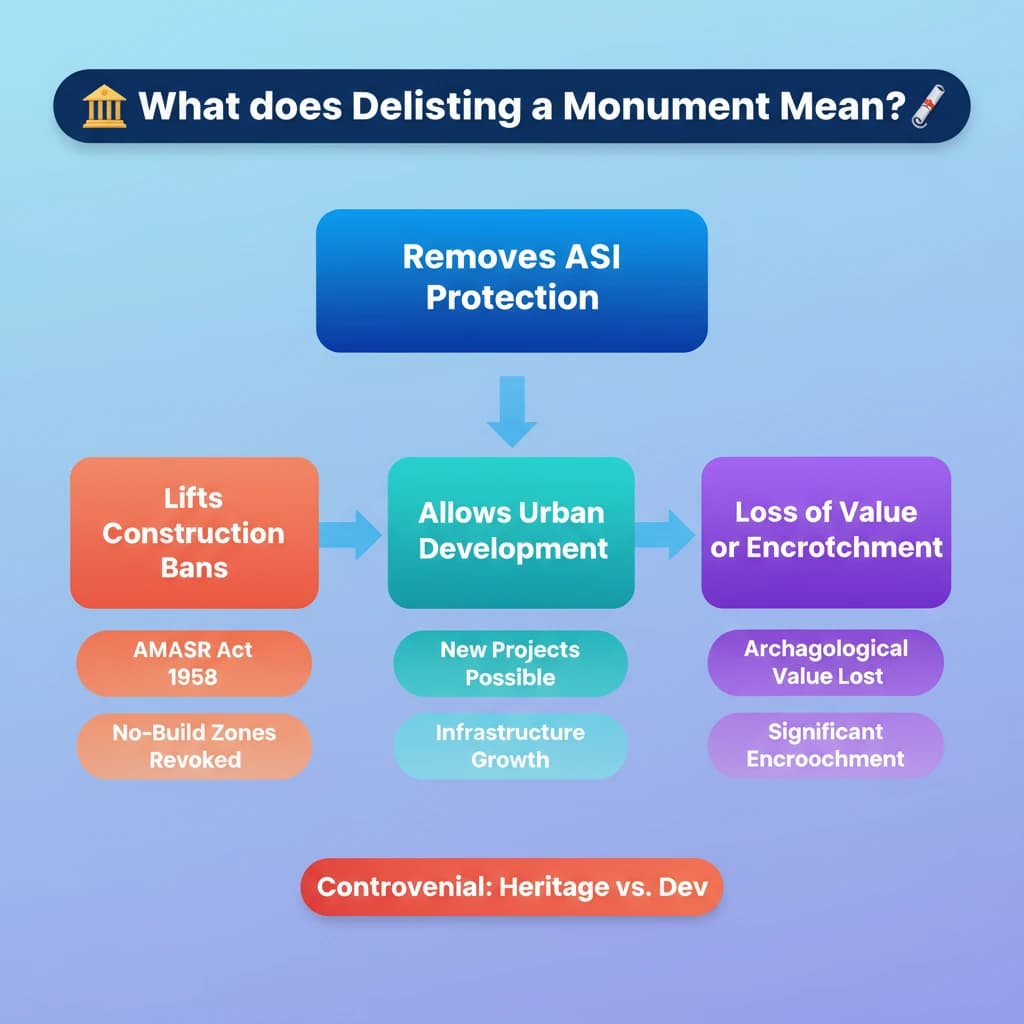
  • Delisting removes a monument from the ASI's protection and conservation.
  • The AMASR Act, 1958, prohibits construction around protected sites.
  • Delisting lifts these construction restrictions, allowing for urban development.
  • Reasons for delisting can include loss of archaeological value or significant encroachment.
  • The process is often controversial, balancing heritage with development needs.
  • It highlights the challenges in managing India's vast cultural heritage.
What does Delisting a Monument Mean?

What does Delisting a Monument Mean?

Medium⏱️ 8 min read✓ 98% Verified
art and culture

📖 Introduction

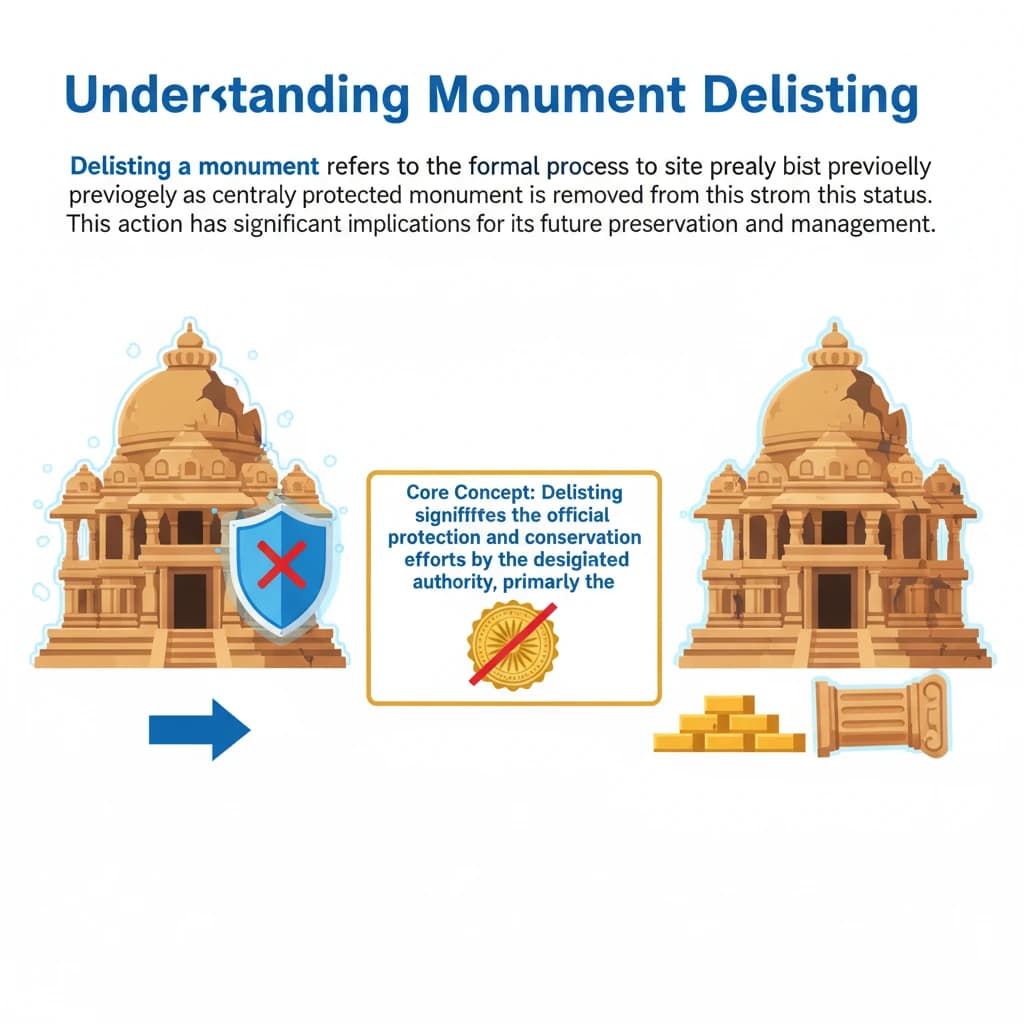
<h4>Understanding Monument Delisting</h4><p><strong>Delisting a monument</strong> refers to the formal process by which a site previously designated as a <strong>centrally protected monument</strong> is removed from this status. This action has significant implications for its future preservation and management.</p><div class="key-point-box"><strong>Core Concept:</strong> Delisting signifies the withdrawal of official protection and conservation efforts by the designated authority, primarily the <strong>Archaeological Survey of India (ASI)</strong>.</div><h4>Removal from ASI's Purview</h4><p>When a monument is <strong>delisted</strong>, it will no longer be conserved, protected, or maintained by the <strong>Archaeological Survey of India (ASI)</strong>. This effectively removes it from the <strong>ASI's list of centrally protected monuments</strong>, ending its statutory protection.</p><div class="info-box"><strong>Key Implication:</strong> Loss of official protection means the monument is no longer subject to the strict conservation guidelines and resources provided by the <strong>ASI</strong>.</div><h4>Impact on Construction and Urbanisation</h4><p>The <strong>Ancient Monuments and Archaeological Sites and Remains Act, 1958 (AMASR Act)</strong>, imposes strict regulations on activities around protected sites. Specifically, any kind of <strong>construction-related activity</strong> is generally prohibited within a designated regulated area.</p><p>Upon <strong>delisting</strong>, these restrictions are lifted. This allows for potential <strong>construction</strong> and <strong>urbanisation</strong> activities in and around the previously protected area, which would have been impossible under the <strong>AMASR Act</strong>.</p><div class="exam-tip-box"><strong>UPSC Insight:</strong> Questions on <strong>heritage management</strong> often revolve around the balance between preservation and development. Understanding delisting helps in analyzing such dilemmas, particularly concerning the <strong>AMASR Act</strong>.</div>
Concept Diagram

💡 Key Takeaways

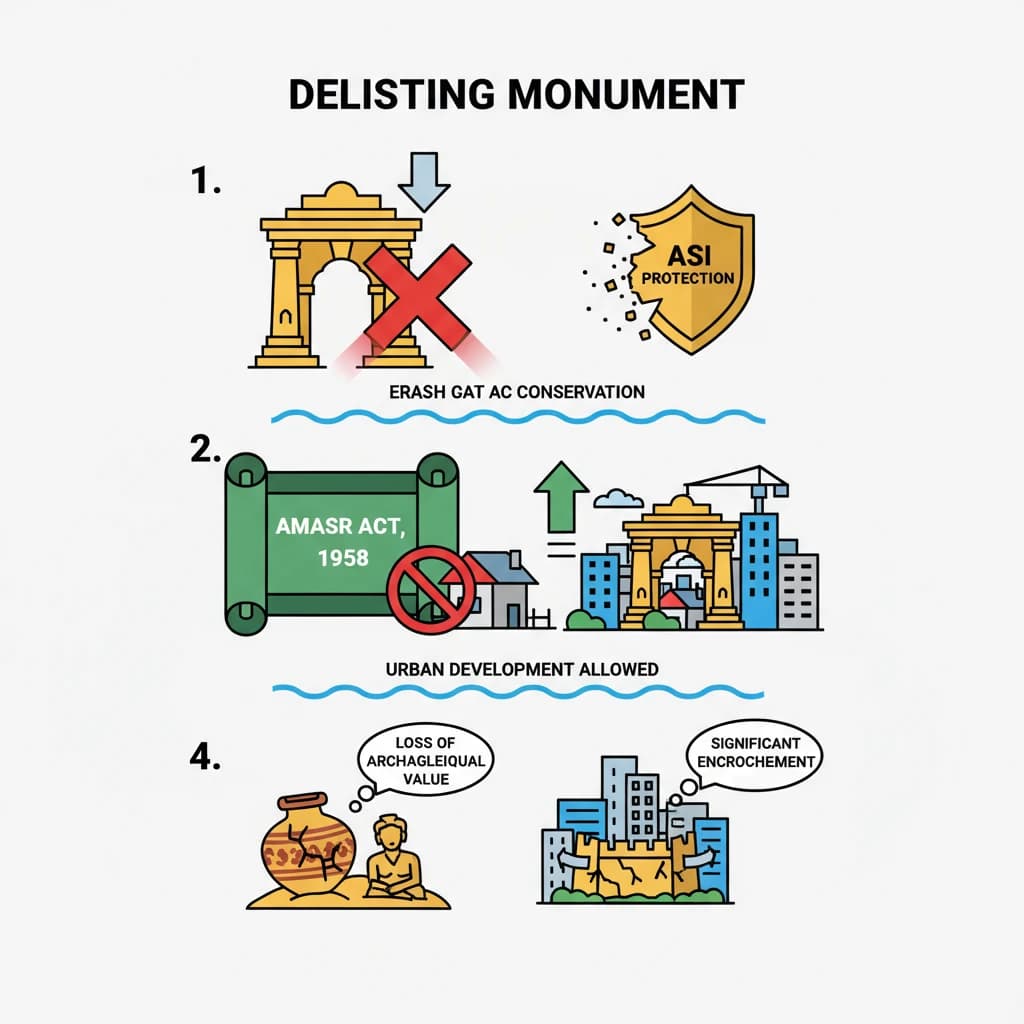
  • •Delisting removes a monument from the ASI's protection and conservation.
  • •The AMASR Act, 1958, prohibits construction around protected sites.
  • •Delisting lifts these construction restrictions, allowing for urban development.
  • •Reasons for delisting can include loss of archaeological value or significant encroachment.
  • •The process is often controversial, balancing heritage with development needs.
  • •It highlights the challenges in managing India's vast cultural heritage.

🧠 Memory Techniques
Memory Aid
98% Verified Content

📚 Reference Sources

•The Ancient Monuments and Archaeological Sites and Remains Act, 1958 (AMASR Act)
•Archaeological Survey of India (ASI) official website
•Ministry of Culture, Government of India publications

Related Topics

Loading related topics...
Explore:Art And Culture Topics·All Subjects·Daily Current Affairs·Editorial Analysis·Previous Year Questions·UPSC GPT
What does Delisting a Monument Mean? - UPSC Art And Culture