Loading page, please wait…
Vaidra Logo
Vaidra

Top 4 items + smart groups

UPSC GPT
New
Current Affairs
Daily Solutions
Daily Puzzle
Mains Evaluator

Version 2.0.0 • Built with ❤️ for UPSC aspirants

Loading...
Loading...
Loading...
Loading...
Loading...
Loading...
Loading...
Loading...
Loading...
Loading...
Loading...
Loading...
Loading...
Back
All Subjects

Topics

0 topics • 0 completed

Loading topics...
Loading...
Loading...
Loading...
Loading...
Loading...
Overall Progress0%

Historical Evolution - UPSC Art And Culture

What is Historical Evolution in UPSC Art And Culture?

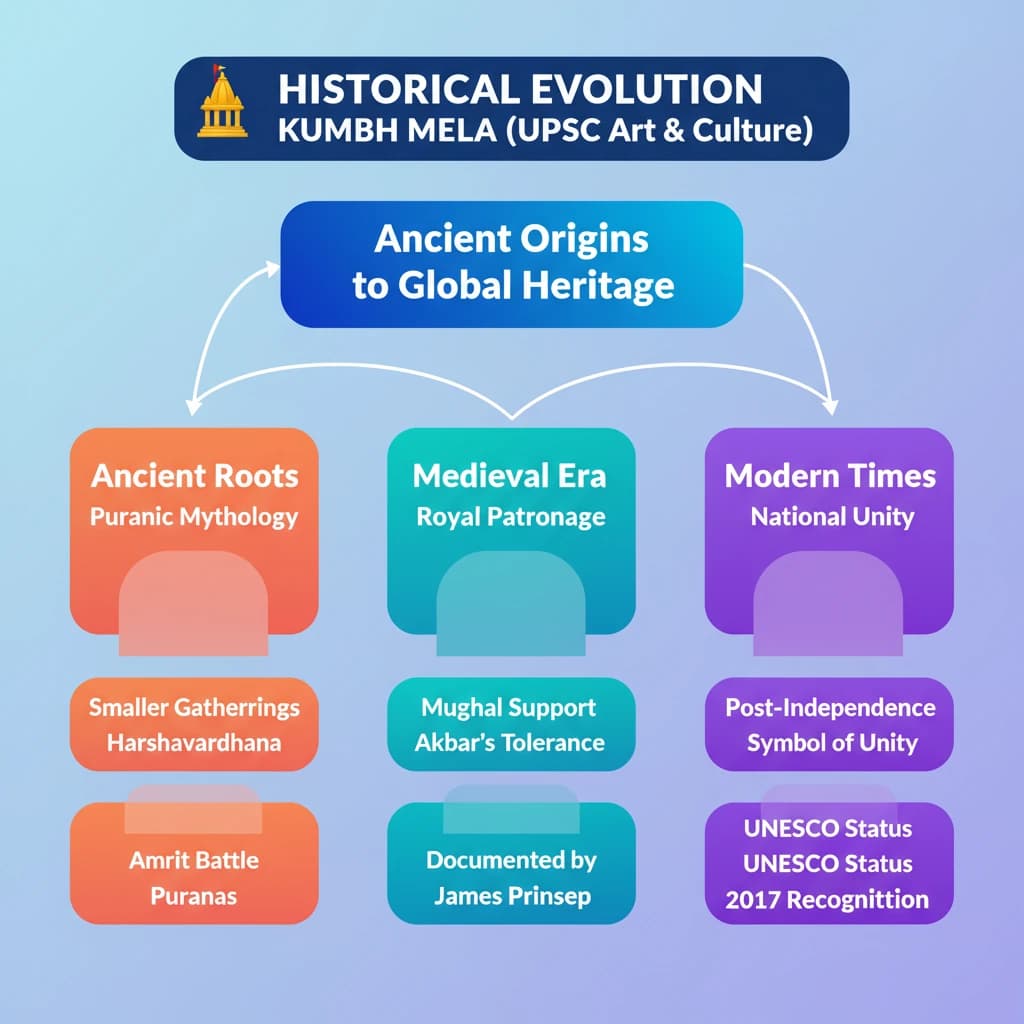
Historical Evolution is a key topic under Art And Culture for UPSC Civil Services Examination. Key points include: Kumbh Mela's origins are rooted in ancient Puranic mythology involving the battle for Amrit.. It evolved from smaller gatherings in ancient times, gaining prominence under rulers like Harshavardhana.. Medieval dynasties, including the Mughals, provided significant patronage, with Akbar demonstrating religious tolerance.. Understanding this topic is essential for both UPSC Prelims and Mains preparation.

Why is Historical Evolution important for UPSC exam?

Historical Evolution is a Medium-level topic in UPSC Art And Culture. It is tested in both Prelims (factual MCQs) and Mains (analytical answer writing). Previous year UPSC questions have frequently covered aspects of Historical Evolution, making it essential for comprehensive IAS preparation.

How to prepare Historical Evolution for UPSC?

To prepare Historical Evolution for UPSC: (1) Study the comprehensive notes covering all key concepts on Vaidra. (2) Practice previous year questions on this topic. (3) Connect it with current affairs using daily updates. (4) Revise using key takeaways and mind maps available for Art And Culture. (5) Write practice answers linking Historical Evolution to related GS Paper topics.

Key takeaways of Historical Evolution for UPSC

  • Kumbh Mela's origins are rooted in ancient Puranic mythology involving the battle for Amrit.
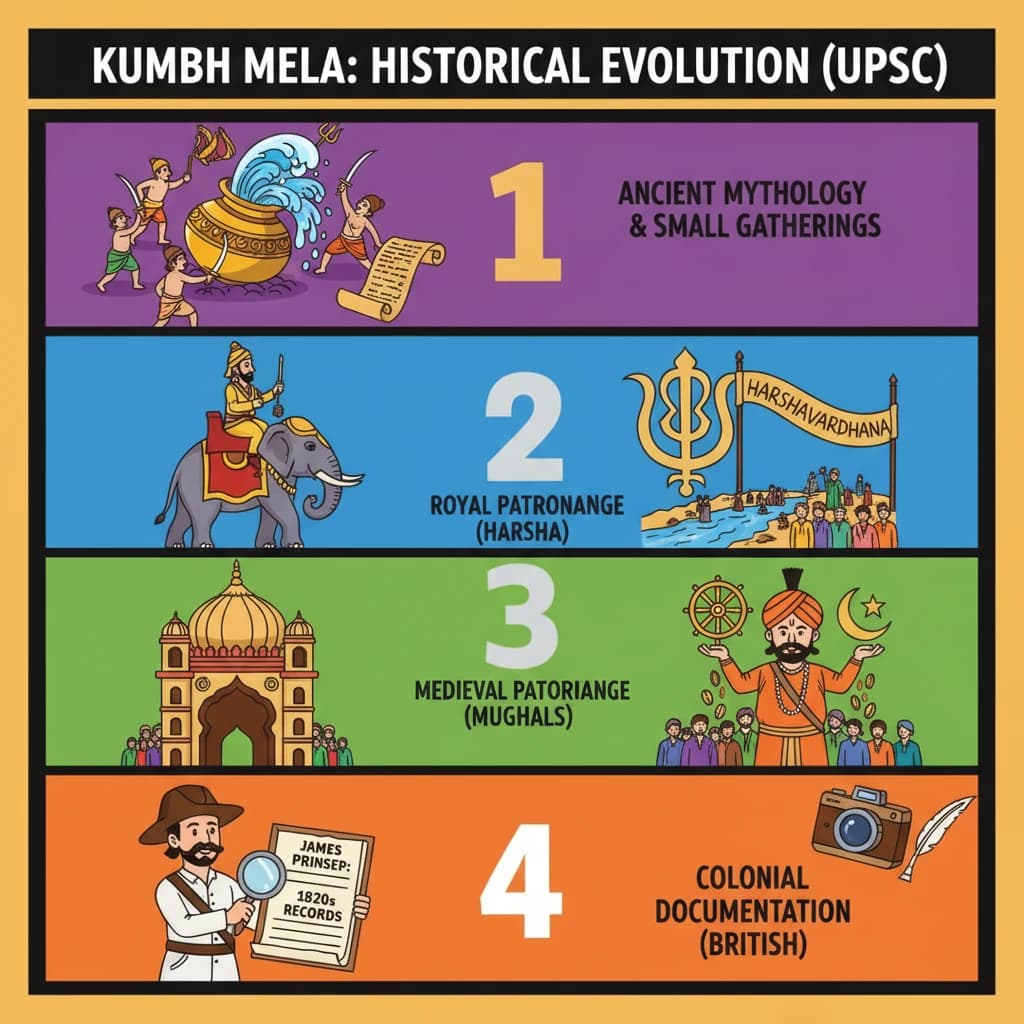
  • It evolved from smaller gatherings in ancient times, gaining prominence under rulers like Harshavardhana.
  • Medieval dynasties, including the Mughals, provided significant patronage, with Akbar demonstrating religious tolerance.
  • British administrators like James Prinsep extensively documented the Mela in the colonial era, providing historical records.
  • Post-independence, it symbolizes national unity and received UNESCO Intangible Cultural Heritage status in 2017.
  • The Mela is a unique blend of spiritual faith, social gathering, and cultural preservation, attracting millions.
  • Its timing is determined by specific astrological alignments at four sacred river confluence sites in India.
Historical Evolution

Historical Evolution

Medium⏱️ 8 min read✓ 98% Verified
art and culture

📖 Introduction

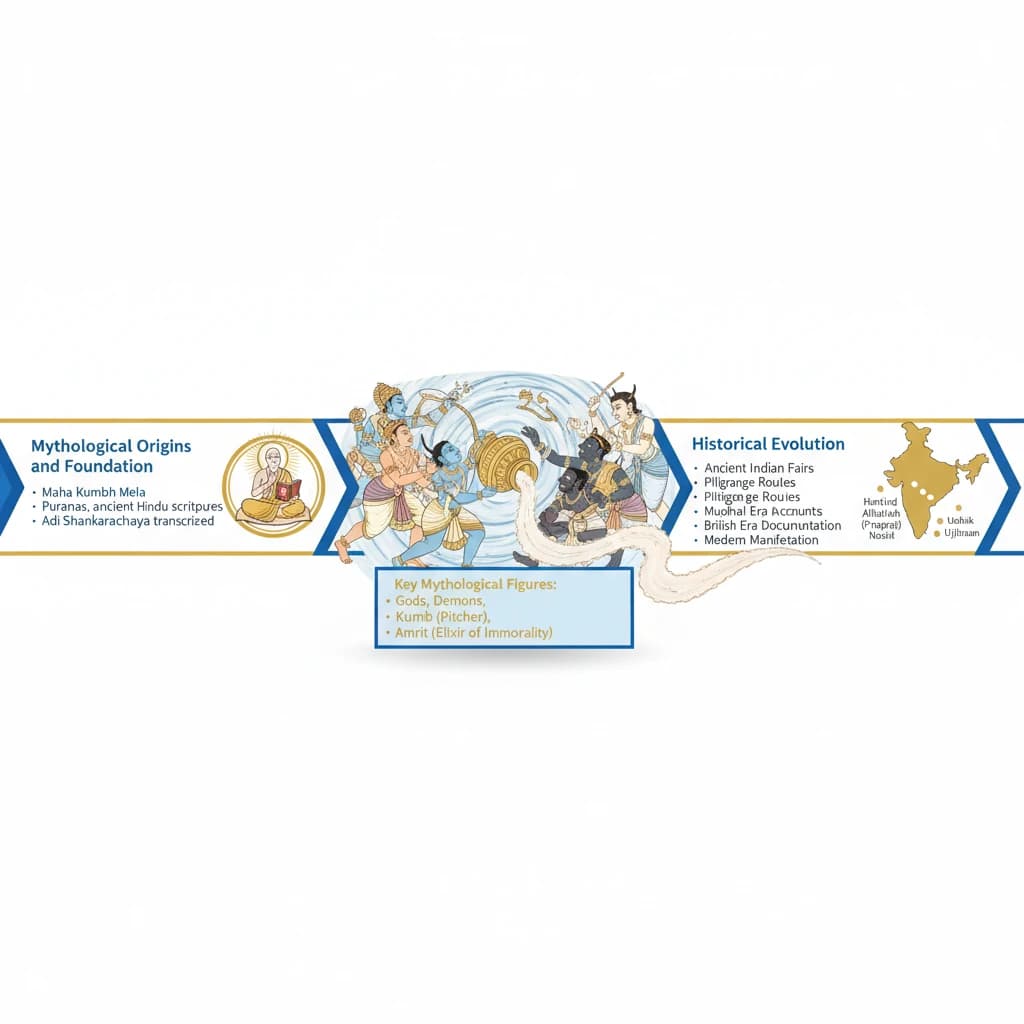
<h4>Mythological Origins and Foundation</h4><p>The <strong>Maha Kumbh Mela</strong> finds its origins in the <strong>Puranas</strong>, ancient Hindu scriptures. Its narrative was significantly transcribed and popularized by <strong>Adi Shankaracharya</strong>.</p><p>The myth describes a fierce battle between <strong>gods and demons</strong> over a sacred pitcher (<strong>Kumbh</strong>) containing <strong>Amrit</strong>, the elixir of immortality.</p><div class="info-box"><strong>Key Mythological Event:</strong> Lord Vishnu, in the guise of <strong>Mohini</strong>, successfully secured the <strong>Amrit</strong> from the demons, leading to its dispersal at four holy sites.</div><h4>Ancient Development and Early Gatherings</h4><p>Historically, the <strong>Kumbh Mela</strong> began as smaller congregations during the <strong>Maurya and Gupta periods</strong>, spanning from the <strong>4th century BCE to the 6th century CE</strong>.</p><p>These early gatherings involved pilgrims from across the <strong>Indian subcontinent</strong>, signifying their nascent importance.</p><div class="key-point-box">The significance of the Mela grew substantially with the rise of <strong>Hinduism</strong>, particularly under influential rulers like the <strong>Guptas</strong>, who elevated its status.</div><p>A pivotal figure in its organization was <strong>King Harshavardhana</strong> of the <strong>Pushyabhuti dynasty</strong>, who initiated the formal organization of the <strong>Kumbh fair at Prayagraj</strong>.</p><h4>Medieval Patronage and Royal Support</h4><p>During the medieval era, the <strong>Kumbh Mela</strong> received significant patronage from various powerful royal dynasties. This support helped sustain and expand the festival.</p><ul><li><strong>Chola Empire</strong></li><li><strong>Vijayanagar Empire</strong></li><li><strong>Delhi Sultanate</strong></li><li><strong>Mughal Empire</strong></li></ul><p>Notably, <strong>Mughal Emperor Akbar</strong>, known for his policy of religious tolerance, granted the <strong>Naga Sadhus</strong> the distinct honour of leading the royal entry to the Mela in <strong>1565</strong>.</p><h4>Colonial Observation and Documentation</h4><p>During the <strong>Colonial Period</strong>, British administrators were profoundly fascinated by the immense scale and diverse nature of the <strong>Kumbh Mela</strong>.</p><p>They undertook extensive observation and documentation of the festival, providing valuable external perspectives.</p><div class="info-box"><strong>Key Chronicler:</strong> In the <strong>19th century</strong>, <strong>James Prinsep</strong> meticulously chronicled the <strong>Kumbh Mela's ritualistic practices</strong> and its complex <strong>socio-religious dynamics</strong>.</div><h4>Post-Independence Significance and Global Recognition</h4><p>In the <strong>Post-Independence</strong> era, the <strong>Kumbh Mela</strong> has come to symbolize <strong>national unity</strong> and stands as a powerful testament to <strong>India’s rich cultural heritage</strong>.</p><div class="exam-tip-box">The Mela's ability to draw millions from diverse backgrounds highlights its role in fostering <strong>social cohesion</strong> and showcasing <strong>India's pluralistic traditions</strong> for <strong>UPSC GS Paper 1 (Indian Heritage and Culture)</strong>.</div><p>Its global significance was formally recognized by <strong>UNESCO in 2017</strong>, when it was inscribed on the list of <strong>Intangible Cultural Heritage of Humanity</strong>, acknowledging its enduring ancient traditions.</p>
Concept Diagram

💡 Key Takeaways

  • •Kumbh Mela's origins are rooted in ancient Puranic mythology involving the battle for Amrit.
  • •It evolved from smaller gatherings in ancient times, gaining prominence under rulers like Harshavardhana.
  • •Medieval dynasties, including the Mughals, provided significant patronage, with Akbar demonstrating religious tolerance.
  • •British administrators like James Prinsep extensively documented the Mela in the colonial era, providing historical records.
  • •Post-independence, it symbolizes national unity and received UNESCO Intangible Cultural Heritage status in 2017.
  • •The Mela is a unique blend of spiritual faith, social gathering, and cultural preservation, attracting millions.
  • •Its timing is determined by specific astrological alignments at four sacred river confluence sites in India.

🧠 Memory Techniques
Memory Aid
98% Verified Content

📚 Reference Sources

•UNESCO official website (Intangible Cultural Heritage)
•NCERT textbooks (Ancient and Medieval Indian History)
•General knowledge resources on Indian culture and history

Related Topics

Loading related topics...
Explore:Art And Culture Topics·All Subjects·Daily Current Affairs·Editorial Analysis·Previous Year Questions·UPSC GPT
Historical Evolution - UPSC Art And Culture