Loading page, please wait…
Vaidra Logo
Vaidra

Top 4 items + smart groups

UPSC GPT
New
Current Affairs
Daily Solutions
Daily Puzzle
Mains Evaluator

Version 2.0.0 • Built with ❤️ for UPSC aspirants

Loading...
Loading...
Loading...
Loading...
Loading...
Loading...
Loading...
Loading...
Loading...
Loading...
Loading...
Loading...
Loading...
Back
All Subjects

Topics

0 topics • 0 completed

Loading topics...
Loading...
Loading...
Loading...
Loading...
Loading...
Overall Progress0%

ASI to Delist Lost Monuments - UPSC Art And Culture

What is ASI to Delist Lost Monuments in UPSC Art And Culture?

ASI to Delist Lost Monuments is a key topic under Art And Culture for UPSC Civil Services Examination. Key points include: ASI delisted 18 centrally protected monuments.. The monuments were deemed to lack national importance.. These 18 monuments were previously categorized as 'untraceable'.. Understanding this topic is essential for both UPSC Prelims and Mains preparation.

Why is ASI to Delist Lost Monuments important for UPSC exam?

ASI to Delist Lost Monuments is a Medium-level topic in UPSC Art And Culture. It is tested in both Prelims (factual MCQs) and Mains (analytical answer writing). Previous year UPSC questions have frequently covered aspects of ASI to Delist Lost Monuments, making it essential for comprehensive IAS preparation.

How to prepare ASI to Delist Lost Monuments for UPSC?

To prepare ASI to Delist Lost Monuments for UPSC: (1) Study the comprehensive notes covering all key concepts on Vaidra. (2) Practice previous year questions on this topic. (3) Connect it with current affairs using daily updates. (4) Revise using key takeaways and mind maps available for Art And Culture. (5) Write practice answers linking ASI to Delist Lost Monuments to related GS Paper topics.

Key takeaways of ASI to Delist Lost Monuments for UPSC

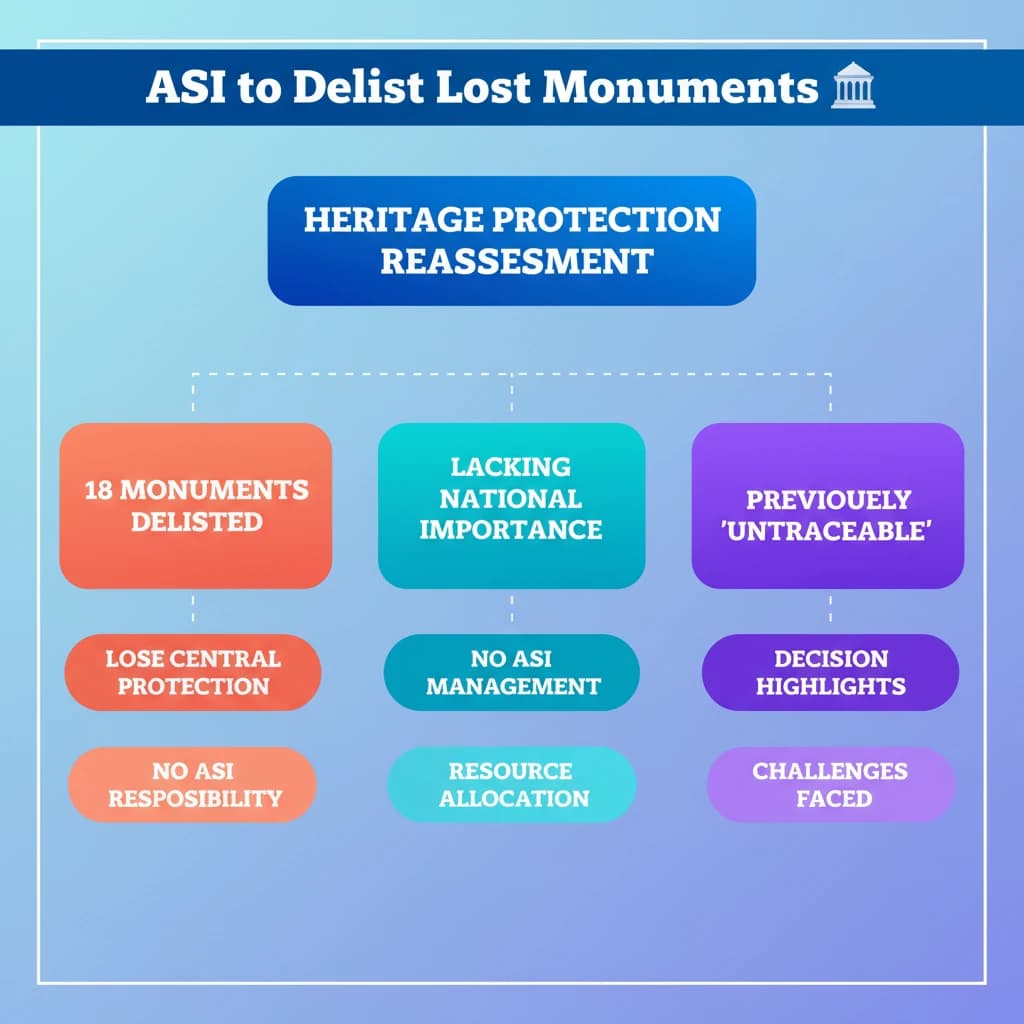
  • ASI delisted 18 centrally protected monuments.
  • The monuments were deemed to lack national importance.
  • These 18 monuments were previously categorized as 'untraceable'.
  • Delisting means they lose central protection and ASI responsibility.
  • The decision highlights challenges in heritage management and resource allocation.
  • It underscores the importance of the AMASR Act and the definition of 'national importance'.
ASI to Delist Lost Monuments

ASI to Delist Lost Monuments

Medium⏱️ 6 min read✓ 95% Verified
art and culture

📖 Introduction

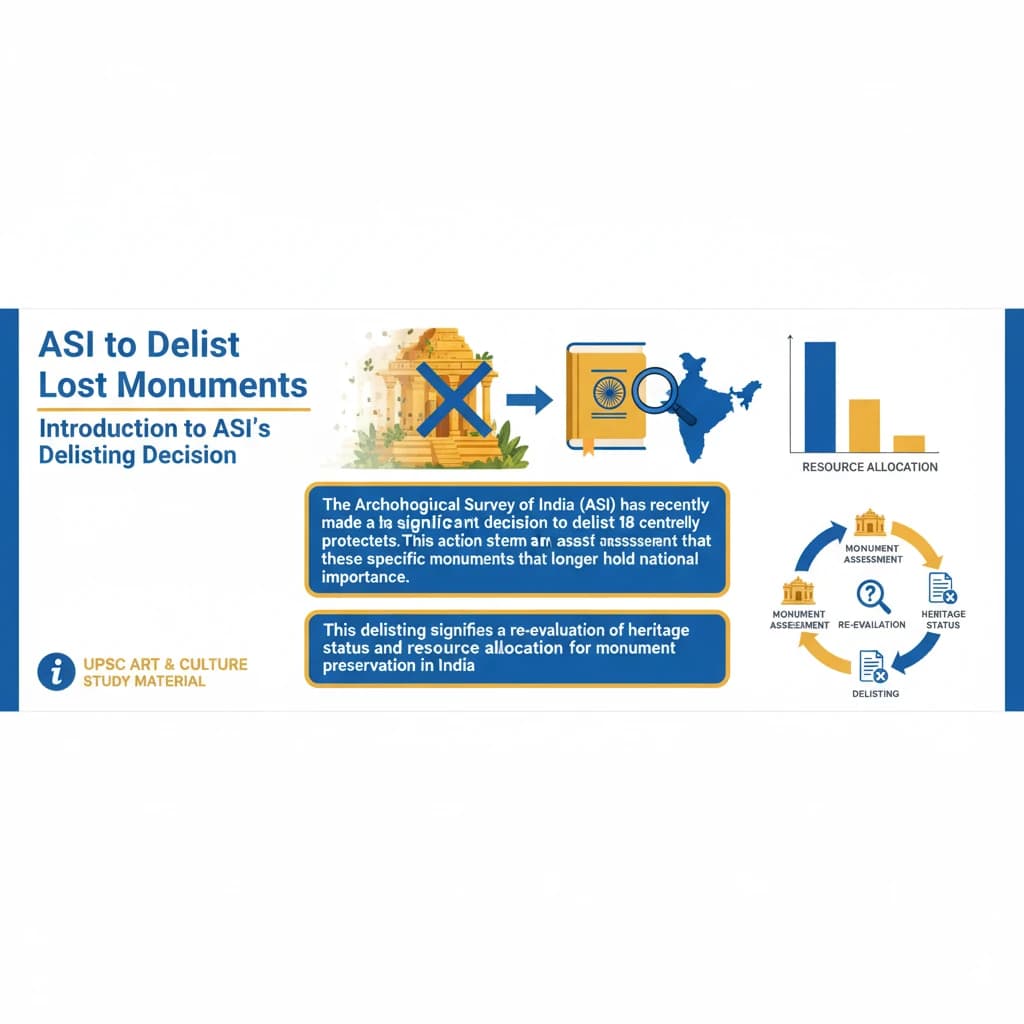
<h4>Introduction to ASI's Delisting Decision</h4><p>The <strong>Archaeological Survey of India (ASI)</strong> has recently made a significant decision to <strong>delist 18 centrally protected monuments</strong>. This action stems from an assessment that these specific monuments no longer hold <strong>national importance</strong>.</p><div class="key-point-box">This delisting signifies a re-evaluation of heritage status and resource allocation for monument preservation in India.</div><h4>Basis of Delisting: Untraceable Monuments</h4><p>The 18 monuments now slated for delisting were previously identified as <strong>'untraceable'</strong> by the ASI. This means their physical location or existence could not be confirmed over time, despite their historical protection status.</p><div class="info-box"><strong>Number of Monuments:</strong> 18<br><strong>Previous Status:</strong> Centrally protected and 'untraceable'<br><strong>Reason for Delisting:</strong> Assessed as lacking national importance</div><h4>Implications of Losing National Importance Status</h4><p>When a monument is delisted, it loses its status as a <strong>'centrally protected monument'</strong>. This implies that the central government, through the ASI, will no longer be responsible for its upkeep, protection, or management.</p><div class="exam-tip-box">Understanding the criteria for 'national importance' as defined by the <strong>Ancient Monuments and Archaeological Sites and Remains Act (AMASR Act)</strong> is crucial for UPSC.</div><h4>What 'Untraceable' Means</h4><p>A monument is declared 'untraceable' when the ASI, after extensive surveys and efforts, fails to locate it. Reasons can include urban encroachment, natural calamities, lack of proper documentation, or even complete destruction over centuries.</p><ul><li><strong>Urbanization:</strong> Rapid expansion of cities often leads to monuments being encroached upon or built over.</li><li><strong>Natural Disasters:</strong> Floods, earthquakes, or erosion can obliterate historical structures.</li><li><strong>Poor Documentation:</strong> Inadequate records from the past can make locating monuments challenging.</li></ul>
Concept Diagram

💡 Key Takeaways

  • •ASI delisted 18 centrally protected monuments.
  • •The monuments were deemed to lack national importance.
  • •These 18 monuments were previously categorized as 'untraceable'.
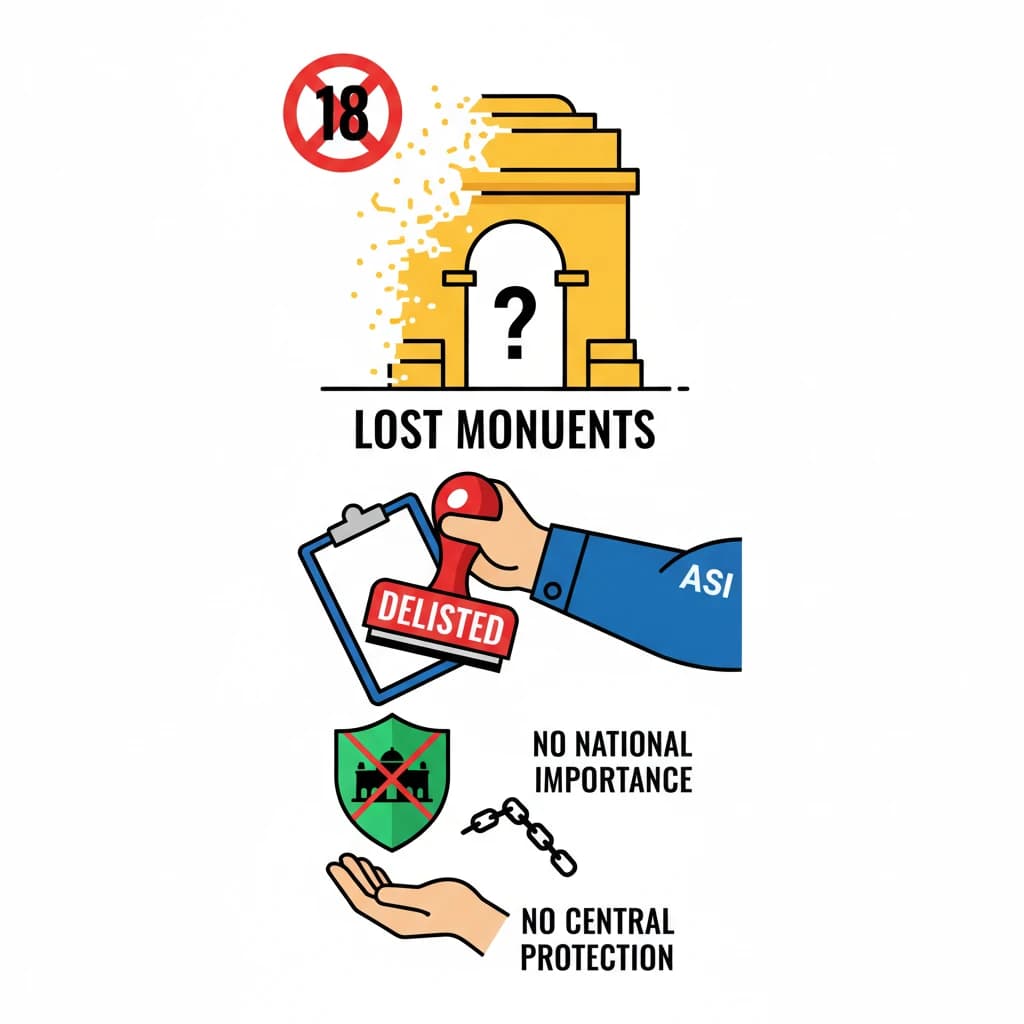
  • •Delisting means they lose central protection and ASI responsibility.
  • •The decision highlights challenges in heritage management and resource allocation.
  • •It underscores the importance of the AMASR Act and the definition of 'national importance'.

🧠 Memory Techniques
Memory Aid
95% Verified Content

📚 Reference Sources

•General knowledge about Archaeological Survey of India (ASI) and Ancient Monuments and Archaeological Sites and Remains Act (AMASR Act)

Related Topics

Loading related topics...
Explore:Art And Culture Topics·All Subjects·Daily Current Affairs·Editorial Analysis·Previous Year Questions·UPSC GPT
ASI to Delist Lost Monuments - UPSC Art And Culture