Loading page, please wait…
Vaidra Logo
Vaidra

Top 4 items + smart groups

UPSC GPT
New
Current Affairs
Daily Solutions
Daily Puzzle
Mains Evaluator

Version 2.0.0 • Built with ❤️ for UPSC aspirants

Loading...
Loading...
Loading...
Loading...
Loading...
Loading...
Loading...
Loading...
Loading...
Loading...
Loading...
Loading...
Loading...
Back
All Subjects

Topics

0 topics • 0 completed

Loading topics...
Loading...
Loading...
Loading...
Loading...
Loading...
Overall Progress0%

Cultural Exchange and Growth of Kashmir’s Craft Industry - UPSC Art And Culture

What is Cultural Exchange and Growth of Kashmir’s Craft Industry in UPSC Art And Culture?

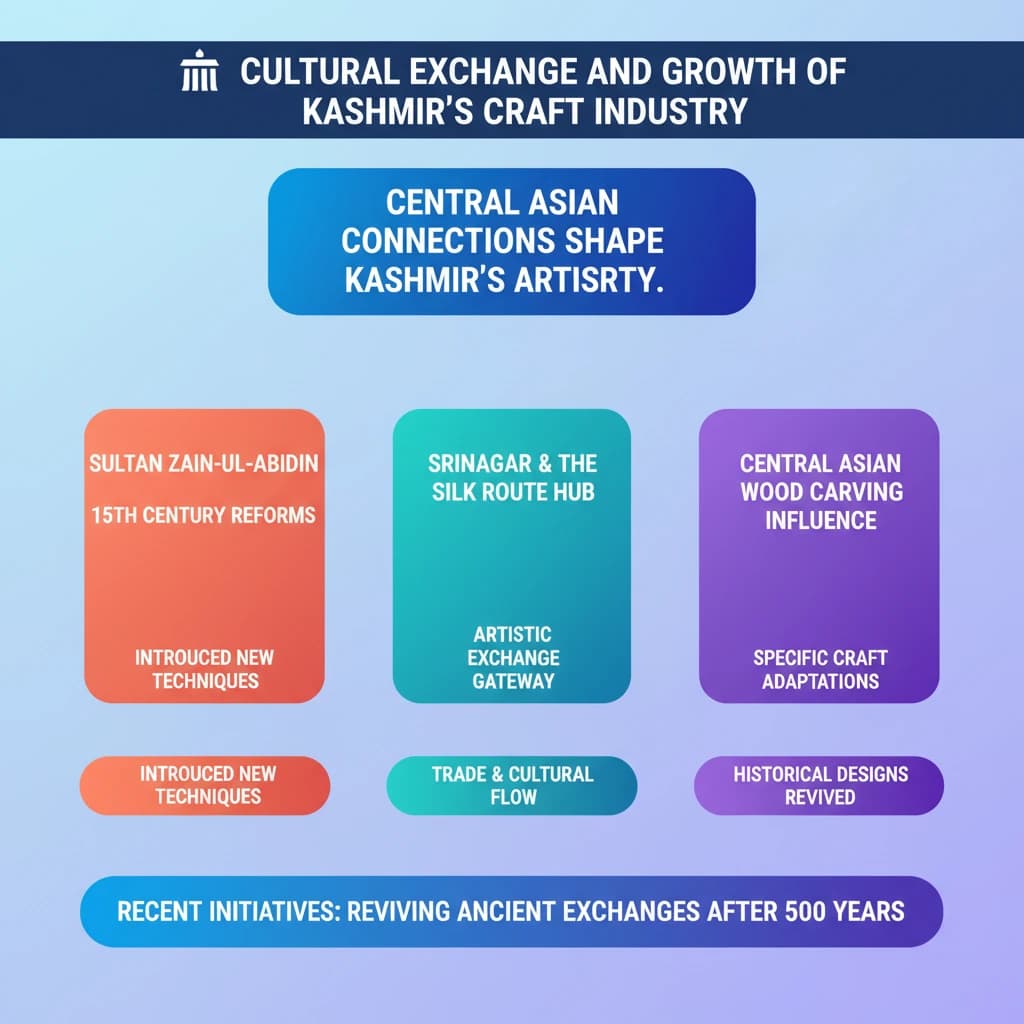
Cultural Exchange and Growth of Kashmir’s Craft Industry is a key topic under Art And Culture for UPSC Civil Services Examination. Key points include: Kashmir's craft industry has a deep historical connection with Central Asia.. Sultan Zain-ul-Abidin in the 15th century played a crucial role in introducing Central Asian craft techniques.. Srinagar's location on the Silk Route facilitated extensive cultural and artistic exchanges.. Understanding this topic is essential for both UPSC Prelims and Mains preparation.

Why is Cultural Exchange and Growth of Kashmir’s Craft Industry important for UPSC exam?

Cultural Exchange and Growth of Kashmir’s Craft Industry is a Medium-level topic in UPSC Art And Culture. It is tested in both Prelims (factual MCQs) and Mains (analytical answer writing). Previous year UPSC questions have frequently covered aspects of Cultural Exchange and Growth of Kashmir’s Craft Industry, making it essential for comprehensive IAS preparation.

How to prepare Cultural Exchange and Growth of Kashmir’s Craft Industry for UPSC?

To prepare Cultural Exchange and Growth of Kashmir’s Craft Industry for UPSC: (1) Study the comprehensive notes covering all key concepts on Vaidra. (2) Practice previous year questions on this topic. (3) Connect it with current affairs using daily updates. (4) Revise using key takeaways and mind maps available for Art And Culture. (5) Write practice answers linking Cultural Exchange and Growth of Kashmir’s Craft Industry to related GS Paper topics.

Key takeaways of Cultural Exchange and Growth of Kashmir’s Craft Industry for UPSC

  • Kashmir's craft industry has a deep historical connection with Central Asia.
  • Sultan Zain-ul-Abidin in the 15th century played a crucial role in introducing Central Asian craft techniques.
  • Srinagar's location on the Silk Route facilitated extensive cultural and artistic exchanges.
  • Specific crafts like wood carving show clear Central Asian influence.
  • Recent initiatives are reviving these ancient cultural exchanges after 500 years.
  • Srinagar's recognition as a "World Craft City" signifies global acknowledgment of its craft heritage.
  • These crafts are vital for preserving cultural identity and supporting local economies.
Cultural Exchange and Growth of Kashmir’s Craft Industry

Cultural Exchange and Growth of Kashmir’s Craft Industry

Medium⏱️ 7 min read✓ 95% Verified
art and culture

📖 Introduction

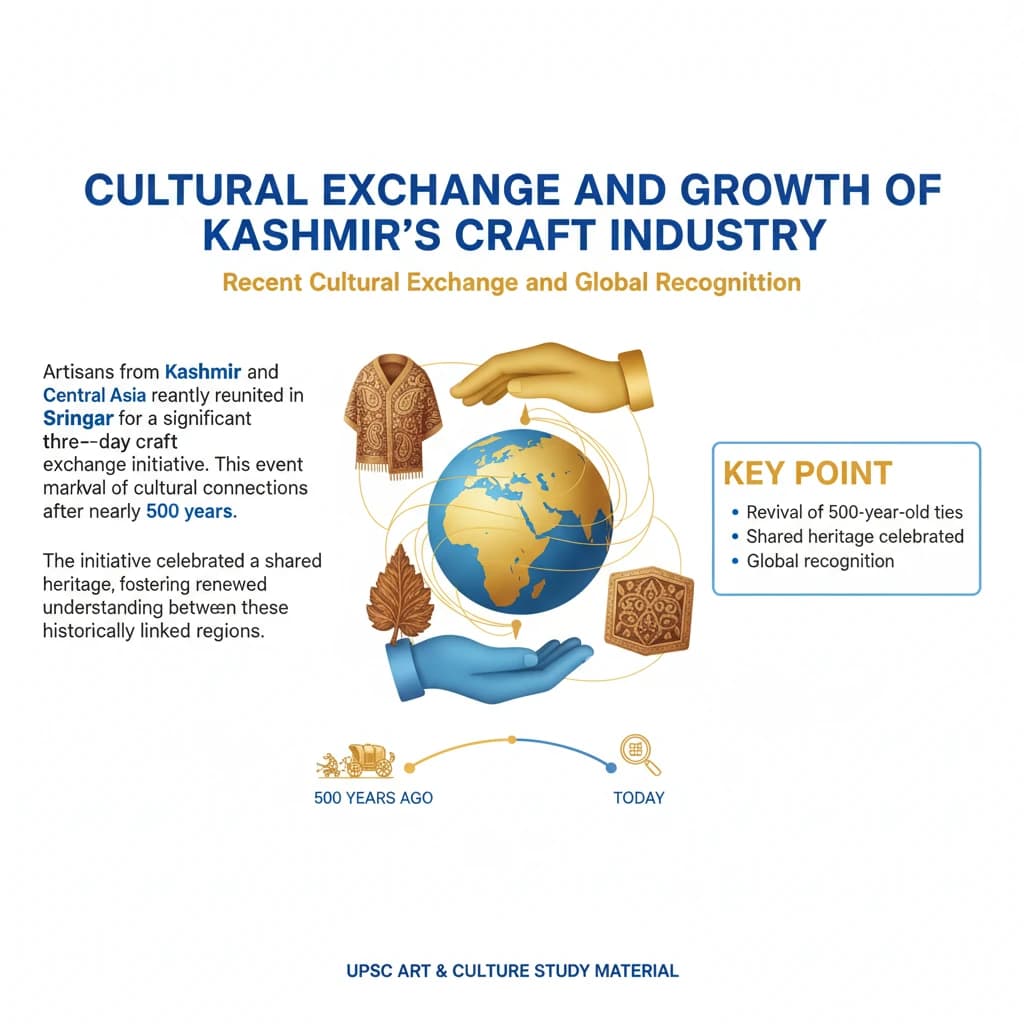
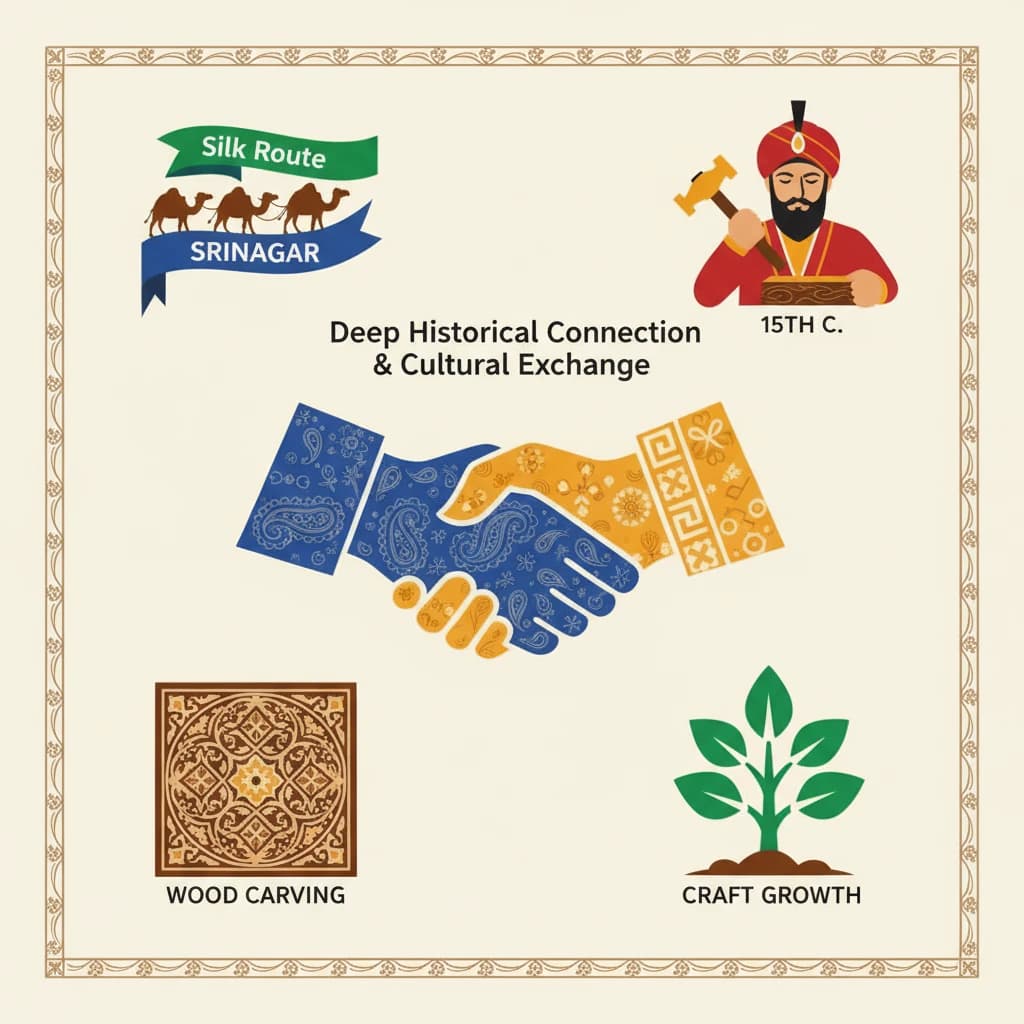
<h4>Recent Cultural Exchange and Global Recognition</h4><p>Artisans from <strong>Kashmir</strong> and <strong>Central Asia</strong> recently reunited in <strong>Srinagar</strong> for a significant three-day craft exchange initiative. This event marked a revival of cultural connections after nearly <strong>500 years</strong>.</p><p>The initiative celebrated a shared heritage, fostering renewed understanding and collaboration between these historically linked regions.</p><div class="key-point-box">The event also celebrated <strong>Srinagar's</strong> recognition as a <strong>“World Craft City”</strong> by the <strong>World Crafts Council (WCC)</strong>. This designation highlights the city's rich artisanal legacy and ongoing contributions to global craft heritage.</div><h4>Historical Central Asian Influence on Srinagar's Crafts</h4><p>The development of <strong>Srinagar's</strong> distinctive crafts has deep roots in historical interactions with <strong>Central Asia</strong>.</p><p>A pivotal figure in this cultural exchange was <strong>Zain-ul-Abidin</strong>, the <strong>9th Sultan of Kashmir</strong>, who reigned in the <strong>15th century</strong>.</p><div class="info-box"><strong>Sultan Zain-ul-Abidin's Contribution:</strong><ul><li>Introduced <strong>Central Asian craft techniques</strong> to <strong>Kashmir</strong>.</li><li>Brought skilled artisans from regions like <strong>Samarkand</strong>, <strong>Bukhara</strong>, and <strong>Persia</strong>.</li></ul></div><p>These initial connections flourished during his reign, significantly shaping the local craft industry.</p><p>However, post <strong>Zain-ul-Abidin's</strong> era, these cultural and craft connections gradually weakened. They eventually came to an end by <strong>1947</strong>, largely due to geopolitical shifts.</p><div class="key-point-box"><strong>Srinagar's Strategic Location:</strong><p>Located on the historic <strong>Silk Route</strong>, <strong>Srinagar</strong> naturally became a melting pot for cultural, economic, and artistic exchanges. This geographical advantage facilitated cross-cultural interactions vital for craft development.</p></div><h4>Specific Craftsmanship Techniques: Wood Carving</h4><p>Among the many crafts influenced, <strong>wood carving</strong> stands out as a prominent example of <strong>Kashmiri</strong> artistry.</p><p><strong>Kashmiri artisans</strong> are renowned for their intricate woodwork, a skill greatly enhanced by the adoption of techniques introduced from <strong>Central Asia</strong>.</p><div class="info-box"><strong>Characteristics of Kashmiri Wood Carving:</strong><ul><li>Known for intricate, detailed patterns.</li><li>Often features floral motifs, calligraphy, and geometric designs.</li><li>Utilizes local woods like <strong>walnut</strong>, which is ideal for fine carving.</li></ul></div>
Concept Diagram

💡 Key Takeaways

  • •Kashmir's craft industry has a deep historical connection with Central Asia.
  • •Sultan Zain-ul-Abidin in the 15th century played a crucial role in introducing Central Asian craft techniques.
  • •Srinagar's location on the Silk Route facilitated extensive cultural and artistic exchanges.
  • •Specific crafts like wood carving show clear Central Asian influence.
  • •Recent initiatives are reviving these ancient cultural exchanges after 500 years.
  • •Srinagar's recognition as a "World Craft City" signifies global acknowledgment of its craft heritage.
  • •These crafts are vital for preserving cultural identity and supporting local economies.

🧠 Memory Techniques
Memory Aid
95% Verified Content

Related Topics

Loading related topics...
Explore:Art And Culture Topics·All Subjects·Daily Current Affairs·Editorial Analysis·Previous Year Questions·UPSC GPT
Cultural Exchange and Growth of Kashmir’s Craft Industry - UPSC Art And Culture