Loading page, please wait…
Vaidra Logo
Vaidra

Top 4 items + smart groups

UPSC GPT
New
Current Affairs
Daily Solutions
Daily Puzzle
Mains Evaluator

Version 2.0.0 • Built with ❤️ for UPSC aspirants

Loading...
Loading...
Loading...
Loading...
Loading...
Loading...
Loading...
Loading...
Loading...
Loading...
Loading...
Loading...
Loading...
Back
All Subjects

Topics

0 topics • 0 completed

Loading topics...
Loading...
Loading...
Loading...
Loading...
Loading...
Overall Progress0%

Archaeological Sites and Remains Act, 1958 (AMASR Act) - UPSC Art And Culture

What is Archaeological Sites and Remains Act, 1958 (AMASR Act) in UPSC Art And Culture?

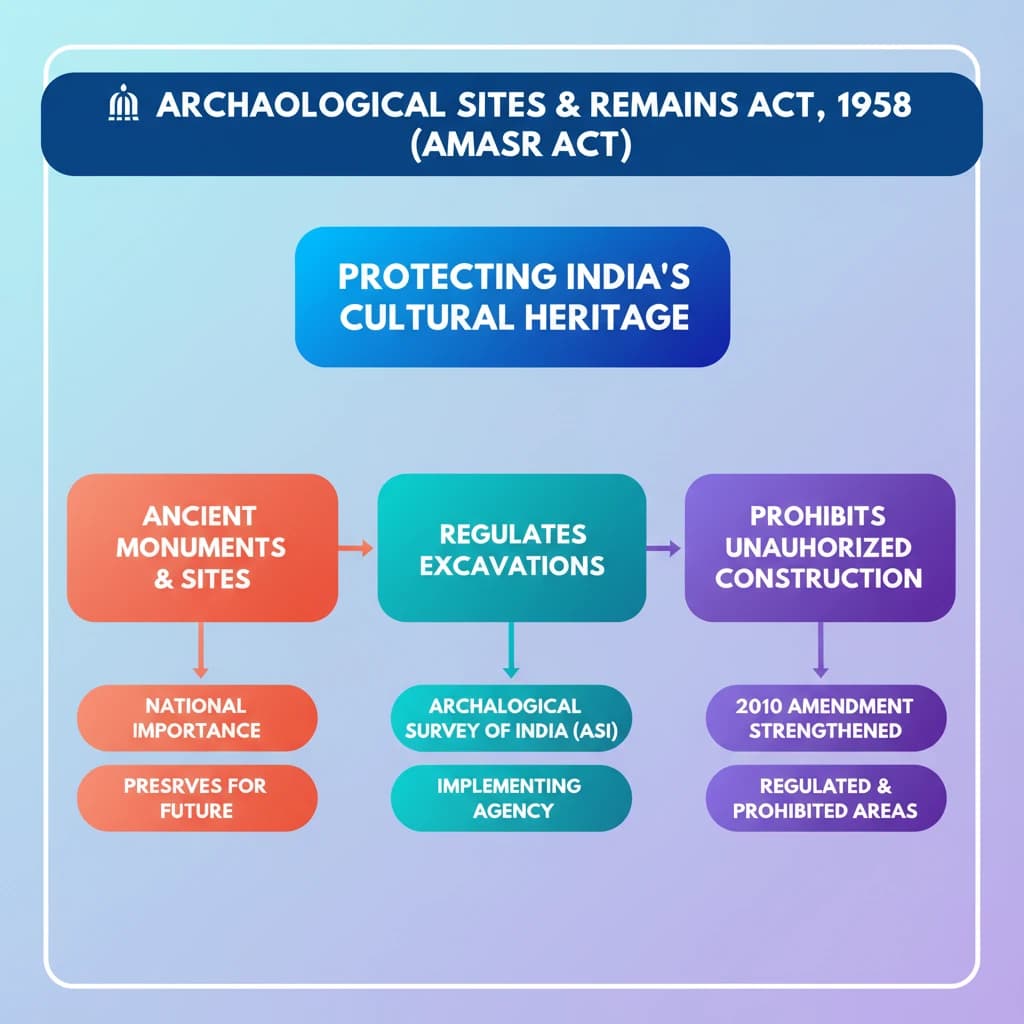
Archaeological Sites and Remains Act, 1958 (AMASR Act) is a key topic under Art And Culture for UPSC Civil Services Examination. Key points include: The AMASR Act, 1958, protects ancient monuments and archaeological sites of national importance.. Its main objective is to preserve India's cultural heritage for future generations.. The Act regulates archaeological excavations and prohibits unauthorized construction near protected sites.. Understanding this topic is essential for both UPSC Prelims and Mains preparation.

Why is Archaeological Sites and Remains Act, 1958 (AMASR Act) important for UPSC exam?

Archaeological Sites and Remains Act, 1958 (AMASR Act) is a Medium-level topic in UPSC Art And Culture. It is tested in both Prelims (factual MCQs) and Mains (analytical answer writing). Previous year UPSC questions have frequently covered aspects of Archaeological Sites and Remains Act, 1958 (AMASR Act), making it essential for comprehensive IAS preparation.

How to prepare Archaeological Sites and Remains Act, 1958 (AMASR Act) for UPSC?

To prepare Archaeological Sites and Remains Act, 1958 (AMASR Act) for UPSC: (1) Study the comprehensive notes covering all key concepts on Vaidra. (2) Practice previous year questions on this topic. (3) Connect it with current affairs using daily updates. (4) Revise using key takeaways and mind maps available for Art And Culture. (5) Write practice answers linking Archaeological Sites and Remains Act, 1958 (AMASR Act) to related GS Paper topics.

Key takeaways of Archaeological Sites and Remains Act, 1958 (AMASR Act) for UPSC

  • The AMASR Act, 1958, protects ancient monuments and archaeological sites of national importance.
  • Its main objective is to preserve India's cultural heritage for future generations.
  • The Act regulates archaeological excavations and prohibits unauthorized construction near protected sites.
  • The 2010 amendment strengthened provisions regarding prohibited and regulated areas around monuments.
  • The Archaeological Survey of India (ASI) is the primary agency responsible for implementing the Act.
  • The Act faces challenges in balancing development needs with heritage preservation.
Archaeological Sites and Remains Act, 1958 (AMASR Act)

Archaeological Sites and Remains Act, 1958 (AMASR Act)

Medium⏱️ 8 min read✓ 98% Verified
art and culture

📖 Introduction

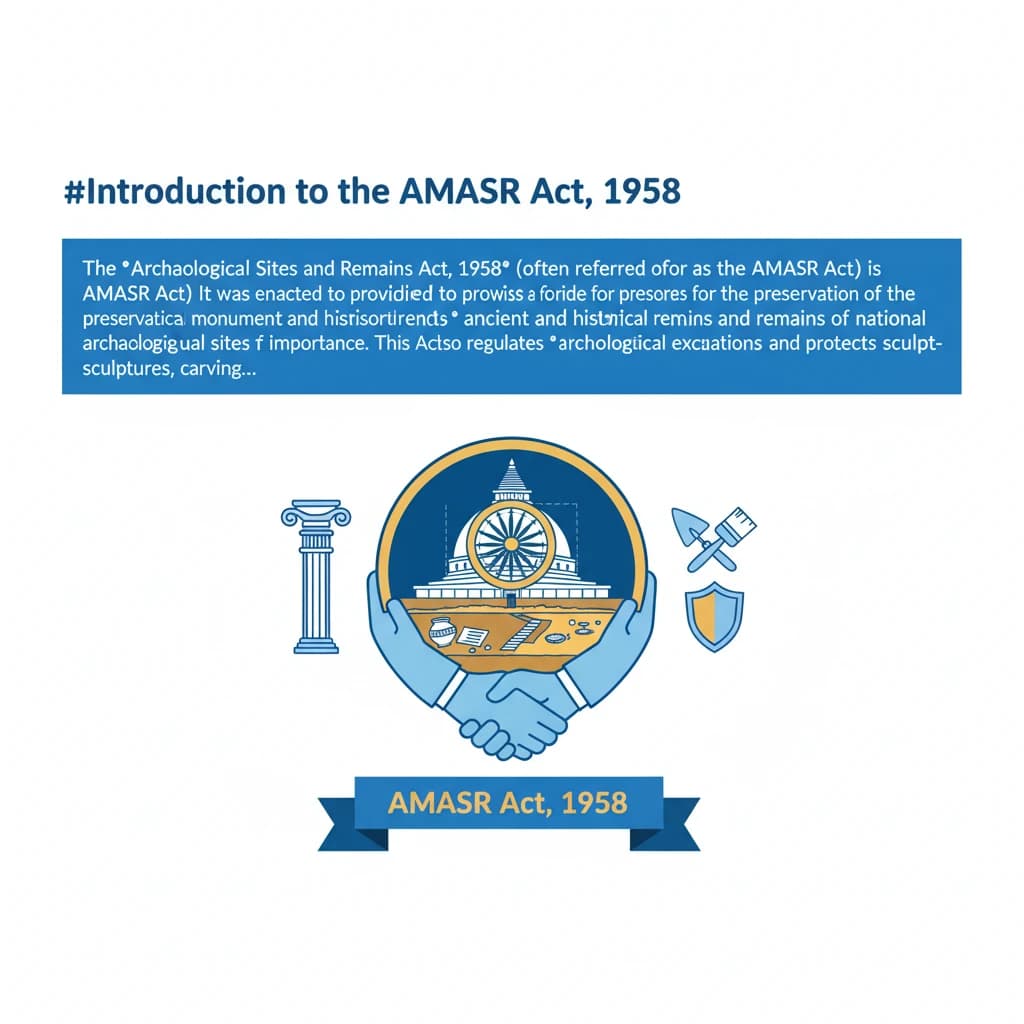
<h4>Introduction to the AMASR Act, 1958</h4><p>The <strong>Archaeological Sites and Remains Act, 1958</strong> (often referred to as the <strong>AMASR Act</strong>) is a pivotal piece of legislation in India. It was enacted to provide for the preservation of <strong>ancient and historical monuments</strong> and <strong>archaeological sites and remains</strong> of national importance.</p><p>This Act also regulates <strong>archaeological excavations</strong> and protects <strong>sculptures, carvings, and other like objects</strong>.</p><div class="info-box"><strong>Full Name:</strong> The Ancient Monuments and Archaeological Sites and Remains Act, 1958<br><strong>Enactment Year:</strong> 1958</div><h4>Core Objective of the Act</h4><p>The primary aim of the <strong>AMASR Act</strong> is to <strong>protect and preserve ancient monuments</strong> and archaeological sites for future generations. This ensures that India's rich cultural heritage is safeguarded against damage, encroachment, and illicit trade.</p><div class="key-point-box">The Act establishes a framework for declaring certain sites and remains as being of <strong>national importance</strong>, thereby bringing them under the purview of central protection.</div><h4>Key Provisions and Scope</h4><p>The Act defines what constitutes an <strong>ancient monument</strong> and an <strong>archaeological site and remains</strong>. It empowers the Central Government, through the <strong>Archaeological Survey of India (ASI)</strong>, to take measures for their upkeep and maintenance.</p><p>It also outlines regulations for construction activities in <strong>prohibited and regulated areas</strong> around protected monuments, which are crucial for maintaining the integrity and visual setting of these sites.</p><div class="exam-tip-box">Understanding the <strong>AMASR Act</strong> is crucial for UPSC as it forms the legal backbone for heritage preservation in India. Questions often relate to its provisions, amendments, and challenges in implementation.</div>
Concept Diagram

💡 Key Takeaways

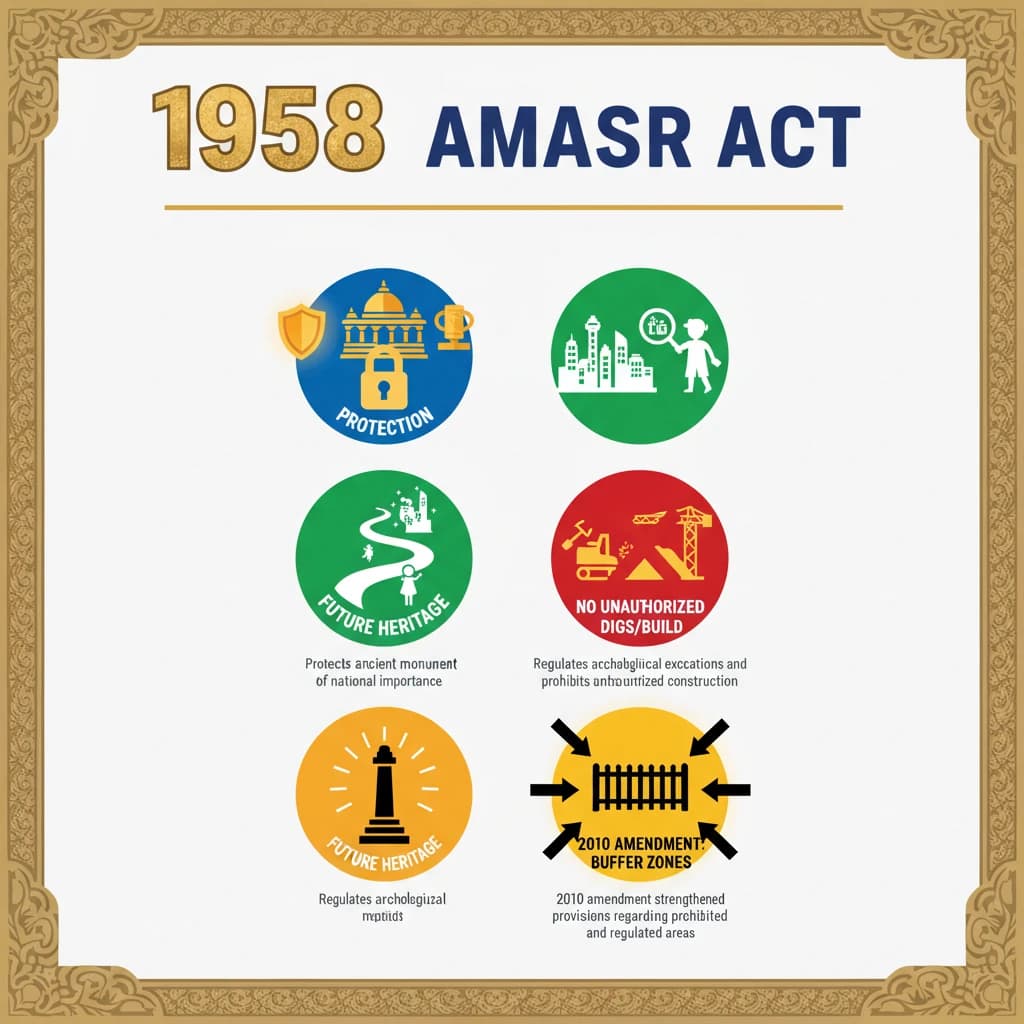
  • •The AMASR Act, 1958, protects ancient monuments and archaeological sites of national importance.
  • •Its main objective is to preserve India's cultural heritage for future generations.
  • •The Act regulates archaeological excavations and prohibits unauthorized construction near protected sites.
  • •The 2010 amendment strengthened provisions regarding prohibited and regulated areas around monuments.
  • •The Archaeological Survey of India (ASI) is the primary agency responsible for implementing the Act.
  • •The Act faces challenges in balancing development needs with heritage preservation.

🧠 Memory Techniques
Memory Aid
98% Verified Content

📚 Reference Sources

•Archaeological Survey of India (ASI) official website
•Drishti IAS study material on Art & Culture
•Ministry of Culture, Government of India publications

Related Topics

Loading related topics...
Explore:Art And Culture Topics·All Subjects·Daily Current Affairs·Editorial Analysis·Previous Year Questions·UPSC GPT
Archaeological Sites and Remains Act, 1958 (AMASR Act) - UPSC Art And Culture