Loading page, please wait…
Vaidra Logo
Vaidra

Top 4 items + smart groups

UPSC GPT
New
Current Affairs
Daily Solutions
Daily Puzzle
Mains Evaluator

Version 2.0.0 • Built with ❤️ for UPSC aspirants

Loading...
Loading...
Loading...
Loading...
Loading...
Loading...
Loading...
Loading...
Loading...
Loading...
Loading...
Loading...
Loading...

Bhimbetka Rock Paintings - UPSC Art And Culture

What is Bhimbetka Rock Paintings in UPSC Art And Culture?

Bhimbetka Rock Paintings is a key topic under Art And Culture for UPSC Civil Services Examination. Key points include: Bhimbetka Rock Shelters in Madhya Pradesh contain some of the oldest rock paintings in India.. The oldest paintings are approximately 30,000 years old, dating back to the Upper Paleolithic period.. V. S. Wakankar discovered the caves in 1957-58.. Understanding this topic is essential for both UPSC Prelims and Mains preparation.

Why is Bhimbetka Rock Paintings important for UPSC exam?

Bhimbetka Rock Paintings is a Medium-level topic in UPSC Art And Culture. It is tested in both Prelims (factual MCQs) and Mains (analytical answer writing). Previous year UPSC questions have frequently covered aspects of Bhimbetka Rock Paintings, making it essential for comprehensive IAS preparation.

How to prepare Bhimbetka Rock Paintings for UPSC?

To prepare Bhimbetka Rock Paintings for UPSC: (1) Study the comprehensive notes covering all key concepts on Vaidra. (2) Practice previous year questions on this topic. (3) Connect it with current affairs using daily updates. (4) Revise using key takeaways and mind maps available for Art And Culture. (5) Write practice answers linking Bhimbetka Rock Paintings to related GS Paper topics.

Key takeaways of Bhimbetka Rock Paintings for UPSC

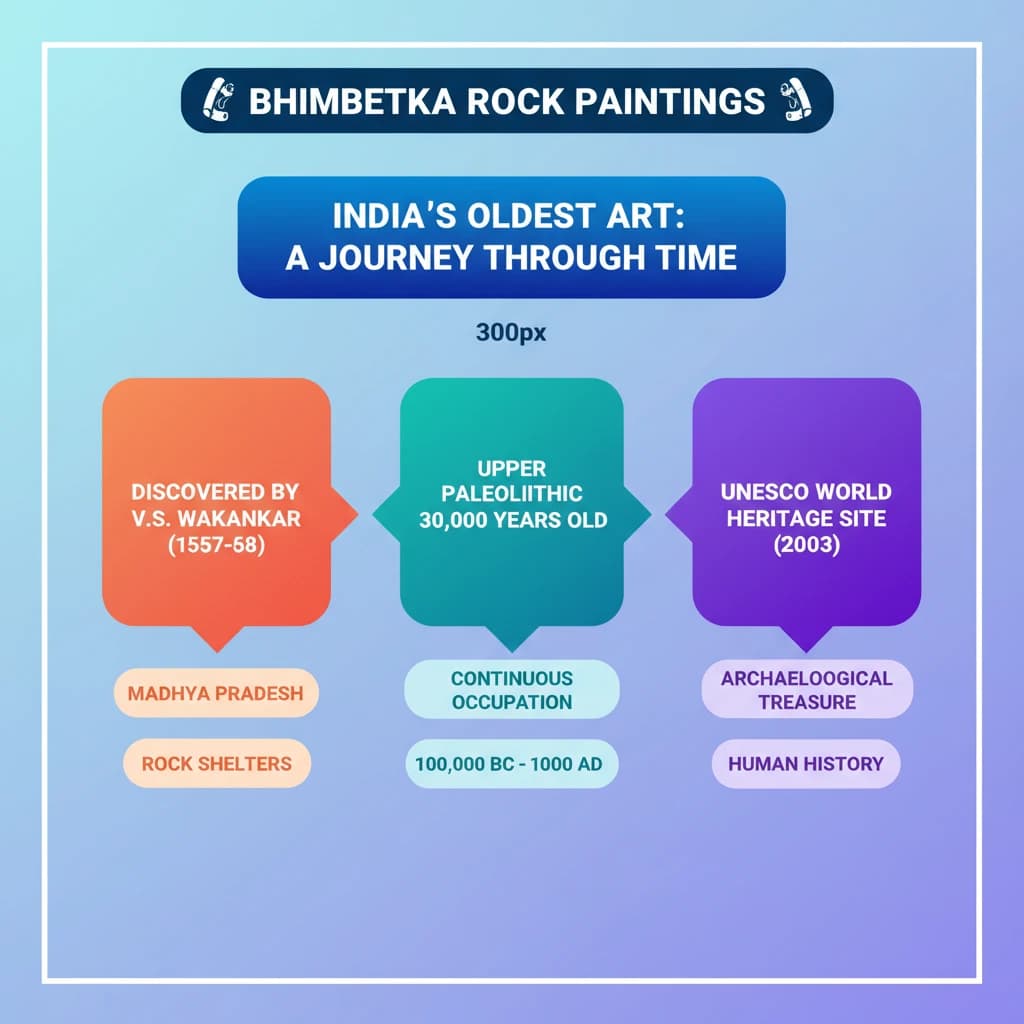
  • Bhimbetka Rock Shelters in Madhya Pradesh contain some of the oldest rock paintings in India.
  • The oldest paintings are approximately 30,000 years old, dating back to the Upper Paleolithic period.
  • V. S. Wakankar discovered the caves in 1957-58.
  • It was declared a UNESCO World Heritage Site in 2003.
  • The site shows continuous human occupation from 100,000 BC to 1000 AD.
  • Most paintings belong to the Mesolithic age and depict figurative scenes of humans and animals.
  • The layered paintings indicate a long tradition of artistic activity.
Bhimbetka Rock Paintings

Bhimbetka Rock Paintings

Medium⏱️ 6 min read✓ 95% Verified
art and culture

📖 Introduction

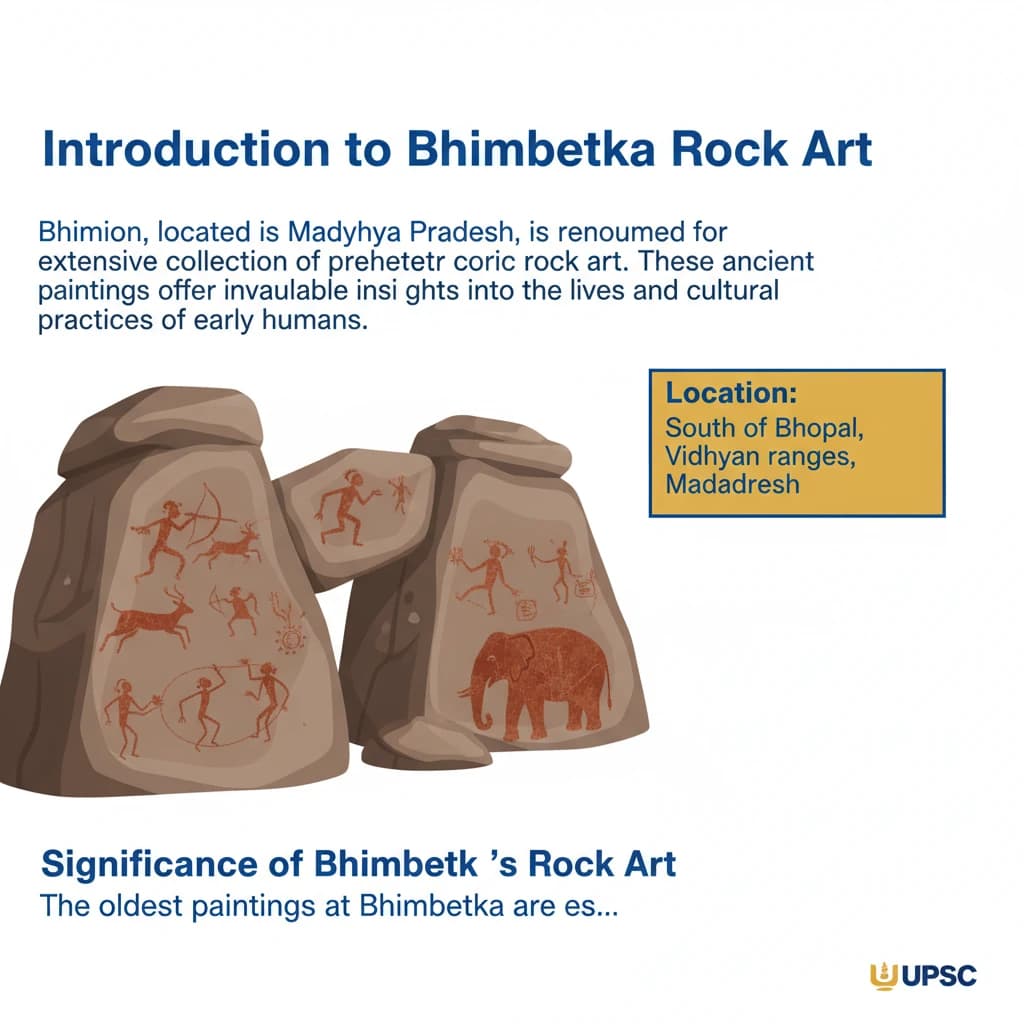
<h4>Introduction to Bhimbetka Rock Art</h4><p><strong>Bhimbetka</strong>, located in <strong>Madhya Pradesh</strong>, is renowned for its extensive collection of prehistoric <strong>rock art</strong>. These ancient paintings offer invaluable insights into the lives and cultural practices of early humans.</p><div class="info-box"><strong>Location:</strong> South of Bhopal, Vidhyan ranges, Madhya Pradesh.</div><h4>Significance of Bhimbetka's Rock Art</h4><p>The oldest paintings at Bhimbetka are estimated to be around <strong>30,000 years old</strong>, making them among the oldest known art forms.</p><p>Researchers have found that the <strong>figurative art</strong> depicting humans and animals in scenes has deeper historical roots than previously believed.</p><div class="key-point-box">This discovery challenges earlier notions, as non-figurative markings by <strong>Neanderthals</strong> began around <strong>75,000 years ago</strong>, but sophisticated narrative art emerged later.</div><p>The art suggests the emergence of a <strong>sophisticated narrative tradition</strong>. It used visual arts to represent complex relationships between humans and animals.</p><h4>Discovery and UNESCO Recognition</h4><p>The caves of Bhimbetka were discovered in <strong>1957–58</strong> by archaeologist <strong>V. S. Wakankar</strong>.</p><p>Its immense historical and cultural value led to its designation as a <strong>UNESCO World Heritage Site</strong> in <strong>2003</strong>.</p><h4>Chronology and Periods of Paintings</h4><p>The site demonstrates a remarkable <strong>continuity in occupancy</strong>, spanning from <strong>100,000 BC to 1000 AD</strong>.</p><p>Many paintings are layered, with new art painted on top of older ones. Some shelters show as many as <strong>20 layers</strong> of paintings.</p><div class="info-box">The paintings at Bhimbetka belong to multiple periods:<ul><li><strong>Upper Paleolithic</strong></li><li><strong>Mesolithic</strong> (most prominent)</li><li><strong>Chalcolithic</strong></li><li><strong>Early Historic</strong></li><li><strong>Medieval Period</strong></li></ul></div><p>The survival of these ancient artworks is attributed to their location deep inside the rock shelters, protecting them from natural elements.</p>
Concept Diagram

💡 Key Takeaways

  • •Bhimbetka Rock Shelters in Madhya Pradesh contain some of the oldest rock paintings in India.
  • •The oldest paintings are approximately 30,000 years old, dating back to the Upper Paleolithic period.
  • •V. S. Wakankar discovered the caves in 1957-58.
  • •It was declared a UNESCO World Heritage Site in 2003.
  • •The site shows continuous human occupation from 100,000 BC to 1000 AD.
  • •Most paintings belong to the Mesolithic age and depict figurative scenes of humans and animals.
  • •The layered paintings indicate a long tradition of artistic activity.

🧠 Memory Techniques

Memory Aid
95% Verified Content

Related Topics

Loading related topics...
Explore:Art And Culture Topics·All Subjects·Daily Current Affairs·Editorial Analysis·Previous Year Questions·UPSC GPT
Back
All Subjects

Topics

0 topics • 0 completed

Loading topics...
Loading...
Loading...
Loading...
Loading...
Loading...
Overall Progress0%
Bhimbetka Rock Paintings - UPSC Art And Culture