Loading page, please wait…
Vaidra Logo
Vaidra

Top 4 items + smart groups

UPSC GPT
New
Current Affairs
Daily Solutions
Daily Puzzle
Mains Evaluator

Version 2.0.0 • Built with ❤️ for UPSC aspirants

Loading...
Loading...
Loading...
Loading...
Loading...
Loading...
Loading...
Loading...
Loading...
Loading...
Loading...
Loading...
Loading...

What Does it Mean When the ASI Declares a Monument “Untraceable”? - UPSC Art And Culture

What is What Does it Mean When the ASI Declares a Monument “Untraceable”? in UPSC Art And Culture?

What Does it Mean When the ASI Declares a Monument “Untraceable”? is a key topic under Art And Culture for UPSC Civil Services Examination. Key points include: An untraceable monument is one that can no longer be physically located or identified.. Urbanisation, encroachments, construction, and neglect are primary reasons for monuments becoming untraceable.. The AMASR Act mandates ASI to conserve protected monuments, but its implementation faces challenges.. Understanding this topic is essential for both UPSC Prelims and Mains preparation.

Why is What Does it Mean When the ASI Declares a Monument “Untraceable”? important for UPSC exam?

What Does it Mean When the ASI Declares a Monument “Untraceable”? is a Medium-level topic in UPSC Art And Culture. It is tested in both Prelims (factual MCQs) and Mains (analytical answer writing). Previous year UPSC questions have frequently covered aspects of What Does it Mean When the ASI Declares a Monument “Untraceable”?, making it essential for comprehensive IAS preparation.

How to prepare What Does it Mean When the ASI Declares a Monument “Untraceable”? for UPSC?

To prepare What Does it Mean When the ASI Declares a Monument “Untraceable”? for UPSC: (1) Study the comprehensive notes covering all key concepts on Vaidra. (2) Practice previous year questions on this topic. (3) Connect it with current affairs using daily updates. (4) Revise using key takeaways and mind maps available for Art And Culture. (5) Write practice answers linking What Does it Mean When the ASI Declares a Monument “Untraceable”? to related GS Paper topics.

Key takeaways of What Does it Mean When the ASI Declares a Monument “Untraceable”? for UPSC

  • An untraceable monument is one that can no longer be physically located or identified.
  • Urbanisation, encroachments, construction, and neglect are primary reasons for monuments becoming untraceable.
  • The AMASR Act mandates ASI to conserve protected monuments, but its implementation faces challenges.
  • The loss of untraceable monuments signifies an irreversible damage to India's cultural heritage.
  • Better conservation efforts, adequate resource allocation, and technological integration are crucial for prevention.
  • Public awareness and active community involvement are key to identifying and protecting vulnerable heritage sites.
What Does it Mean When the ASI Declares a Monument “Untraceable”?

What Does it Mean When the ASI Declares a Monument “Untraceable”?

Medium⏱️ 8 min read✓ 95% Verified
art and culture

📖 Introduction

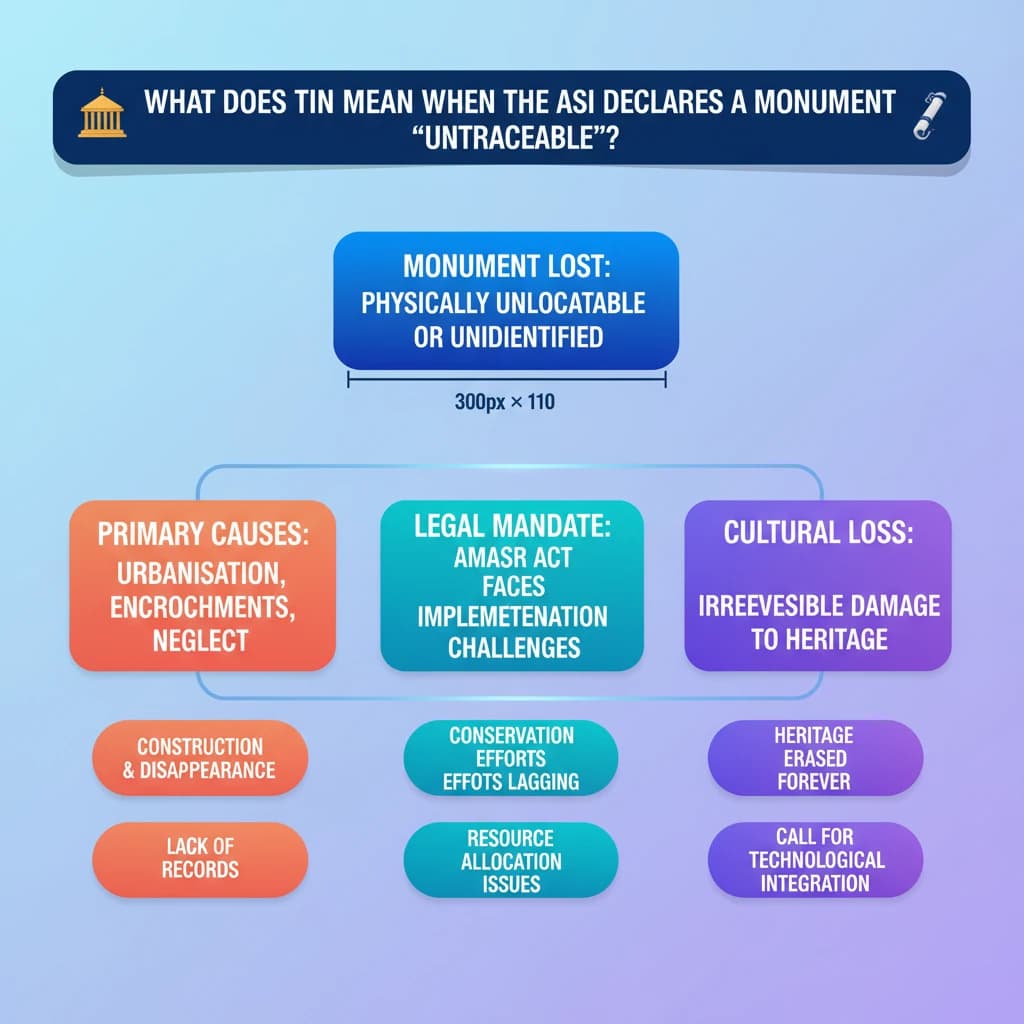
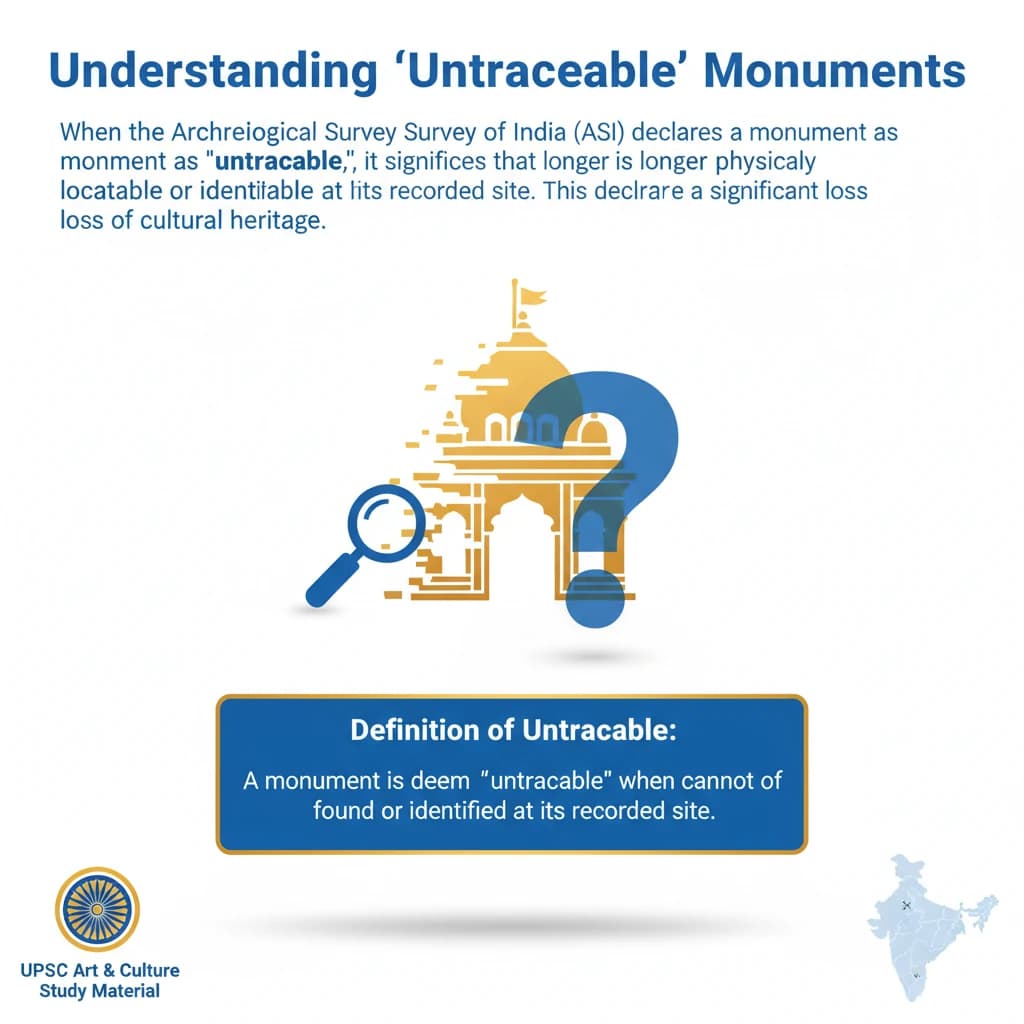
<h4>Understanding 'Untraceable' Monuments</h4><p>When the <strong>Archaeological Survey of India (ASI)</strong> declares a monument as "<strong>untraceable</strong>," it signifies that the monument is no longer physically locatable or identifiable at its recorded site. This declaration underscores a significant loss of cultural heritage.</p><div class="info-box"><strong>Definition of Untraceable:</strong> A monument is deemed "<strong>untraceable</strong>" when it cannot be found or identified at its documented location, implying its physical disappearance or severe deterioration.</div><h4>Factors Leading to Monument Loss</h4><p>Several critical factors contribute to monuments becoming <strong>untraceable</strong> and subsequently lost:</p><ul><li><strong>Urbanisation:</strong> Rapid expansion of cities often leads to the demolition or burying of smaller heritage structures during development.</li><li><strong>Encroachments:</strong> Illegal occupation of land around monuments can obscure or destroy them over time, making them difficult to locate.</li><li><strong>Construction Activities:</strong> Large-scale infrastructure projects like <strong>dams</strong>, <strong>reservoirs</strong>, and roads can submerge or displace heritage sites, rendering them inaccessible.</li><li><strong>Neglect:</strong> Prolonged lack of maintenance and conservation efforts causes monuments to deteriorate, collapse, or become completely covered by natural growth.</li><li><strong>Loss of Public Memory:</strong> Smaller or lesser-known monuments often lack surviving public memory of their existence, making their rediscovery challenging.</li></ul><h4>Implications of Declaring Monuments Untraceable</h4><p>The declaration of a monument as <strong>untraceable</strong> carries significant implications for India's cultural heritage and governance:</p><div class="key-point-box">It represents an irreplaceable loss of valuable <strong>cultural heritage</strong> and historical records. These monuments often embody unique architectural styles, artistic traditions, and historical narratives that are permanently lost.</div><p>Despite the mandate of the <strong>Ancient Monuments and Archaeological Sites and Remains (AMASR) Act</strong>, the effectiveness of conservation efforts has been inconsistent. The Act requires the <strong>ASI</strong> to regularly inspect and conserve protected monuments.</p><div class="exam-tip-box">This issue highlights critical gaps in heritage management, resource allocation, and the need for more robust <strong>conservation strategies</strong>. It is a recurring theme in <strong>UPSC GS Paper I (Art and Culture)</strong> and can also be linked to <strong>GS Paper III (Environment and Disaster Management, Urbanisation Challenges)</strong>.</div>
Concept Diagram

💡 Key Takeaways

  • •An untraceable monument is one that can no longer be physically located or identified.
  • •Urbanisation, encroachments, construction, and neglect are primary reasons for monuments becoming untraceable.
  • •The AMASR Act mandates ASI to conserve protected monuments, but its implementation faces challenges.
  • •The loss of untraceable monuments signifies an irreversible damage to India's cultural heritage.
  • •Better conservation efforts, adequate resource allocation, and technological integration are crucial for prevention.
  • •Public awareness and active community involvement are key to identifying and protecting vulnerable heritage sites.

🧠 Memory Techniques
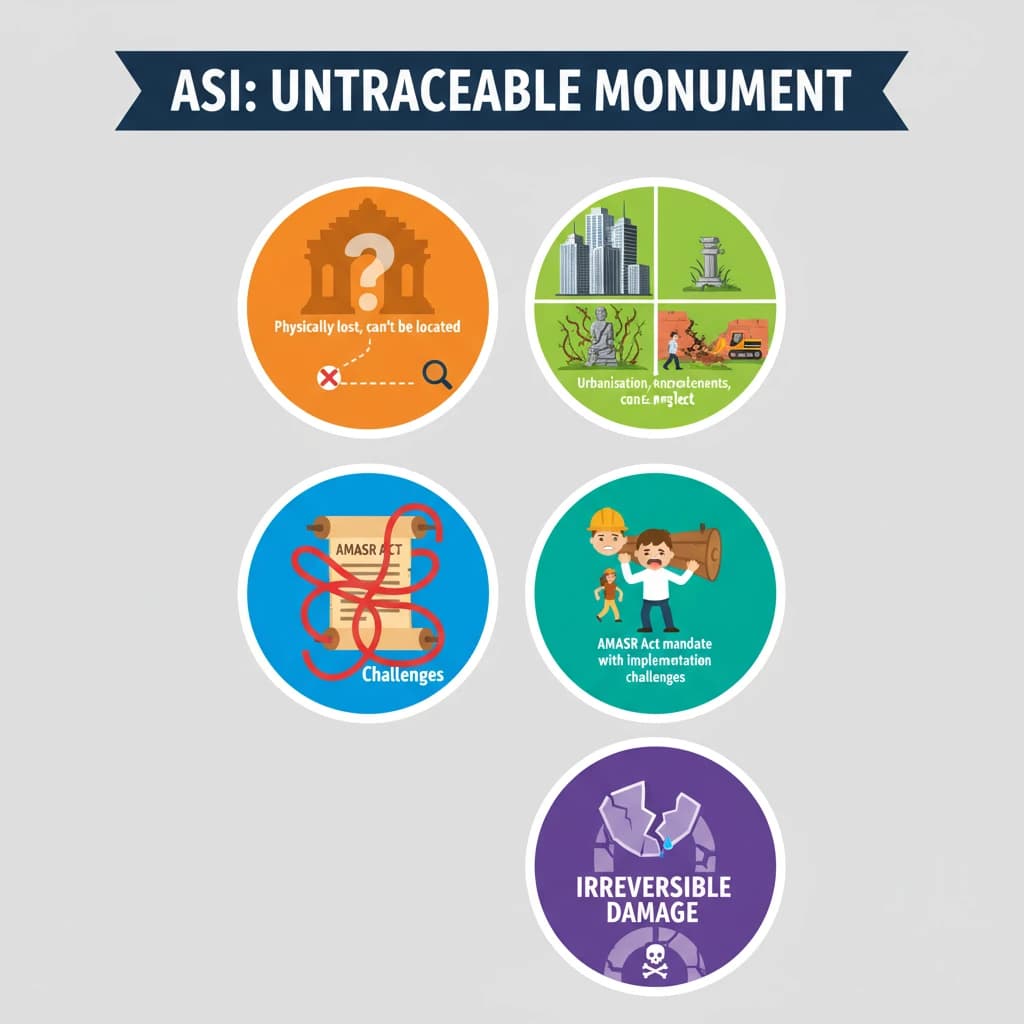
Memory Aid
95% Verified Content

Related Topics

Loading related topics...
Explore:Art And Culture Topics·All Subjects·Daily Current Affairs·Editorial Analysis·Previous Year Questions·UPSC GPT
Back
All Subjects

Topics

0 topics • 0 completed

Loading topics...
Loading...
Loading...
Loading...
Loading...
Loading...
Overall Progress0%
What Does it Mean When the ASI Declares a Monument “Untraceable”? - UPSC Art And Culture