Loading page, please wait…
Vaidra Logo
Vaidra

Top 4 items + smart groups

UPSC GPT
New
Current Affairs
Daily Solutions
Daily Puzzle
Mains Evaluator

Version 2.0.0 • Built with ❤️ for UPSC aspirants

Loading...
Loading...
Loading...
Loading...
Loading...
Loading...
Loading...
Loading...
Loading...
Loading...
Loading...
Loading...
Loading...
What are Key Facts about Pali Language - UPSC Art And Culture
Back
All Subjects

Topics

0 topics • 0 completed

Loading topics...
Loading...
Loading...
Loading...
Loading...
Loading...
Overall Progress0%

What are Key Facts about Pali Language - UPSC Art And Culture

What is What are Key Facts about Pali Language in UPSC Art And Culture?

What are Key Facts about Pali Language is a key topic under Art And Culture for UPSC Civil Services Examination. Key points include: Pali is an Indo-European language, a Middle Indo-Aryan Prakrit.. It was initially confused with Magadhi but shows stronger ties to Western Indian Prakrits.. Pali is recognized as a classical language by the Union Cabinet.. Understanding this topic is essential for both UPSC Prelims and Mains preparation.

Why is What are Key Facts about Pali Language important for UPSC exam?

What are Key Facts about Pali Language is a Easy-level topic in UPSC Art And Culture. It is tested in both Prelims (factual MCQs) and Mains (analytical answer writing). Previous year UPSC questions have frequently covered aspects of What are Key Facts about Pali Language, making it essential for comprehensive IAS preparation.

How to prepare What are Key Facts about Pali Language for UPSC?

To prepare What are Key Facts about Pali Language for UPSC: (1) Study the comprehensive notes covering all key concepts on Vaidra. (2) Practice previous year questions on this topic. (3) Connect it with current affairs using daily updates. (4) Revise using key takeaways and mind maps available for Art And Culture. (5) Write practice answers linking What are Key Facts about Pali Language to related GS Paper topics.

Key takeaways of What are Key Facts about Pali Language for UPSC

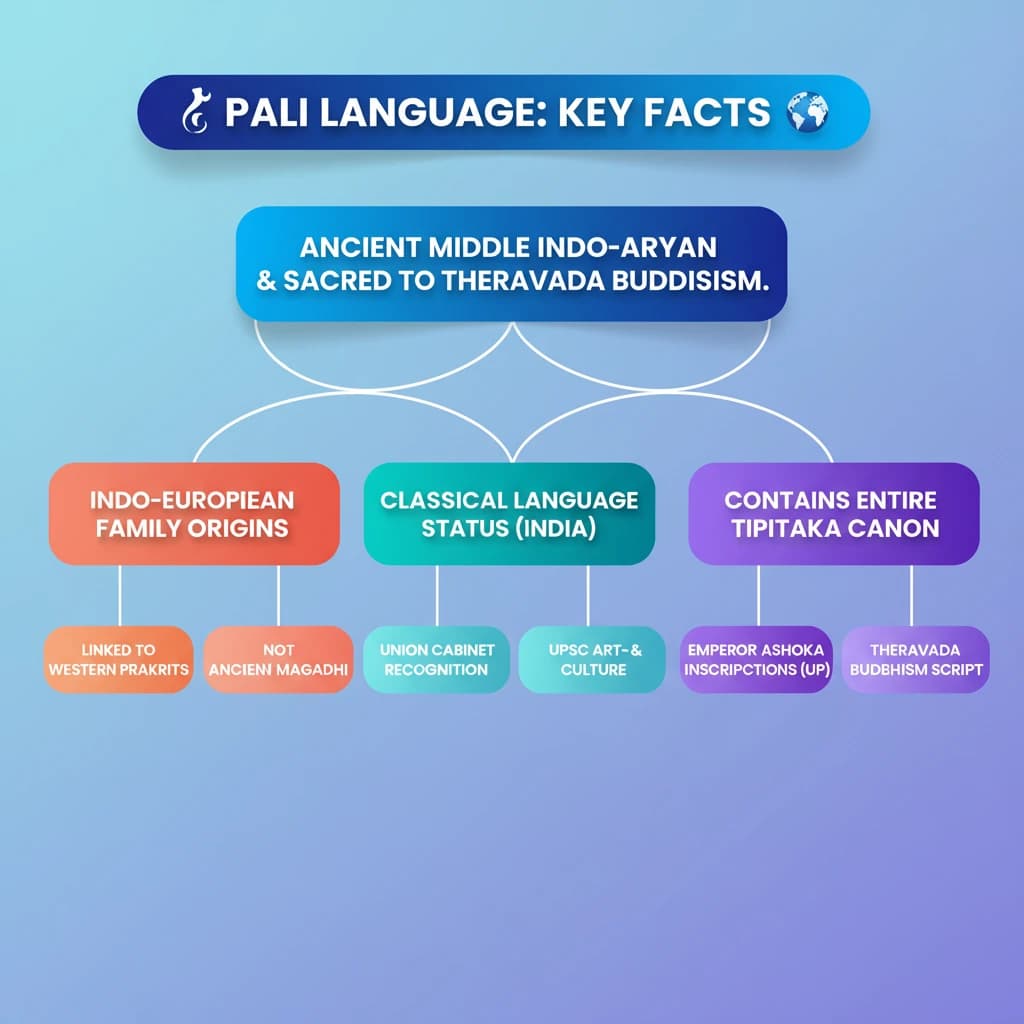
  • Pali is an Indo-European language, a Middle Indo-Aryan Prakrit.
  • It was initially confused with Magadhi but shows stronger ties to Western Indian Prakrits.
  • Pali is recognized as a classical language by the Union Cabinet.
  • Emperor Ashoka used Pali for some of his inscriptions, especially in Uttar Pradesh.
  • It is the sacred language of the Theravada Buddhist canon (Vinaya, Sutta, Abhidhamma Pitaka).
  • Originally written in Brahmi and Kharoshti, it adapted to local scripts like Sinhalese, Burmese, Thai, and Khmer.
What are Key Facts about Pali Language

What are Key Facts about Pali Language

Easy⏱️ 6 min read✓ 98% Verified
art and culture

📖 Introduction

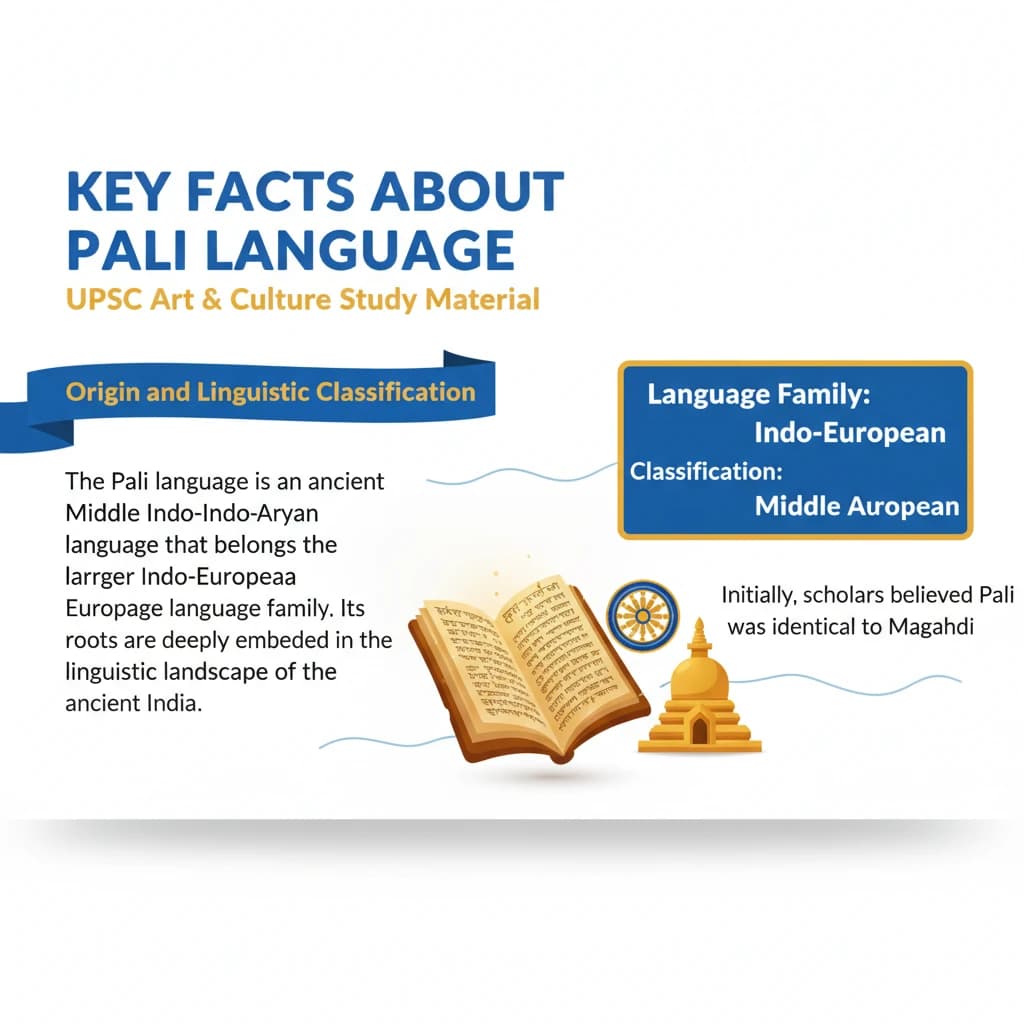
<h4>Linguistic Origin and Characteristics of Pali</h4><p>The <strong>Pali language</strong> belongs to the extensive <strong>Indo-European language family</strong>. Its roots are deeply embedded in the ancient linguistic landscape of India.</p><p>Initially, scholars believed that <strong>Pali</strong> was identical to <strong>Magadhi</strong>, the prominent language spoken in <strong>Magadha</strong> (modern-day Bihar). This perception was largely due to its strong association with early Buddhism, which flourished in the Magadhan region.</p><div class="info-box"><strong>Recent Linguistic Studies:</strong> Modern research indicates that <strong>Pali</strong> shows a stronger resemblance to the <strong>Prakrits</strong> of <strong>Western India</strong> rather than directly to <strong>Magadhi</strong>. This refines our understanding of its geographical and linguistic origins.</div><h4>Classical Status and Historical Significance</h4><p>The <strong>Union Cabinet</strong> has officially approved the recognition of <strong>Pali</strong> as a <strong>classical language</strong>. This prestigious status is shared with other significant Indian languages, including <strong>Prakrit</strong>, <strong>Marathi</strong>, <strong>Sanskrit</strong>, and <strong>Bengali</strong>.</p><p><strong>Pali</strong> holds a crucial connection with <strong>Emperor Ashoka</strong>. Many of <strong>Ashoka’s inscriptions</strong>, particularly those found in modern-day <strong>Uttar Pradesh</strong>, were written in <strong>Pali</strong>. This highlights its administrative and communicative importance during the Mauryan era.</p><div class="key-point-box"><strong>Connection with Buddhism:</strong> <strong>Pali</strong> is most famously known as the sacred language of the <strong>Theravada Buddhist canon</strong>. This includes the three principal collections of Buddhist scriptures, collectively known as the <strong>Tipitaka</strong>.</div><ul><li><strong>Vinaya Pitaka:</strong> Deals with monastic rules and discipline.</li><li><strong>Sutta Pitaka:</strong> Contains discourses and sermons of the Buddha.</li><li><strong>Abhidhamma Pitaka:</strong> Focuses on philosophical and psychological doctrines.</li></ul><h4>Scripts and Geographic Spread of Pali</h4><p>Originally, <strong>Pali</strong> was primarily written using the ancient Indian scripts of <strong>Brahmi</strong> and <strong>Kharoshti</strong>. These scripts were foundational to early Indian writing systems.</p><p>As <strong>Buddhism</strong> spread across Asia, the <strong>Pali language</strong> adapted to local writing systems. This facilitated the dissemination of Buddhist teachings to diverse cultural regions.</p><div class="info-box"><strong>Adaptation of Scripts:</strong><ul><li><strong>Sri Lanka:</strong> Written in <strong>Sinhalese</strong> script.</li><li><strong>Myanmar:</strong> Written in <strong>Burmese</strong> script.</li><li><strong>Thailand:</strong> Written in <strong>Thai</strong> script.</li><li><strong>Cambodia:</strong> Written in <strong>Khmer</strong> script.</li></ul>This widespread adoption underscores Pali's role as a lingua franca for Theravada Buddhism.</div>
Concept Diagram

💡 Key Takeaways

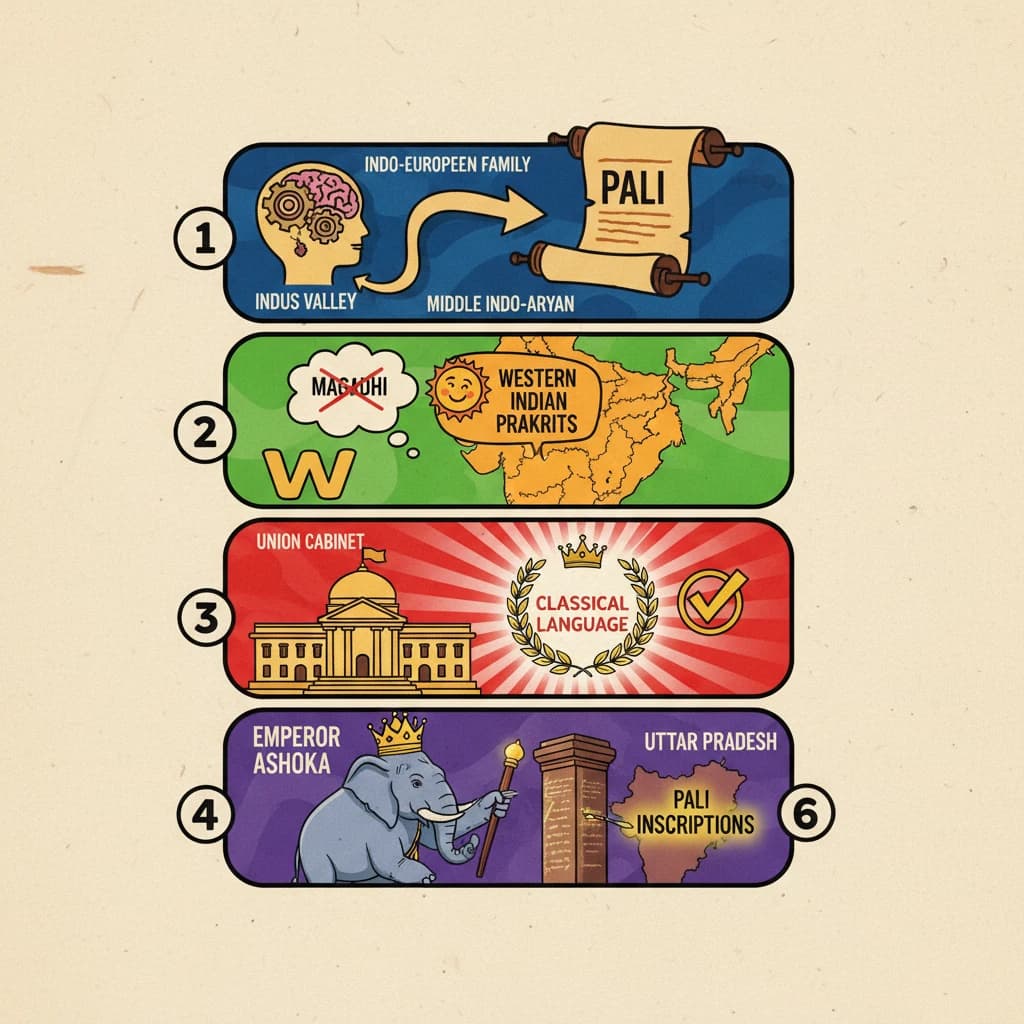
  • •Pali is an Indo-European language, a Middle Indo-Aryan Prakrit.
  • •It was initially confused with Magadhi but shows stronger ties to Western Indian Prakrits.
  • •Pali is recognized as a classical language by the Union Cabinet.
  • •Emperor Ashoka used Pali for some of his inscriptions, especially in Uttar Pradesh.
  • •It is the sacred language of the Theravada Buddhist canon (Vinaya, Sutta, Abhidhamma Pitaka).
  • •Originally written in Brahmi and Kharoshti, it adapted to local scripts like Sinhalese, Burmese, Thai, and Khmer.

🧠 Memory Techniques
Memory Aid
98% Verified Content

📚 Reference Sources

•NCERTs for Ancient Indian History and Art & Culture
•Standard academic texts on Indian languages and Buddhism

Related Topics

Loading related topics...
Explore:Art And Culture Topics·All Subjects·Daily Current Affairs·Editorial Analysis·Previous Year Questions·UPSC GPT