Loading page, please wait…
Vaidra Logo
Vaidra

Top 4 items + smart groups

UPSC GPT
New
Current Affairs
Daily Solutions
Daily Puzzle
Mains Evaluator

Version 2.0.0 • Built with ❤️ for UPSC aspirants

Loading...
Loading...
Loading...
Loading...
Loading...
Loading...
Loading...
Loading...
Loading...
Loading...
Loading...
Loading...
Loading...
Back
All Subjects

Topics

0 topics • 0 completed

Loading topics...
Loading...
Loading...
Loading...
Loading...
Loading...
Overall Progress0%

What are the Other Provisions to Promote Language? - UPSC Art And Culture

What is What are the Other Provisions to Promote Language? in UPSC Art And Culture?

What are the Other Provisions to Promote Language? is a key topic under Art And Culture for UPSC Civil Services Examination. Key points include: The Eighth Schedule promotes the use, enrichment, and promotion of 22 recognized Indian languages.. It was originally adopted with 14 languages and has been expanded through constitutional amendments.. Sindhi was added by the 21st Amendment, Konkani, Manipuri, and Nepali by the 71st Amendment.. Understanding this topic is essential for both UPSC Prelims and Mains preparation.

Why is What are the Other Provisions to Promote Language? important for UPSC exam?

What are the Other Provisions to Promote Language? is a Medium-level topic in UPSC Art And Culture. It is tested in both Prelims (factual MCQs) and Mains (analytical answer writing). Previous year UPSC questions have frequently covered aspects of What are the Other Provisions to Promote Language?, making it essential for comprehensive IAS preparation.

How to prepare What are the Other Provisions to Promote Language? for UPSC?

To prepare What are the Other Provisions to Promote Language? for UPSC: (1) Study the comprehensive notes covering all key concepts on Vaidra. (2) Practice previous year questions on this topic. (3) Connect it with current affairs using daily updates. (4) Revise using key takeaways and mind maps available for Art And Culture. (5) Write practice answers linking What are the Other Provisions to Promote Language? to related GS Paper topics.

Key takeaways of What are the Other Provisions to Promote Language? for UPSC

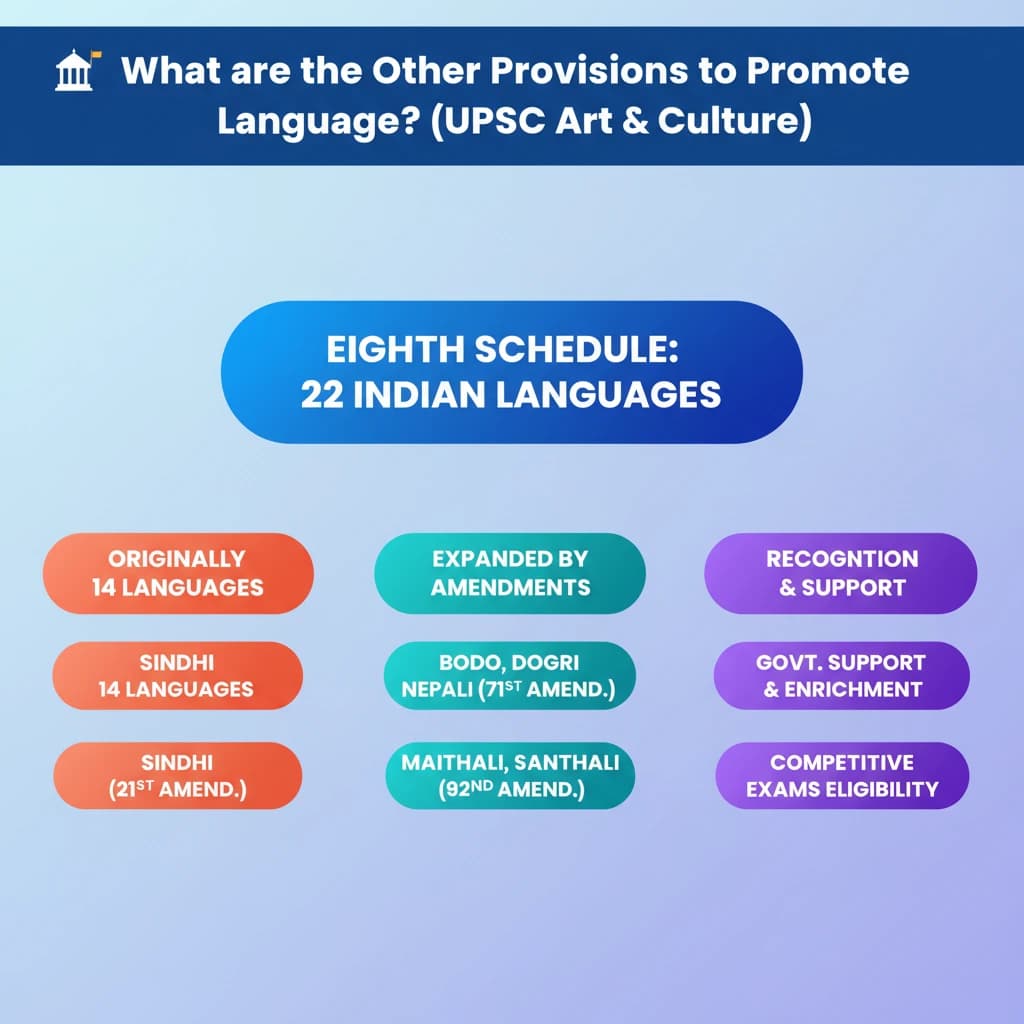
  • The Eighth Schedule promotes the use, enrichment, and promotion of 22 recognized Indian languages.
  • It was originally adopted with 14 languages and has been expanded through constitutional amendments.
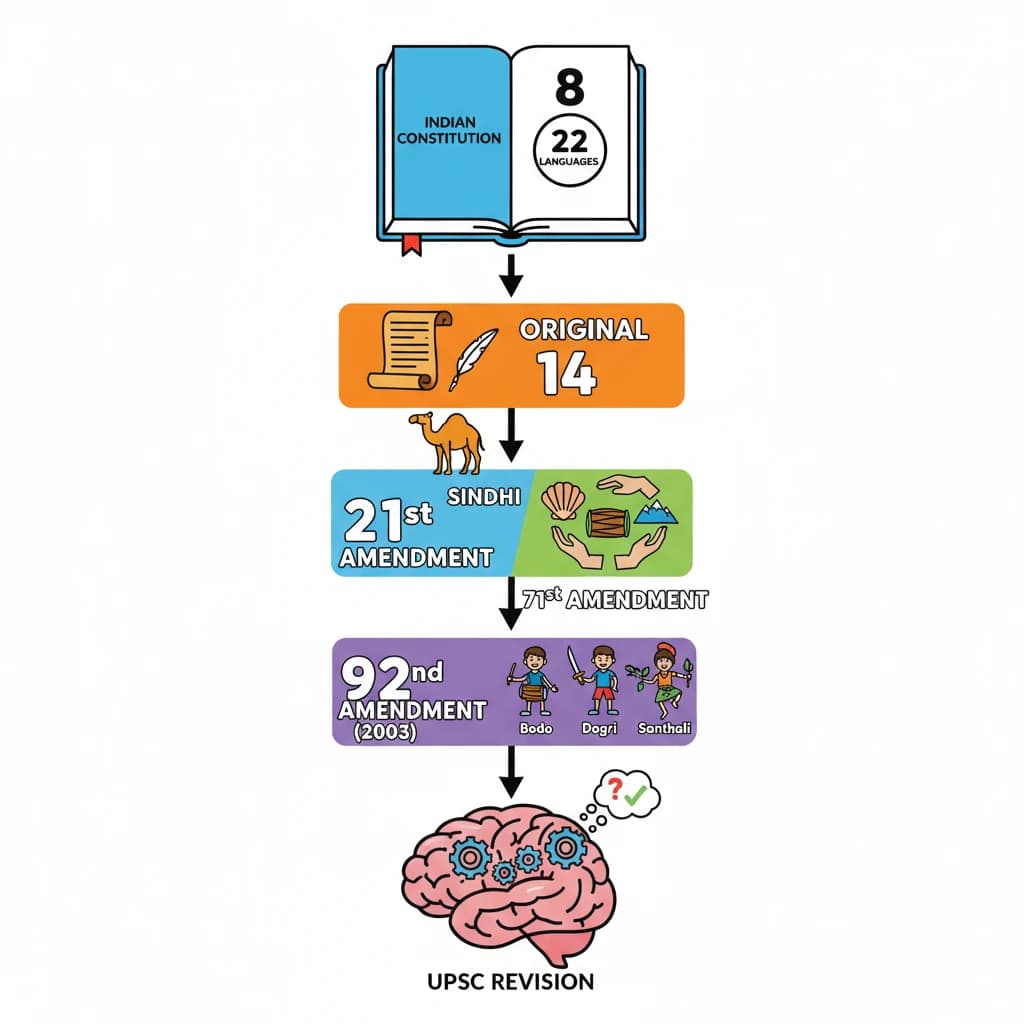
  • Sindhi was added by the 21st Amendment, Konkani, Manipuri, and Nepali by the 71st Amendment.
  • Bodo, Dogri, Maithili, and Santhali were added by the 92nd Amendment in 2003.
  • Inclusion provides official recognition, government support, and eligibility for competitive exams.
  • The schedule reflects India's commitment to linguistic diversity and cultural preservation.
  • There are ongoing demands for the inclusion of more languages, highlighting its contemporary relevance.

What are the Other Provisions to Promote Language?

What are the Other Provisions to Promote Language?

Medium⏱️ 7 min read✓ 98% Verified
art and culture

📖 Introduction

<h4>Purpose of the Eighth Schedule</h4><p>The <strong>Eighth Schedule</strong> of the <strong>Indian Constitution</strong> serves a crucial role in promoting India's linguistic diversity. Its primary purpose is to facilitate the <strong>progressive use</strong>, <strong>enrichment</strong>, and overall <strong>promotion</strong> of the languages listed within it.</p><div class="key-point-box">This schedule officially recognizes certain languages, granting them a special status within the Indian governmental framework.</div><h4>Languages Listed in the Eighth Schedule</h4><p>Currently, the Eighth Schedule includes <strong>22 languages</strong>, reflecting the vast linguistic landscape of India. These languages are:</p><ul><li><strong>Assamese</strong></li><li><strong>Bengali</strong></li><li><strong>Gujarati</strong></li><li><strong>Hindi</strong></li><li><strong>Kannada</strong></li><li><strong>Kashmiri</strong></li><li><strong>Konkani</strong></li><li><strong>Malayalam</strong></li><li><strong>Manipuri</strong></li><li><strong>Marathi</strong></li><li><strong>Nepali</strong></li><li><strong>Oriya (now Odia)</strong></li><li><strong>Punjabi</strong></li><li><strong>Sanskrit</strong></li><li><strong>Sindhi</strong></li><li><strong>Tamil</strong></li><li><strong>Telugu</strong></li><li><strong>Urdu</strong></li><li><strong>Bodo</strong></li><li><strong>Santhali</strong></li><li><strong>Maithili</strong></li><li><strong>Dogri</strong></li></ul><div class="info-box">The inclusion of a language in the Eighth Schedule means it is eligible for various government initiatives aimed at its development and promotion.</div><h4>Significance of Inclusion</h4><p>Inclusion in the Eighth Schedule brings several benefits and recognitions. It allows these languages to be used in official communications and competitive examinations.</p><div class="exam-tip-box"><strong>UPSC Insight:</strong> Questions often relate to the criteria for inclusion, the historical amendments, or the cultural significance of these languages. Understanding the timeline of additions is key.</div>
Concept Diagram

💡 Key Takeaways

  • •The Eighth Schedule promotes the use, enrichment, and promotion of 22 recognized Indian languages.
  • •It was originally adopted with 14 languages and has been expanded through constitutional amendments.
  • •Sindhi was added by the 21st Amendment, Konkani, Manipuri, and Nepali by the 71st Amendment.
  • •Bodo, Dogri, Maithili, and Santhali were added by the 92nd Amendment in 2003.
  • •Inclusion provides official recognition, government support, and eligibility for competitive exams.
  • •The schedule reflects India's commitment to linguistic diversity and cultural preservation.
  • •There are ongoing demands for the inclusion of more languages, highlighting its contemporary relevance.

🧠 Memory Techniques
Memory Aid
98% Verified Content

📚 Reference Sources

•Ministry of Home Affairs, Government of India (Official Languages Department)
•NCERT Textbooks on Indian Polity and Culture
•Drishti IAS Study Material (as provided)

Related Topics

Loading related topics...
Explore:Art And Culture Topics·All Subjects·Daily Current Affairs·Editorial Analysis·Previous Year Questions·UPSC GPT
What are the Other Provisions to Promote Language? - UPSC Art And Culture