Loading page, please wait…
Vaidra Logo
Vaidra

Top 4 items + smart groups

UPSC GPT
New
Current Affairs
Daily Solutions
Daily Puzzle
Mains Evaluator

Version 2.0.0 • Built with ❤️ for UPSC aspirants

Loading...
Loading...
Loading...
Loading...
Loading...
Loading...
Loading...
Loading...
Loading...
Loading...
Loading...
Loading...
Loading...
Back
All Subjects

Topics

0 topics • 0 completed

Loading topics...
Loading...
Loading...
Loading...
Loading...
Loading...
Overall Progress0%
What are the Key Facts About Vishnupad Temple and the Mahabodhi Temple? - UPSC Art And Culture

What are the Key Facts About Vishnupad Temple and the Mahabodhi Temple? - UPSC Art And Culture

What is What are the Key Facts About Vishnupad Temple and the Mahabodhi Temple? in UPSC Art And Culture?

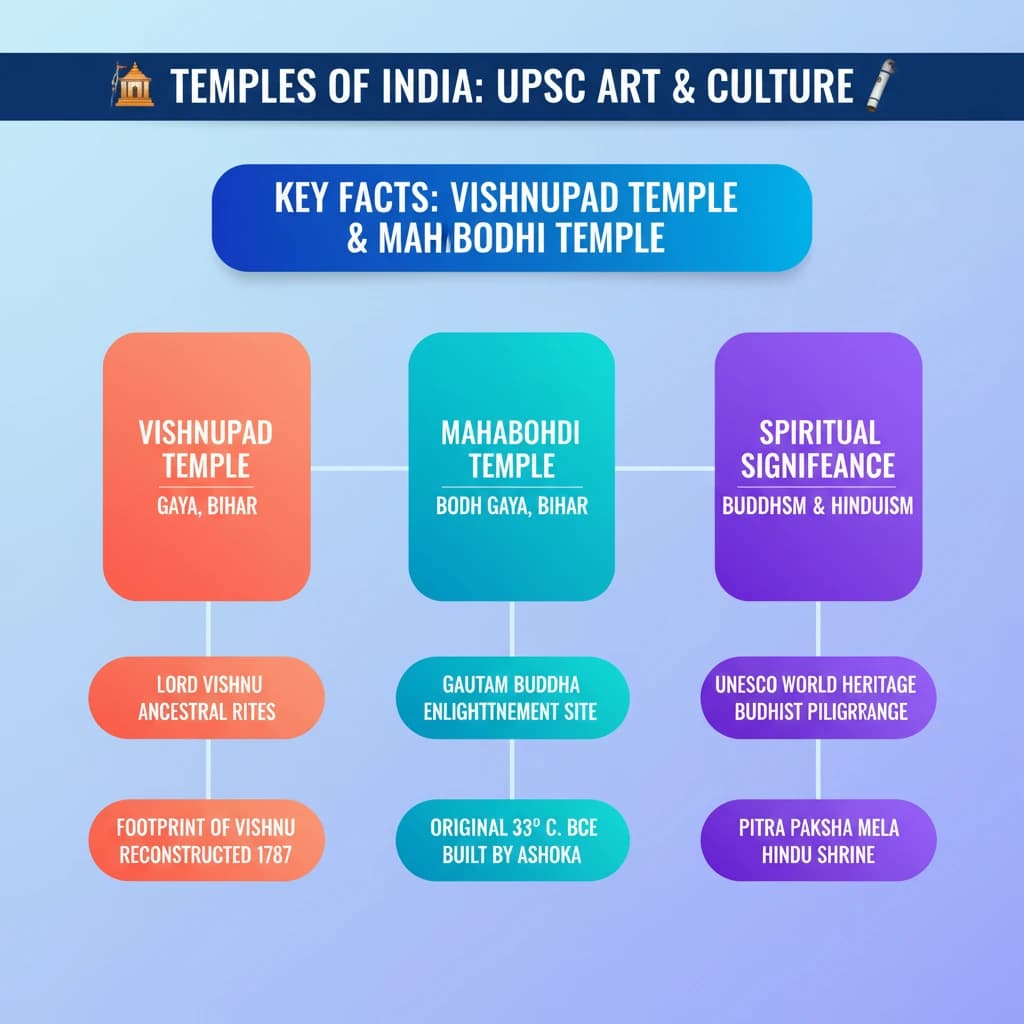
What are the Key Facts About Vishnupad Temple and the Mahabodhi Temple? is a key topic under Art And Culture for UPSC Civil Services Examination. Key points include: Vishnupad Temple in Gaya is dedicated to Lord Vishnu and is famous for ancestral rites during Pitra Paksha.. A legendary footprint of Lord Vishnu is believed to be present at the Vishnupad Temple.. Queen Ahilyabai Holkar reconstructed the current Vishnupad Temple in 1787.. Understanding this topic is essential for both UPSC Prelims and Mains preparation.

Why is What are the Key Facts About Vishnupad Temple and the Mahabodhi Temple? important for UPSC exam?

What are the Key Facts About Vishnupad Temple and the Mahabodhi Temple? is a Easy-level topic in UPSC Art And Culture. It is tested in both Prelims (factual MCQs) and Mains (analytical answer writing). Previous year UPSC questions have frequently covered aspects of What are the Key Facts About Vishnupad Temple and the Mahabodhi Temple?, making it essential for comprehensive IAS preparation.

How to prepare What are the Key Facts About Vishnupad Temple and the Mahabodhi Temple? for UPSC?

To prepare What are the Key Facts About Vishnupad Temple and the Mahabodhi Temple? for UPSC: (1) Study the comprehensive notes covering all key concepts on Vaidra. (2) Practice previous year questions on this topic. (3) Connect it with current affairs using daily updates. (4) Revise using key takeaways and mind maps available for Art And Culture. (5) Write practice answers linking What are the Key Facts About Vishnupad Temple and the Mahabodhi Temple? to related GS Paper topics.

Key takeaways of What are the Key Facts About Vishnupad Temple and the Mahabodhi Temple? for UPSC

  • Vishnupad Temple in Gaya is dedicated to Lord Vishnu and is famous for ancestral rites during Pitra Paksha.
  • A legendary footprint of Lord Vishnu is believed to be present at the Vishnupad Temple.
  • Queen Ahilyabai Holkar reconstructed the current Vishnupad Temple in 1787.
  • Mahabodhi Temple in Bodh Gaya is the site where Gautam Buddha attained enlightenment.
  • Emperor Ashoka built the original Mahabodhi Temple in the 3rd century BCE.
  • Both temples are significant pilgrimage sites in Bihar, attracting devotees from India and worldwide.
  • The Mahabodhi Temple is a UNESCO World Heritage Site, emphasizing its global cultural importance.
What are the Key Facts About Vishnupad Temple and the Mahabodhi Temple?

What are the Key Facts About Vishnupad Temple and the Mahabodhi Temple?

Easy⏱️ 7 min read✓ 95% Verified
art and culture

📖 Introduction

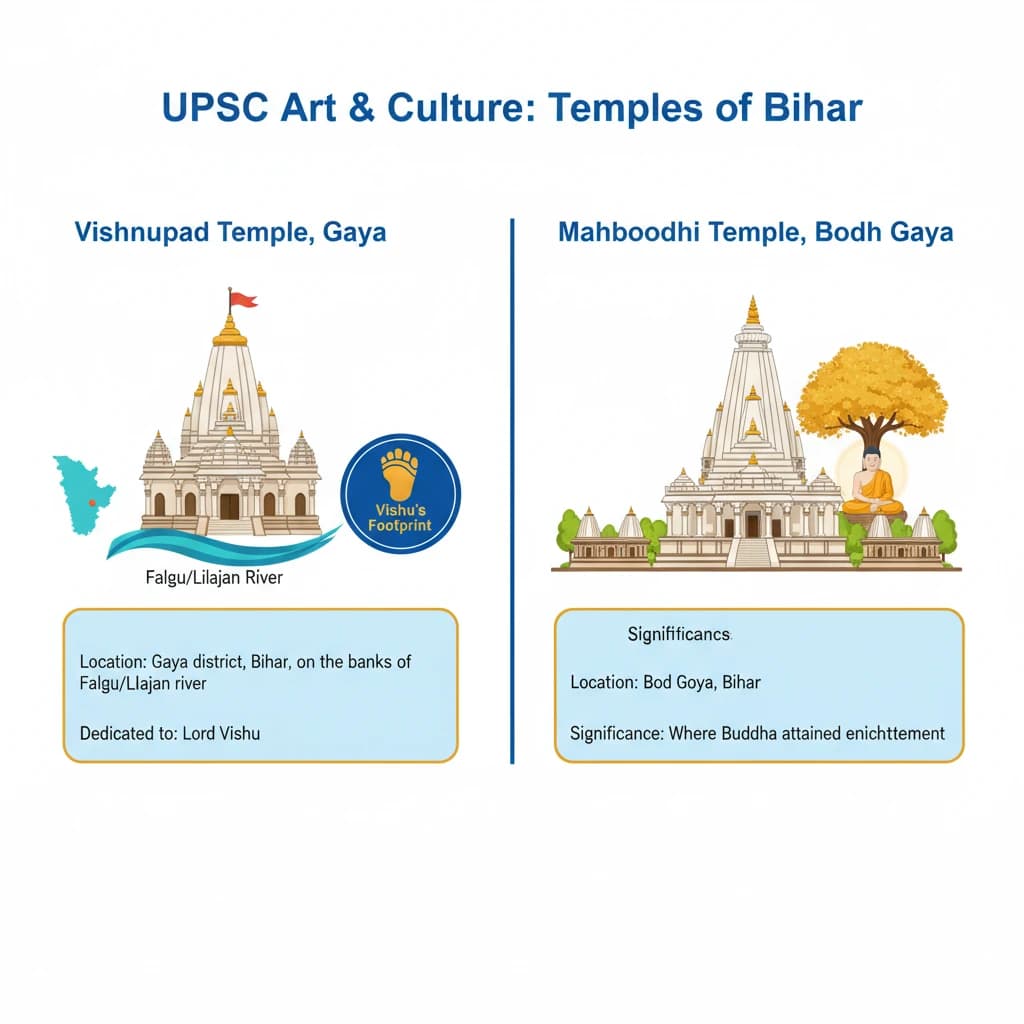
<h4>Vishnupad Temple, Gaya: Location and Dedication</h4><p>The <strong>Vishnupad Temple</strong> is prominently located on the banks of the <strong>Falgu/Lilajan river</strong> in the <strong>Gaya district</strong> of <strong>Bihar</strong>. This significant pilgrimage site is dedicated to <strong>Lord Vishnu</strong>, a principal deity in Hinduism.</p><div class="info-box"><strong>Location:</strong> Gaya district, Bihar, on the banks of Falgu/Lilajan river<br><strong>Dedicated to:</strong> Lord Vishnu</div><h4>The Legend of Gayasur and Vishnu's Footprint</h4><p>According to local mythology, a demon named <strong>Gayasur</strong> was granted the power to help others attain <strong>moksha</strong> (liberation from the cycle of rebirth) by the gods. However, he began to misuse this immense power.</p><p><strong>Lord Vishnu</strong> intervened to subdue Gayasur, leaving a divine <strong>footprint</strong> at the temple site. This footprint is believed to be a sacred mark commemorating this pivotal event.</p><div class="key-point-box"><strong>Legend:</strong> Lord Vishnu subdued demon <strong>Gayasur</strong>, leaving a sacred <strong>footprint</strong> at the temple site.</div><h4>Architectural Features of Vishnupad Temple</h4><p>The temple stands impressively at approximately <strong>100 feet tall</strong>. Its construction incorporates <strong>44 pillars</strong>, meticulously built from large blocks of <strong>gray granite</strong>, specifically <strong>Munger Black stone</strong>.</p><p>These granite blocks are joined using traditional <strong>iron clamps</strong>, showcasing ancient engineering techniques. The main shrine is <strong>octagonal</strong> in shape and is oriented towards the <strong>east</strong>.</p><div class="info-box"><strong>Height:</strong> ~100 feet<br><strong>Pillars:</strong> 44, made of <strong>Munger Black stone</strong> (gray granite)<br><strong>Structure:</strong> Octagonal shrine, east-facing</div><h4>Construction and Cultural Practices</h4><p>The current structure of the <strong>Vishnupad Temple</strong> was constructed in <strong>1787</strong> under the patronage and orders of <strong>Queen Ahilyabai Holkar</strong>, a renowned Maratha ruler.</p><p>The temple holds particular significance during <strong>Pitra Paksha</strong>, a period dedicated to honoring ancestors, attracting a large number of devotees for ancestral rites. The traditional priests of the temple, known as <strong>Brahma Kalpit Brahmins</strong> or <strong>Gayawal Brahmins</strong>, have served here since ancient times.</p><div class="exam-tip-box"><strong>UPSC Insight:</strong> Note the role of <strong>Queen Ahilyabai Holkar</strong> in temple construction, a common theme in Art & Culture for philanthropic rulers. The mention of <strong>Pitra Paksha</strong> connects to Hindu rituals and cultural practices.</div><h4>Mahabodhi Temple, Bodh Gaya: Site of Enlightenment</h4><p>The <strong>Mahabodhi Temple</strong> in <strong>Bodh Gaya</strong> is one of the most sacred sites in Buddhism. It is universally believed to be the exact location where <strong>Gautam Buddha</strong> attained <strong>enlightenment</strong>.</p><p>This profound spiritual awakening occurred while Buddha meditated under the sacred <strong>Mahabodhi Tree</strong>, a descendant of which still stands at the site today.</p><div class="key-point-box"><strong>Significance:</strong> Site where <strong>Gautam Buddha</strong> attained <strong>enlightenment</strong> under the <strong>Mahabodhi Tree</strong>.</div><h4>Construction History of Mahabodhi Temple</h4><p>The original structure of the <strong>Mahabodhi Temple</strong> was built by the great <strong>Emperor Asoka</strong> in the <strong>3rd century BCE</strong>. Asoka's patronage was crucial in establishing Buddhism as a major religion.</p><p>Over centuries, the temple complex has undergone several renovations and expansions, reflecting various architectural styles while preserving its core spiritual essence.</p><div class="info-box"><strong>Original Construction:</strong> By <strong>Emperor Asoka</strong> in the <strong>3rd century BCE</strong>.</div>
Concept Diagram

💡 Key Takeaways

  • •Vishnupad Temple in Gaya is dedicated to Lord Vishnu and is famous for ancestral rites during Pitra Paksha.
  • •A legendary footprint of Lord Vishnu is believed to be present at the Vishnupad Temple.
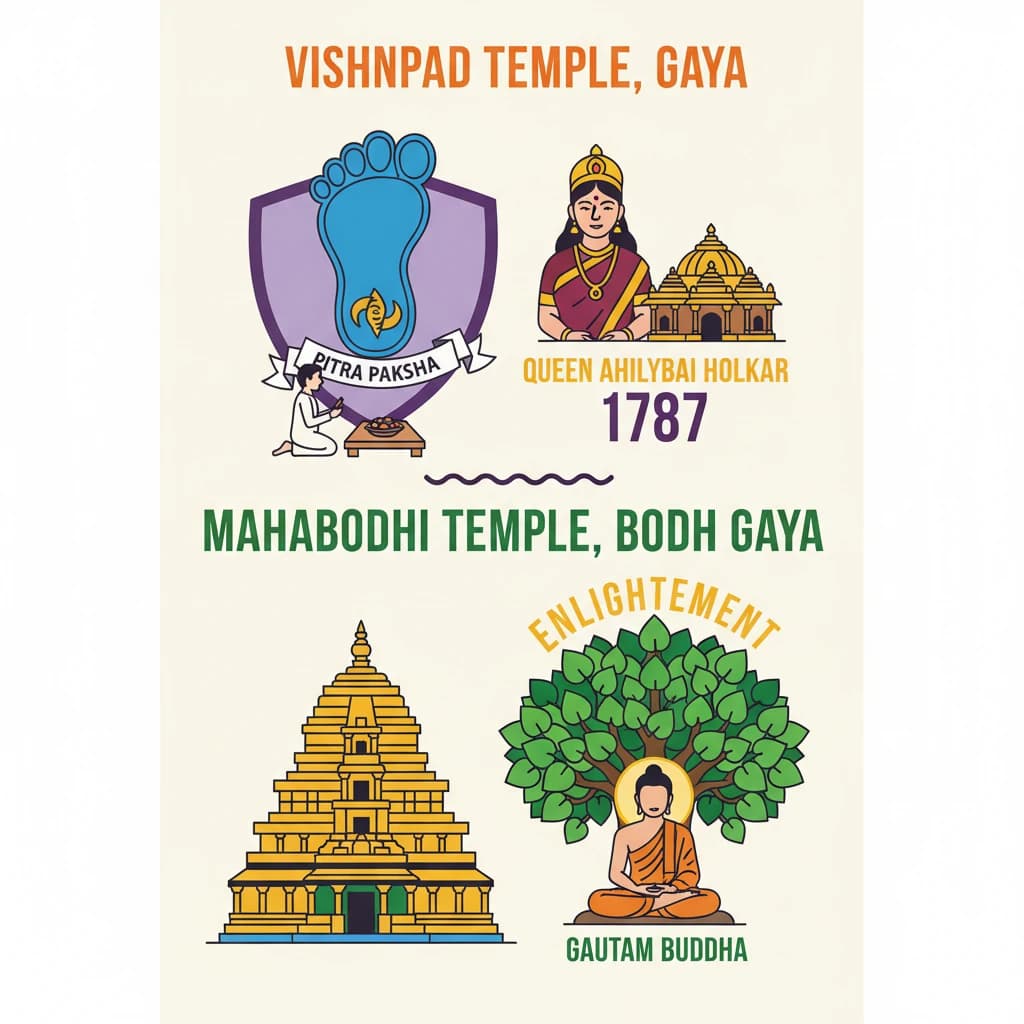
  • •Queen Ahilyabai Holkar reconstructed the current Vishnupad Temple in 1787.
  • •Mahabodhi Temple in Bodh Gaya is the site where Gautam Buddha attained enlightenment.
  • •Emperor Ashoka built the original Mahabodhi Temple in the 3rd century BCE.
  • •Both temples are significant pilgrimage sites in Bihar, attracting devotees from India and worldwide.
  • •The Mahabodhi Temple is a UNESCO World Heritage Site, emphasizing its global cultural importance.

🧠 Memory Techniques
Memory Aid
95% Verified Content

Related Topics

Loading related topics...
Explore:Art And Culture Topics·All Subjects·Daily Current Affairs·Editorial Analysis·Previous Year Questions·UPSC GPT