Loading page, please wait…
51,200 Year Old Cave Painting Discovered - UPSC Art And Culture
What is 51,200 Year Old Cave Painting Discovered in UPSC Art And Culture?
51,200 Year Old Cave Painting Discovered is a key topic under Art And Culture for UPSC Civil Services Examination. Key points include: The world's oldest known figurative cave painting is approximately 51,200 years old.. It was discovered on the ceiling of a limestone cave in Sulawesi, Indonesia.. The painting depicts a pig surrounded by three human-like figures.. Understanding this topic is essential for both UPSC Prelims and Mains preparation.
Why is 51,200 Year Old Cave Painting Discovered important for UPSC exam?
51,200 Year Old Cave Painting Discovered is a Medium-level topic in UPSC Art And Culture. It is tested in both Prelims (factual MCQs) and Mains (analytical answer writing). Previous year UPSC questions have frequently covered aspects of 51,200 Year Old Cave Painting Discovered, making it essential for comprehensive IAS preparation.
How to prepare 51,200 Year Old Cave Painting Discovered for UPSC?
To prepare 51,200 Year Old Cave Painting Discovered for UPSC: (1) Study the comprehensive notes covering all key concepts on Vaidra. (2) Practice previous year questions on this topic. (3) Connect it with current affairs using daily updates. (4) Revise using key takeaways and mind maps available for Art And Culture. (5) Write practice answers linking 51,200 Year Old Cave Painting Discovered to related GS Paper topics.
Key takeaways of 51,200 Year Old Cave Painting Discovered for UPSC
- The world's oldest known figurative cave painting is approximately 51,200 years old.
- It was discovered on the ceiling of a limestone cave in Sulawesi, Indonesia.
- The painting depicts a pig surrounded by three human-like figures.
- The age was determined using Uranium Series (U-series) analysis of calcite deposits.
- This discovery significantly pushes back the timeline for complex figurative art.
- It offers crucial insights into early human artistic expression and cognitive abilities.
- The U-series method also re-dated the Leang Tedongnge painting, making it 4,000 years older than previously thought.
51,200 Year Old Cave Painting Discovered
Medium⏱️ 7 min read
art and culture
📖 Introduction
Discovery of the World's Oldest Figurative Cave Painting
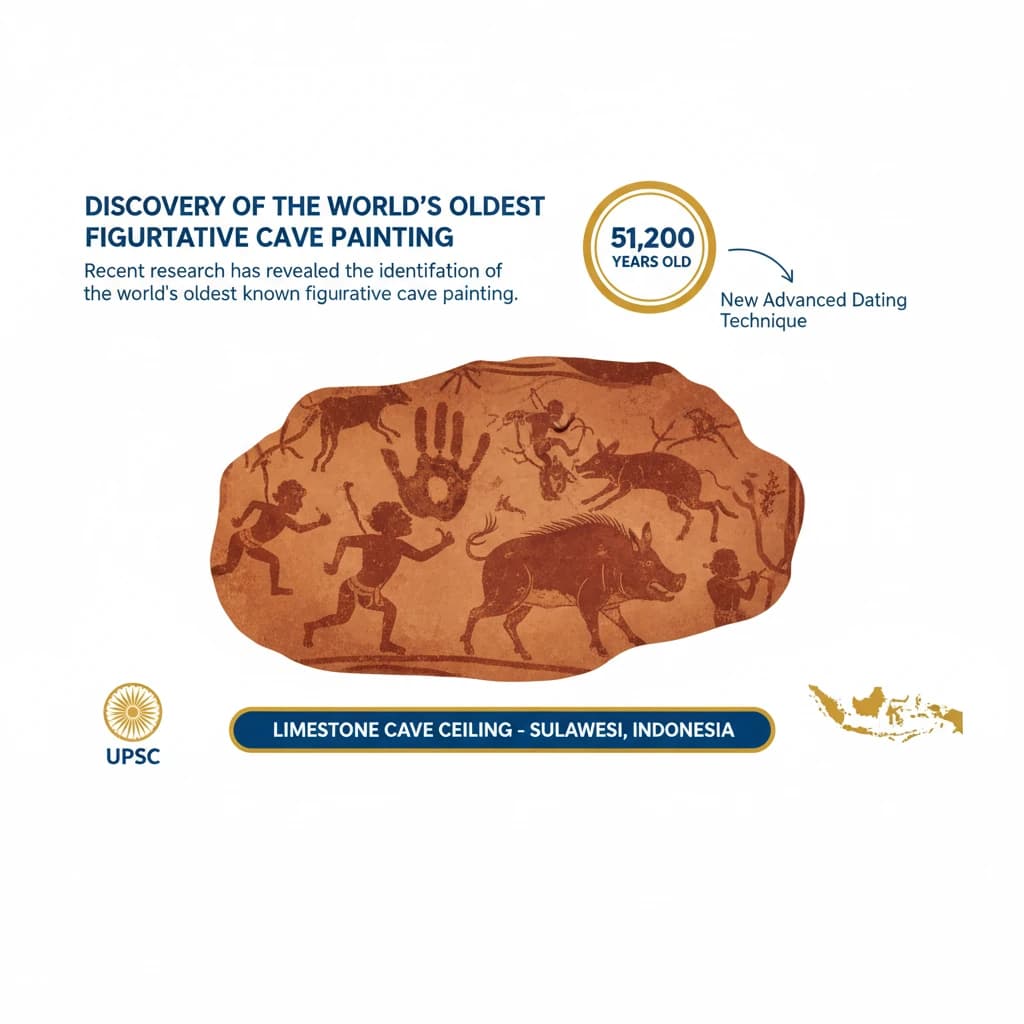
Recent research has revealed the identification of the world's oldest known figurative cave painting. This remarkable artwork is approximately 51,200 years old, a discovery made possible through a new, advanced dating technique.
The painting is strategically located on the ceiling of a limestone cave, specifically found on the island of Sulawesi, Indonesia.
Location: 📍 Sulawesi, Indonesia
Age: 📅 Approximately 51,200 years old
Type: Figurative cave painting
Age: 📅 Approximately 51,200 years old
Type: Figurative cave painting
Artistic Representation and Details
The ancient artwork depicts a compelling scene, primarily featuring a pig standing still with its mouth partly open. This central figure is surrounded by several others.
Accompanying the pig are three human-like figures, each shown in distinct poses and actions:
- The largest figure is depicted with outstretched arms, gripping a rod.
- A second figure is positioned directly in front of the pig, holding a stick.
- The third figure is shown upside-down, with legs pointing upwards and one hand reaching towards the pig’s head.
This detailed depiction offers invaluable insights into the narrative abilities and artistic sophistication of early human societies.
Understanding Uranium Series (U-series) Dating Technique
The precise age of the rock art was determined using Uranium Series (U-series) analysis. This advanced dating technique is particularly effective for materials found in limestone caves.
The method involves analyzing calcite deposits that form on the surface of the cave paintings. Researchers use laser beams to meticulously compare the ratio of specific isotopes of uranium to thorium within these deposits.
This comparison allows for an accurate calculation of the time elapsed since the calcite layer formed, thereby dating the artwork either above or below it.
Isotope Definition: An isotope is a variant of an atom within the same element. It shares the same atomic number and chemical properties but differs in atomic mass and physical characteristics.
Previous Applications and Impact of U-series Dating
The U-series dating method has also been successfully applied to other significant archaeological sites. Notably, it was used to date another cave painting at Leang Tedongnge, Sipong 4.
This painting was initially estimated to be around 43,900 years old. However, the application of U-series analysis revealed that the Leang Tedongnge painting is at least 4,000 years older than previously believed.
⚡ For UPSC, understanding such scientific dating techniques like U-series analysis is crucial. It directly impacts our understanding of historical timelines and archaeological findings, relevant for GS Paper 1 (Art & Culture, History) and GS Paper 3 (Science & Technology).
💡 Key Takeaways
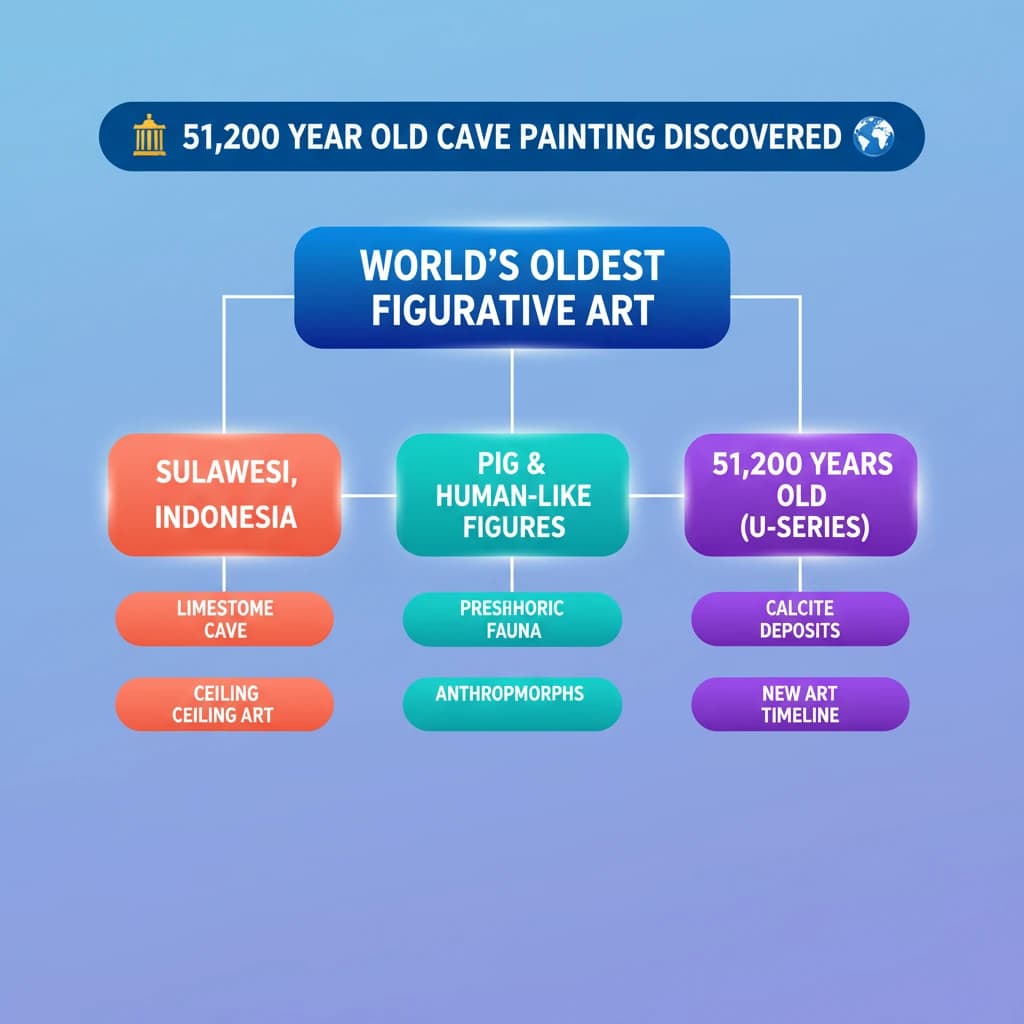
- •The world's oldest known figurative cave painting is approximately 51,200 years old.
- •It was discovered on the ceiling of a limestone cave in Sulawesi, Indonesia.
- •The painting depicts a pig surrounded by three human-like figures.
- •The age was determined using Uranium Series (U-series) analysis of calcite deposits.
- •This discovery significantly pushes back the timeline for complex figurative art.
- •It offers crucial insights into early human artistic expression and cognitive abilities.
- •The U-series method also re-dated the Leang Tedongnge painting, making it 4,000 years older than previously thought.
🧠 Memory Techniques

95% Verified Content
📚 Reference Sources
•General archaeological and scientific literature on cave paintings and U-series dating