Loading page, please wait…
Vaidra Logo
Vaidra

Top 4 items + smart groups

UPSC GPT
New
Current Affairs
Daily Solutions
Daily Puzzle
Mains Evaluator

Version 2.0.0 • Built with ❤️ for UPSC aspirants

Loading...
Loading...
Loading...
Loading...
Loading...
Loading...
Loading...
Loading...
Loading...
Loading...
Loading...
Loading...
Loading...
What are the Key Features of the Gateways of Sanchi Stupa? - UPSC Art And Culture
Back
All Subjects

Topics

0 topics • 0 completed

Loading topics...
Loading...
Loading...
Loading...
Loading...
Loading...
Overall Progress0%

What are the Key Features of the Gateways of Sanchi Stupa? - UPSC Art And Culture

What is What are the Key Features of the Gateways of Sanchi Stupa? in UPSC Art And Culture?

What are the Key Features of the Gateways of Sanchi Stupa? is a key topic under Art And Culture for UPSC Civil Services Examination. Key points include: Sanchi Stupa has four ornate gateways (toranas) oriented to cardinal directions.. These gateways were constructed in the first century BCE under the Satavahana dynasty.. They are made of two square pillars supporting three curved architraves with spirally-rolled ends.. Understanding this topic is essential for both UPSC Prelims and Mains preparation.

Why is What are the Key Features of the Gateways of Sanchi Stupa? important for UPSC exam?

What are the Key Features of the Gateways of Sanchi Stupa? is a Medium-level topic in UPSC Art And Culture. It is tested in both Prelims (factual MCQs) and Mains (analytical answer writing). Previous year UPSC questions have frequently covered aspects of What are the Key Features of the Gateways of Sanchi Stupa?, making it essential for comprehensive IAS preparation.

How to prepare What are the Key Features of the Gateways of Sanchi Stupa? for UPSC?

To prepare What are the Key Features of the Gateways of Sanchi Stupa? for UPSC: (1) Study the comprehensive notes covering all key concepts on Vaidra. (2) Practice previous year questions on this topic. (3) Connect it with current affairs using daily updates. (4) Revise using key takeaways and mind maps available for Art And Culture. (5) Write practice answers linking What are the Key Features of the Gateways of Sanchi Stupa? to related GS Paper topics.

Key takeaways of What are the Key Features of the Gateways of Sanchi Stupa? for UPSC

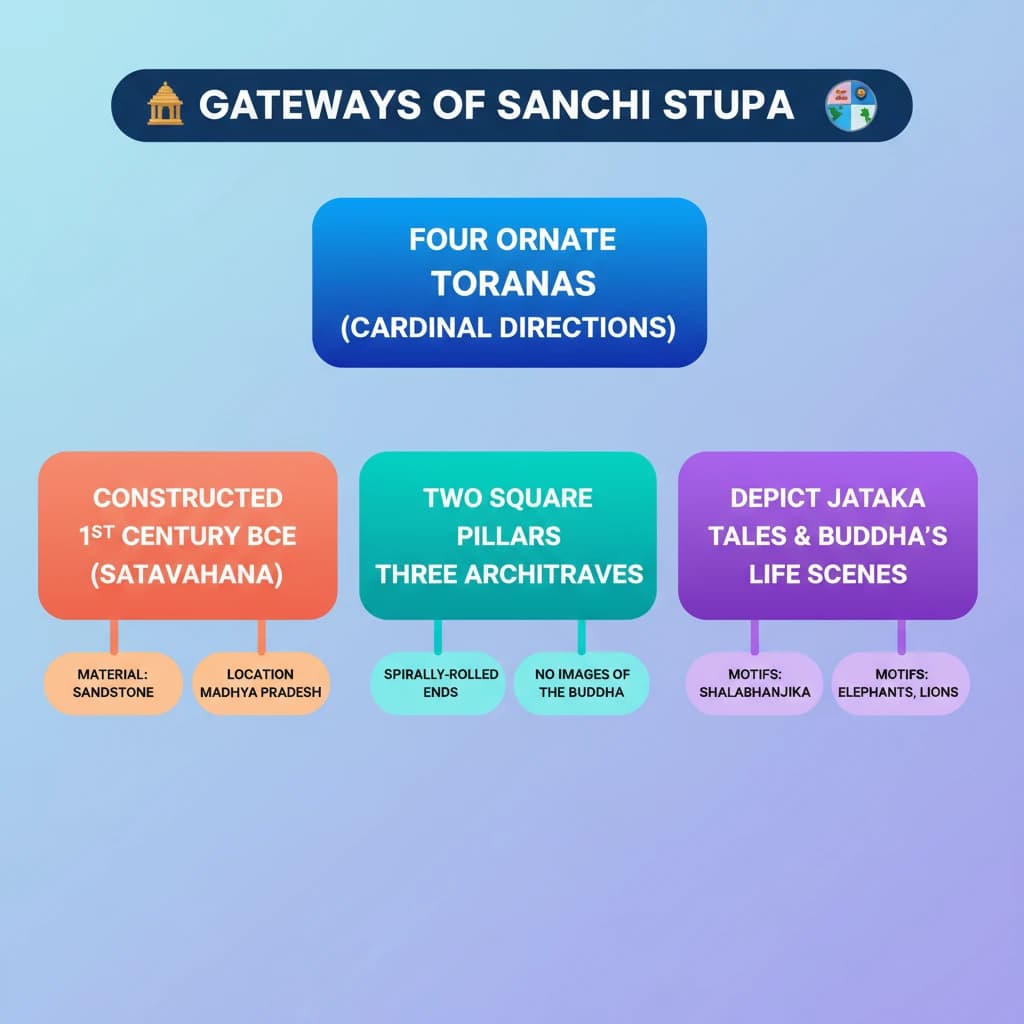
  • Sanchi Stupa has four ornate gateways (toranas) oriented to cardinal directions.
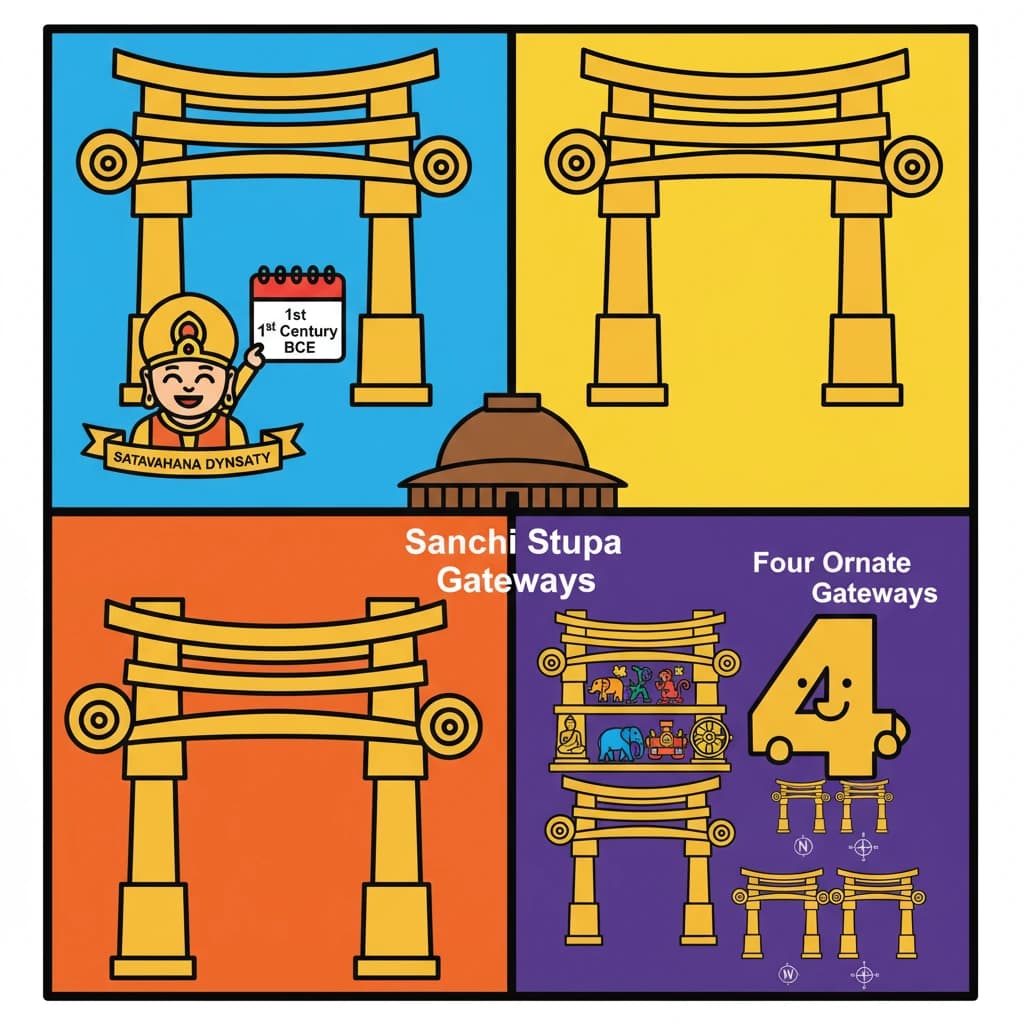
  • These gateways were constructed in the first century BCE under the Satavahana dynasty.
  • They are made of two square pillars supporting three curved architraves with spirally-rolled ends.
  • The carvings depict scenes from Buddha's life, Jataka tales, and Buddhist iconography.
  • Key motifs include shalabhanjika, elephants, winged lions, and peacocks.
  • Buddha is represented symbolically (aniconic form), not in human form.
  • Architraves hold philosophical significance, depicting Manushi Buddhas and the Great Departure.
What are the Key Features of the Gateways of Sanchi Stupa?

What are the Key Features of the Gateways of Sanchi Stupa?

Medium⏱️ 8 min read✓ 98% Verified
art and culture

📖 Introduction

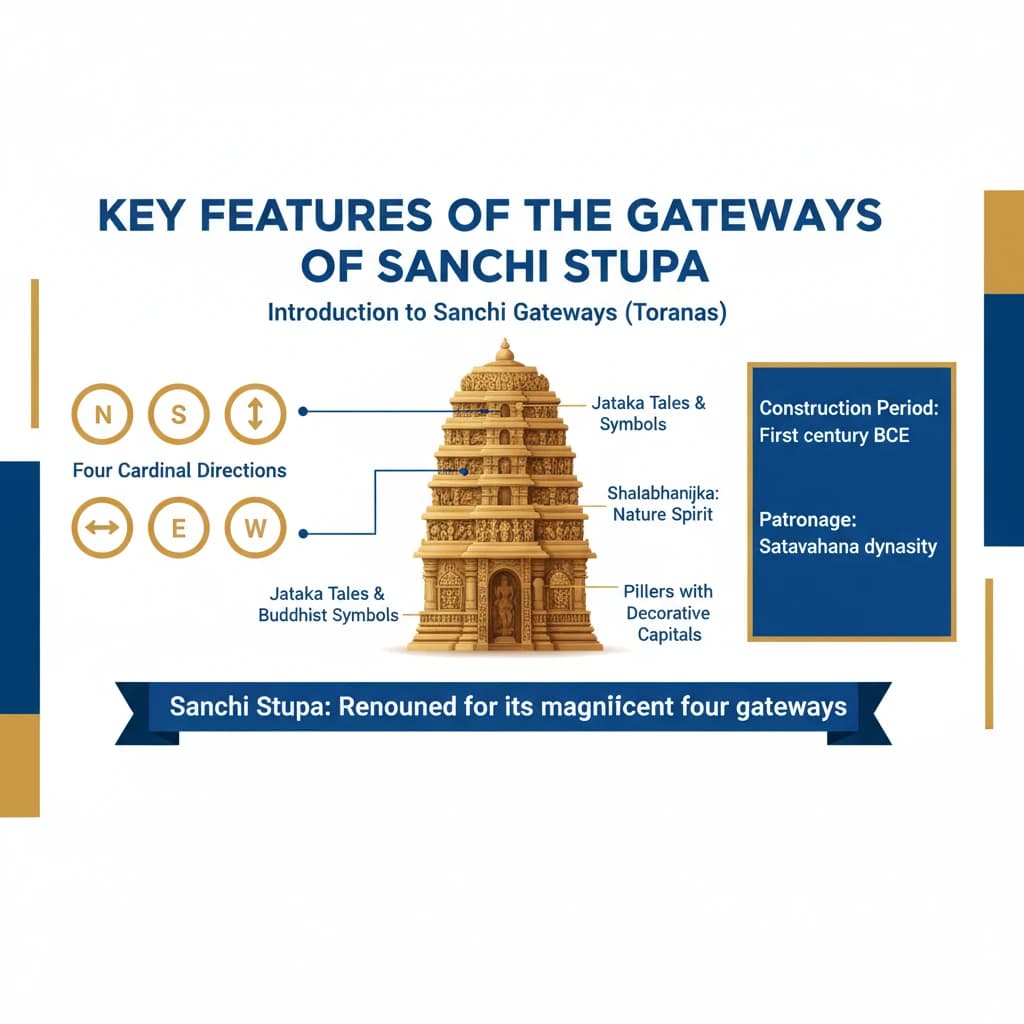
<h4>Introduction to Sanchi Gateways (Toranas)</h4><p>The <strong>Sanchi Stupa</strong> is renowned for its magnificent <strong>four gateways</strong>, known as <strong>toranas</strong>. These monumental structures are strategically oriented towards the <strong>four cardinal directions</strong>, marking the entrance to the sacred precinct.</p><div class="info-box"><strong>Construction Period:</strong> <strong>First century BCE</strong><br><strong>Patronage:</strong> <strong>Satavahana dynasty</strong> (built over several decades)</div><h4>Architectural Structure of the Gateways</h4><p>Each gateway is fundamentally composed of <strong>two robust square pillars</strong>. These pillars serve as the primary support for the elaborate superstructure above, showcasing advanced ancient Indian engineering.</p><p>The superstructure features <strong>three curved architraves</strong> (or beams). These architraves are distinctive for their <strong>spirally-rolled ends</strong>, adding to the aesthetic appeal and intricate design of the gateways.</p><h4>Rich Reliefs and Sculptural Decorations</h4><p>The <strong>pillars</strong> and <strong>architraves</strong> of the gateways are extensively adorned with intricate <strong>reliefs and sculptures</strong>. These carvings are central to understanding early Buddhist art and narrative traditions.</p><p>The decorations vividly depict various themes, offering a visual encyclopedia of Buddhist thought:</p><ul><li>Scenes from the <strong>Buddha’s life</strong>, illustrating key events and miracles.</li><li>Stories from the <strong>Jataka tales</strong>, which narrate the previous incarnations of the Buddha.</li><li>Other significant <strong>Buddhist iconography</strong>, symbolizing various aspects of the Dharma.</li></ul><p>Specific motifs found include the <strong>shalabhanjika</strong> (a fertility emblem), which is a <strong>yakshi</strong> grasping the branch of a tree, symbolizing auspiciousness. Other animal figures like <strong>elephants</strong>, <strong>winged lions</strong>, and <strong>peacocks</strong> are also prominently featured, often with symbolic meanings.</p><div class="key-point-box"><strong>Important Artistic Feature:</strong> The gates notably <strong>do not represent the Buddha in his human form</strong>. Instead, symbolic representations like the <strong>Bodhi tree</strong>, <strong>stupa</strong>, or <strong>footprints</strong> are used to denote his presence, characteristic of early Buddhist art.</div><h4>Philosophical Significance of the Architraves</h4><p>The <strong>three curved architraves</strong> are not merely decorative but carry profound <strong>philosophical significance</strong>, conveying key Buddhist doctrines and narratives through their specific depictions.</p><ul><li><strong>Upper Architrave:</strong> This section symbolically represents the <strong>seven Manushi Buddhas</strong>, referring to the previous incarnations of the Buddha, emphasizing the lineage of enlightenment.</li><li><strong>Middle Architrave:</strong> A pivotal narrative, the <strong>Great Departure</strong>, is depicted here. This scene illustrates <strong>Prince Siddhartha</strong> leaving <strong>Kapilavastu</strong> to embark on his ascetic journey in pursuit of enlightenment, a crucial step towards Buddhahood.</li></ul>
Concept Diagram

💡 Key Takeaways

  • •Sanchi Stupa has four ornate gateways (toranas) oriented to cardinal directions.
  • •These gateways were constructed in the first century BCE under the Satavahana dynasty.
  • •They are made of two square pillars supporting three curved architraves with spirally-rolled ends.
  • •The carvings depict scenes from Buddha's life, Jataka tales, and Buddhist iconography.
  • •Key motifs include shalabhanjika, elephants, winged lions, and peacocks.
  • •Buddha is represented symbolically (aniconic form), not in human form.
  • •Architraves hold philosophical significance, depicting Manushi Buddhas and the Great Departure.

🧠 Memory Techniques
Memory Aid
98% Verified Content

📚 Reference Sources

•NCERT Class 11 Fine Arts Textbook: An Introduction to Indian Art, Part I
•Archaeological Survey of India (ASI) official website
•UNESCO World Heritage Centre website (Sanchi)

Related Topics

Loading related topics...
Explore:Art And Culture Topics·All Subjects·Daily Current Affairs·Editorial Analysis·Previous Year Questions·UPSC GPT