Loading page, please wait…
Vaidra Logo
Vaidra

Top 4 items + smart groups

UPSC GPT
New
Current Affairs
Daily Solutions
Daily Puzzle
Mains Evaluator

Version 2.0.0 • Built with ❤️ for UPSC aspirants

Loading...
Loading...
Loading...
Loading...
Loading...
Loading...
Loading...
Loading...
Loading...
Loading...
Loading...
Loading...
Loading...
Back
All Subjects

Topics

0 topics • 0 completed

Loading topics...
Loading...
Loading...
Loading...
Loading...
Loading...
Overall Progress0%

Historical Group of Dhamnar - UPSC Art And Culture

What is Historical Group of Dhamnar in UPSC Art And Culture?

Historical Group of Dhamnar is a key topic under Art And Culture for UPSC Civil Services Examination. Key points include: Gwalior Fort is a historic hill fort in Madhya Pradesh, renowned for its strategic importance.. Its legendary origin involves chieftain Suraj Sen and hermit-saint Gwalipa.. The fort's history saw control by Tomars, Mughals, Marathas (Scindias), and the British.. Understanding this topic is essential for both UPSC Prelims and Mains preparation.

Why is Historical Group of Dhamnar important for UPSC exam?

Historical Group of Dhamnar is a Medium-level topic in UPSC Art And Culture. It is tested in both Prelims (factual MCQs) and Mains (analytical answer writing). Previous year UPSC questions have frequently covered aspects of Historical Group of Dhamnar, making it essential for comprehensive IAS preparation.

How to prepare Historical Group of Dhamnar for UPSC?

To prepare Historical Group of Dhamnar for UPSC: (1) Study the comprehensive notes covering all key concepts on Vaidra. (2) Practice previous year questions on this topic. (3) Connect it with current affairs using daily updates. (4) Revise using key takeaways and mind maps available for Art And Culture. (5) Write practice answers linking Historical Group of Dhamnar to related GS Paper topics.

Key takeaways of Historical Group of Dhamnar for UPSC

  • Gwalior Fort is a historic hill fort in Madhya Pradesh, renowned for its strategic importance.
  • Its legendary origin involves chieftain Suraj Sen and hermit-saint Gwalipa.
  • The fort's history saw control by Tomars, Mughals, Marathas (Scindias), and the British.
  • Key monuments include Teli ka Mandir, Chaturbhuj Temple (with an early reference to zero), and Sas Bahu Temples.
  • Gurudwara Data Bandi Chhor commemorates Guru Hargobind Sahib's imprisonment.
  • Ancient Sanskrit inscriptions refer to the fort as Gopachala and Gopagiri.
  • It represents a blend of diverse architectural styles and cultural influences.

Historical Group of Dhamnar

Historical Group of Dhamnar

Medium⏱️ 8 min read✓ 98% Verified
art and culture

📖 Introduction

<h4>Introduction to Gwalior Fort: A Historical Stronghold</h4><p>The <strong>Gwalior Fort</strong>, often referred to as 'the pearl amongst fortresses in India' by <strong>Mughal emperor Babur</strong>, stands majestically on a rocky outcrop in <strong>Gwalior, Madhya Pradesh</strong>. Its strategic location and formidable structure have made it a witness to centuries of Indian history, invasions, and architectural evolution.</p><div class="key-point-box"><strong>Key Point:</strong> Gwalior Fort is renowned for its strategic importance and rich cultural heritage, reflecting diverse dynastic influences.</div><h4>Historical Genesis and Early Legends</h4><p>The origins of <strong>Gwalior Fort</strong> are steeped in legend. Local chieftain <strong>Suraj Sen</strong>, suffering from severe leprosy, was miraculously healed by a hermit-saint named <strong>Gwalipa</strong>. In gratitude, <strong>Suraj Sen</strong> established the city of <strong>Gwalior</strong>, named after the saint.</p><div class="info-box"><strong>Founder:</strong> Suraj Sen<br><strong>Named After:</strong> Hermit-saint Gwalipa<br><strong>Location:</strong> Gwalior, Madhya Pradesh</div><h4>Evolution Through Dynasties: A Tumultuous History</h4><p>The fort has endured a tumultuous history, marked by numerous invasions and subsequent reconstructions. Each ruling dynasty left its indelible mark on the fort's architecture and cultural landscape.</p><ol><li><strong>Tomar Rule:</strong> The fort witnessed significant development under the <strong>Tomar ruler Maan Singh</strong>, who in <strong>1398 CE</strong>, added several monuments to its premises, enhancing its grandeur.</li><li><strong>Mughal Sultanate:</strong> Following <strong>Maan Singh's</strong> reign, <strong>Tomar</strong> control over <strong>Gwalior</strong> was briefly usurped by <strong>Ibrahim Lodi</strong> of the <strong>Mughal Sultanate</strong>. However, <strong>Akbar</strong> regained control in <strong>1550 CE</strong>.</li><li><strong>Maratha Empire:</strong> Later, the <strong>Marathas</strong>, under the leadership of the <strong>Scindias</strong>, took control of the fort, adding another layer to its rich history.</li><li><strong>British Interventions:</strong> The fort briefly fell to <strong>General White</strong> during the <strong>Second Maratha War</strong> but was returned to <strong>Scindia</strong> control in <strong>1805 CE</strong>. British rule lasted until <strong>1886 CE</strong>, when it was exchanged for <strong>Jhansi</strong> and once again returned to the <strong>Scindias</strong>.</li></ol><h4>Architectural Marvels: Key Temples and Structures</h4><p>The <strong>Gwalior Fort</strong> complex is home to several ancient temples, each possessing unique architectural and cultural significance. These structures showcase the diverse religious and artistic traditions that flourished within its walls.</p><h5>Teli ka Mandir</h5><p>This unique temple is dedicated to a trinity of deities: <strong>Shiva, Vishnu, and Matrikas</strong>. Its distinctive architectural style, often described as a blend of North and South Indian influences, makes it a prominent feature of the fort.</p><div class="info-box"><strong>Deities:</strong> Shiva, Vishnu, Matrikas<br><strong>Architectural Style:</strong> Blend of North and South Indian influences</div><h5>Chaturbhuj Temple</h5><p>The <strong>Chaturbhuj Temple</strong> holds immense mathematical significance. It features one of the oldest known references to the concept of <strong>zero</strong> in mathematics, inscribed within its premises. This highlights the advanced scientific knowledge of ancient India.</p><div class="key-point-box"><strong>Mathematical Significance:</strong> Contains one of the oldest references to the numeral <strong>zero</strong>.</div><h5>Sas Bahu Temples</h5><p>Dating back to <strong>1150 CE</strong>, the <strong>Sas Bahu temples</strong> are a pair of intricately carved structures. The larger of the two is dedicated to <strong>Vishnu</strong> and is renowned for its elaborate sculptures and detailed inscriptions, providing insights into the period's art and religious practices.</p><div class="info-box"><strong>Construction Date:</strong> 1150 CE<br><strong>Primary Deity (Larger Temple):</strong> Vishnu<br><strong>Notable Feature:</strong> Intricate inscriptions and sculptures</div><h4>Spiritual Significance: Gurudwara Data Bandi Chhor</h4><p>Beyond Hindu temples, the fort also houses the <strong>Gurudwara Data Bandi Chhor</strong>. This sacred Sikh shrine commemorates <strong>Guru Hargobind Sahib</strong>, the <strong>sixth Sikh Guru</strong>, who was imprisoned here by <strong>Mughal emperor Jahangir</strong>. It symbolizes religious tolerance and historical intermingling.</p><h4>Strategic Importance and Ancient Nomenclature</h4><p>The fort's strategic location atop <strong>basalt rock hills</strong> made it a formidable defensive structure. This importance is reflected in ancient Sanskrit inscriptions, where it is referred to as <strong>Gopachala</strong> and <strong>Gopagiri</strong>, highlighting its elevated and protected position.</p><div class="exam-tip-box"><strong>UPSC Insight:</strong> Questions on <strong>Gwalior Fort</strong> often focus on its architectural diversity, historical evolution through different dynasties, and specific monuments like the <strong>Chaturbhuj Temple's</strong> mathematical significance.</div>
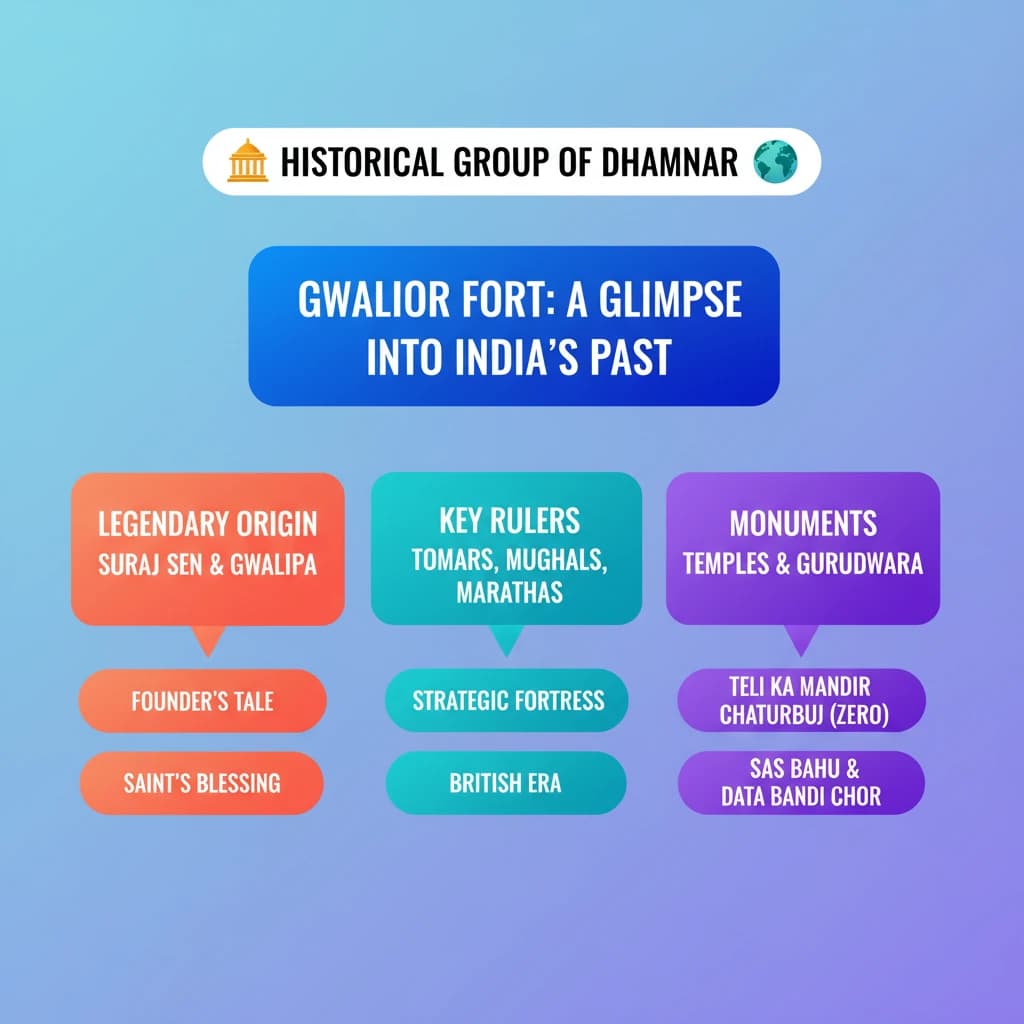
Concept Diagram

💡 Key Takeaways

  • •Gwalior Fort is a historic hill fort in Madhya Pradesh, renowned for its strategic importance.
  • •Its legendary origin involves chieftain Suraj Sen and hermit-saint Gwalipa.
  • •The fort's history saw control by Tomars, Mughals, Marathas (Scindias), and the British.
  • •Key monuments include Teli ka Mandir, Chaturbhuj Temple (with an early reference to zero), and Sas Bahu Temples.
  • •Gurudwara Data Bandi Chhor commemorates Guru Hargobind Sahib's imprisonment.
  • •Ancient Sanskrit inscriptions refer to the fort as Gopachala and Gopagiri.
  • •It represents a blend of diverse architectural styles and cultural influences.

🧠 Memory Techniques
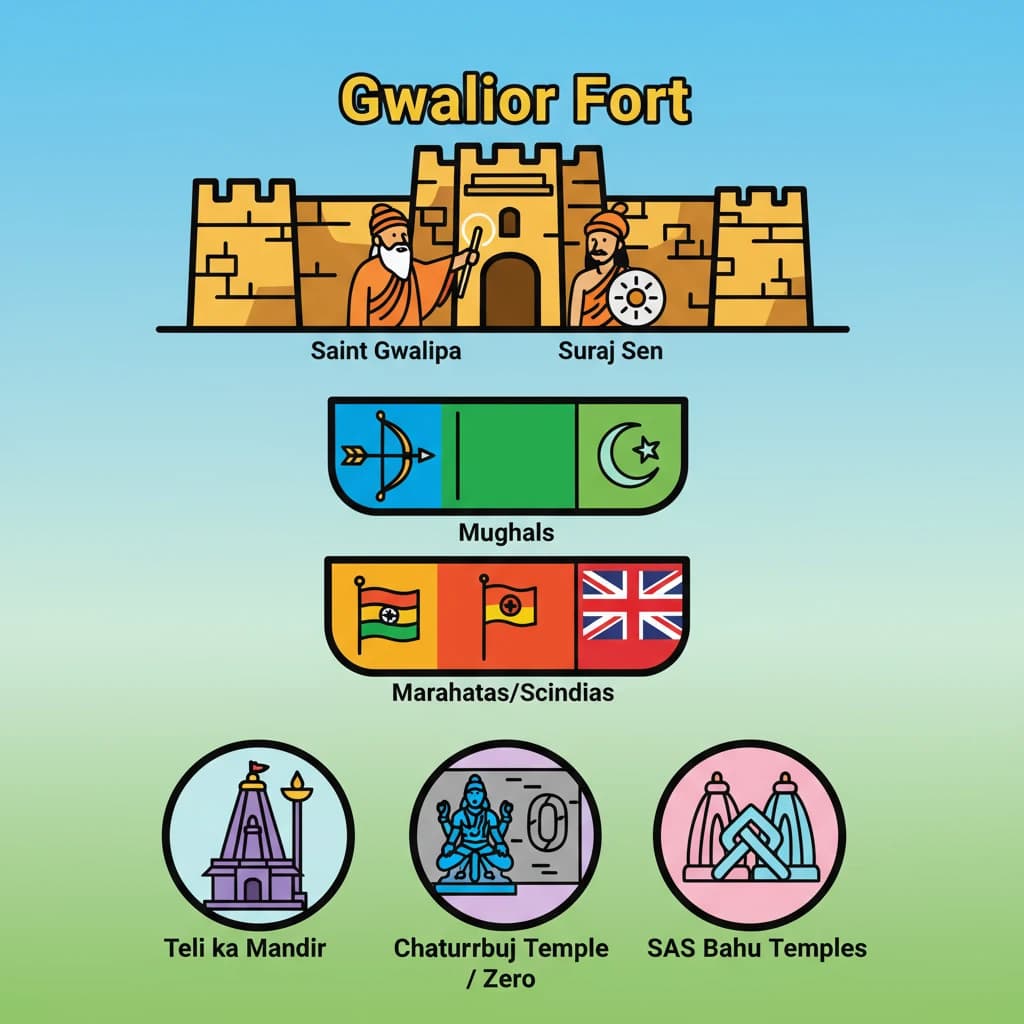
Memory Aid
98% Verified Content

📚 Reference Sources

•Archaeological Survey of India (ASI) official records on Gwalior Fort
•Culturalindia.net - Gwalior Fort
•Madhya Pradesh Tourism official website
•Wikipedia - Gwalior Fort (for cross-referencing dates and rulers)

Related Topics

Loading related topics...
Explore:Art And Culture Topics·All Subjects·Daily Current Affairs·Editorial Analysis·Previous Year Questions·UPSC GPT
Historical Group of Dhamnar - UPSC Art And Culture