Loading page, please wait…
Vaidra Logo
Vaidra

Top 4 items + smart groups

UPSC GPT
New
Current Affairs
Daily Solutions
Daily Puzzle
Mains Evaluator

Version 2.0.0 • Built with ❤️ for UPSC aspirants

Loading...
Loading...
Loading...
Loading...
Loading...
Loading...
Loading...
Loading...
Loading...
Loading...
Loading...
Loading...
Loading...
Great Indian Hornbill: Distribution, Habitat, and Significance - UPSC Art And Culture
Back
All Subjects

Topics

0 topics • 0 completed

Loading topics...
Loading...
Loading...
Loading...
Loading...
Loading...
Overall Progress0%

Great Indian Hornbill: Distribution, Habitat, and Significance - UPSC Art And Culture

What is Great Indian Hornbill: Distribution, Habitat, and Significance in UPSC Art And Culture?

Great Indian Hornbill: Distribution, Habitat, and Significance is a key topic under Art And Culture for UPSC Civil Services Examination. Key points include: The Great Indian Hornbill is a large, iconic bird found in the Indian subcontinent and Southeast Asia.. It primarily inhabits evergreen and moist deciduous forests, thriving in tall tree canopies.. It is the state bird of Arunachal Pradesh.. Understanding this topic is essential for both UPSC Prelims and Mains preparation.

Why is Great Indian Hornbill: Distribution, Habitat, and Significance important for UPSC exam?

Great Indian Hornbill: Distribution, Habitat, and Significance is a Easy-level topic in UPSC Art And Culture. It is tested in both Prelims (factual MCQs) and Mains (analytical answer writing). Previous year UPSC questions have frequently covered aspects of Great Indian Hornbill: Distribution, Habitat, and Significance, making it essential for comprehensive IAS preparation.

How to prepare Great Indian Hornbill: Distribution, Habitat, and Significance for UPSC?

To prepare Great Indian Hornbill: Distribution, Habitat, and Significance for UPSC: (1) Study the comprehensive notes covering all key concepts on Vaidra. (2) Practice previous year questions on this topic. (3) Connect it with current affairs using daily updates. (4) Revise using key takeaways and mind maps available for Art And Culture. (5) Write practice answers linking Great Indian Hornbill: Distribution, Habitat, and Significance to related GS Paper topics.

Key takeaways of Great Indian Hornbill: Distribution, Habitat, and Significance for UPSC

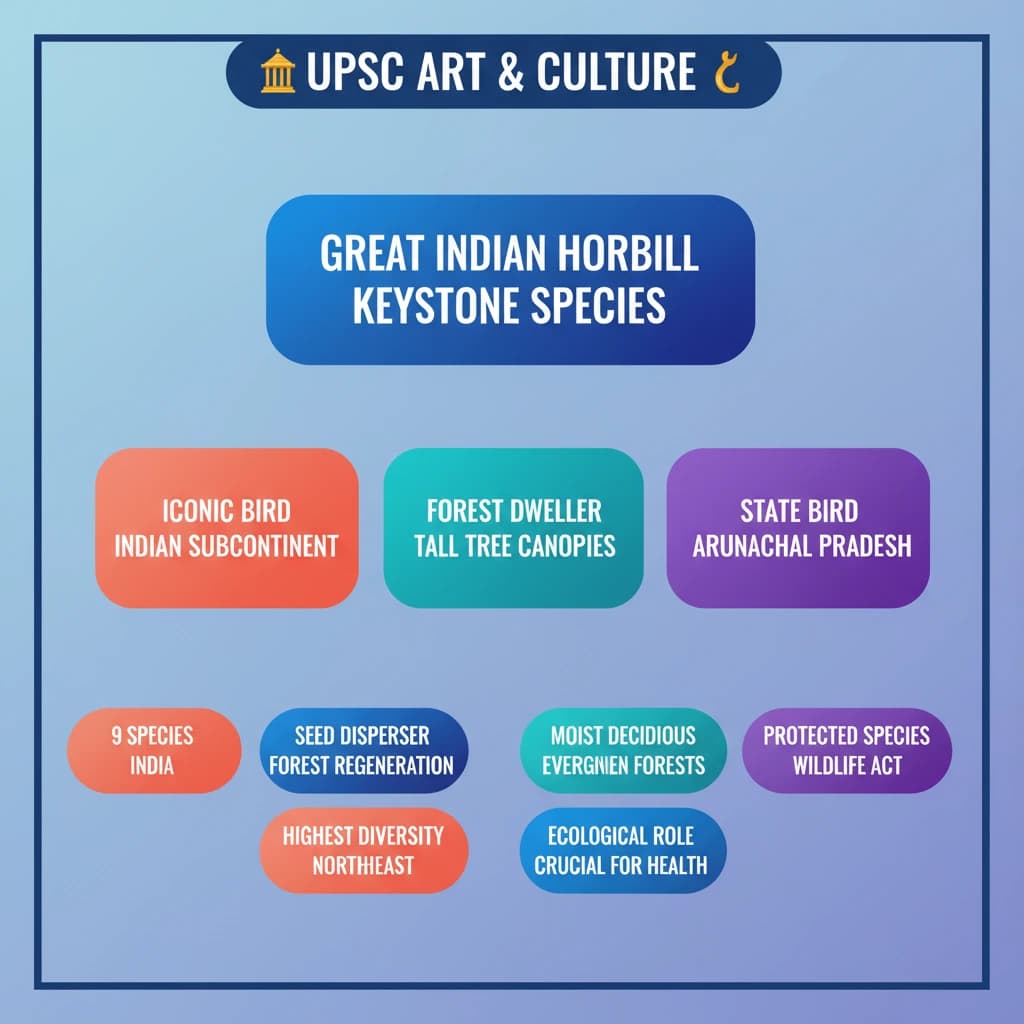
  • The Great Indian Hornbill is a large, iconic bird found in the Indian subcontinent and Southeast Asia.
  • It primarily inhabits evergreen and moist deciduous forests, thriving in tall tree canopies.
  • It is the state bird of Arunachal Pradesh.
  • India is home to nine hornbill species, with the highest diversity in the Northeast.
  • Hornbills are crucial seed dispersers, making them a keystone species for forest regeneration.
  • Habitat loss and poaching are major threats to its survival.
  • The species is protected under Schedule I of the Wildlife Protection Act, 1972.
Great Indian Hornbill: Distribution, Habitat, and Significance

Great Indian Hornbill: Distribution, Habitat, and Significance

Easy⏱️ 6 min read✓ 95% Verified
art and culture

📖 Introduction

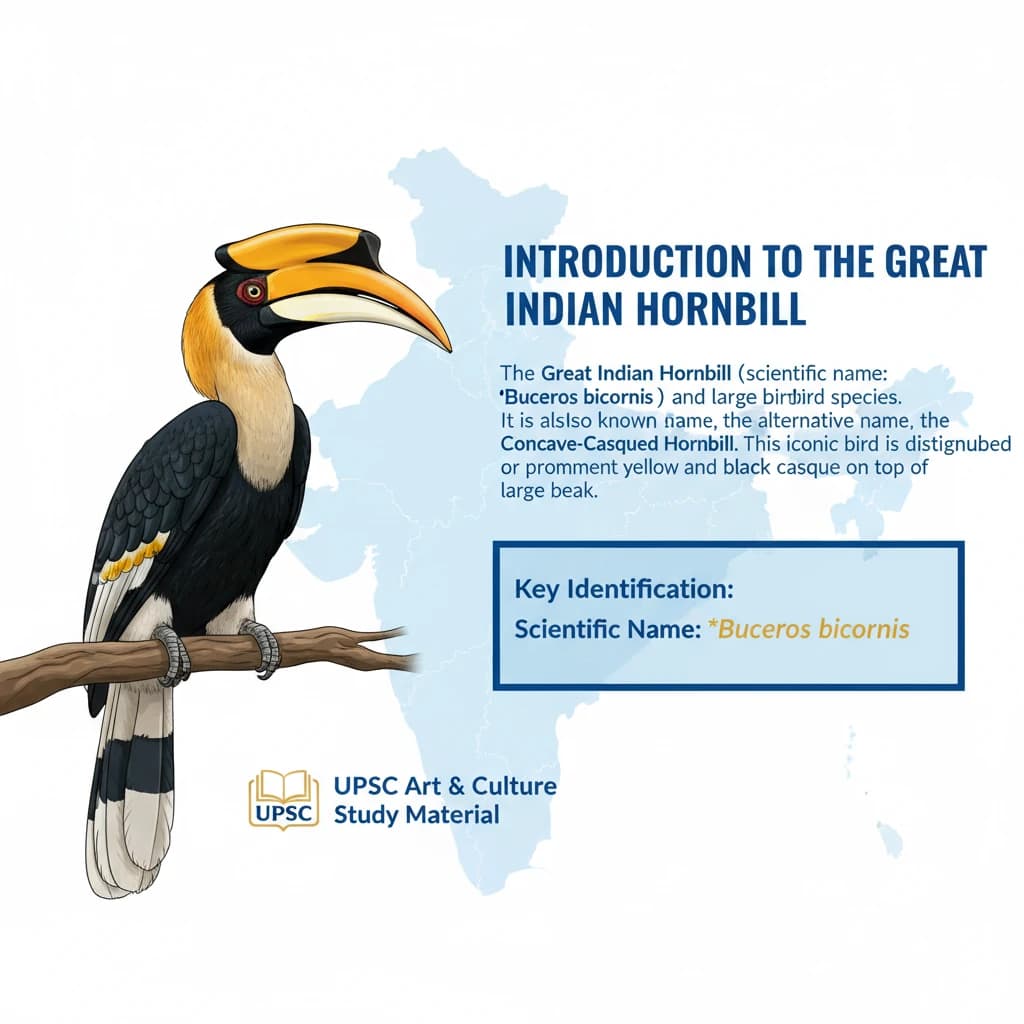
<h4>Introduction to the Great Indian Hornbill</h4><p>The <strong>Great Indian Hornbill</strong> (scientific name: <strong>Buceros bicornis</strong>) is a magnificent and large bird species. It is also known by the alternative name, the <strong>Concave-Casqued Hornbill</strong>. This iconic bird is distinguished by its prominent yellow and black casque on top of its large beak.</p><div class="info-box"><strong>Key Identification:</strong><br><strong>Scientific Name:</strong> <em>Buceros bicornis</em><br><strong>Common Name:</strong> Great Indian Hornbill<br><strong>Alternate Name:</strong> Concave-Casqued Hornbill<br><strong>Size:</strong> Large bird</div><h4>Habitat and Distribution</h4><p>The <strong>Great Indian Hornbill</strong> primarily inhabits dense <strong>evergreen and moist deciduous forests</strong>. It thrives within the canopy of tall trees, which provide both shelter and foraging grounds.</p><p>Geographically, its range extends across the <strong>Indian subcontinent</strong> and into <strong>Southeast Asia</strong>. Within India, significant populations are found in the <strong>Western Ghats</strong>, the various <strong>northeastern states</strong>, and the lower reaches of the <strong>Himalayas</strong>.</p><div class="info-box"><strong>Preferred Habitat:</strong> Canopy of tall trees in evergreen and moist deciduous forests<br><strong>Geographic Range:</strong> Indian subcontinent, Southeast Asia<br><strong>Indian Distribution:</strong> Western Ghats, Northeastern states, Himalayas</div><h4>State Bird and Species Diversity in India</h4><p>The <strong>Great Indian Hornbill</strong> holds the prestigious status of being the <strong>state bird of Arunachal Pradesh</strong>. This highlights its cultural and ecological importance in the region.</p><p>India is home to a remarkable diversity of hornbill species, hosting a total of <strong>nine hornbill species</strong>. The <strong>northeastern region of India</strong> is particularly rich in hornbill diversity, boasting the highest number of species.</p><div class="key-point-box"><strong>State Bird:</strong> Arunachal Pradesh<br><strong>Indian Hornbill Species:</strong> 9<br><strong>Highest Diversity:</strong> Northeastern states of India</div>
Concept Diagram

💡 Key Takeaways

  • •The Great Indian Hornbill is a large, iconic bird found in the Indian subcontinent and Southeast Asia.
  • •It primarily inhabits evergreen and moist deciduous forests, thriving in tall tree canopies.
  • •It is the state bird of Arunachal Pradesh.
  • •India is home to nine hornbill species, with the highest diversity in the Northeast.
  • •Hornbills are crucial seed dispersers, making them a keystone species for forest regeneration.
  • •Habitat loss and poaching are major threats to its survival.
  • •The species is protected under Schedule I of the Wildlife Protection Act, 1972.

🧠 Memory Techniques
Memory Aid
95% Verified Content

📚 Reference Sources

•Wildlife Protection Act, 1972 (Schedule I)
•Various online wildlife conservation resources (e.g., WWF, IUCN, eBird)

Related Topics

Loading related topics...
Explore:Art And Culture Topics·All Subjects·Daily Current Affairs·Editorial Analysis·Previous Year Questions·UPSC GPT