Loading page, please wait…
Asian Buddhist Conference for Peace - UPSC Art And Culture
What is Asian Buddhist Conference for Peace in UPSC Art And Culture?
Asian Buddhist Conference for Peace is a key topic under Art And Culture for UPSC Civil Services Examination. Key points include: The ABCP is a voluntary mass movement of Buddhists in Asia dedicated to peace and justice.. It was founded in 1969 in Ulaanbaatar, Mongolia, to unite Buddhist communities for global peace.. The 12th General Assembly was recently held in New Delhi, highlighting India's strong ties with Buddhism.. Understanding this topic is essential for both UPSC Prelims and Mains preparation.
Why is Asian Buddhist Conference for Peace important for UPSC exam?
Asian Buddhist Conference for Peace is a Medium-level topic in UPSC Art And Culture. It is tested in both Prelims (factual MCQs) and Mains (analytical answer writing). Previous year UPSC questions have frequently covered aspects of Asian Buddhist Conference for Peace, making it essential for comprehensive IAS preparation.
How to prepare Asian Buddhist Conference for Peace for UPSC?
To prepare Asian Buddhist Conference for Peace for UPSC: (1) Study the comprehensive notes covering all key concepts on Vaidra. (2) Practice previous year questions on this topic. (3) Connect it with current affairs using daily updates. (4) Revise using key takeaways and mind maps available for Art And Culture. (5) Write practice answers linking Asian Buddhist Conference for Peace to related GS Paper topics.
Key takeaways of Asian Buddhist Conference for Peace for UPSC
- The ABCP is a voluntary mass movement of Buddhists in Asia dedicated to peace and justice.
- It was founded in 1969 in Ulaanbaatar, Mongolia, to unite Buddhist communities for global peace.
- The 12th General Assembly was recently held in New Delhi, highlighting India's strong ties with Buddhism.
- ABCP advocates for nuclear disarmament, inter-faith dialogue, and provides humanitarian aid.
- Its activities are rooted in core Buddhist principles such as Ahimsa, Karuna, and Metta.
- The organization plays a significant role in cultural diplomacy and enhancing India's soft power.
- It addresses contemporary global challenges including conflict resolution, human rights, and environmental protection.
Asian Buddhist Conference for Peace
Medium⏱️ 7 min read
art and culture
📖 Introduction
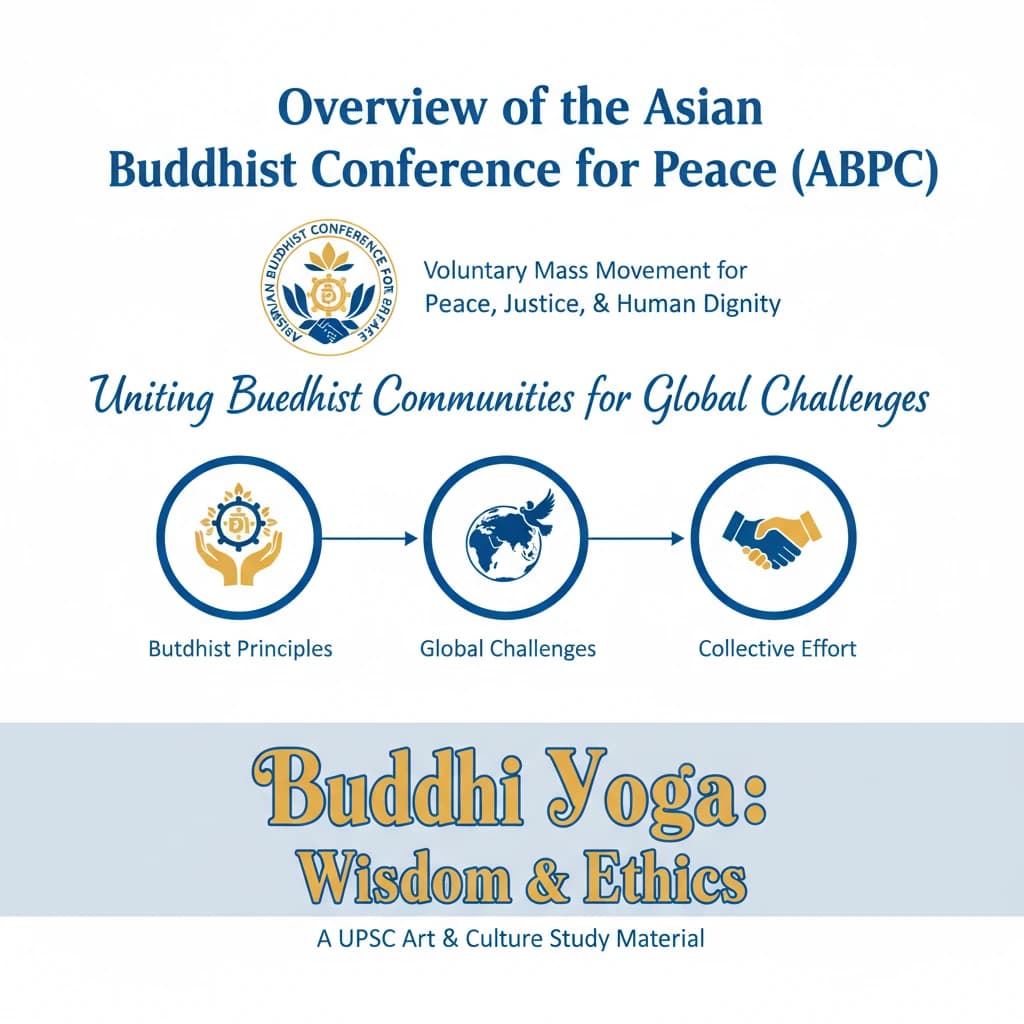
Overview of the Asian Buddhist Conference for Peace (ABCP)
The Asian Buddhist Conference for Peace (ABCP) is a significant international organization. It functions as a voluntary mass movement comprising Buddhists across Asia, dedicated to promoting peace, justice, and human dignity.
Its primary goal is to unite Buddhist communities in a collective effort to address global challenges. The organization emphasizes the application of Buddhist principles to contemporary issues.
Nature: Voluntary mass movement of Buddhists
Geographical Scope: Primarily Asian countries
Recent Event: 12th General Assembly convened in New Delhi
Geographical Scope: Primarily Asian countries
Recent Event: 12th General Assembly convened in New Delhi
Formation and Core Objectives
The ABCP was established with a vision to foster solidarity among Buddhists. It aims to contribute to world peace through dialogue and cooperation, drawing upon the inherent peaceful tenets of Buddhism.
Key Objectives:
- Promoting peace and disarmament
- Advocating for justice and human rights
- Fostering inter-religious dialogue and understanding
- Contributing to social development and environmental protection
The 12th General Assembly in New Delhi
The convening of the 12th General Assembly in New Delhi underscores India's historical and cultural ties with Buddhism. Such assemblies serve as crucial platforms for deliberation and strategy formulation among member organizations.
This event brought together Buddhist leaders, scholars, and activists from various Asian countries. They discussed strategies for promoting peace and addressing regional and global issues through a Buddhist lens.
Hosting international conferences like the ABCP General Assembly enhances India's soft power and cultural diplomacy. This is relevant for UPSC GS Paper 2 (International Relations) and GS Paper 1 (Art & Culture).
💡 Key Takeaways
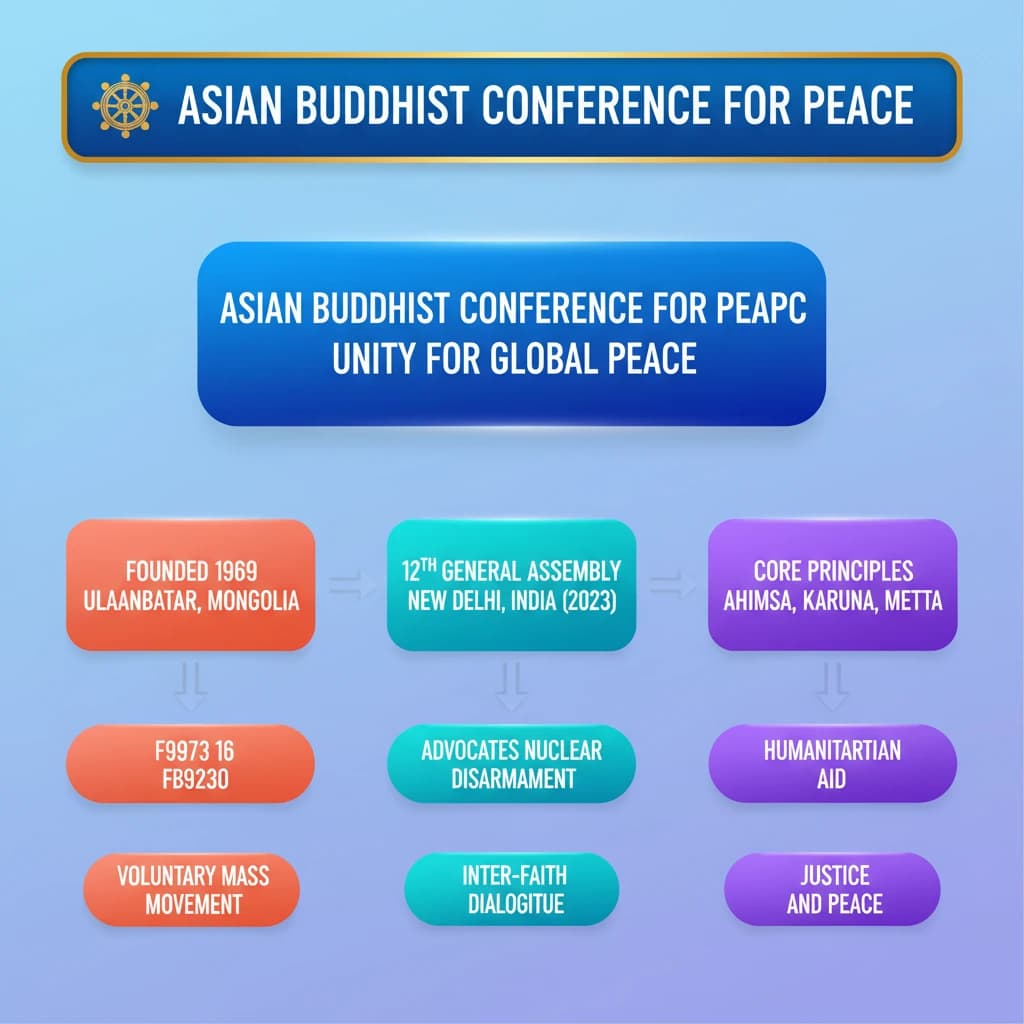
- •The ABCP is a voluntary mass movement of Buddhists in Asia dedicated to peace and justice.
- •It was founded in 1969 in Ulaanbaatar, Mongolia, to unite Buddhist communities for global peace.
- •The 12th General Assembly was recently held in New Delhi, highlighting India's strong ties with Buddhism.
- •ABCP advocates for nuclear disarmament, inter-faith dialogue, and provides humanitarian aid.
- •Its activities are rooted in core Buddhist principles such as Ahimsa, Karuna, and Metta.
- •The organization plays a significant role in cultural diplomacy and enhancing India's soft power.
- •It addresses contemporary global challenges including conflict resolution, human rights, and environmental protection.
🧠 Memory Techniques

95% Verified Content
📚 Reference Sources
•General knowledge about Asian Buddhist Conference for Peace (ABCP)
•Publicly available information on ABCP's history, objectives, and activities