Loading page, please wait…
Vaidra Logo
Vaidra

Top 4 items + smart groups

UPSC GPT
New
Current Affairs
Daily Solutions
Daily Puzzle
Mains Evaluator

Version 2.0.0 • Built with ❤️ for UPSC aspirants

Loading...
Loading...
Loading...
Loading...
Loading...
Loading...
Loading...
Loading...
Loading...
Loading...
Loading...
Loading...
Loading...
Back
All Subjects

Topics

0 topics • 0 completed

Loading topics...
Loading...
Loading...
Loading...
Loading...
Loading...
Overall Progress0%

What are the Key Features of Amravati School of Art? - UPSC Art And Culture

What is What are the Key Features of Amravati School of Art? in UPSC Art And Culture?

What are the Key Features of Amravati School of Art? is a key topic under Art And Culture for UPSC Civil Services Examination. Key points include: The Amravati School of Art flourished in the post-Mauryan period, primarily in Andhra Pradesh.. It was patronized by the Satvahana rulers.. The Amravati Stupa was its central monument and a hub of artistic activity.. Understanding this topic is essential for both UPSC Prelims and Mains preparation.

Why is What are the Key Features of Amravati School of Art? important for UPSC exam?

What are the Key Features of Amravati School of Art? is a Medium-level topic in UPSC Art And Culture. It is tested in both Prelims (factual MCQs) and Mains (analytical answer writing). Previous year UPSC questions have frequently covered aspects of What are the Key Features of Amravati School of Art?, making it essential for comprehensive IAS preparation.

How to prepare What are the Key Features of Amravati School of Art? for UPSC?

To prepare What are the Key Features of Amravati School of Art? for UPSC: (1) Study the comprehensive notes covering all key concepts on Vaidra. (2) Practice previous year questions on this topic. (3) Connect it with current affairs using daily updates. (4) Revise using key takeaways and mind maps available for Art And Culture. (5) Write practice answers linking What are the Key Features of Amravati School of Art? to related GS Paper topics.

Key takeaways of What are the Key Features of Amravati School of Art? for UPSC

  • The Amravati School of Art flourished in the post-Mauryan period, primarily in Andhra Pradesh.
  • It was patronized by the Satvahana rulers.
  • The Amravati Stupa was its central monument and a hub of artistic activity.
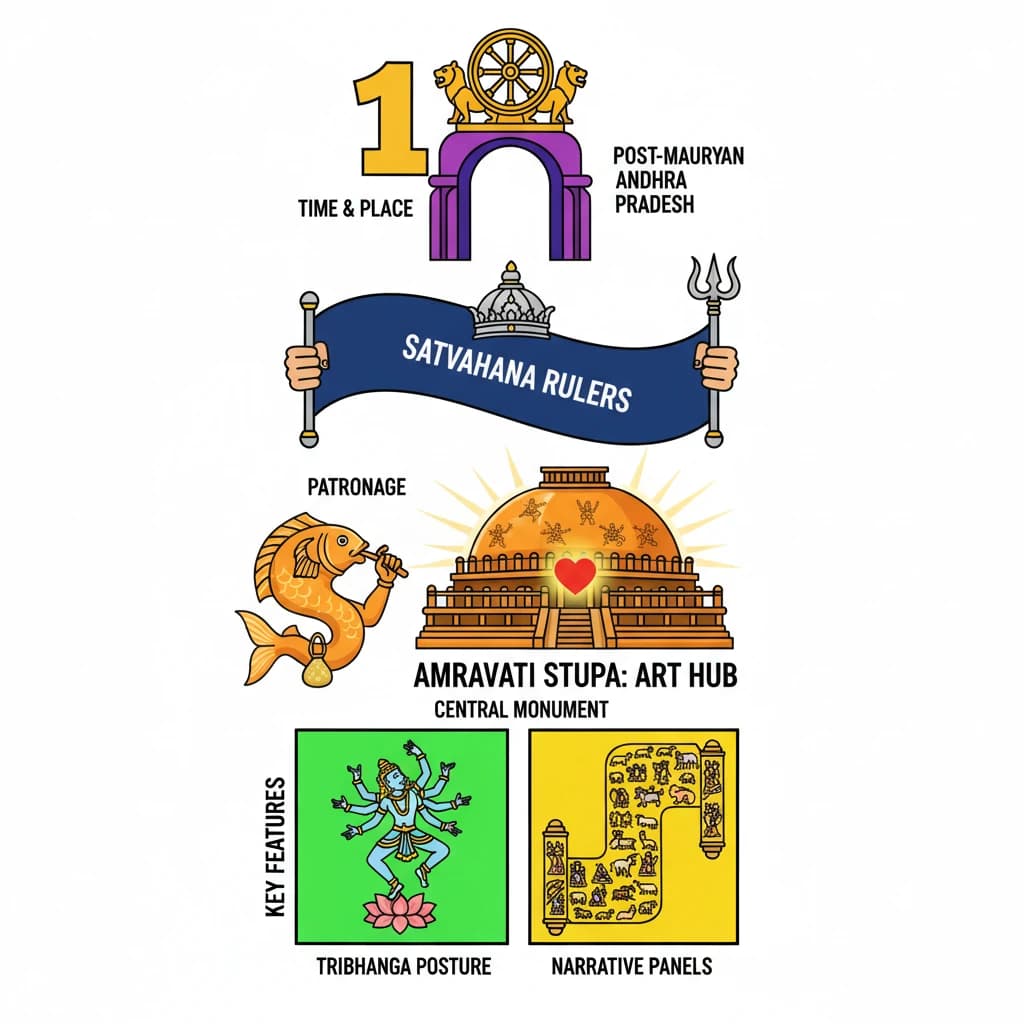
  • Key features include the extensive use of the Tribhanga posture and narrative panels.
  • Sculptures were predominantly crafted from Palnad marble, allowing for intricate detailing.
  • Unlike Mathura and Gandhara, it developed a unique indigenous style with minimal external influence.
  • Many Amravati sculptures are now dispersed globally, with Australia being the only country to return one.
What are the Key Features of Amravati School of Art?

What are the Key Features of Amravati School of Art?

Medium⏱️ 6 min read✓ 98% Verified
art and culture

📖 Introduction

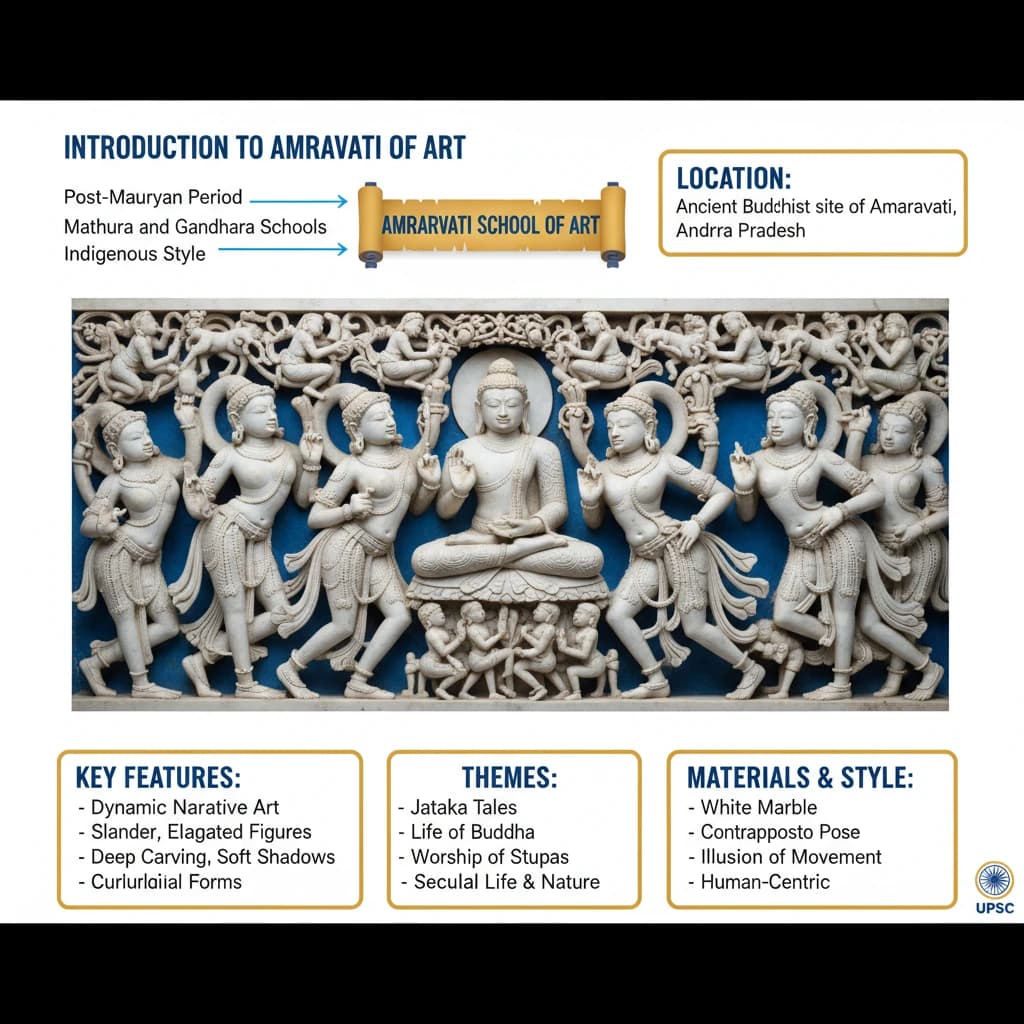
<h4>Introduction to Amravati School of Art</h4><p>The <strong>Amravati School of Art</strong> emerged during the <strong>post-Mauryan period</strong>, establishing itself as one of the three most significant styles of ancient Indian art. It flourished alongside the <strong>Mathura</strong> and <strong>Gandhara schools</strong>, distinguishing itself with a unique indigenous style.</p><div class="info-box"><strong>Location:</strong> Ancient Buddhist site of <strong>Amaravati</strong>, Andhra Pradesh<br><strong>Period:</strong> Post-Mauryan era</div><h4>The Amravati Stupa: A Central Hub</h4><p>The magnificent <strong>Amravati Stupa</strong> served as the focal point and primary inspiration for the Amravati School of Art. This grand Buddhist monument became a vibrant center for artistic and architectural endeavors, significantly influencing the development of <strong>Buddhist art</strong> across India.</p><h4>Historical Neglect and Excavations</h4><p>Unfortunately, the <strong>Amravati Stupa</strong> suffered significant degradation due to a lack of conservation efforts in the <strong>early 19th century</strong>. Local inhabitants and British officials often repurposed stupa materials for construction, leading to its decline.</p><div class="info-box"><strong>Key Events:</strong><ul><li><strong>Early 19th century:</strong> Government indifference led to material reuse.</li><li><strong>1845:</strong> Excavations by <strong>Walter Elliot</strong>.</li><li><strong>Sculpture dispersal:</strong> Pieces shipped to <strong>Calcutta, London, and Madras</strong>.</li></ul></div><h4>Key Characteristics of Amravati Art</h4><p>The sculptures of the Amravati School are renowned for their exceptional aesthetic quality and intricate detailing. They primarily utilized <strong>Palnad marble</strong>, a distinctive type of limestone that allowed for very fine and elaborate carvings.</p><div class="key-point-box"><strong>Major Centres:</strong> <strong>Amaravati</strong> and <strong>Nagarjunakonda</strong><br><strong>Patronage:</strong> <strong>Satvahana rulers</strong></div><h4>Distinctive Artistic Features</h4><ul><li><strong>Tribhanga Posture:</strong> The <strong>Tribhanga posture</strong>, characterized by the body having three distinct bends, was extensively employed in Amravati sculptures. This dynamic pose adds fluidity and grace to the figures.</li><li><strong>Narrative Panels:</strong> The art frequently features elaborate <strong>narrative panels</strong>. These panels vividly depict scenes from the <strong>life of the Buddha</strong>, various <strong>Jataka tales</strong>, and a range of Buddhist rituals and practices.</li><li><strong>Iconic Buddha Depiction:</strong> A particular representation of the <strong>Buddha</strong>, showing the robe draped over the <strong>left shoulder</strong> and the other hand in the <strong>abhaya mudra</strong> (gesture of fearlessness), became iconic. This style was widely replicated across South and Southeast Asia.</li><li><strong>Indigenous Style:</strong> Unlike the <strong>Mathura</strong> and <strong>Gandhara schools</strong>, which exhibited significant <strong>Graeco-Roman influences</strong>, the Amravati school developed a largely indigenous style with minimal external impact. It emphasized local artistic traditions.</li></ul><h4>Global Dispersal of Amravati Sculptures</h4><p>Today, numerous sculptures from the <strong>Amravati Stupa</strong> are housed in museums worldwide, reflecting a broad dispersal of this ancient Indian art. Significant collections can be found in various international institutions.</p><div class="info-box"><strong>International Collections:</strong><ul><li><strong>British Museum</strong> (London)</li><li><strong>Art Institute of Chicago</strong> (USA)</li><li><strong>Musée Guimet</strong> (Paris)</li><li><strong>Metropolitan Museum of Art</strong> (New York)</li></ul><strong>Indian Collections:</strong><ul><li><strong>Government Museum</strong> (Chennai)</li><li><strong>National Museum</strong> (New Delhi)</li></ul></div><h4>Repatriation Efforts</h4><p>Notably, <strong>Australia</strong> stands as the sole country to have returned a stolen <strong>Amravati-style sculpture</strong> to India. This act highlights growing awareness and efforts regarding the repatriation of cultural heritage.</p><div class="exam-tip-box"><strong>UPSC Insight:</strong> Understanding the unique characteristics of the <strong>Amravati School</strong>, especially its indigenous nature and the <strong>Tribhanga posture</strong>, is crucial for distinguishing it from other art schools like <strong>Gandhara</strong> and <strong>Mathura</strong> in <strong>Art and Culture</strong> (<strong>GS Paper 1</strong>).</div>
Concept Diagram

💡 Key Takeaways

  • •The Amravati School of Art flourished in the post-Mauryan period, primarily in Andhra Pradesh.
  • •It was patronized by the Satvahana rulers.
  • •The Amravati Stupa was its central monument and a hub of artistic activity.
  • •Key features include the extensive use of the Tribhanga posture and narrative panels.
  • •Sculptures were predominantly crafted from Palnad marble, allowing for intricate detailing.
  • •Unlike Mathura and Gandhara, it developed a unique indigenous style with minimal external influence.
  • •Many Amravati sculptures are now dispersed globally, with Australia being the only country to return one.

🧠 Memory Techniques
Memory Aid
98% Verified Content

Related Topics

Loading related topics...
Explore:Art And Culture Topics·All Subjects·Daily Current Affairs·Editorial Analysis·Previous Year Questions·UPSC GPT
What are the Key Features of Amravati School of Art? - UPSC Art And Culture