Loading page, please wait…
Corridor Projects for Vishnupad and Mahabodhi Temples - UPSC Art And Culture
What is Corridor Projects for Vishnupad and Mahabodhi Temples in UPSC Art And Culture?
Corridor Projects for Vishnupad and Mahabodhi Temples is a key topic under Art And Culture for UPSC Civil Services Examination. Key points include: Union Budget 2024-25 includes corridor projects for Vishnupad and Mahabodhi Temples.. These projects aim to boost pilgrimage and tourism, modeled after the Kashi Vishwanath Corridor.. Rashtrapati Bhavan renamed Durbar Hall to Gyanatantra Mandap and Ashok Hall to Ashok Mandap.. Understanding this topic is essential for both UPSC Prelims and Mains preparation.
Why is Corridor Projects for Vishnupad and Mahabodhi Temples important for UPSC exam?
Corridor Projects for Vishnupad and Mahabodhi Temples is a Medium-level topic in UPSC Art And Culture. It is tested in both Prelims (factual MCQs) and Mains (analytical answer writing). Previous year UPSC questions have frequently covered aspects of Corridor Projects for Vishnupad and Mahabodhi Temples, making it essential for comprehensive IAS preparation.
How to prepare Corridor Projects for Vishnupad and Mahabodhi Temples for UPSC?
To prepare Corridor Projects for Vishnupad and Mahabodhi Temples for UPSC: (1) Study the comprehensive notes covering all key concepts on Vaidra. (2) Practice previous year questions on this topic. (3) Connect it with current affairs using daily updates. (4) Revise using key takeaways and mind maps available for Art And Culture. (5) Write practice answers linking Corridor Projects for Vishnupad and Mahabodhi Temples to related GS Paper topics.
Key takeaways of Corridor Projects for Vishnupad and Mahabodhi Temples for UPSC
- Union Budget 2024-25 includes corridor projects for Vishnupad and Mahabodhi Temples.
- These projects aim to boost pilgrimage and tourism, modeled after the Kashi Vishwanath Corridor.
- Rashtrapati Bhavan renamed Durbar Hall to Gyanatantra Mandap and Ashok Hall to Ashok Mandap.
- The renaming reflects a move towards Indian cultural values and away from colonial influences.
- Vishnupad Temple is dedicated to Lord Vishnu, built by Queen Ahilyabai Holkar, and significant for Pitra Paksha.
- Mahabodhi Temple is where Gautam Buddha attained enlightenment, originally built by Emperor Ashoka.
- The Konark wheels demonstrate ancient Indian sundial functionality for precise time measurement.
Corridor Projects for Vishnupad and Mahabodhi Temples
Medium⏱️ 7 min read
art and culture
📖 Introduction
Understanding Sundial Functionality
The Sundial Functionality described relates to the Konark wheels, which are ancient astronomical instruments. Two of the wheels are designed to accurately determine the time from sunrise to sunset.
Time Measurement: Two wheels determine time from sunrise to sunset.
The arrangement of spokes on these wheels is crucial for timekeeping. Wider spokes indicate 3-hour intervals, while thinner spokes represent 1.5-hour periods. Smaller beads between spokes mark even finer increments of 3 minutes.
The sundial operates with a unique orientation. The top center wider spoke symbolizes midnight. From this point, the dial moves in an anti-clockwise direction to display the time.
Rashtrapati Bhavan Renaming Initiatives
In a significant move to align with Indian cultural values and diminish traces of colonial influence, Rashtrapati Bhavan has officially renamed two of its prominent halls.
Objective: Align with Indian cultural values, reduce colonial influence.
The former Durbar Hall has been renamed Gyanatantra Mandap. This new name reflects the concept of a republic, directly replacing the colonial term 'Durbar', which referred to courts and assemblies of Indian rulers and the British.
Similarly, Ashok Hall has been renamed Ashok Mandap. This change honors Emperor Ashoka and reinforces Indian cultural significance, aiming to remove anglicized influences associated with the original ballroom function.
Original Use of Ashok Hall: Ballroom
Meaning of 'Ashok': Free from sufferings/sorrow; refers to Emperor Ashoka (symbol of unity, peaceful co-existence); also refers to the Ashok tree (deep significance in Indian traditions).
Meaning of 'Ashok': Free from sufferings/sorrow; refers to Emperor Ashoka (symbol of unity, peaceful co-existence); also refers to the Ashok tree (deep significance in Indian traditions).
The Rashtrapati Bhavan in New Delhi is the largest residence of any Head of State globally. It was originally constructed as the 'Viceroy House' for the British Viceroy of India and was renamed Rashtrapati Bhavan in 1950 when India became a Republic.
The architectural design was by Sir Edwin Landseer Lutyens, a British architect, who blended Indian, Mughal, and European architectural styles in its construction.
Vishnupad and Mahabodhi Temple Corridor Projects
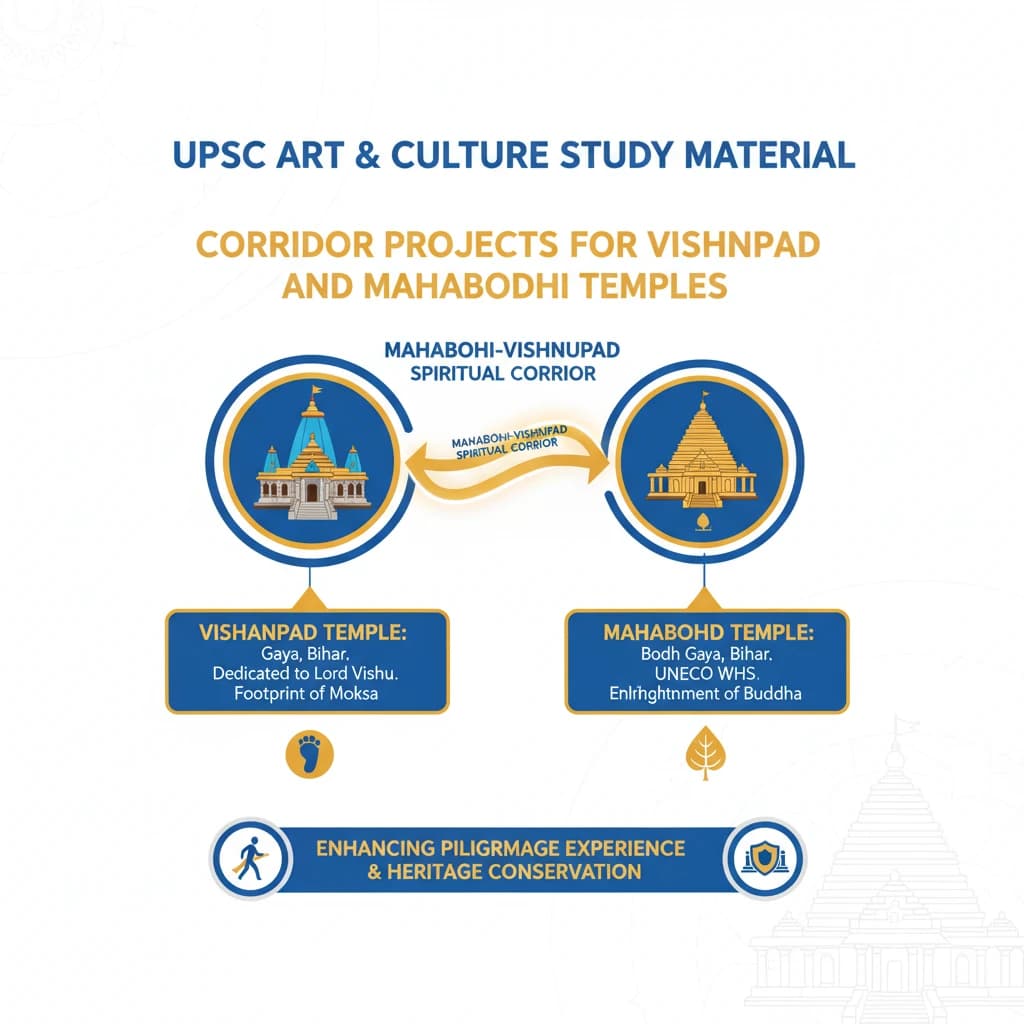
The Union Budget 2024-25 announced plans for new corridor projects for the Vishnupad Temple at Gaya and the Mahabodhi Temple at Bodh Gaya, both located in Bihar.
UPSC Relevance: These projects reflect the government's focus on heritage tourism and infrastructure development, a recurring theme in GS-1 Art & Culture and GS-3 Economy/Infrastructure.
These projects are envisioned to be modeled after the successful Kashi Vishwanath Corridor. Their primary goal is to significantly enhance both temples, transforming them into major pilgrim and tourist destinations.
The two temples, Vishnupad and Mahabodhi, are approximately 10 kilometers apart and hold immense cultural and religious significance for devotees and tourists alike.
Vishnupad Temple at Gaya: Key Details
The Vishnupad Temple is located on the banks of the Falgu/Falgun river in the Gaya district of Bihar. It is a revered shrine dedicated to Lord Vishnu.
Local mythology narrates the legend of a demon named Gayasur. He requested the gods to grant him the power to help others achieve moksha (liberation from the cycle of rebirth). However, upon misusing this power, Lord Vishnu subdued him, leaving a footprint within the temple, believed to be a mark of this event.
Architectural Features:
Height: Approximately 100 feet
Pillars: 44, constructed from large gray granite blocks (Munger Black stone)
Construction Method: Blocks joined with iron clamps
Shrine Orientation: Octagonal, oriented towards the east
Height: Approximately 100 feet
Pillars: 44, constructed from large gray granite blocks (Munger Black stone)
Construction Method: Blocks joined with iron clamps
Shrine Orientation: Octagonal, oriented towards the east
The temple's construction dates back to 1787, commissioned by Queen Ahilyabai Holkar.
It holds particular significance during Pitra Paksha, a period dedicated to honoring ancestors, drawing numerous devotees. The Brahma Kalpit Brahmins, also known as Gayawal Brahmins, have served as the traditional priests of the temple since ancient times.
Mahabodhi Temple at Bodh Gaya: Key Details
The Mahabodhi Temple, situated at Bodh Gaya, is widely believed to be the sacred site where Gautam Buddha attained enlightenment under the legendary Mahabodhi Tree.
Historical Construction: The original temple was built by Emperor Ashoka in the 3rd century BCE.
💡 Key Takeaways
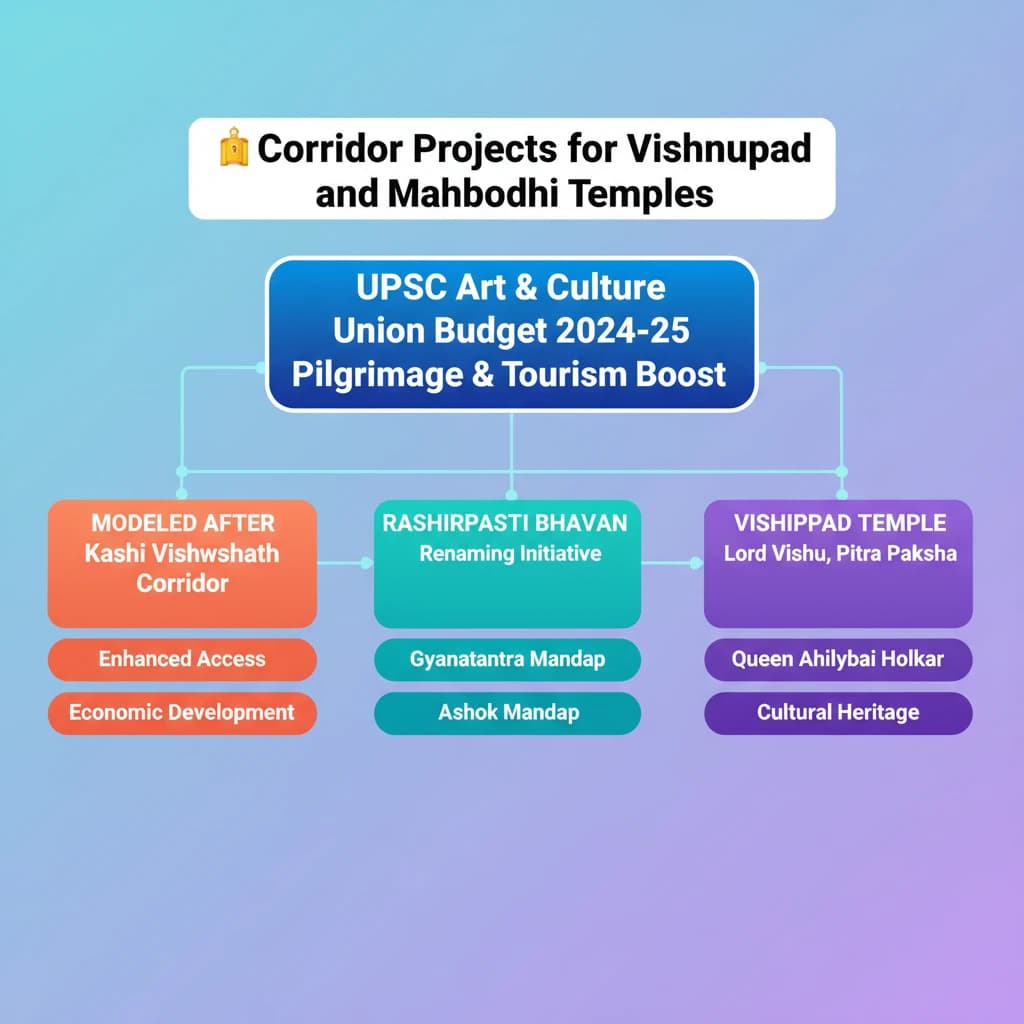
- •Union Budget 2024-25 includes corridor projects for Vishnupad and Mahabodhi Temples.
- •These projects aim to boost pilgrimage and tourism, modeled after the Kashi Vishwanath Corridor.
- •Rashtrapati Bhavan renamed Durbar Hall to Gyanatantra Mandap and Ashok Hall to Ashok Mandap.
- •The renaming reflects a move towards Indian cultural values and away from colonial influences.
- •Vishnupad Temple is dedicated to Lord Vishnu, built by Queen Ahilyabai Holkar, and significant for Pitra Paksha.
- •Mahabodhi Temple is where Gautam Buddha attained enlightenment, originally built by Emperor Ashoka.
- •The Konark wheels demonstrate ancient Indian sundial functionality for precise time measurement.
🧠 Memory Techniques
95% Verified Content