Loading page, please wait…
Vaidra Logo
Vaidra

Top 4 items + smart groups

UPSC GPT
New
Current Affairs
Daily Solutions
Daily Puzzle
Mains Evaluator

Version 2.0.0 • Built with ❤️ for UPSC aspirants

Loading...
Loading...
Loading...
Loading...
Loading...
Loading...
Loading...
Loading...
Loading...
Loading...
Loading...
Loading...
Loading...
Back
All Subjects

Topics

0 topics • 0 completed

Loading topics...
Loading...
Loading...
Loading...
Loading...
Loading...
Overall Progress0%

Archaeological Survey of India (ASI) - UPSC Art And Culture

What is Archaeological Survey of India (ASI) in UPSC Art And Culture?

Archaeological Survey of India (ASI) is a key topic under Art And Culture for UPSC Civil Services Examination. Key points include: The Archaeological Survey of India (ASI) is India's premier organization for archaeological research and cultural heritage protection.. It operates under the Ministry of Culture and administers over 3650 national monuments and sites.. ASI's core functions include surveys, exploration, excavation, and conservation of historical sites.. Understanding this topic is essential for both UPSC Prelims and Mains preparation.

Why is Archaeological Survey of India (ASI) important for UPSC exam?

Archaeological Survey of India (ASI) is a Medium-level topic in UPSC Art And Culture. It is tested in both Prelims (factual MCQs) and Mains (analytical answer writing). Previous year UPSC questions have frequently covered aspects of Archaeological Survey of India (ASI), making it essential for comprehensive IAS preparation.

How to prepare Archaeological Survey of India (ASI) for UPSC?

To prepare Archaeological Survey of India (ASI) for UPSC: (1) Study the comprehensive notes covering all key concepts on Vaidra. (2) Practice previous year questions on this topic. (3) Connect it with current affairs using daily updates. (4) Revise using key takeaways and mind maps available for Art And Culture. (5) Write practice answers linking Archaeological Survey of India (ASI) to related GS Paper topics.

Key takeaways of Archaeological Survey of India (ASI) for UPSC

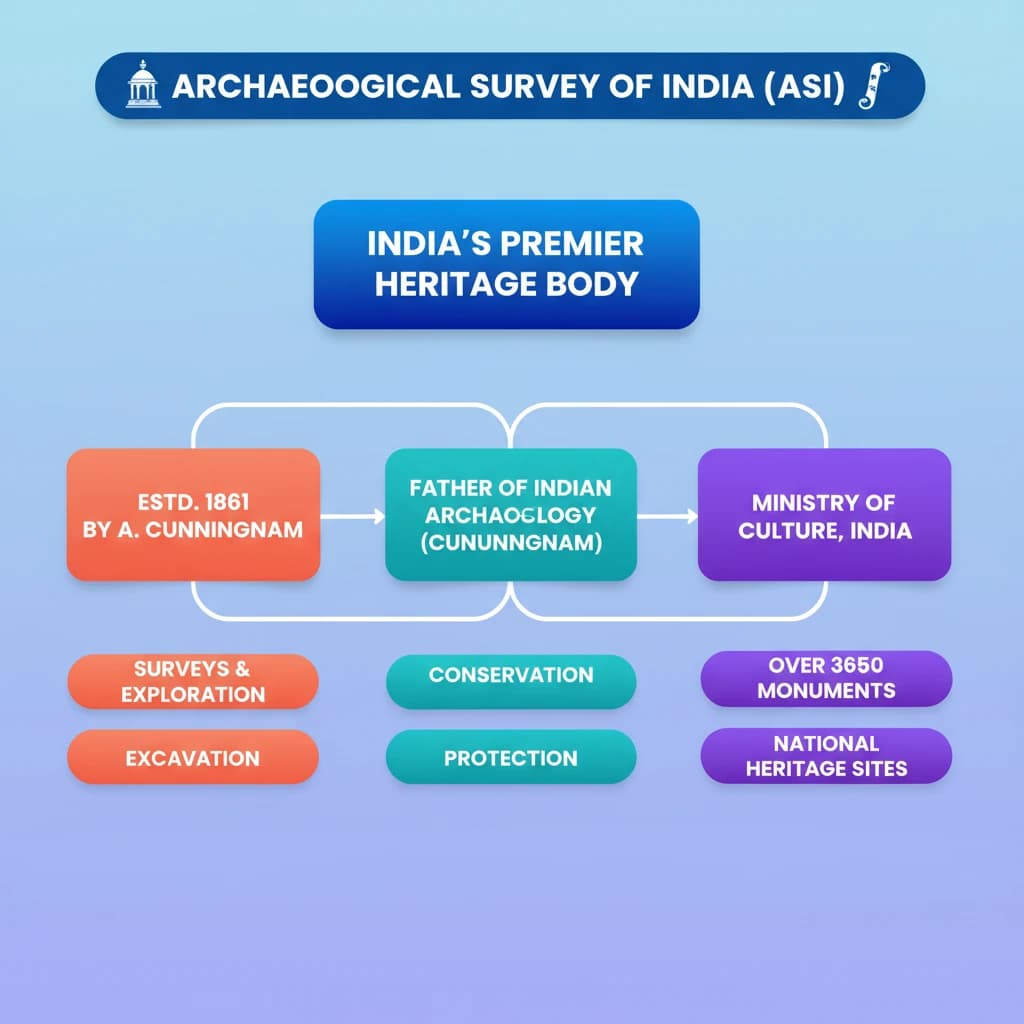
  • The Archaeological Survey of India (ASI) is India's premier organization for archaeological research and cultural heritage protection.
  • It operates under the Ministry of Culture and administers over 3650 national monuments and sites.
  • ASI's core functions include surveys, exploration, excavation, and conservation of historical sites.
  • It was founded in 1861 by Alexander Cunningham, who became its first Director-General.
  • Alexander Cunningham is widely recognized as the "Father of Indian Archaeology."
  • ASI plays a vital role in preserving national identity, promoting heritage tourism, and educating the public about India's past.
Archaeological Survey of India (ASI)

Archaeological Survey of India (ASI)

Medium⏱️ 8 min read✓ 98% Verified
art and culture

📖 Introduction

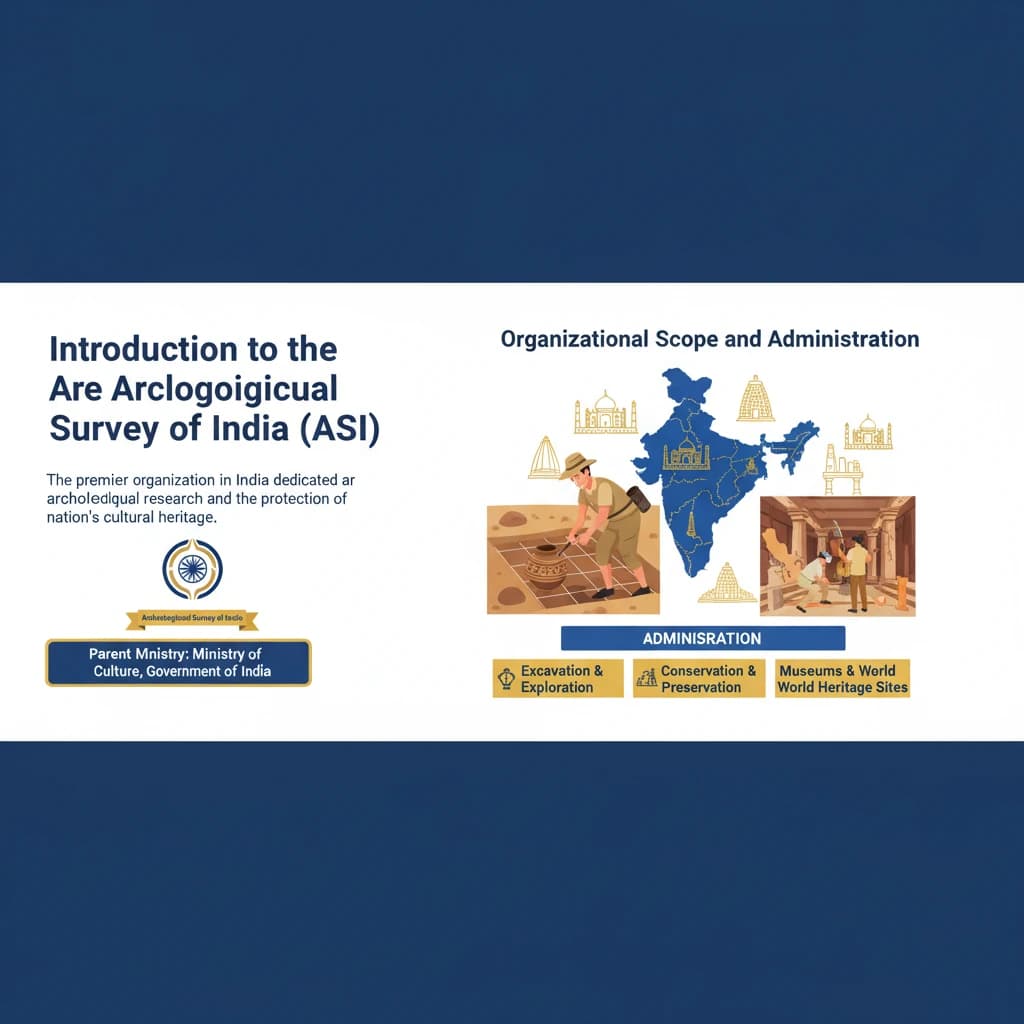
<h4>Introduction to the Archaeological Survey of India (ASI)</h4><p>The <strong>Archaeological Survey of India (ASI)</strong> stands as the premier organization in India dedicated to <strong>archaeological research</strong> and the <strong>protection of the nation's cultural heritage</strong>.</p><div class="info-box"><strong>Parent Ministry:</strong> Ministry of Culture, Government of India</div><h4>Organizational Scope and Administration</h4><p>The ASI is responsible for the administration of a vast network of historical sites. It oversees more than <strong>3650 ancient monuments</strong>, various <strong>archaeological sites</strong>, and numerous <strong>remains of national importance</strong> across the country.</p><div class="key-point-box">The sheer number of sites under ASI's purview highlights its critical role in safeguarding India's diverse historical landscape.</div><h4>Core Functions of the ASI</h4><p>The activities of the ASI are multi-faceted, encompassing a wide range of responsibilities essential for heritage management:</p><ul><li><strong>Surveys of Antiquarian Remains:</strong> Identifying and documenting historical artifacts and structures.</li><li><strong>Exploration and Excavation:</strong> Unearthing and studying archaeological sites to understand past civilizations.</li><li><strong>Conservation and Maintenance:</strong> Preserving and restoring protected monuments and sites to ensure their longevity.</li><li><strong>Epigraphical Research:</strong> Studying inscriptions to decipher historical records.</li><li><strong>Museum Management:</strong> Overseeing site museums to display excavated artifacts.</li></ul><h4>Establishment and Founding Figure</h4><p>The <strong>Archaeological Survey of India</strong> was formally established in <strong>1861</strong>. Its foundation marked a pivotal moment in the systematic study and preservation of India's ancient past.</p><div class="info-box"><strong>Founder and First Director-General:</strong> Alexander Cunningham<br><strong>Title:</strong> "Father of Indian Archaeology"</div><p><strong>Alexander Cunningham</strong>, a British army engineer, played an instrumental role in shaping India's archaeological landscape. His pioneering efforts led to him being posthumously recognized as the <strong>"Father of Indian Archaeology"</strong>.</p><div class="exam-tip-box">Remember <strong>Alexander Cunningham</strong> and the year <strong>1861</strong> as crucial facts for preliminary exams. His title, <strong>"Father of Indian Archaeology"</strong>, is also a frequently tested piece of information.</div>
Concept Diagram

💡 Key Takeaways

  • •The Archaeological Survey of India (ASI) is India's premier organization for archaeological research and cultural heritage protection.
  • •It operates under the Ministry of Culture and administers over 3650 national monuments and sites.
  • •ASI's core functions include surveys, exploration, excavation, and conservation of historical sites.
  • •It was founded in 1861 by Alexander Cunningham, who became its first Director-General.
  • •Alexander Cunningham is widely recognized as the "Father of Indian Archaeology."
  • •ASI plays a vital role in preserving national identity, promoting heritage tourism, and educating the public about India's past.

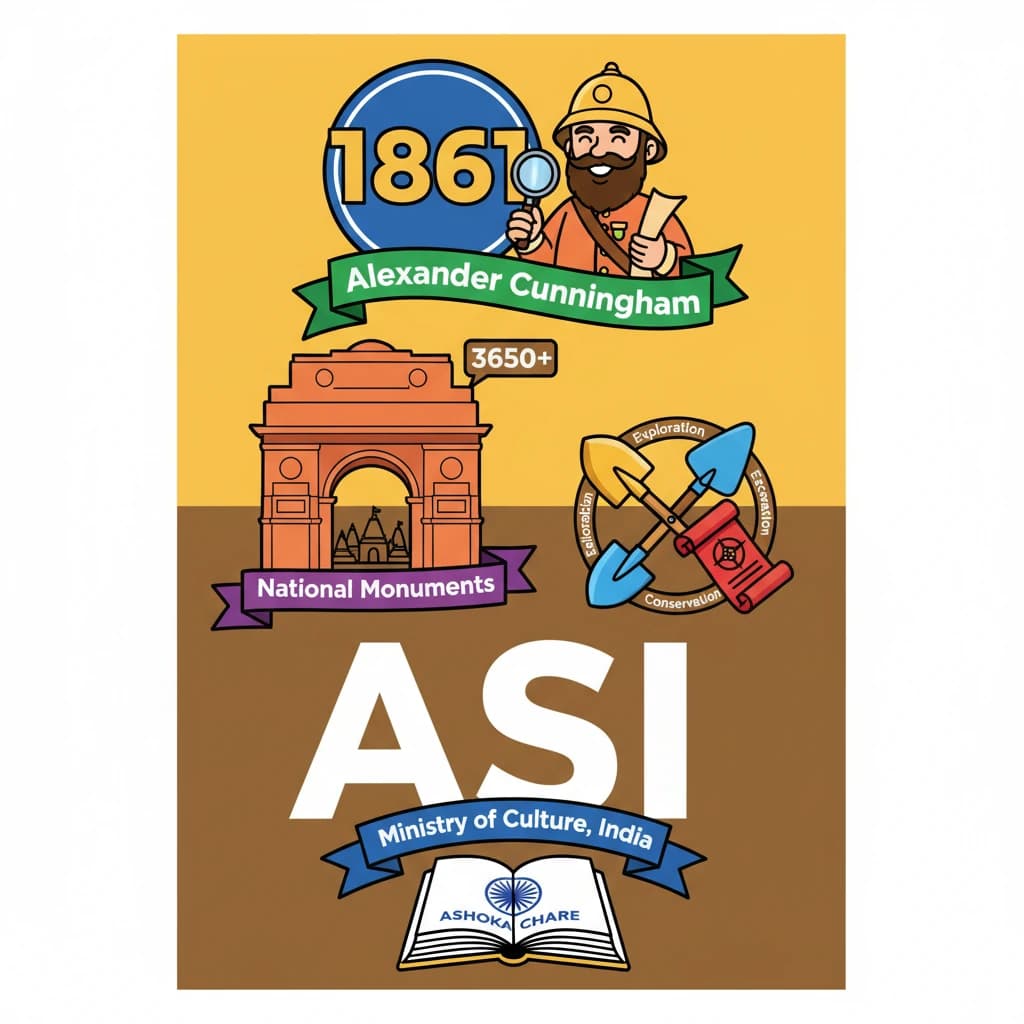
🧠 Memory Techniques
Memory Aid
98% Verified Content

📚 Reference Sources

•Official website of Archaeological Survey of India (ASI)
•Ministry of Culture, Government of India reports
•General knowledge on Indian History and Archaeology

Related Topics

Loading related topics...
Explore:Art And Culture Topics·All Subjects·Daily Current Affairs·Editorial Analysis·Previous Year Questions·UPSC GPT
Archaeological Survey of India (ASI) - UPSC Art And Culture