Loading page, please wait…
Heritage & Other Important Sites and Cultural Institutions - UPSC Art And Culture
What is Heritage & Other Important Sites and Cultural Institutions in UPSC Art And Culture?
Heritage & Other Important Sites and Cultural Institutions is a key topic under Art And Culture for UPSC Civil Services Examination. Key points include: Recent discoveries include a 4th-century CE Sanskrit inscription in Gilgit (POK) and a 10th-century CE Sanskrit/Sharada inscription near Peshawar.. The Gilgit inscription mentions 'Pushpasingha' installing a Mahaesvaralinga, indicating Shaivite presence.. The Peshawar inscription references Buddhist Dharani chants, including 'Om Mani Padme Hum'.. Understanding this topic is essential for both UPSC Prelims and Mains preparation.
Why is Heritage & Other Important Sites and Cultural Institutions important for UPSC exam?
Heritage & Other Important Sites and Cultural Institutions is a Medium-level topic in UPSC Art And Culture. It is tested in both Prelims (factual MCQs) and Mains (analytical answer writing). Previous year UPSC questions have frequently covered aspects of Heritage & Other Important Sites and Cultural Institutions, making it essential for comprehensive IAS preparation.
How to prepare Heritage & Other Important Sites and Cultural Institutions for UPSC?
To prepare Heritage & Other Important Sites and Cultural Institutions for UPSC: (1) Study the comprehensive notes covering all key concepts on Vaidra. (2) Practice previous year questions on this topic. (3) Connect it with current affairs using daily updates. (4) Revise using key takeaways and mind maps available for Art And Culture. (5) Write practice answers linking Heritage & Other Important Sites and Cultural Institutions to related GS Paper topics.
Key takeaways of Heritage & Other Important Sites and Cultural Institutions for UPSC
- Recent discoveries include a 4th-century CE Sanskrit inscription in Gilgit (POK) and a 10th-century CE Sanskrit/Sharada inscription near Peshawar.
- The Gilgit inscription mentions 'Pushpasingha' installing a Mahaesvaralinga, indicating Shaivite presence.
- The Peshawar inscription references Buddhist Dharani chants, including 'Om Mani Padme Hum'.
- Important ancient inscriptions include Junagarh (Rudradaman), Bhitari Pillar (Skandagupta), Paharpur (Buddha Gupta), and Mandasaur (Yashodharman).
- These inscriptions provide crucial details on political achievements, military victories (e.g., against Hunas), administrative reforms, and religious patronage.
- Inscriptions are primary sources for understanding ancient Indian history, scripts, languages, religions, and socio-political structures.
Heritage & Other Important Sites and Cultural Institutions
Medium⏱️ 8 min read
art and culture
📖 Introduction
Recent Discoveries of Sanskrit Inscriptions
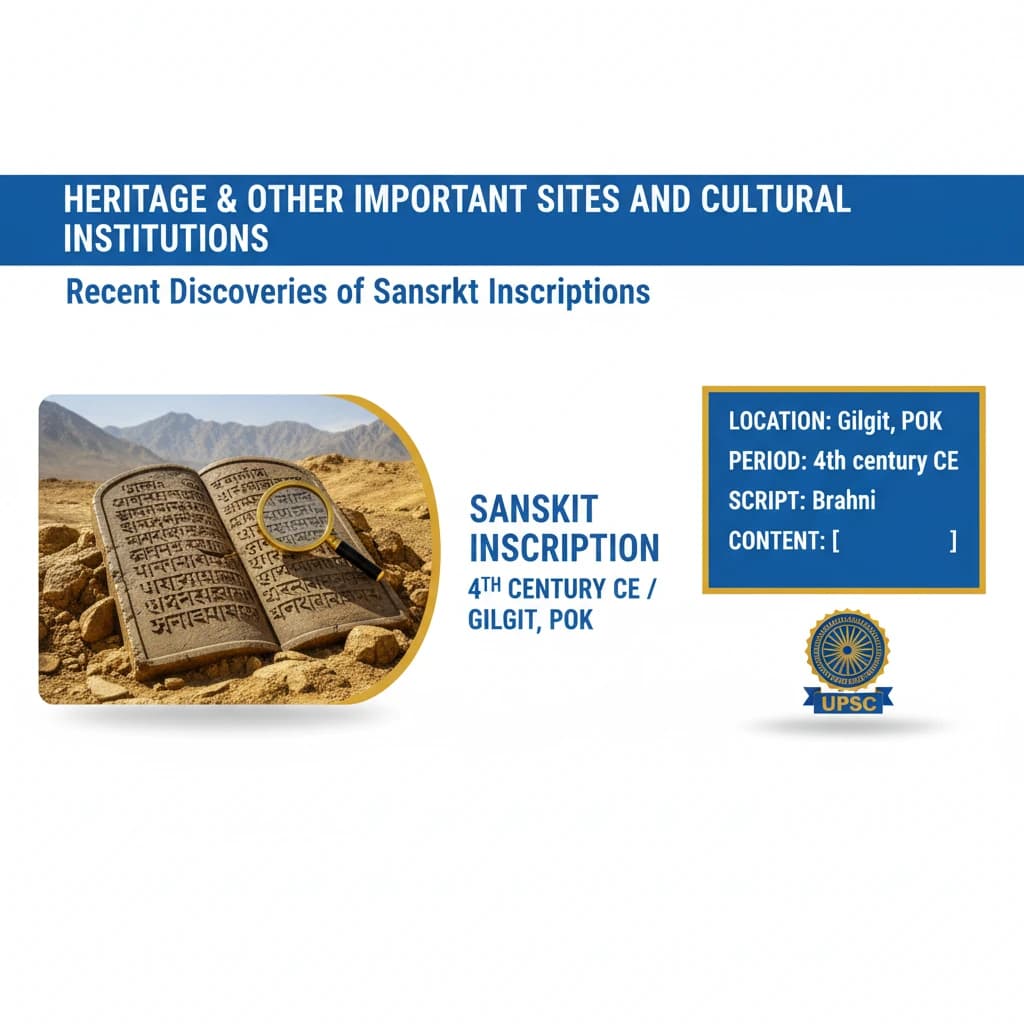
A significant Sanskrit inscription dating back to the 4th century CE was recently discovered near Gilgit in Pakistan-Occupied Kashmir (POK). This inscription is written in the ancient Brahmi script.
Location: Gilgit, POK
Period: 4th century CE
Script: Brahmi
Content: Mentions “Pushpasingha” installing a Mahaesvaralinga for the merit of his guru (name partially lost).
Period: 4th century CE
Script: Brahmi
Content: Mentions “Pushpasingha” installing a Mahaesvaralinga for the merit of his guru (name partially lost).
Earlier in 2024, another important discovery was made near Peshawar. This was a 10th-century CE Sanskrit and Sharada script inscription.
Location: Near Peshawar
Period: 10th century CE
Scripts: Sanskrit and Sharada
Content: References Buddhist Dharani chants, specifically mentioning “Om Mani Padme Hum” in its six lines.
Period: 10th century CE
Scripts: Sanskrit and Sharada
Content: References Buddhist Dharani chants, specifically mentioning “Om Mani Padme Hum” in its six lines.
Buddhist Dharani: These are sacred mantras or chants used in Buddhism. They are believed to possess spiritual power, offering protection, purification, and invoking blessings. Dharanis often contain sacred syllables or phrases recited in rituals for well-being.
Important Inscriptions of Ancient India
Ancient Indian inscriptions serve as invaluable primary sources for reconstructing history, culture, and societal structures. They are broadly categorized based on their content and purpose.
Political Inscriptions
- Junagarh (Girnar) Inscription (Rudradaman): This 2nd-century CE Sanskrit inscription provides detailed accounts of Rudradaman’s achievements. It notably mentions the construction of the Sudarshana lake, initiated by Chandragupta Maurya’s governor, Pushyagupta.
- Bhitari Pillar Inscription: This inscription is crucial for understanding the Gupta period. It chronicles Skandagupta’s military success, particularly his victories against the invading Hunas, and highlights his administrative reforms.
Administrative and Land Grant Inscriptions
- Paharpur Inscription (Buddha Gupta): Discovered in Bangladesh, this inscription from the Gupta period sheds light on land grants. It illustrates the prevalent practice of religious patronage during that era.
- Mandasaur Inscription: This inscription details the significant victory of Yashodharman over the Huns. It emphasizes his pivotal role in restoring stability and order in the region during a turbulent period.
💡 Key Takeaways
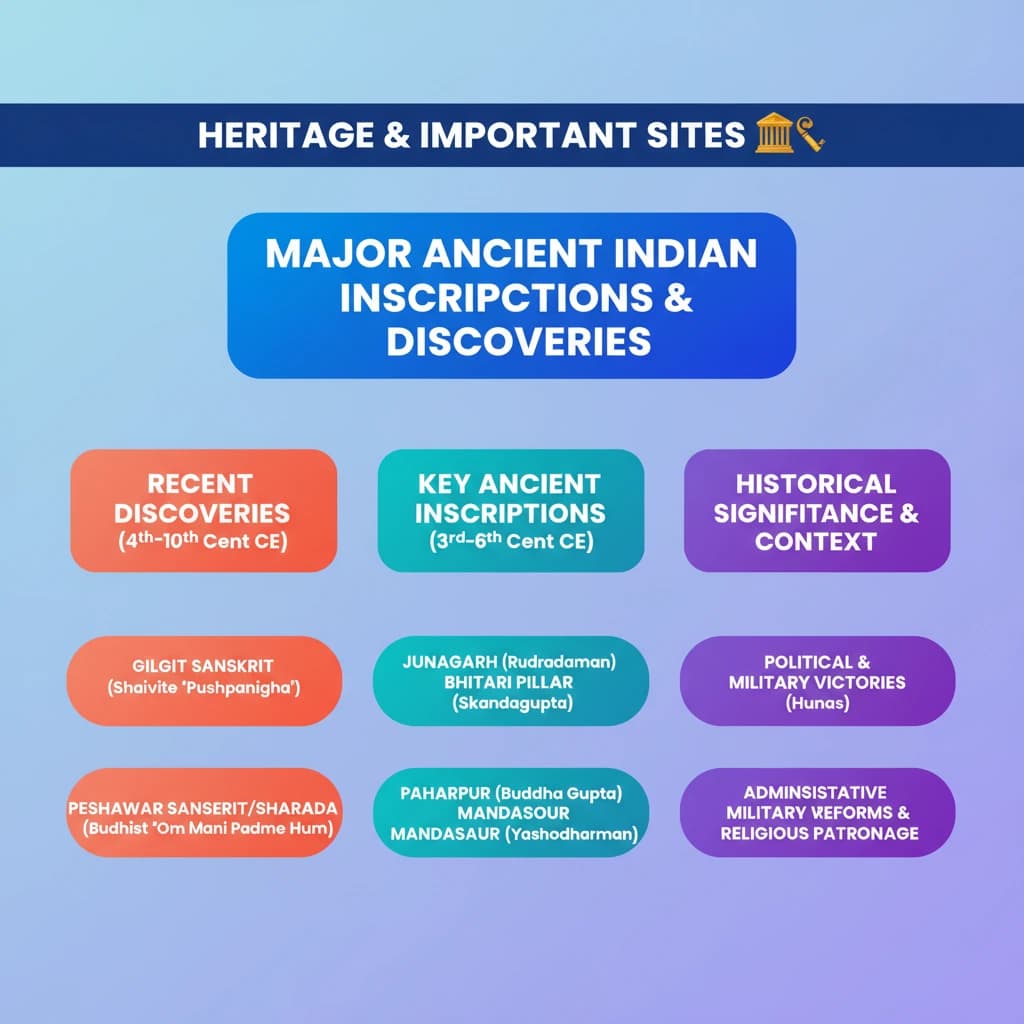
- •Recent discoveries include a 4th-century CE Sanskrit inscription in Gilgit (POK) and a 10th-century CE Sanskrit/Sharada inscription near Peshawar.
- •The Gilgit inscription mentions 'Pushpasingha' installing a Mahaesvaralinga, indicating Shaivite presence.
- •The Peshawar inscription references Buddhist Dharani chants, including 'Om Mani Padme Hum'.
- •Important ancient inscriptions include Junagarh (Rudradaman), Bhitari Pillar (Skandagupta), Paharpur (Buddha Gupta), and Mandasaur (Yashodharman).
- •These inscriptions provide crucial details on political achievements, military victories (e.g., against Hunas), administrative reforms, and religious patronage.
- •Inscriptions are primary sources for understanding ancient Indian history, scripts, languages, religions, and socio-political structures.
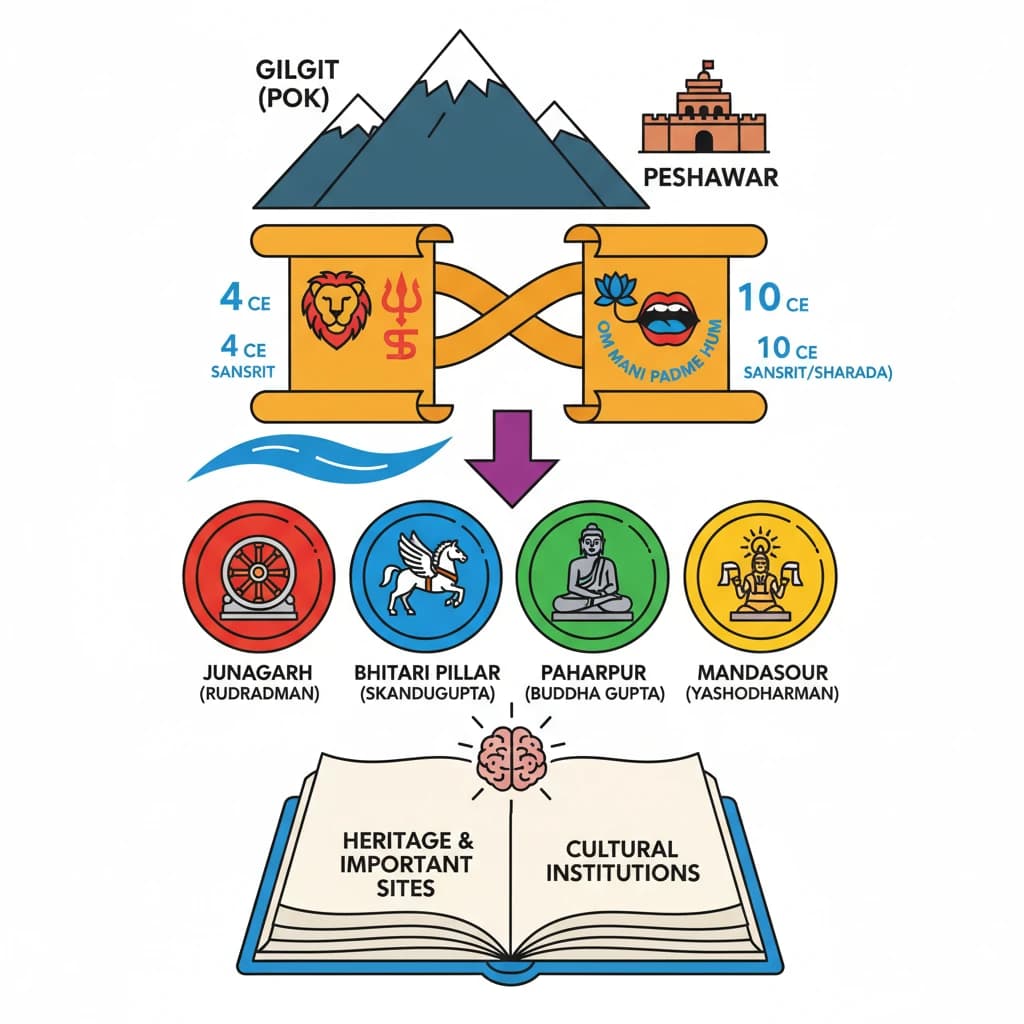
🧠 Memory Techniques
98% Verified Content
📚 Reference Sources
•General knowledge of ancient Indian epigraphy and history