Loading page, please wait…
Journey of East Gate of Sanchi Stupa to Europe - UPSC Art And Culture
What is Journey of East Gate of Sanchi Stupa to Europe in UPSC Art And Culture?
Journey of East Gate of Sanchi Stupa to Europe is a key topic under Art And Culture for UPSC Civil Services Examination. Key points include: The East Gate of Sanchi Stupa was first cast in plaster by Lt. Henry Hardy Cole in the late 1860s.. This original cast was intended for the Victoria and Albert Museum in London.. Multiple copies were made and displayed across various European museums.. Understanding this topic is essential for both UPSC Prelims and Mains preparation.
Why is Journey of East Gate of Sanchi Stupa to Europe important for UPSC exam?
Journey of East Gate of Sanchi Stupa to Europe is a Medium-level topic in UPSC Art And Culture. It is tested in both Prelims (factual MCQs) and Mains (analytical answer writing). Previous year UPSC questions have frequently covered aspects of Journey of East Gate of Sanchi Stupa to Europe, making it essential for comprehensive IAS preparation.
How to prepare Journey of East Gate of Sanchi Stupa to Europe for UPSC?
To prepare Journey of East Gate of Sanchi Stupa to Europe for UPSC: (1) Study the comprehensive notes covering all key concepts on Vaidra. (2) Practice previous year questions on this topic. (3) Connect it with current affairs using daily updates. (4) Revise using key takeaways and mind maps available for Art And Culture. (5) Write practice answers linking Journey of East Gate of Sanchi Stupa to Europe to related GS Paper topics.
Key takeaways of Journey of East Gate of Sanchi Stupa to Europe for UPSC
- The East Gate of Sanchi Stupa was first cast in plaster by Lt. Henry Hardy Cole in the late 1860s.
- This original cast was intended for the Victoria and Albert Museum in London.
- Multiple copies were made and displayed across various European museums.
- A significant plaster cast was exhibited in the Königliches Museum für Völkerkunde Berlin from 1886.
- Later replicas in Berlin included an artificial stone cast in 1970.
- The latest Berlin replica utilized 3D scanning, robots, and skilled sculptors.
- This journey highlights colonial-era documentation and modern preservation techniques.
Journey of East Gate of Sanchi Stupa to Europe
Medium⏱️ 7 min read
art and culture
📖 Introduction
Journey of Sanchi Stupa's East Gate to Europe
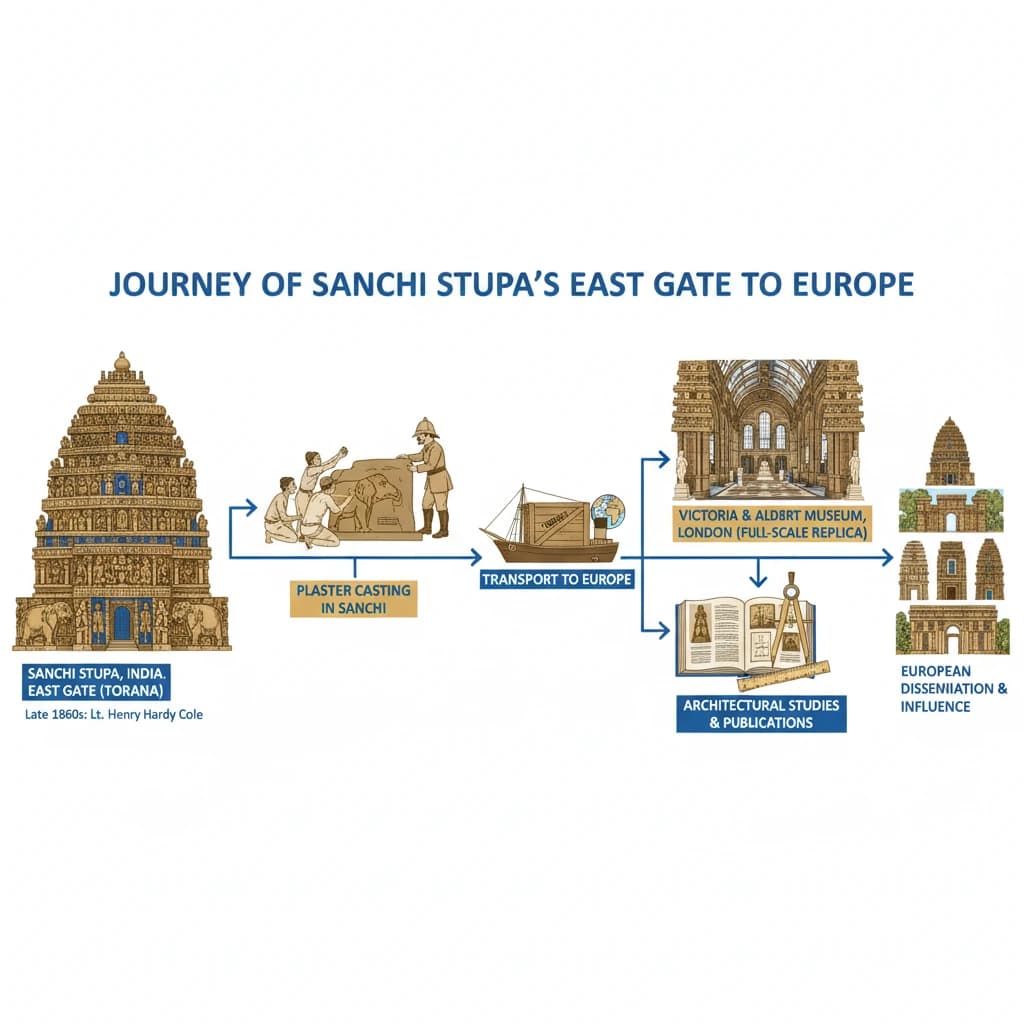
The East Gate, or Torana, of the renowned Sanchi Stupa holds significant artistic and historical value. Its journey to Europe, primarily through replicas, showcases a fascinating aspect of cultural exchange and colonial-era documentation.
Initial Casting and European Dissemination
In the late 1860s, Lieutenant Henry Hardy Cole undertook the task of casting the East Gate of Sanchi Stupa. This initial plaster cast was specifically created for the Victoria and Albert Museum in London.
Key Figure: Lieutenant Henry Hardy Cole
Year: Late 1860s
Recipient Museum: Victoria and Albert Museum, London
Material: Plaster cast
Year: Late 1860s
Recipient Museum: Victoria and Albert Museum, London
Material: Plaster cast
Following this initial effort, numerous copies of this plaster cast were produced. These replicas were subsequently displayed across various museums and institutions throughout Europe, making the intricate carvings of Sanchi accessible to a wider audience.
The Berlin Connection: A Prominent Display
One notable display of these copies was at the Königliches Museum für Völkerkunde Berlin. A plaster cast of the original gate was prominently exhibited in its entrance hall starting from 1886.
This display in Berlin highlights the widespread European interest in Indian art and architecture during the late 19th century, often facilitated through colonial expeditions and documentation.
Evolution of Replicas: From Plaster to 3D Scanning
The Berlin collection saw further evolution. In 1970, a cast was made from this preserved plaster copy, using artificial stone. This demonstrates the ongoing efforts to preserve and replicate significant cultural artifacts.
The latest replica in Berlin is a testament to modern technological advancements. It directly traces its origin back to the original cast and was created using cutting-edge methods.
- Technology Used: 3D scanning, modern robots
- Human Expertise: Skilled German and Indian sculptors
- Reference Material: Enlarged photos of the original torana
UPSC often asks about the intersection of technology and heritage preservation. This example of 3D scanning and robotics for replicas is highly relevant for GS Paper I (Art & Culture) and GS Paper III (Science & Technology).
💡 Key Takeaways
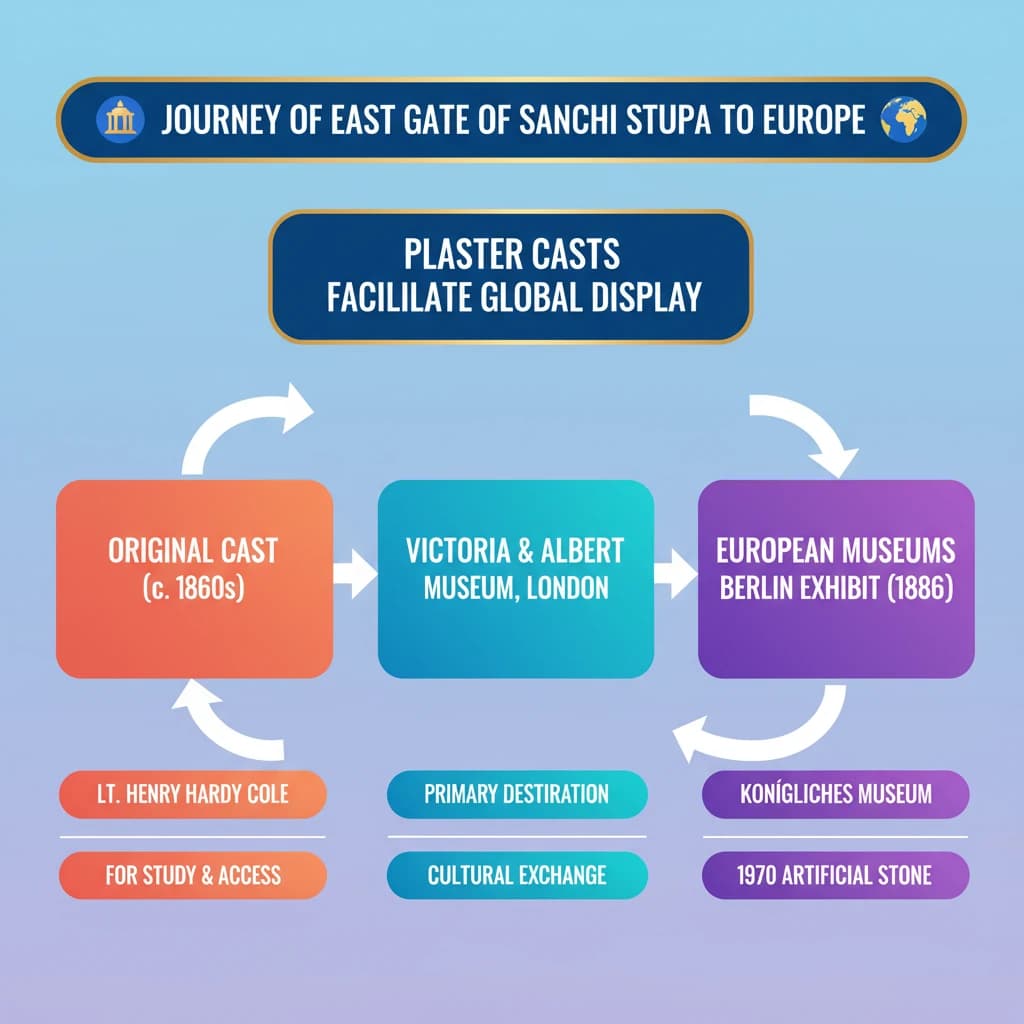
- •The East Gate of Sanchi Stupa was first cast in plaster by Lt. Henry Hardy Cole in the late 1860s.
- •This original cast was intended for the Victoria and Albert Museum in London.
- •Multiple copies were made and displayed across various European museums.
- •A significant plaster cast was exhibited in the Königliches Museum für Völkerkunde Berlin from 1886.
- •Later replicas in Berlin included an artificial stone cast in 1970.
- •The latest Berlin replica utilized 3D scanning, robots, and skilled sculptors.
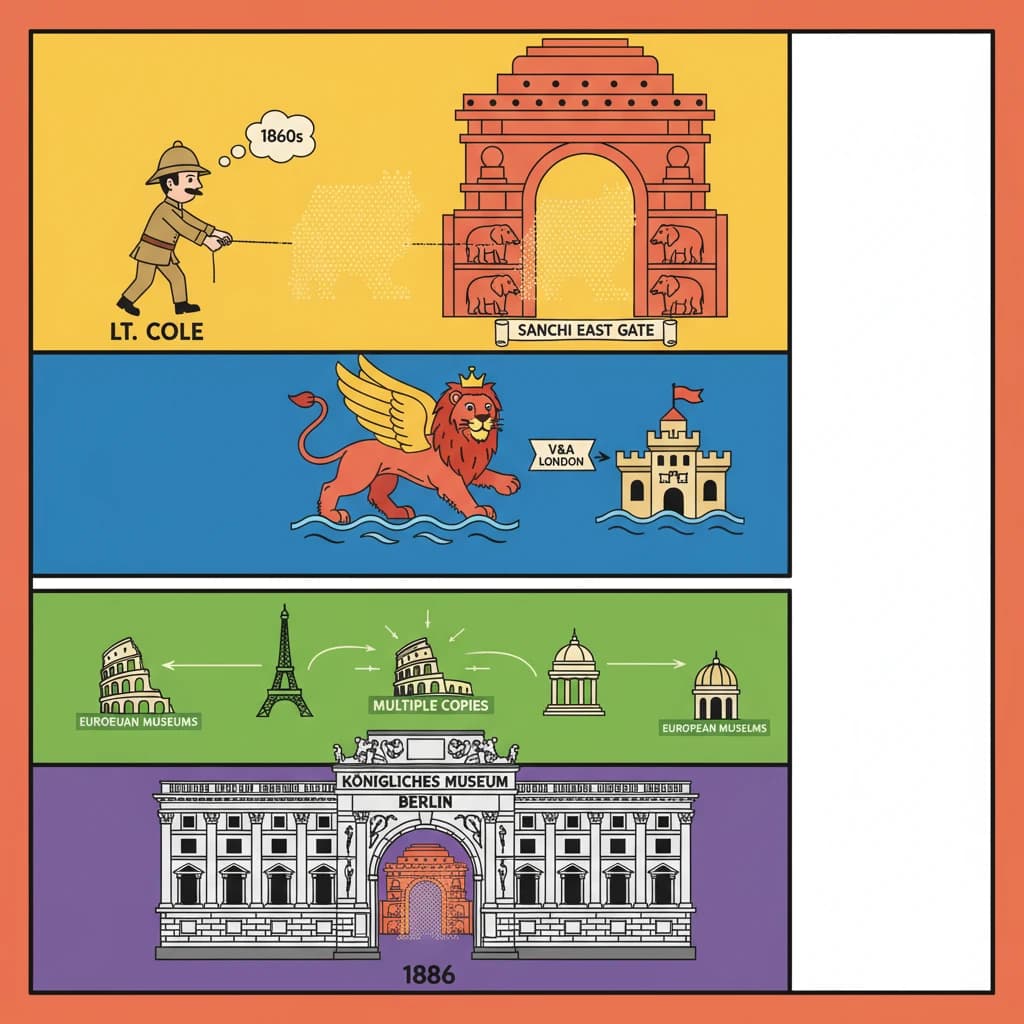
- •This journey highlights colonial-era documentation and modern preservation techniques.
🧠 Memory Techniques
95% Verified Content
📚 Reference Sources
•General knowledge on Sanchi Stupa and colonial archaeology