Loading page, please wait…
Konark Wheels at Rashtrapati Bhavan - UPSC Art And Culture
What is Konark Wheels at Rashtrapati Bhavan in UPSC Art And Culture?
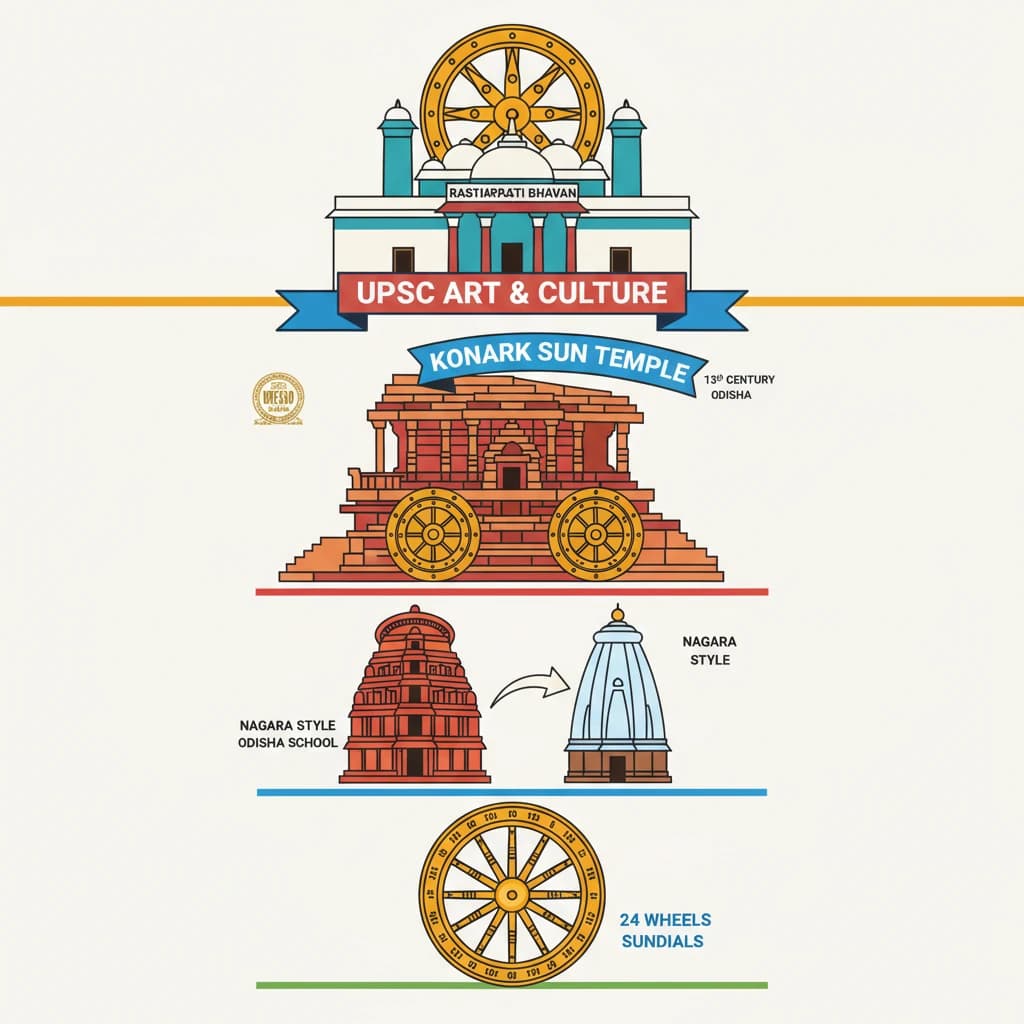
Konark Wheels at Rashtrapati Bhavan is a key topic under Art And Culture for UPSC Civil Services Examination. Key points include: Konark Wheel replicas are installed at Rashtrapati Bhavan to integrate cultural elements.. The Konark Sun Temple is a 13th-century UNESCO World Heritage Site in Odisha.. It exemplifies the Odisha School of Temple Architecture, a sub-school of the Nagara style.. Understanding this topic is essential for both UPSC Prelims and Mains preparation.
Why is Konark Wheels at Rashtrapati Bhavan important for UPSC exam?
Konark Wheels at Rashtrapati Bhavan is a Medium-level topic in UPSC Art And Culture. It is tested in both Prelims (factual MCQs) and Mains (analytical answer writing). Previous year UPSC questions have frequently covered aspects of Konark Wheels at Rashtrapati Bhavan, making it essential for comprehensive IAS preparation.
How to prepare Konark Wheels at Rashtrapati Bhavan for UPSC?
To prepare Konark Wheels at Rashtrapati Bhavan for UPSC: (1) Study the comprehensive notes covering all key concepts on Vaidra. (2) Practice previous year questions on this topic. (3) Connect it with current affairs using daily updates. (4) Revise using key takeaways and mind maps available for Art And Culture. (5) Write practice answers linking Konark Wheels at Rashtrapati Bhavan to related GS Paper topics.
Key takeaways of Konark Wheels at Rashtrapati Bhavan for UPSC
- Konark Wheel replicas are installed at Rashtrapati Bhavan to integrate cultural elements.
- The Konark Sun Temple is a 13th-century UNESCO World Heritage Site in Odisha.
- It exemplifies the Odisha School of Temple Architecture, a sub-school of the Nagara style.
- The temple is designed as a colossal chariot with 24 wheels, which function as sundials.
- King Narasimhadeva I of the Eastern Ganga dynasty built the Konark Sun Temple.
- Odisha temples feature distinct 'deul' (shikhara) and 'jagamohana' (mandapa) with lavish exteriors.
- The wheels symbolize months, hours, the 'Wheel of Life', and connect to the Buddhist Dharmachakra.
Konark Wheels at Rashtrapati Bhavan
Medium⏱️ 7 min read
art and culture
📖 Introduction
Konark Wheels at Rashtrapati Bhavan: A Cultural Integration
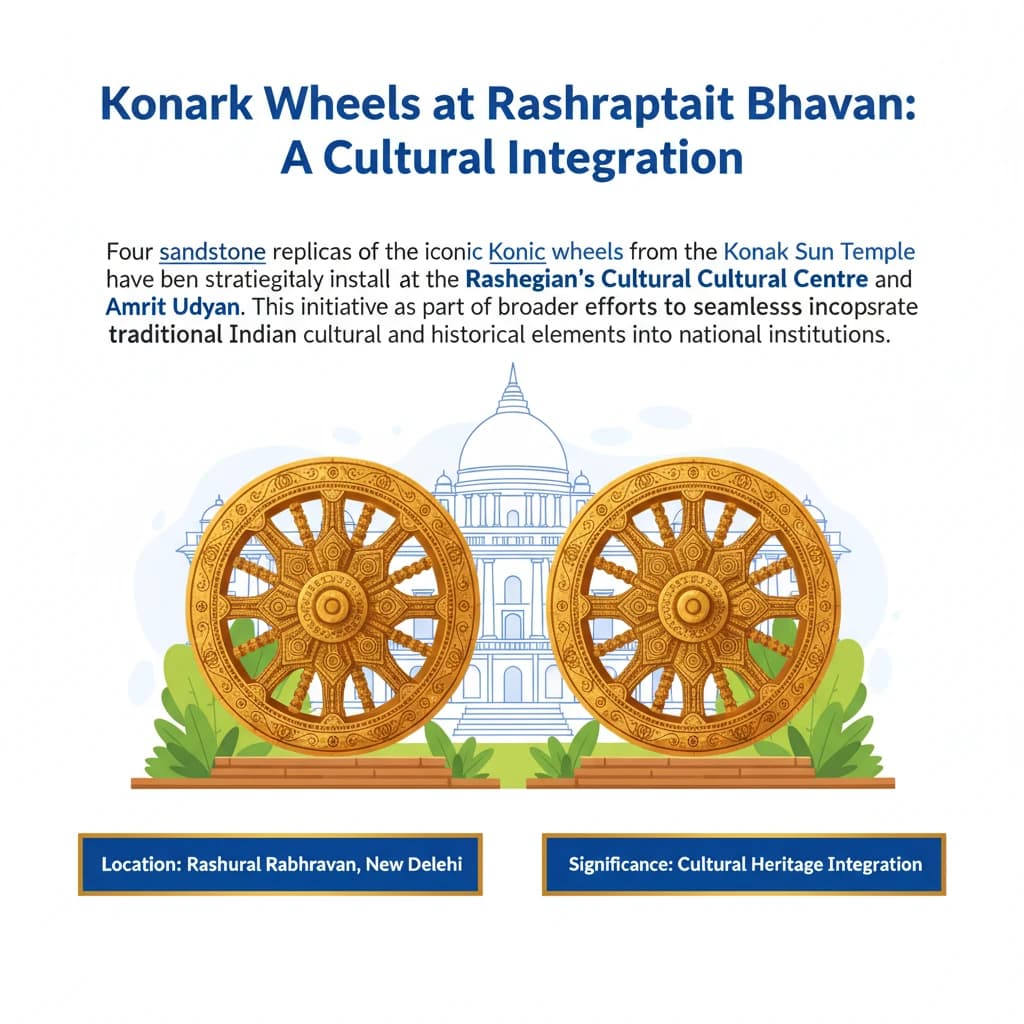
Four sandstone replicas of the iconic Konark wheels from the Konark Sun Temple have been strategically installed at the Rashtrapati Bhavan's Cultural Centre and Amrit Udyan. This initiative is part of broader efforts to seamlessly incorporate traditional Indian cultural and historical elements into national institutions.
Location of Replicas: Rashtrapati Bhavan's Cultural Centre and Amrit Udyan
Origin: Konark Sun Temple, Odisha
Purpose: Integration of traditional cultural and historical elements
Origin: Konark Sun Temple, Odisha
Purpose: Integration of traditional cultural and historical elements
The Konark Sun Temple: An Overview
The Konark Sun Temple, a magnificent 13th-century edifice near Puri in Odisha, was constructed by King Narasimhadeva I (1238–1264 AD). Its grand scale and intricate design stand as a powerful symbol of the architectural prowess and cultural values of the Eastern Ganga dynasty.
The Konark Temple was declared a UNESCO World Heritage Site in 1984, recognizing its outstanding universal value.
Odisha School of Temple Architecture
The Konark Temple is a prime example of the Odisha School of Temple Architecture, which is a sub-school of the broader Nagara School of Architecture. This style is predominantly found in East Indian Temples, particularly in the ancient Kalinga region (modern Puri District, including Bhubaneswar, Puri, and Konark).
The main architectural features of Odisha temples are categorized into three distinct orders:
- Rekhapida: Refers to the curvilinear tower over the sanctum.
- Pidhadeul: Denotes the pyramidal roof over the assembly hall.
- Khakhra: A distinct type of roof structure, often seen in subsidiary shrines.
Key Architectural Characteristics of Odisha Temples
In Odisha temple architecture, the shikhara, which is the tower over the sanctum, is locally known as deul. It typically rises almost vertically before curving sharply inwards near the top.
Preceding the deul, there is usually a mandapa (assembly hall) known as the jagamohana. Most Odisha temples are enclosed by prominent boundary walls.
Deul: The shikhara (main tower) of an Odisha temple.
Jagamohana: The mandapa (audience hall) preceding the deul.
Jagamohana: The mandapa (audience hall) preceding the deul.
The ground plan of the main temple is almost always square. However, in the upper reaches of its superstructure, it transitions to a circular form at the crowning element, known as the mastaka.
While the exteriors of these temples are lavishly carved with intricate details, their interiors are generally quite bare, creating a stark contrast.
Konark Sun Temple: Key Features and Significance
The Konark Sun Temple, built by King Narasimhadeva I, is renowned for its unique design as a colossal chariot. The vimana (principal sanctuary) was originally surmounted by a high tower, a shikhara (also known as Rekha deul), which collapsed and was largely restored in the 19th century.
To the east, the jagamohana (audience hall) dominates the ruins with its impressive pyramidal mass. Further east, the natmandir (dance hall), now unroofed, stands on a high platform, indicating its original grandeur.
Architectural Significance: The Chariot Design and Wheels
The temple is conceived as a colossal chariot for the Sun God, pulled by seven horses (though only one remains intact). It features 12 pairs of intricately carved wheels, making a total of 24 wheels, each approximately 9 feet 9 inches in diameter.
Wheel Dimensions: 9 feet 9 inches in diameter
Spokes: Each wheel has 8 thick and 8 thin spokes
Function: Serve as precise ancient sundials
Spokes: Each wheel has 8 thick and 8 thin spokes
Function: Serve as precise ancient sundials
The intricate carvings on the wheels include circular medallions, animals, and foliage on the rims. The medallions themselves depict various luxury scenes, adding to the temple's artistic richness.
Symbolic Interpretations of the Konark Wheels
The 12 pairs of wheels are widely interpreted to signify the 12 months of the year. The 24 wheels collectively represent the 24 hours in a day, highlighting the temple's connection to time and celestial movements.
Another significant interpretation links the wheel to the “Wheel of Life” – symbolizing the continuous cycle of creation, preservation, and realization in cosmic existence.
Cultural and Religious Heritage
The Konark Wheel bears a strong resemblance to the Buddhist Dharmachakra, symbolizing the cosmic cycle of Dharma (righteousness) and Karma (action). This connection underscores the broader philosophical themes prevalent in ancient Indian thought.
Furthermore, some interpretations suggest that the 12 wheels represent the zodiac signs, linking the temple's design to astrological and cosmic principles, reflecting a holistic worldview.
💡 Key Takeaways
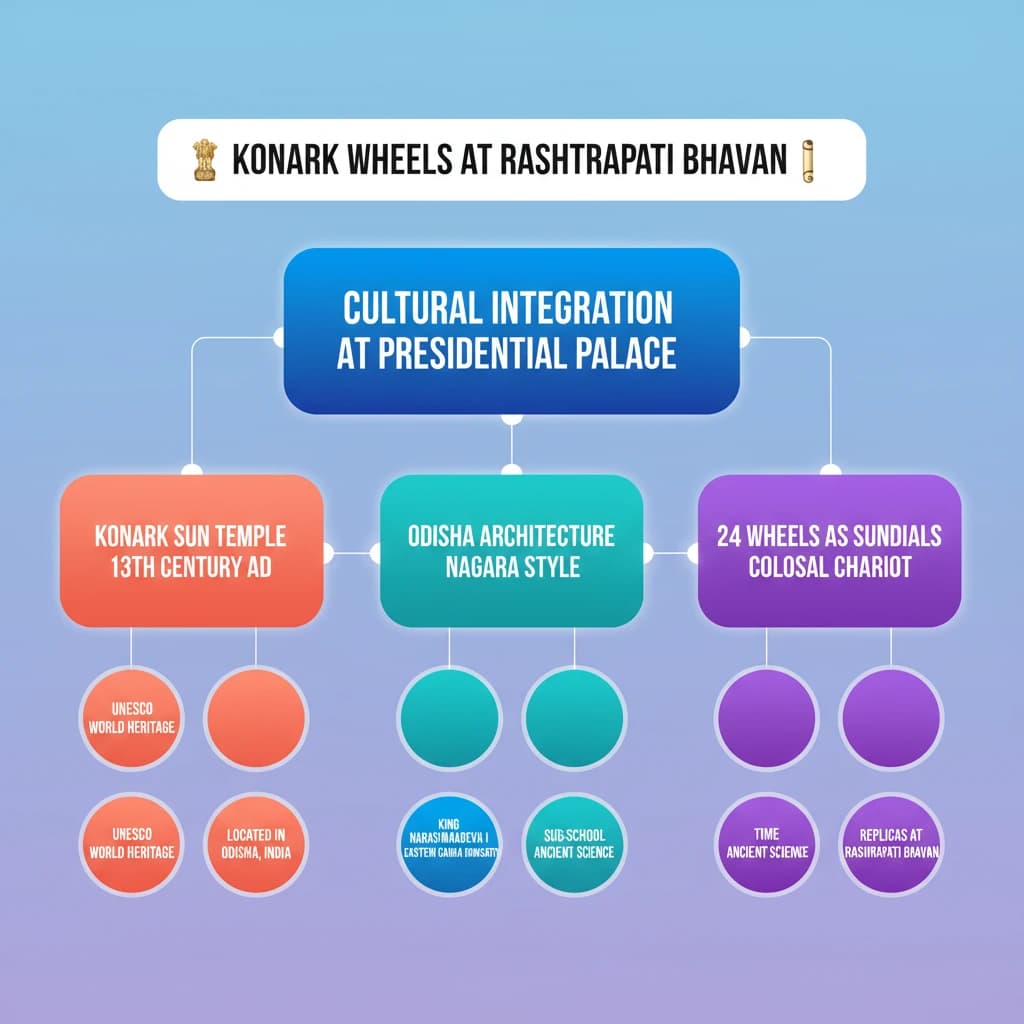
- •Konark Wheel replicas are installed at Rashtrapati Bhavan to integrate cultural elements.
- •The Konark Sun Temple is a 13th-century UNESCO World Heritage Site in Odisha.
- •It exemplifies the Odisha School of Temple Architecture, a sub-school of the Nagara style.
- •The temple is designed as a colossal chariot with 24 wheels, which function as sundials.
- •King Narasimhadeva I of the Eastern Ganga dynasty built the Konark Sun Temple.
- •Odisha temples feature distinct 'deul' (shikhara) and 'jagamohana' (mandapa) with lavish exteriors.
- •The wheels symbolize months, hours, the 'Wheel of Life', and connect to the Buddhist Dharmachakra.
🧠 Memory Techniques
98% Verified Content
📚 Reference Sources
•UNESCO World Heritage Centre - Konark Sun Temple
•NCERT Fine Arts Class 11 - An Introduction to Indian Art
•Indian Culture Portal (Ministry of Culture, Government of India)