Loading page, please wait…
Loss of Legal Protection - UPSC Art And Culture
What is Loss of Legal Protection in UPSC Art And Culture?
Loss of Legal Protection is a key topic under Art And Culture for UPSC Civil Services Examination. Key points include: The AMASR Act, 1958, provides legal protection to monuments of national importance.. Delisting removes this legal protection, making monuments vulnerable to damage and neglect.. Section 35 of the AMASR Act empowers the Central Government to delist monuments.. Understanding this topic is essential for both UPSC Prelims and Mains preparation.
Why is Loss of Legal Protection important for UPSC exam?
Loss of Legal Protection is a Medium-level topic in UPSC Art And Culture. It is tested in both Prelims (factual MCQs) and Mains (analytical answer writing). Previous year UPSC questions have frequently covered aspects of Loss of Legal Protection, making it essential for comprehensive IAS preparation.
How to prepare Loss of Legal Protection for UPSC?
To prepare Loss of Legal Protection for UPSC: (1) Study the comprehensive notes covering all key concepts on Vaidra. (2) Practice previous year questions on this topic. (3) Connect it with current affairs using daily updates. (4) Revise using key takeaways and mind maps available for Art And Culture. (5) Write practice answers linking Loss of Legal Protection to related GS Paper topics.
Key takeaways of Loss of Legal Protection for UPSC
- The AMASR Act, 1958, provides legal protection to monuments of national importance.
- Delisting removes this legal protection, making monuments vulnerable to damage and neglect.
- Section 35 of the AMASR Act empowers the Central Government to delist monuments.
- Delisting is formalized through a notification in the Official Gazette.
- In March 2024, 18 monuments were delisted, followed by a public objection window.
- Delisting facilitates construction and urbanization in the monument's vicinity.
- This issue highlights the ongoing challenge of balancing development with heritage preservation.
Loss of Legal Protection
Medium⏱️ 6 min read
art and culture
📖 Introduction
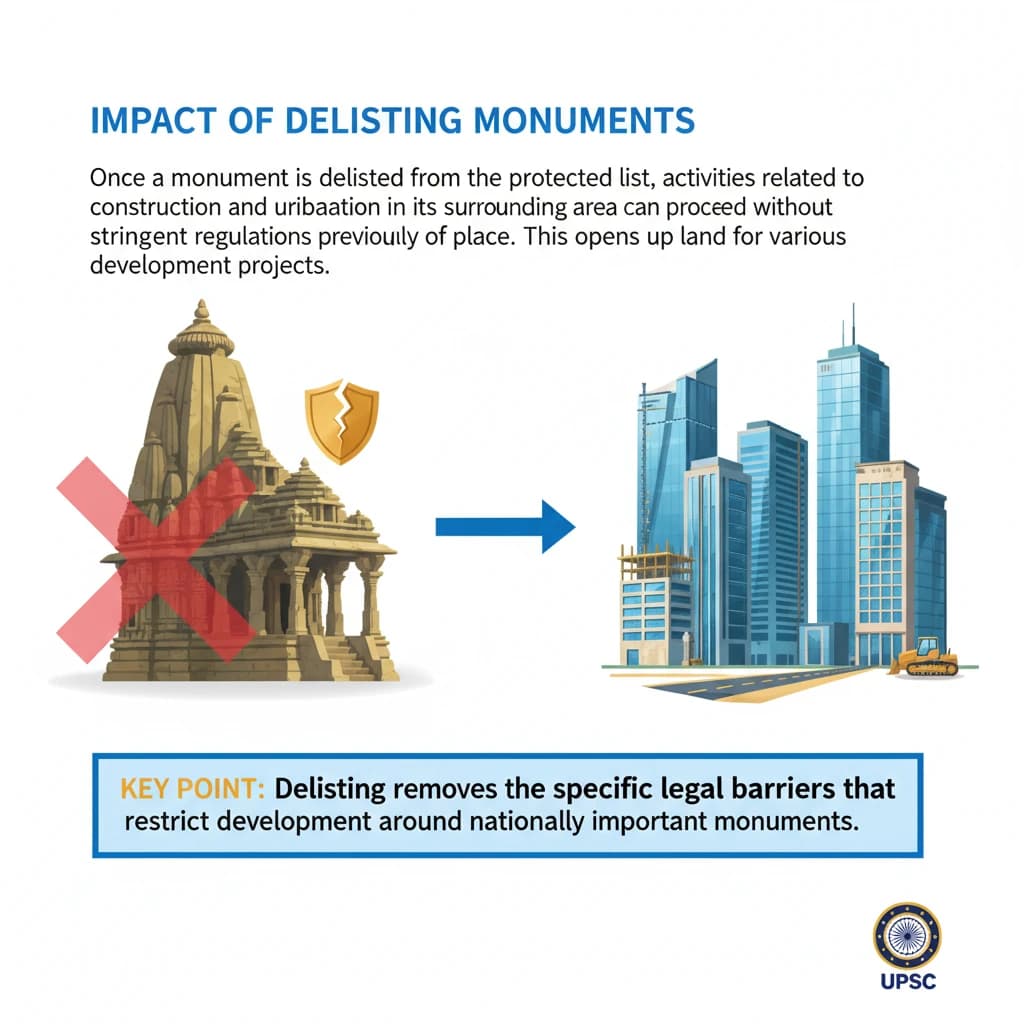
Impact of Delisting Monuments
Once a monument is delisted from the protected list, activities related to construction and urbanisation in its surrounding area can proceed without the stringent regulations previously in place. This opens up land for various developmental projects.
Key Point: Delisting removes the specific legal barriers that restrict development around nationally important heritage sites, potentially altering their environment.
Loss of Legal Protection
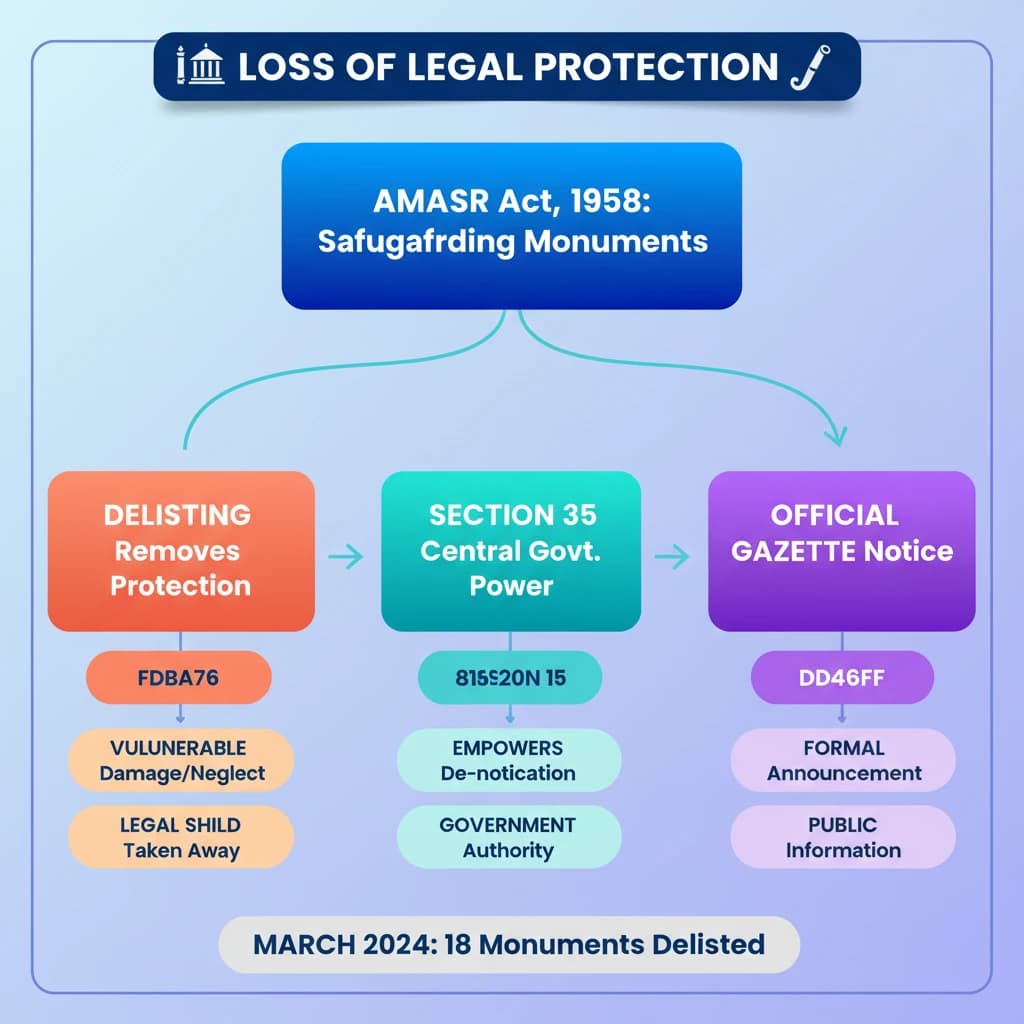
The Ancient Monuments and Archaeological Sites and Remains Act (AMASR Act), 1958, is the primary legislation that provides legal protection to monuments declared to be of national importance. This Act safeguards these sites from encroachment, damage, and unregulated construction.
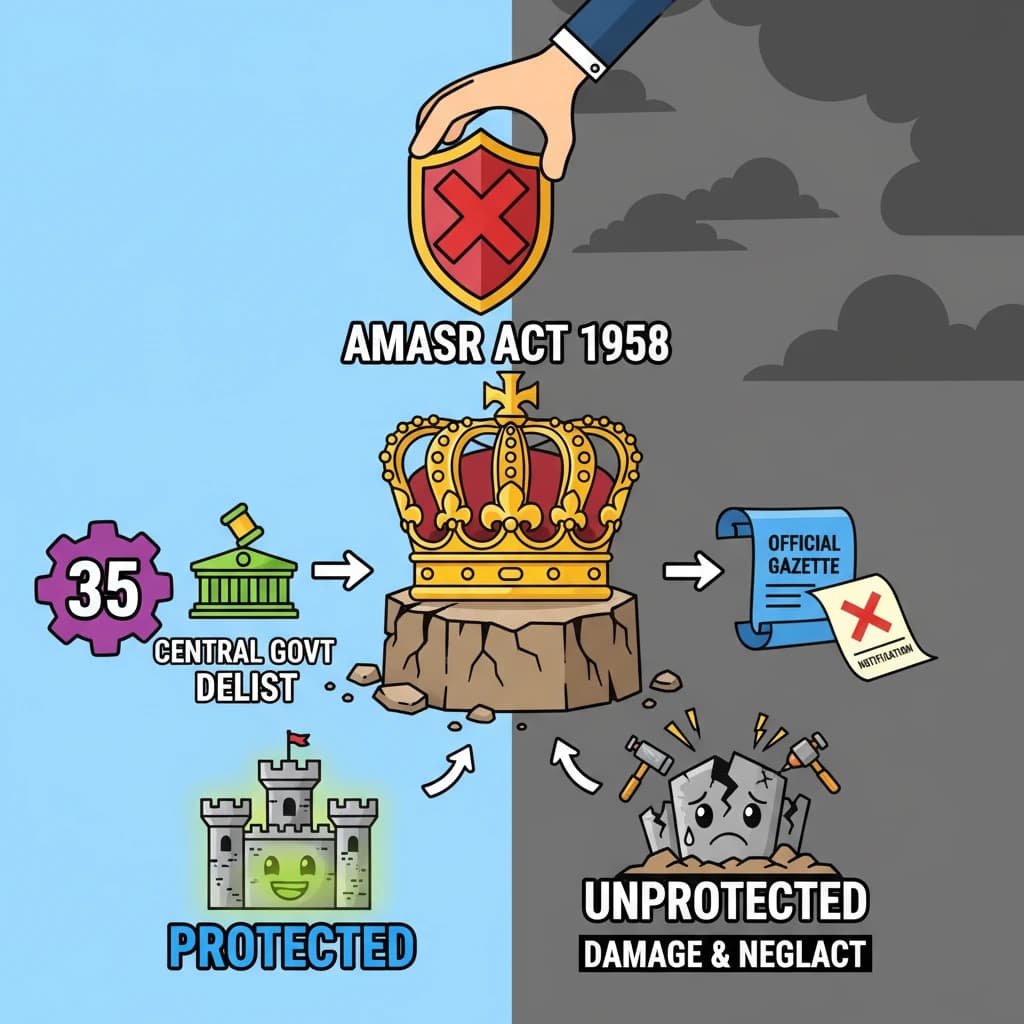
Delisting a monument signifies that it will no longer fall under the purview of the AMASR Act, 1958. Consequently, it loses this crucial legal protection, making it vulnerable to neglect, damage, or even demolition in the long term.
UPSC Insight: Understanding the AMASR Act is crucial for questions on heritage protection (GS-I Art & Culture, GS-II Governance). The concept of 'delisting' highlights the dynamic nature of such protections.
Procedure for Delisting
The AMASR Act, 1958, itself outlines the procedure for delisting monuments. Section 35 of the Act empowers the Central Government to declare that any ancient monument or archaeological site previously deemed of national importance has ceased to be so.
This declaration is made through a formal notification published in the Official Gazette. The gazette notification serves as the official legal instrument for removing a monument from the protected list.
Recent Example of Delisting
A significant instance of delisting occurred recently. A gazette notification was issued on March 8, 2024, announcing the delisting of 18 monuments from national importance. This action sparked considerable discussion regarding heritage preservation.
Date of Notification: March 8, 2024
Number of Monuments Delisted: 18
Public Feedback Window: Two months for objections or suggestions
Number of Monuments Delisted: 18
Public Feedback Window: Two months for objections or suggestions
Following the notification, a two-month window was provided for the public to submit any objections or suggestions regarding the proposed delisting. This period allows for public discourse and potential reconsideration.
💡 Key Takeaways
- •The AMASR Act, 1958, provides legal protection to monuments of national importance.
- •Delisting removes this legal protection, making monuments vulnerable to damage and neglect.
- •Section 35 of the AMASR Act empowers the Central Government to delist monuments.
- •Delisting is formalized through a notification in the Official Gazette.
- •In March 2024, 18 monuments were delisted, followed by a public objection window.
- •Delisting facilitates construction and urbanization in the monument's vicinity.
- •This issue highlights the ongoing challenge of balancing development with heritage preservation.
🧠 Memory Techniques
98% Verified Content
📚 Reference Sources
•The Ancient Monuments and Archaeological Sites and Remains Act, 1958 (AMASR Act)
•Official Gazette notifications of the Ministry of Culture, Government of India