Loading page, please wait…
Manuscripts: Definition, Characteristics, and Significance for UPSC - UPSC Art And Culture
What is Manuscripts: Definition, Characteristics, and Significance for UPSC in UPSC Art And Culture?
Manuscripts: Definition, Characteristics, and Significance for UPSC is a key topic under Art And Culture for UPSC Civil Services Examination. Key points include: Manuscripts are handwritten compositions on various materials, at least 75 years old.. They are distinct from lithographs and printed volumes, primarily containing knowledge content.. One language can be represented in multiple scripts in Indian manuscripts.. Understanding this topic is essential for both UPSC Prelims and Mains preparation.
Why is Manuscripts: Definition, Characteristics, and Significance for UPSC important for UPSC exam?
Manuscripts: Definition, Characteristics, and Significance for UPSC is a Easy-level topic in UPSC Art And Culture. It is tested in both Prelims (factual MCQs) and Mains (analytical answer writing). Previous year UPSC questions have frequently covered aspects of Manuscripts: Definition, Characteristics, and Significance for UPSC, making it essential for comprehensive IAS preparation.
How to prepare Manuscripts: Definition, Characteristics, and Significance for UPSC for UPSC?
To prepare Manuscripts: Definition, Characteristics, and Significance for UPSC for UPSC: (1) Study the comprehensive notes covering all key concepts on Vaidra. (2) Practice previous year questions on this topic. (3) Connect it with current affairs using daily updates. (4) Revise using key takeaways and mind maps available for Art And Culture. (5) Write practice answers linking Manuscripts: Definition, Characteristics, and Significance for UPSC to related GS Paper topics.
Key takeaways of Manuscripts: Definition, Characteristics, and Significance for UPSC for UPSC
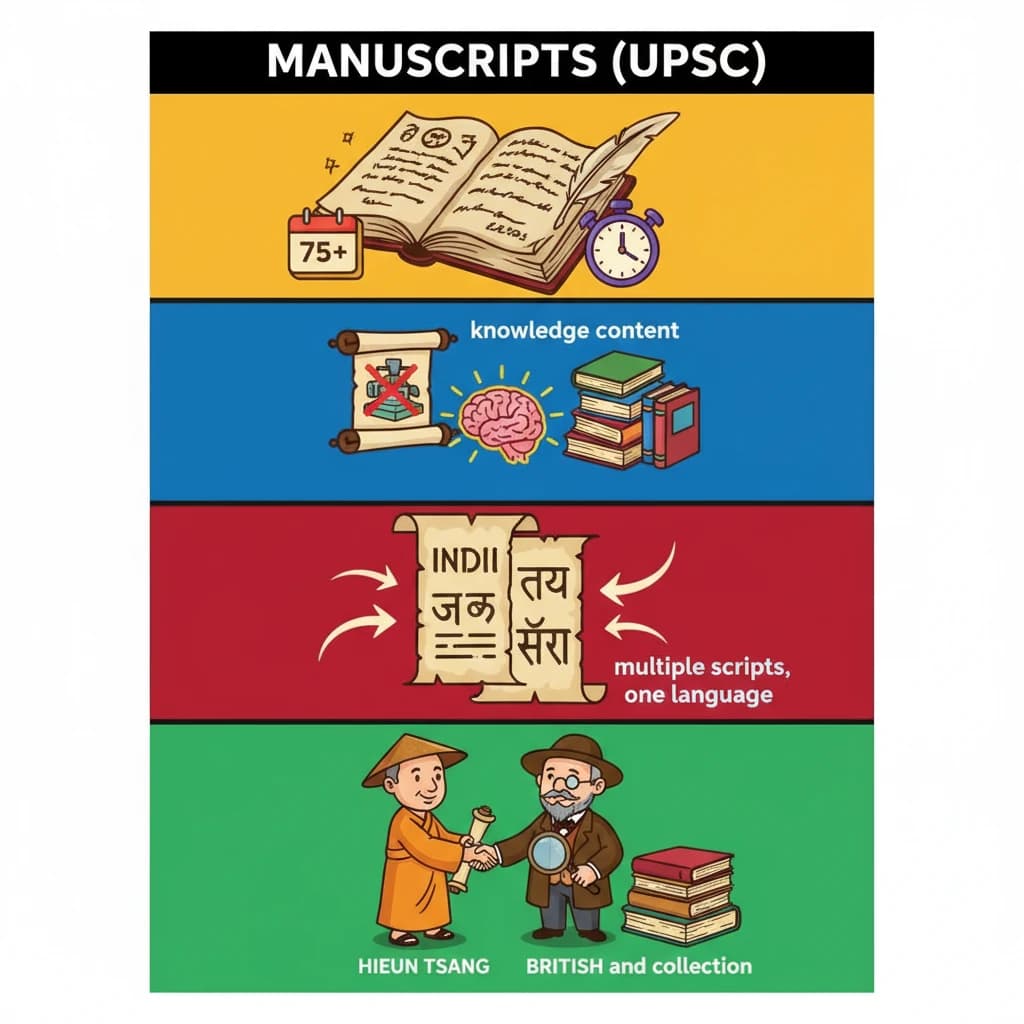
- Manuscripts are handwritten compositions on various materials, at least 75 years old.
- They are distinct from lithographs and printed volumes, primarily containing knowledge content.
- One language can be represented in multiple scripts in Indian manuscripts.
- Historical figures like Hieun Tsang and British scholars played roles in studying and collecting manuscripts.
- The National Mission for Manuscripts (NMM) was launched in 2003 by the Ministry of Culture.
- NMM's objectives include uncovering, documenting, conserving, and making manuscripts accessible.
- IGNCA serves as the nodal agency for the National Mission for Manuscripts.
Manuscripts: Definition, Characteristics, and Significance for UPSC
Easy⏱️ 8 min read
art and culture
📖 Introduction
What is a Manuscript?
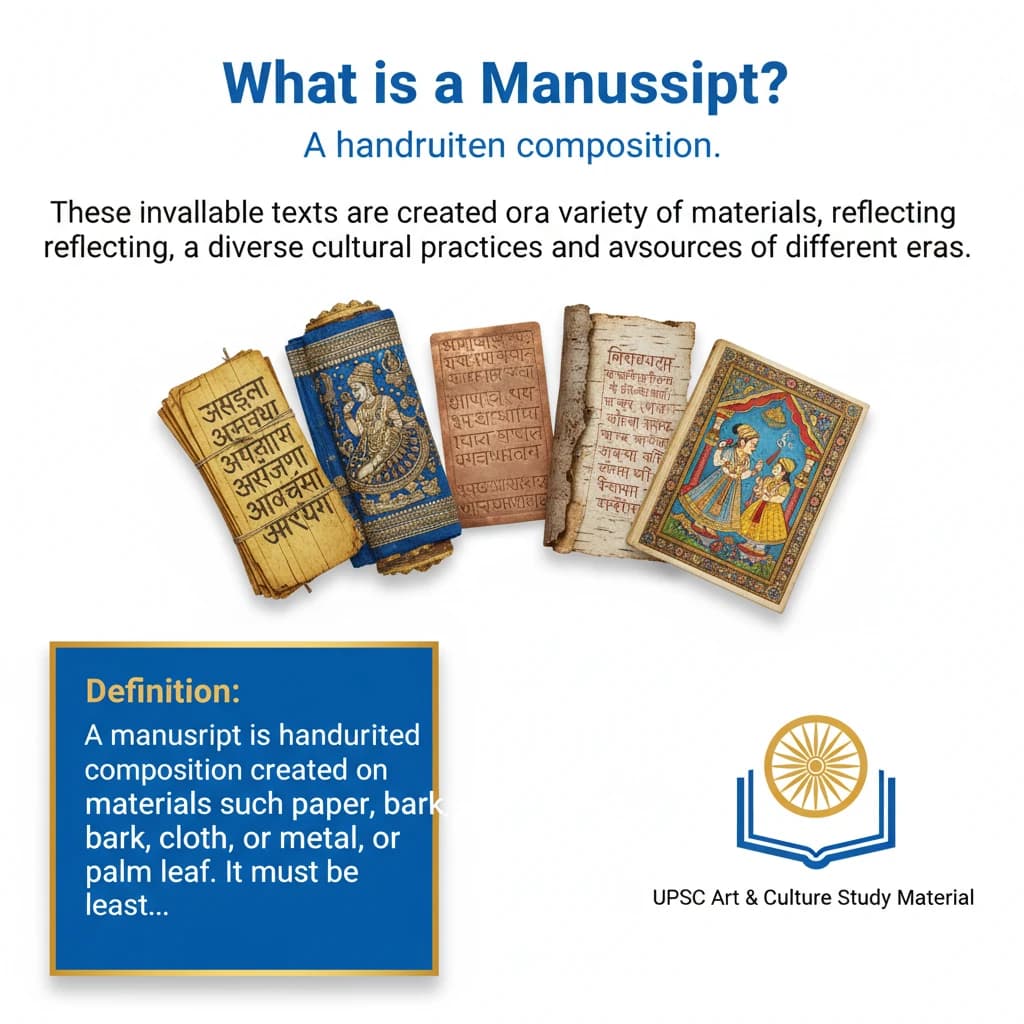
A manuscript is fundamentally a handwritten composition. These invaluable texts are created on a variety of materials, reflecting the diverse cultural practices and available resources of different eras.
Definition: A manuscript is a handwritten composition created on materials such as paper, bark, cloth, metal, or palm leaf. It must be at least 75 years old to qualify as a manuscript.
Key Characteristics of Manuscripts
Manuscripts possess several distinct characteristics that differentiate them from other forms of historical documentation and printed materials. Understanding these helps in their study and preservation.
- Material Diversity: They were inscribed on various surfaces including palm leaves, birch bark, cloth, metal plates, and eventually paper.
- Age Criterion: A crucial characteristic is their age; a composition must be at least 75 years old to be classified as a manuscript.
- Exclusions: Lithographs and printed volumes are explicitly not considered manuscripts, as they are not handwritten.
- Script Variability: Often, a single language might be represented in multiple scripts. For example, Sanskrit has been written in scripts like Oriya, Grantha, and Devanagari.
- Distinction from Historical Records: Unlike historical records such as epigraphs, firmans, or revenue records, which primarily document historical events, manuscripts primarily contain knowledge content.
Manuscripts are vital repositories of knowledge, offering insights into philosophy, science, literature, and art across various periods.
Early Historical Engagement with Manuscripts
Interest in manuscripts dates back centuries, with various rulers and scholars recognizing their immense value. These early interactions highlight their cultural and intellectual significance.
In the 18th century, the Nawab of Awadh presented an illuminated manuscript of the Padshahnama to King George III of England, showcasing their diplomatic and artistic value.
The 7th-century Chinese traveller Hieun Tsang is renowned for taking numerous Indian manuscripts back to China, contributing significantly to the spread of knowledge and Buddhism.
British Contributions to Manuscript Study
During the British colonial period, several scholars played pivotal roles in the study, collection, and preservation of Indian manuscripts, laying the groundwork for modern Indology.
Notable figures like William Jones, C.P. Brown, John Leyden, Colin Mackenzie, Charles Wilkins, H.H. Wilson, and HT Colebrooke were instrumental in these efforts. Their work brought many hidden texts to light.
Key British Scholars:
- William Jones: Founder of the Asiatic Society of Bengal.
- HT Colebrooke: Pioneer in cataloging Indian manuscripts.
- Charles Wilkins: Translated the Bhagavad Gita into English.
Early efforts to catalogue Indian manuscripts began as early as 1803, spearheaded by HT Colebrooke, who served as the fourth president of the Asiatic Society of Bengal.
Introduction to National Mission for Manuscripts (NMM)
Recognizing the vast and invaluable heritage contained in manuscripts, the Indian government launched a dedicated initiative for their preservation and documentation.
About NMM: The National Mission for Manuscripts (NMM) is an initiative of the Ministry of Culture. It was launched in 2003 with the primary goal of preserving and documenting India’s extensive collection of manuscripts.
Objectives and Implementation of NMM
The NMM operates with clear objectives and a defined structure to ensure the comprehensive management of India's manuscript heritage.
The mission aims to uncover, document, conserve, and make India’s vast manuscript heritage accessible to scholars and the public.
- Conservation: Dedicated to physically preserving manuscripts from decay and damage.
- Documentation: Creating a comprehensive national database of all Indian manuscripts.
- Dissemination: Making the knowledge contained within these manuscripts available for study and research.
- Accessibility: Ensuring these cultural treasures are accessible for future generations.
Implementing Bodies:
- The Department of Culture is responsible for implementing the mission.
- The Indira Gandhi National Centre for the Arts (IGNCA) serves as the nodal agency for the NMM.
The NMM's guiding principle and motto is: “conserving the past for the future.” This encapsulates its commitment to both preservation and knowledge dissemination.
💡 Key Takeaways
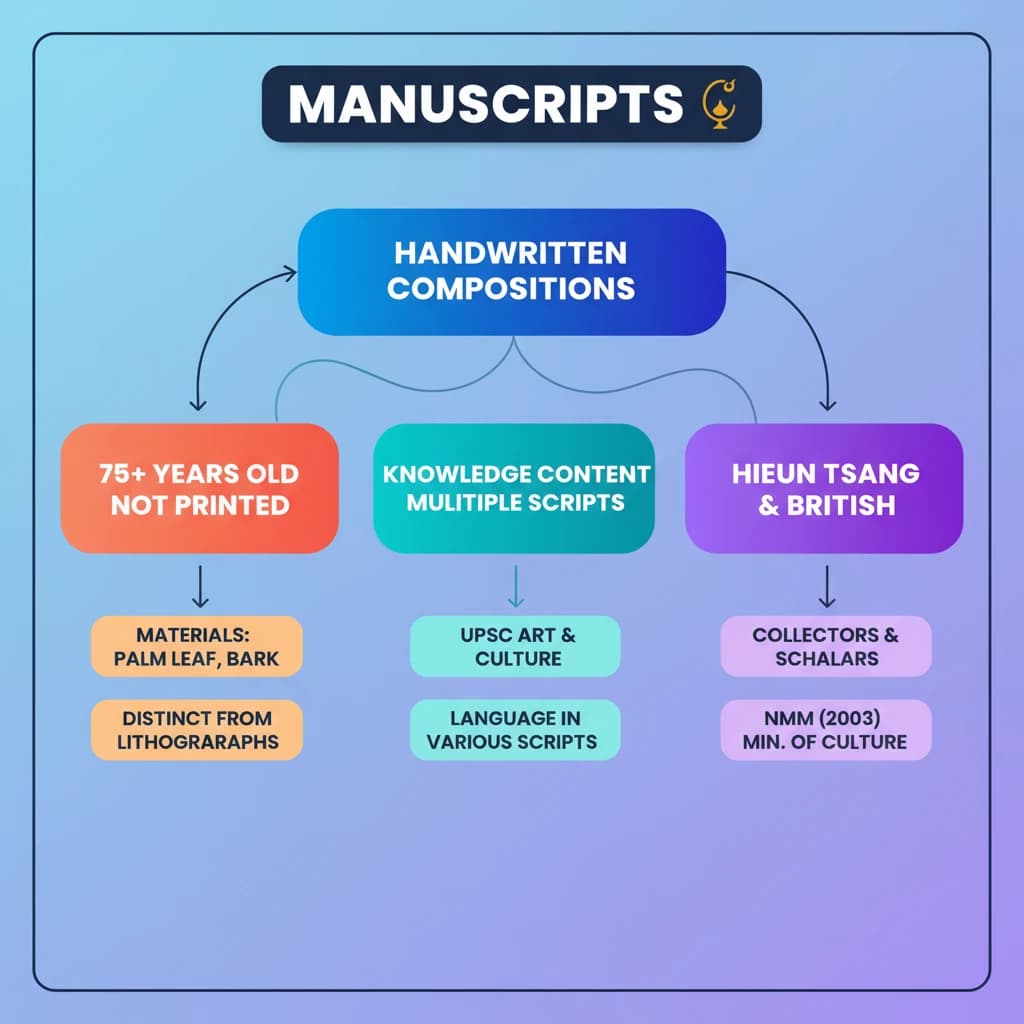
- •Manuscripts are handwritten compositions on various materials, at least 75 years old.
- •They are distinct from lithographs and printed volumes, primarily containing knowledge content.
- •One language can be represented in multiple scripts in Indian manuscripts.
- •Historical figures like Hieun Tsang and British scholars played roles in studying and collecting manuscripts.
- •The National Mission for Manuscripts (NMM) was launched in 2003 by the Ministry of Culture.
- •NMM's objectives include uncovering, documenting, conserving, and making manuscripts accessible.
- •IGNCA serves as the nodal agency for the National Mission for Manuscripts.
🧠 Memory Techniques
95% Verified Content