Loading page, please wait…
Maratha Military Landscapes - UPSC Art And Culture
What is Maratha Military Landscapes in UPSC Art And Culture?
Maratha Military Landscapes is a key topic under Art And Culture for UPSC Civil Services Examination. Key points include: India has nominated 'Maratha Military Landscapes' for UNESCO World Heritage status for 2024-25.. The nomination comprises 12 forts, including 11 in Maharashtra and 1 in Tamil Nadu (Gingee Fort).. These forts represent the strategic military system of Maratha rulers from the 17th to 19th centuries.. Understanding this topic is essential for both UPSC Prelims and Mains preparation.
Why is Maratha Military Landscapes important for UPSC exam?
Maratha Military Landscapes is a Medium-level topic in UPSC Art And Culture. It is tested in both Prelims (factual MCQs) and Mains (analytical answer writing). Previous year UPSC questions have frequently covered aspects of Maratha Military Landscapes, making it essential for comprehensive IAS preparation.
How to prepare Maratha Military Landscapes for UPSC?
To prepare Maratha Military Landscapes for UPSC: (1) Study the comprehensive notes covering all key concepts on Vaidra. (2) Practice previous year questions on this topic. (3) Connect it with current affairs using daily updates. (4) Revise using key takeaways and mind maps available for Art And Culture. (5) Write practice answers linking Maratha Military Landscapes to related GS Paper topics.
Key takeaways of Maratha Military Landscapes for UPSC
- India has nominated 'Maratha Military Landscapes' for UNESCO World Heritage status for 2024-25.
- The nomination comprises 12 forts, including 11 in Maharashtra and 1 in Tamil Nadu (Gingee Fort).
- These forts represent the strategic military system of Maratha rulers from the 17th to 19th centuries.
- Forts are diverse, including hill, hill-forest, hill-plateau, coastal, and island types, integrating natural terrain.
- The Maratha military ideology originated under Chhatrapati Shivaji Maharaj around 1670 CE.
- The landscapes were added to India's Tentative List of World Heritage Sites in 2021.
- The nomination is under UNESCO Cultural Criteria (iii), (iv), and (vi).
Maratha Military Landscapes
Medium⏱️ 8 min read
art and culture
📖 Introduction
India's UNESCO Nomination for Maratha Military Landscapes
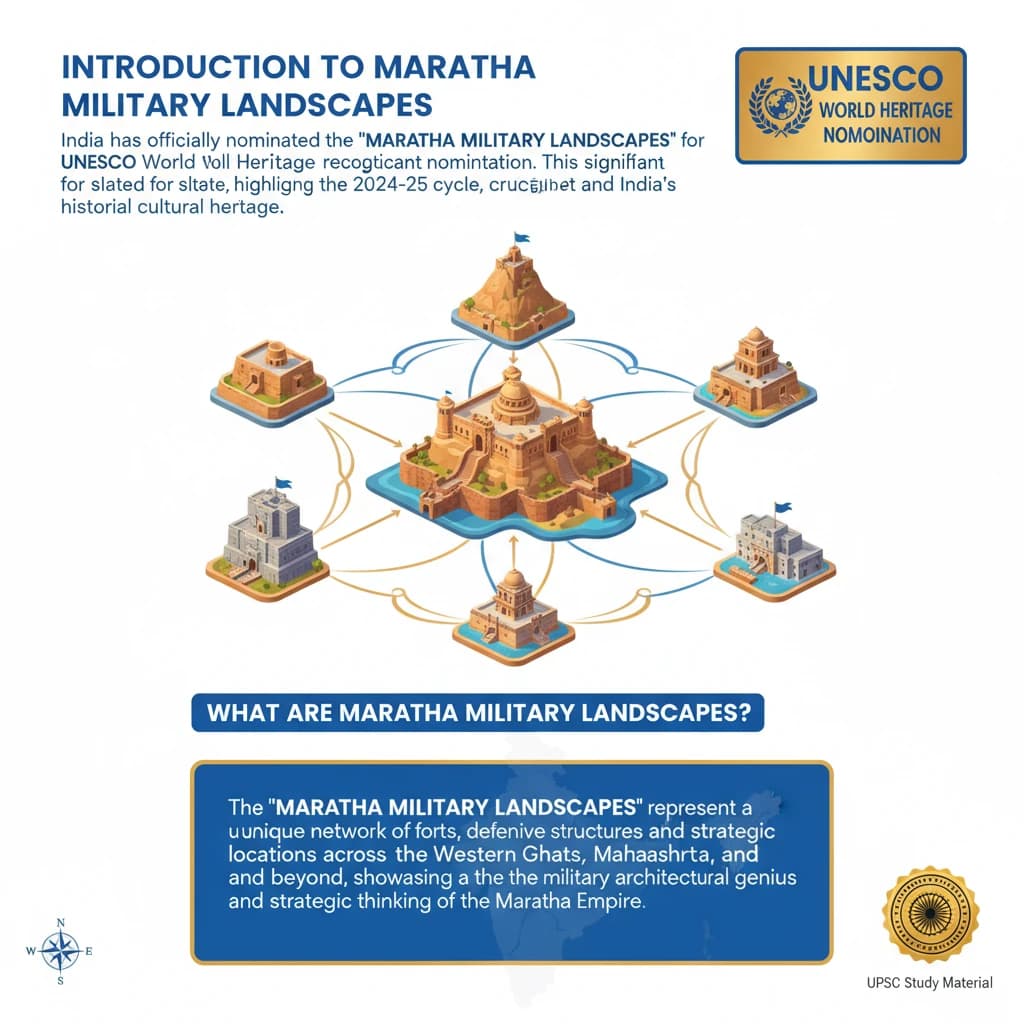
India has formally nominated the “Maratha Military Landscapes” for UNESCO World Heritage recognition for the 2024-25 cycle. This significant nomination highlights the unique strategic military system of the Maratha rulers.
Nomination Year: 2024-25 Cycle
Purpose: UNESCO World Heritage recognition
Focus: Strategic military prowess of Maratha rule
Purpose: UNESCO World Heritage recognition
Focus: Strategic military prowess of Maratha rule
Overview of Maratha Military Landscapes
The ‘Maratha Military Landscapes’ represent a vast network of 12 forts and fortifications. These structures collectively showcase the extraordinary military system and strategic genius employed by Maratha rulers between the 17th and 19th centuries.
This network is not just a collection of forts, but a demonstration of an integrated military defense strategy across diverse geographical terrains.
Components of the Nomination
The nomination includes 12 specific forts, strategically located across different regions. These forts are crucial examples of Maratha military architecture and planning.
- Maharashtra Forts: Salher Fort, Shivneri Fort, Lohgad, Khanderi Fort, Raigad, Rajgad, Pratapgad, Suvarnadurg, Panhala Fort, Vijaydurg, Sindhudurg.
- Tamil Nadu Fort: Gingee Fort.
The Maratha Military Landscapes of India were initially included in the Tentative List of World Heritage Sites in 2021. This is the sixth cultural property nominated from Maharashtra for inclusion in the World Heritage List.
Features and Typology of Maratha Forts
The network of forts exhibits diverse hierarchies, scales, and typological features. Their design brilliantly integrates the natural landscape, terrain, and physiographic characteristics of their locations.
- Geographical Integration: Forts are found across the Western Ghats (Sahyadri Hills), the Konkan Coast, the Deccan Plateau, and the Eastern Ghats.
- Total Forts: Maharashtra boasts more than 390 forts, but only 12 are selected for this specific nomination.
Protection and Administration of Forts
Out of the 12 nominated forts, 8 are protected by the Archaeological Survey of India (ASI), ensuring their preservation and historical integrity.
ASI Protected Forts: Shivneri Fort, Lohgad, Raigad, Suvarnadurg, Panhala Fort, Vijaydurg, Sindhudurg, and Gingee Fort.
The remaining four forts are under the protection of the Directorate of Archaeology and Museums, Government of Maharashtra.
Maharashtra State Protected Forts: Salher Fort, Rajgad, Khanderi Fort, and Pratapgarh.
Classification of Forts by Location
The forts within the Maratha Military Landscapes demonstrate a variety of strategic locations and designs:
- Hill Forts: Salher Fort, Shivneri Fort, Lohgad, Raigad, Rajgad, and Gingee Fort.
- Hill-Forest Fort: Pratapgad.
- Hill-Plateau Fort: Panhala.
- Coastal Fort: Vijaydurg.
- Island Forts: Khanderi Fort, Suvarnadurg, and Sindhudurg.
Historical Origin of Maratha Military Ideology
The distinctive Maratha Military ideology and its associated fort-building tradition originated in the 17th century. It began under the visionary rule of Chhatrapati Shivaji Maharaj around 1670 CE.
Founding Figure: Chhatrapati Shivaji Maharaj
Period: 17th century (c. 1670 CE) to 1818 CE (Peshwa rule conclusion)
Period: 17th century (c. 1670 CE) to 1818 CE (Peshwa rule conclusion)
This military system continued to evolve and expand through subsequent Maratha rulers, culminating with the conclusion of the Peshwa rule in 1818 CE.
💡 Key Takeaways
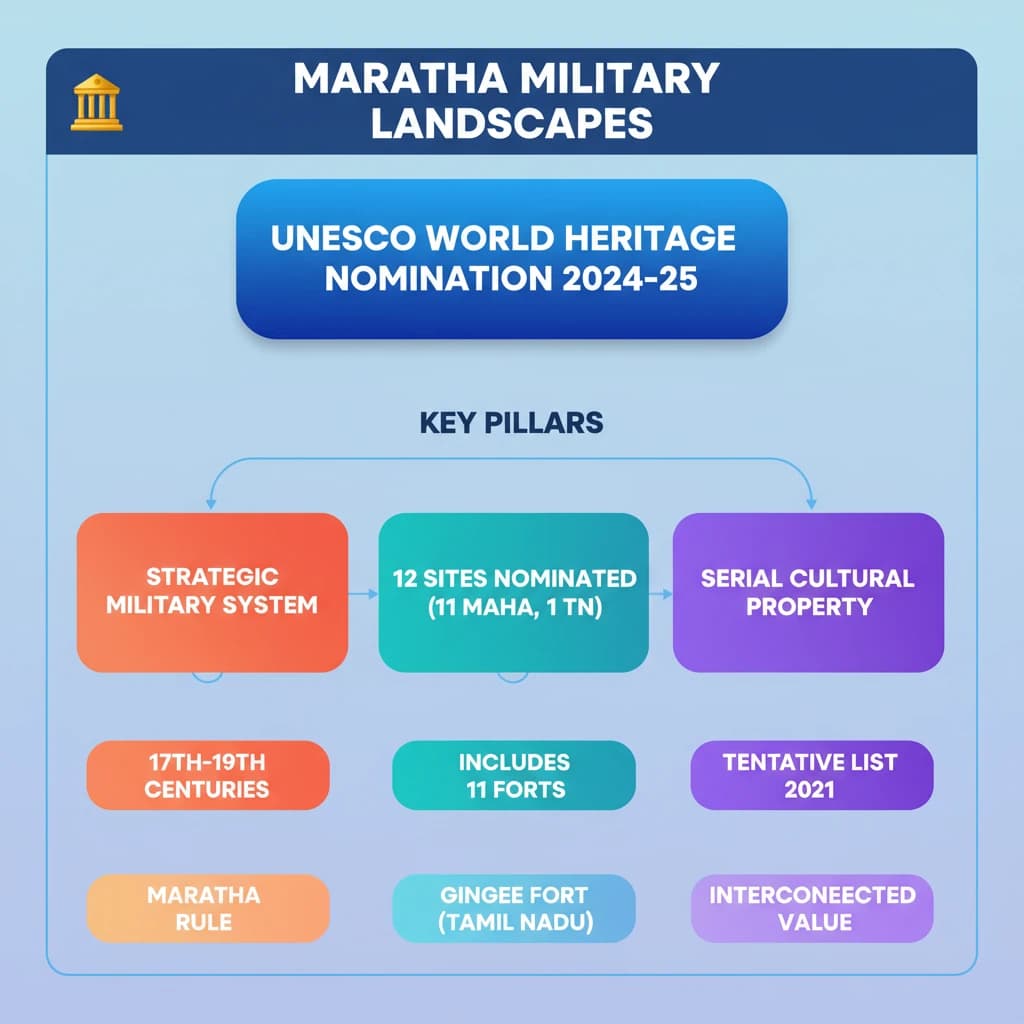
- •India has nominated 'Maratha Military Landscapes' for UNESCO World Heritage status for 2024-25.
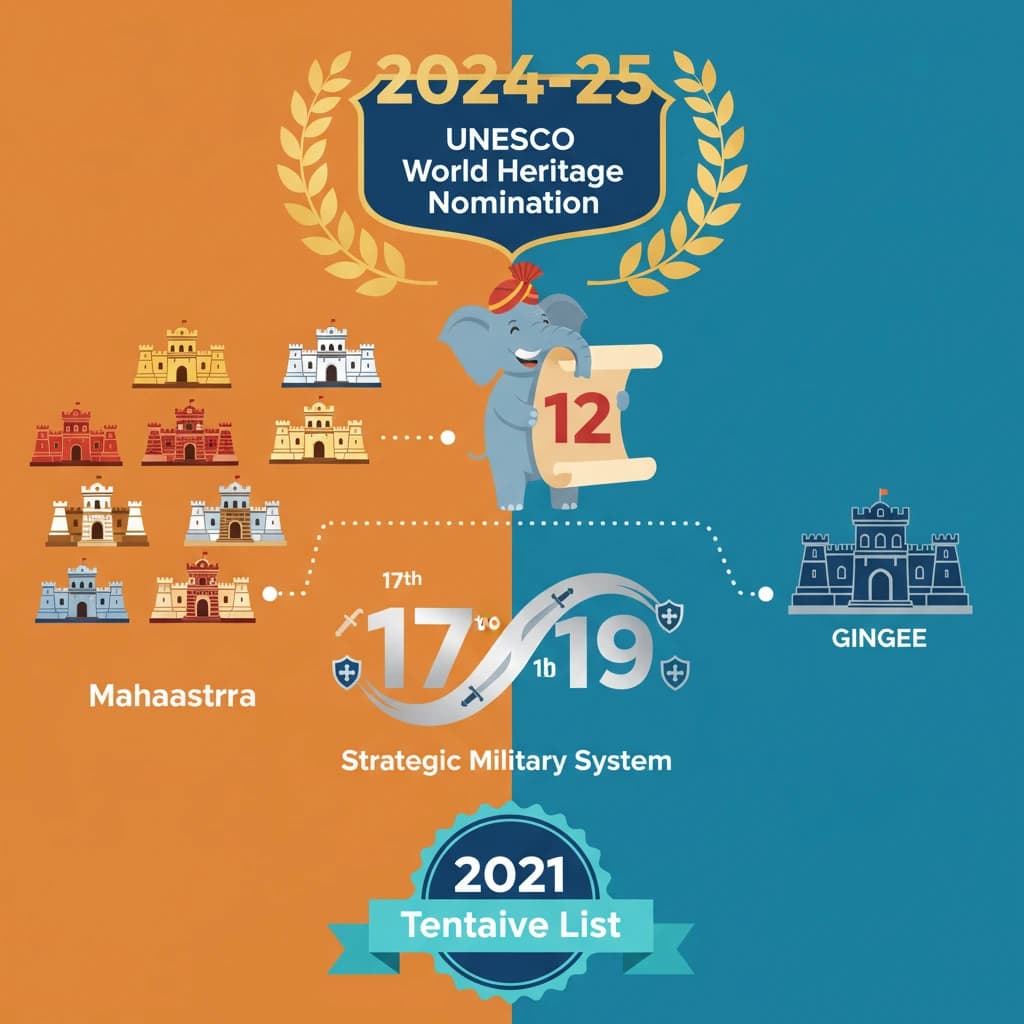
- •The nomination comprises 12 forts, including 11 in Maharashtra and 1 in Tamil Nadu (Gingee Fort).
- •These forts represent the strategic military system of Maratha rulers from the 17th to 19th centuries.
- •Forts are diverse, including hill, hill-forest, hill-plateau, coastal, and island types, integrating natural terrain.
- •The Maratha military ideology originated under Chhatrapati Shivaji Maharaj around 1670 CE.
- •The landscapes were added to India's Tentative List of World Heritage Sites in 2021.
- •The nomination is under UNESCO Cultural Criteria (iii), (iv), and (vi).
🧠 Memory Techniques
98% Verified Content
📚 Reference Sources
•UNESCO World Heritage Centre official website
•Archaeological Survey of India (ASI) records